Scandalous Dickens: LFM Reviews The Invisible Woman

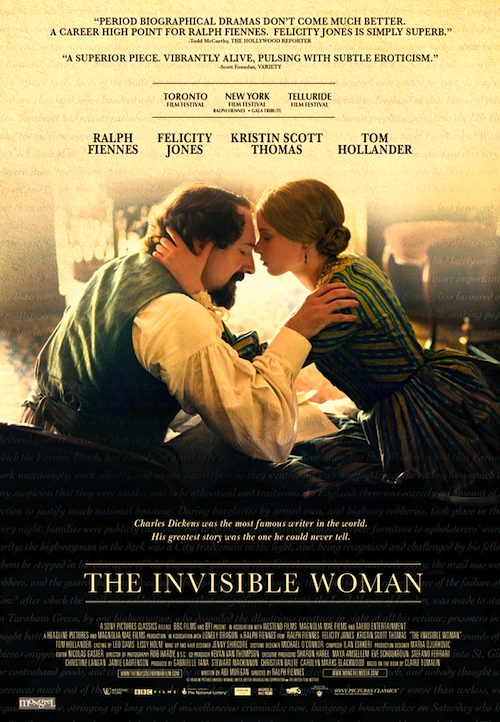
By Joe Bendel. Her actress-sister Frances eventually became Anthony Trollope’s sister-in-law. For her part, Ellen Ternan had a much closer relationship with Charles Dickens, but she was infamously not his wife. Ralph Fiennes brings their not-so-secret affair to the screen as the director and star of The Invisible Woman, which opened yesterday in New York.

Dickens was a genuine literary celebrity—the Stephen King of his era. He even wrote serialized novels, too. Dickens also had ten children from his plain, unassuming wife, Catherine. As the Dickenses grow increasingly distant, it is not terribly surprising the novelist will eventually succumb to temptation with one of his many admirers. That will be Ellen “Nelly” Ternan.

By all accounts, Ternan was a middling actress at best, but she still caught Dickens’ eye in a production of The Frozen Deep, his quasi-collaboration with Wilkie Collins. Dickens quickly becomes a patron to the Ternan family, including her mother and two sisters, all of whom are considered better thespians than Ellen. Of course, Mrs. Ternan is no fool, but she understands the limits of her daughter’s options.
Nevertheless, this is still Victorian England, when scandal meant something. To play the part of Dickens’ mistress, Ternan will have to assume the titular invisibility. Even if she wanted to, she is incapable of flaunting social norms, like Collins and his lover. Regardless, the truth is bound to come out sooner or later, or else Fiennes’ film would never exist.

So here it is, somewhat more preoccupied with societal conventions and class distinctions than a typical installment of PBS’s Masterpiece, but not too very far removed stylistically. It is hardly an apology for Dickens, but Fiennes’ lead performance is easily the best thing going for it. He rather brilliantly expresses the passion and recklessness lurking beneath his almost painful reserve. Unfortunately, it is sort of like watching one hand clap during his scenes with Felicity Jones’ Ternan. When Fiennes is quietly intense, she is just quiet.

Frankly, Invisible must stack the deck against Dickens’ poor, anti-trophy wife to sell his attraction to the pale, mousy Ternan. Maybe we just don’t get Jones here, but it seems like most red blooded scribblers would be more interested in Kristin Scott Thomas’s elegant and sultry Mrs. Ternan. Regardless, Joanna Scanlon’s performance subverts the intended sabotage of her character, investing the real Mrs. Dickens with excruciating dignity and humility.

Certainly presentable by general British costume drama standards, The Invisible Woman is more distinguished by Fiennes’ turn as an actor than a director. There is also plenty of fine work from Thomas, Scanlon, and Tom Hollander as Collins, but the central chemistry is lacking. Recommended mostly just for voracious Victorian readers, it opened Christmas Day in New York at the Angelika Film Center.

LFM GRADE: C+

Posted on December 26th, 2013 at 2:02pm.

LFM Reviews Personal Tailor

By Joe Bendel. Yang Zhong is sort of like Mr. Roarke on Fantasy Island, except he is always on the make. For a price, his company realizes their clients’ fantasies. He is nobody’s altruist, but lessons will still be learned in Feng Xiaogang’s Personal Tailor, which opened last Friday in New York.

Yang is the “Director of Dreams,” his right hand man Ma Qing is the “Spiritual Anesthetist,” Miss Bai is the “Fantastician,” and Xiaolu Lu is the “Caterer of Whims.” Together, they are “Personal Tailor” and they are used to some strange requests, like the creepy woman with a WWII martyr fetish in the James Bond-like prologue. Many of their fantasy scenarios are a peculiar product of contemporary China, such as the chauffeur, whose recent string of bosses were all government officials convicted of corruption. Believing he would wield power more responsibly, the driver hires Personal Tailor to put his ethics to the test.

Much of the broad humor in Tailor is not particularly suited to the American market. However, art house patrons familiar with the Digital Generation and related Chinese indie filmmakers will be amused by their next client. Having achieved every possible measure of success for his “vulgar” films, a popular director hires Yang’s team to experience the world of art cinema, which Personal Tailor equates with hand-to-mouth Miserablism.

While the first two primary assignments are played largely for laughs, the third is a sweet tale with considerable heart. To thank her for saving Ma from drowning, Yang’s team treats Mrs. Dan, a poor working woman, to a pro bono day as a Nouveau Riche industrialist. Song Dandan adds a touch of class and a strong screen presence in her “guest-starring” role and Feng’s bittersweet vibe is quite potent, making it Tailor’s most appealing full story arc thus far.

From "Personal Tailor."

Almost shockingly, Tailor becomes quite pointed and strangely touching in its concluding sequences. Lamenting the appalling state of China’s environment, Yang disperses the team on a spiritual apology mission. It sounds corny, but it is effective. In fact, Tailor reveals it was never the farce it pretended to be, but is in fact a work of political protest. Yang and his colleagues bemoan the rampant corruption, widening class inequality, and environmental devastation just as strongly as Jia Zhangke’s followers, but in a manner far more accessible to Chinese popular audiences.

Chen Kaige regular Ge You is suitably manic as Yang, but dials it down nicely when the film gets serious. Bai Baihe brings appropriate sass and seductiveness as Miss Bai, while Li Xiaolu plays the more demur Xiaolu Lu with greater sensitivity than one might expect. Zheng Kai has the odd moment too, especially with the down-to-earth Song.

While some viewers might lose patience with Tailor’s goofiness, it is fascinating to see its serious side slowly emerge. Frankly, one would not expect such a strong critique from Feng, who has established a reputation for flag-wavers, like Assembly and Back to 1942, which China has selected as their official submission for the best foreign language Academy Award. Although clearly intended for popular audiences, China watchers should not dismiss it out of snobbishness. Recommended for those who prefer screwball comedy with their social commentary, Personal Tailor opened last Friday at the AMC Empire in New York and the AMC Cupertino in the Bay Area, courtesy of China Lion Entertainment.

LFM GRADE: B-

Posted on December 26th, 2013 at 1:59pm.

A Hero’s Journey: LFM Reviews Andrzej Wajda’s Walesa, Man of Hope, Poland’s Oscar Submission

By Joe Bendel. He is an electrician with a Nobel Peace Prize and a Presidential Medal of Freedom. That would be none other than Lech Wałęsa, the co-founder and leader of Poland’s first independent trade union, Solidarity. Notoriously blunt-spoken and inconveniently principled, Wałęsa has become a figure of controversy in post-Cold War Europe—so much so honorary Academy Award winner Andrzej Wajda felt compelled to set the record straight on film. Representing Poland as its official foreign language Academy Award submission, Wajda’s Walesa, Man of Hope, merits serious award consideration wherever it is eligible.

Robert Więckiewicz is a strong likeness for Walesa, as Wajda would know, since the Solidarity leader appeared as himself in the director’s 1981 Palme D’Or winning Man of Iron. Revisiting the era of his classic duology, Wajda even includes brief Easter egg snippets of Man of Marble and its companion film. However, Wajda’s fictional characters are merely cinematic window-dressing, yielding to the historical record.

Brash yet reflective, Walesa was one of the few people capable of impressing celebrated Italian iconoclast-journalist Oriana Fallaci, whose interview with the still relatively young Solidarity leader serves as the film’s framing device. Even at this early stage of his career, Walesa has accepted his role as a man of destiny. Yet, as he explains to Fallaci (played with suitably charismatic flair by Maria Rosario Omaggio), it was not always so. Resolutely opposed to violence on both moral and pragmatic grounds, Walesa initially advocated more modest demands. However, he instinctively recognizes that the national zeitgeist has reached a turning point.

From "Walesa, Man of Hope."

Wajda’s Walesa is not hagiography, except perhaps with regards to Walesa’s long suffering wife Danuta. Więckiewicz’s portrayal certainly suggests the Solidarity leader did not lack for confidence, but there is a roguish charm to his bluster (as well as the obvious historical justification). He also constantly tries his beloved Danuta’s patience, but the love shines through in all of Więckiewicz’s scenes with Agnieszka Grochowska. Still, Wajda clearly has special sympathy for Ms. Walesa, saving his greatest outrage for the abusive treatment she receives from the authorities when returning from Oslo with her husband’s Nobel Prize.

For a searing indictment of the Communist era, Wajda’s Katyn is tough to beat. While his Walesa obviously shares some common themes, it is a different sort of film. More personal in scope, it celebrates the Walesas, his comrades in Solidarity, and his unique foibles. While Katyn’s sense of outrage is impassioned and visceral, Man of Hope is celebratory and even nostalgic for the idealism and solidarity (if you will) of Solidarity’s headiest days.

Frankly, it is rather baffling that Walesa: Man of Hope has not had more Oscar buzz. How many films feature two defining figures of their eras (Walesa and Fallaci) on-screen, with a third titan (Wajda) behind the camera? It is a quality period production, with Magdalena Dipont’s design team perfectly recreating the look and dank, depressed vibe of Brezhnev-era Gdansk. Refreshingly earnest and enthusiastic, Wajda’s Walesa gives thanks for Poland’s new era of freedom and pays tribute to those who fought to realize it. It is the sort of film all American civics students should see. Highly recommended (especially to the Academy) Walesa, Man of Hope should have a considerable life on the festival circuit and eventual distribution, regardless of what Oscar decides.

LFM GRADE: A

Posted on December 18th, 2013 at 11:43am.

Clio Barnard Adapts Oscar Wilde (sort of): LFM Reviews The Selfish Giant

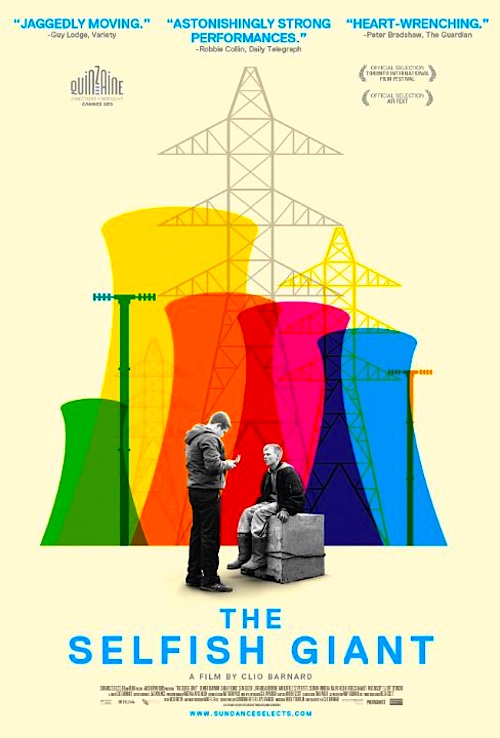
By Joe Bendel. Under the shadow of nuclear containment domes, Arbor Fenton and his mate Swifty collect scrap metal with a horse-drawn cart. It is more or less modern day Yorkshire, but the vibe is often Dickensian. However, it was inspired by Oscar Wilde’s Christian parable. Light years removed from the mythical giant’s garden, Clio Barnard creates her own modern fable in The Selfish Giant, which opens this Friday at the IFC Center.

Forget the “hard kid to love” cliché. The aggressively annoying Fenton is a hard kid not to pummel whenever you see him. It is not entirely his fault. He is the irregularly medicated, hyperactive product of a completely fractured home. Fenton has affection for his mother, but openly defies her parental authority. He is even more contemptuous of his teachers, welcoming his expulsion from school as a personal victory. Fenton has only one friend, the mild mannered Swifty, who was also temporarily dismissed from class due to Fenton’s misadventures.

For Fenton, this is a fine turn of events, allowing them time to collect scrap metal for the dodgy local dealer, Kitten. The grizzled junkman is the sort of authority figure Fenton can finally relate to. However, Kitten has more use for the horse savvy Swifty, whom he recruits to drive his trotter in the local unsanctioned sulkie races. Always unstable, Fenton takes Kitten’s rejection rather badly.

Evidently, Kitten is the giant (after all, he carries an ax during his big entrance), but viewers will be hard pressed to find any other remnants of Wilde lingering in the film. It hardly matters, though. Barnard’s Giant is a grimly naturalistic but deeply humane morality tale. Sort of like Wilde, Barnard ends on a redemptive note, but she really makes viewers work for it.

Eschewing cutesy shenanigans, Giant features two remarkably assured performances from its young principle cast members. It is rather rare to see such a thoroughly unlikable young character on-screen, but Conner Chapman wholeheartedly throws himself into the role of Fenton with a twitchy, petulant tour de force performance. Shaun Thomas nicely counterbalances him as the shy, empathic Swifty.

Barnard masterfully sets the scene and controls the uncompromisingly cheerless vibe, immersing the audience in the profoundly depressed working class estate. Viewers will definitely feel like they are there, sharing their cold, dingy, over-cramped quarters (and doesn’t that sound appealing?). Think of it as apolitical proletarian cinema. Recommended for the work of its young cast and Barnard’s distinctive vision, The Selfish Giant opens this Friday (12/20) in New York at the IFC Center.

LFM GRADE: B

Posted on December 18th, 2013 at 11:40am.

LFM Reviews Asghar Farhadi’s The Past, Iran’s Oscar Submission

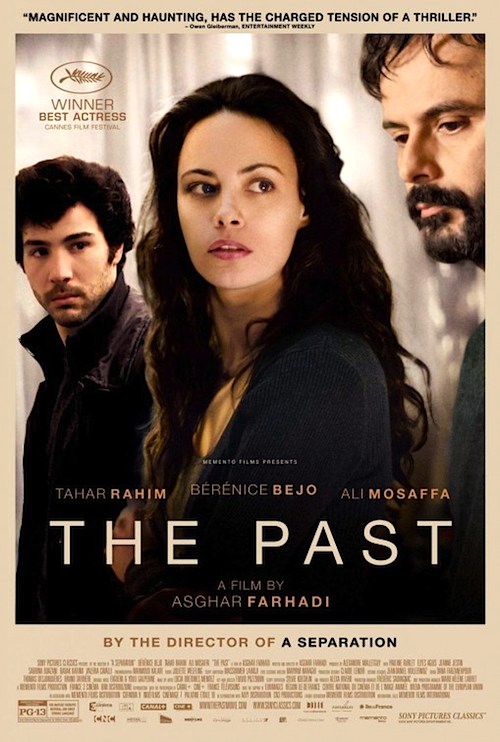
By Joe Bendel. It is hard to define Ahmad’s role in the family drama he re-submerges himself in. As Marie’s soon to be ex-husband, he is intimately familiar with her and her two daughters from a previous relationship. Of course, he is a complete stranger to Samir, her next intended husband, and his young son. That ambiguity provides rich fodder for Asghar Farhadi’s French language, Iranian Oscar submission, The Past, which opens this Friday at Film Forum.

Ahmad, the former Iranian expat, has returned to Paris to finalize his divorce with his French wife, Marie. One might wonder why he should travel such a long way for a bit of paperwork. Frankly, the same question crosses Ahmad’s mind as well. Regardless, here he is. Much to his surprise, he learns he will be staying with Marie and Samir in their distinctly unfashionable suburban Paris home.

Viewers quickly deduce Ahmad has a history of mental instability, whereas Marie is a bit of game-player. The now stoic Ahmad tries to take the high road, but he is soon drawn into his eldest former step-daughter’s cold war with Marie. Lucie is dead set against her mother’s engagement to Samir, because she believes their love affair drove his comatose wife to her suicide attempt. As Ahmad tries to counsel Lucie, he discovers the truth is considerably more complicated than anyone suspected.

Despite having no formal position in the family, Ahmad becomes the closest thing to a referee they have. Yet, it is clear the feelings he and Marie once had for each other remain unresolved. It is fascinating to watch him navigate this tortuous emotional terrain, acting as an honest broker and peace-maker, while keenly aware of his own destabilizing influence. Ahmad is a tricky role to pull off, considering he often serves as an audience proxy as well as an independent actor in his own right, but Ali Mosaffa pulls it off masterfully. It is an exquisitely humane turn that darkly suggests volumes of unspoken back-story.

Although Ahmad is central to the narrative, he is still a supporting player in the overall scheme of things. This is Marie’s story, driven by her problematic relationships with Samir and Lucie. The thoroughly de-glamorized Bérénice Bejo’s lead performance is earthy and passionate, constantly approaching the overwrought, put always pulling back just in time (because the working class cannot afford such indulgences). Pauline Burlet is also quite remarkable, making Lucie’s inner turmoil vivid and believable in an angsty teen-aged sort of way. She could be this year’s equivalent of Shailene Woodley in The Descendants.

The opening of The Past essentially closes the year in film. Granted, there are some presumptive Oscar candidates slated to open Christmas week, but they do not deserve their buzz. In contrast, The Past should be a contender in multiple categories. It might not have quite the same visceral intensity of Farhadi’s A Separation and About Elly, but those films set the bar awfully high, making comparisons decidedly unfair. The Past is a gripping film that embraces the messy humanity of its characters. It is a bracing yet forgiving film, much in keeping with the rest of Farhadi’s filmography. Highly recommended, The Past opens this Friday (12/20) at New York’s Film Forum.

LFM GRADE: A-

Posted on December 16th, 2013 at 10:02pm.

The Literary Godfather of All CSIs: LFM Reviews How Sherlock Changed The World; Airs Tuesday (12/17) on PBS

By Joe Bendel. We think of Sherlock Holmes stories as classic mysteries, but they were practically science fiction when they were first released. Such was the state of forensic science at the time—it simply did not exist. Various forensic fans pay their respects to the consulting detective in the two-part, one-night special How Sherlock Changed the World, which premieres this Tuesday on most PBS stations nationwide.

The first Holmes story came out during the Jack the Ripper investigation, when most of London had concluded most of the city’s coppers were just a pack of dumb thugs—and not without justification. Crime scenes were not preserved and nobody bothered to give them the once-over for telling information. Instead, it was round-up the usuals and beat out a confession—a strategy doomed to fail with a serial killer.

The fact that the fictional Holmes served as a catalyst for smarter investigative techniques makes perfect sense, considering how science fiction has always inspired technological breakthroughs. In the early segments, producer-director Paul Bernays and his expert witnesses make a strong case for Sherlock’s influence on the pioneers of forensic investigation, particularly Edmond Locard, a French Holmes fan who assembled the first legitimate crime lab in 1910.

Eventually, HSCTW settles into a familiar pattern, introducing an investigative avenue prefigured in Doyle’s stories (like toxicology, ballistics, and hair and fiber analysis) and then demonstrating real world applications from the case files of its talking heads, including the sometimes controversial Dr. Henry Lee, probably best known for his work on the notorious “Woodchipper Murder.” Initially a bit of a revelation, the Sherlock tribute largely becomes reasonably diverting comfort viewing for true crime fans.

From "How Sherlock Changed The World."

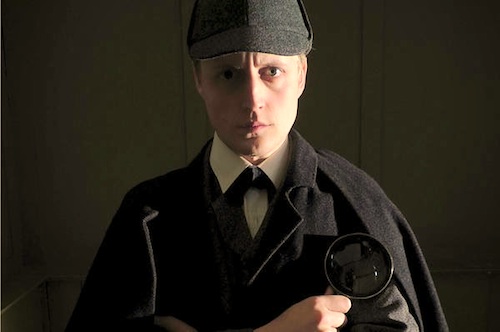
Obviously, HSCTW was shrewdly programmed to stoke viewer enthusiasm for the upcoming third season of PBS’s Sherlock. We do indeed see clips from the Cumberbatch show, but most of the points are illustrated with original recreations of Holmes at work. Granted, clearances can be tricky, but the HSCTW cast lacks the distinctive presence of the many classic screen Holmeses, such as Basil Rathbone, Peter Cushing, Christopher Lee, Jeremy Brett, Patrick Macnee, Tom Baker, Christopher Plummer, or even Ronald Howard.

HSCTW is television viewers can safely dip in and out of. Nonetheless, it makes a compelling case on behalf of the contributions made to criminal justice by Holmes, as well as his creator, Arthur Conan Doyle. In fact, it leads one to believe Doyle’s stock is rather undervalued given his post-Sherlock endeavors. While it has a fair amount of filler, How Sherlock Changed the World also provides some intriguing cultural history. Recommended as a pleasant distraction for Holmes and CSI fans eagerly anticipating the new season of Sherlock, it airs this Tuesday (12/17) on most PBS affiliates nationwide.

Posted on December 16th, 2013 at 9:58pm.