LFM Reviews Harlem Street Singer @ The 2013 DOC NYC

By Joe Bendel. Reverend Gary Davis was a man of God, but his finger-picking attack sure was fierce. Eventually embraced by the Blues Revival, the Reverend Davis had spent years performing on the streets of Harlem. He also took on students, including future neo-roots artists like David Bromberg and Stefan Grossman. Davis’s loyal students and admirers piece together his story and trace his elusive influence in Trevor Laurence & Simeon Hutner’s Harlem Street Singer, which screens during this year’s DOC NYC.

Davis was a real deal bluesman from North Carolina, who recorded some real deal blues sides, before dedicating himself to songs of praise and worship. They were still drenched in the blues, making him rather tricky to classify. A modest man with an idiosyncratic teaching style, Davis accepted any student bold enough to sign-up with him. In addition to Bromberg and Grossman (who discuss their teacher throughout HSS), Davis also provided musical instruction to Roy Book Binder, Dave Van Ronk, and Woody Mann, who also serves as the film’s musical director and co-producer.
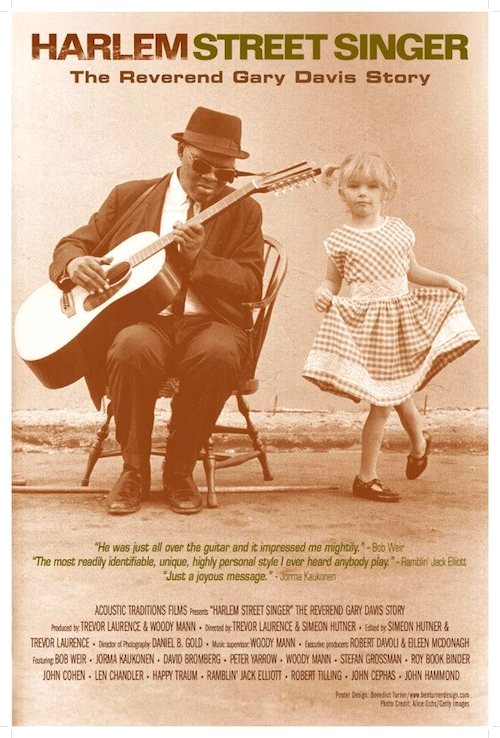
Davis was legally blind since birth, grew-up in the Jim Crow-era south, and lived most of his life in poverty, yet HSS is a defiantly upbeat movie. According to those who knew him, Davis just played his music and preached the Word (indeed, the two were always closely related), regardless of his circumstances. Of course, there is a lot of music in the film and it is consistently great. Laurence & Hutner scored a coup with the inclusion of previously unseen footage of Davis laying it down at the Newport Folk Festival and they do not keep viewers waiting for it, using it to kick off the film with a big statement.

Keeping the apostolic flame burning, Mann leads a tribute ensemble that periodically plays some dynamite Davis covers. Mann and Bill Sims, Jr. have the unenviable role of handling the guitar and vocal duties respectively, but they both sound fantastic, getting first rate support from Dave Keyes on piano and Brian Glassman on bass. It is a killer quartet that ought to get a ton of gigs together if HSS receives the attention it deserves.

Few docs are as wildly entertaining as HSS, but it still does justice to the seriousness of Davis’s life and times. Hopefully, someone from PBS has it on their radar, because it is as good as anything that has been on American Masters since Cachao: Uno Mas and is considerably better than most. Highly recommended to general audiences beyond established blues fans, Harlem Street Singer screens again as part of DOC NYC this Thursday morning (11/21) at the IFC Center, so consider calling in sick for it.

LFM GRADE: A

Posted on November 19th, 2013 at 11:52am.
LFM Reviews The New Restoration of 1972’s Weekend of a Champion

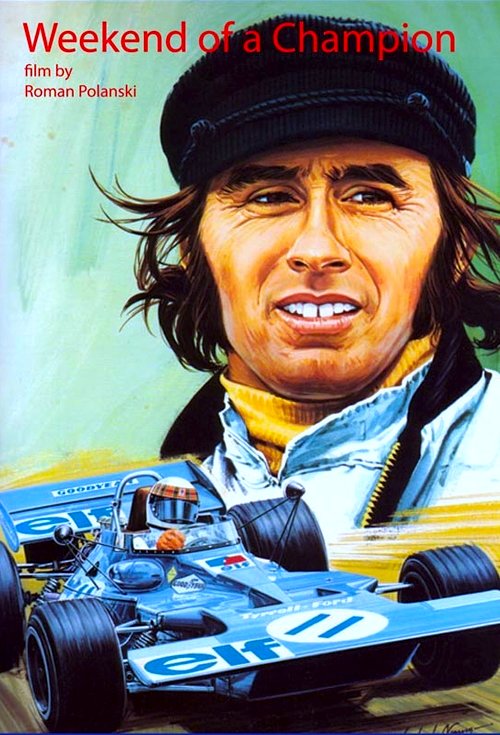
By Joe Bendel. It came between Macbeth and Chinatown, or in less edifying terms, between the horrifying murder of Sharon Tate and the infamous rape of an under-aged girl in Jack Nicholson’s Mulholland home. Even Formula One champion Jackie Stewart seemed rather surprised by Roman Polanski’s interest in the sport, but they got on famously in Frank Simon’s rarely seen documentary, Weekend of a Champion, produced by on-camera super-fan Polanski, which opens this Friday at the IFC Center.

In 1971, it was debatable who was a bigger celebrity, Stewart or Polanski. Stewart was looking to win his second Monaco Grand Prix as part of his march towards a second Formula One world championship. However, this would be his first race in a brand new car. Although unharmed, Stewart was still somewhat shook up from the accident that had totaled his previous vehicle. Still, Stewart appears to have a natural affinity for Monte Carlo’s street course, explaining each twisty turn to Polanski in the drive-along that might be the film’s highlight.

If you are a fan of Jackie Stewart or Formula One racing in general, then Weekend is all kinds of awesome. If not, the Polanski factor and the nostalgic vibe are just enough to keep non-fans invested. Evidently, Formula One was a different beast forty-some years ago. Having already lost most of his closest friends and colleagues to track related accidents, Stewart was arguably lucky just to be alive. His tireless advocacy of safety reforms would dramatically improve driver mortality rates. Yet, the sport was also considerably more intimate at the time. Fans lining the Monte Carlo streets could practically reach out and touch the cars as they flashed by.

The newly restored Weekend adds a new postscript featuring Stewart and Polanski talking about how things used to be. It is mostly forgettable mutual appreciation stuff, but when they revisit the road course, it really brings home that sense of how time passes.

In all likelihood, Weekend probably will not convert vast armies of Formula One fans, but viewers can easily see how Stewart smoothly segued into a second career as a broadcast commentator. He has a way of explaining nuts-and-bolts details in clear and descriptive terms. Frankly, Polanski is just along for the ride, but his rapport with Stewart seems genuine.

Once the race starts, there is hardly any question as to the outcome, but Simon and the battery of editors nicely bake in a fair degree of suspense through sequences addressing the new car and uncertain weather conditions. While not exactly a cinematic landmark, Weekend is a highly watchable as a sports documentary time capsule, with obvious novelty value to cineastes. It is sort of mind-blowing that this even exists, but here it is (with fleeting cameos from Ringo Starr and Joan Collins). Recommended for motor sports enthusiasts and compulsive Polanski apologists, Weekend of a Champion opens this Friday (11/22) in New York at the IFC Center.

LFM GRADE: B

Posted on November 19th, 2013 at 11:49am.

Faith and Fraud in Provincial Korea: LFM Reviews The Fake

By Joe Bendel. Pastor Sung is sort of a Korean Elmer Gantry, except he is the closest thing to a good guy in this dark, animated examination of human nature. He had the profound misfortune to become entangled with a ruthless con artist, but the man out to expose them is the worst of the lot in Yeon Sang-ho’s The Fake, which just started a week-long Oscar-qualifying run in Los Angeles.

The best part of absentee father Min-chul has been his absence. Physically and emotionally abusive, his homecoming is far from a happy event for his meek wife and daughter, the long suffering Young-sun. Plundering Young-sun’s college savings for gambling money, Min-chul inadvertently drives her into the arms of the local faith-healing church—the very sort of outfit he most despises.

Devastated by a prior scandal, the gentle Pastor Sung has fallen for the false promises of “Elder” Choi, a wanted con man. Through drunken happenstance (and a night in lock-up), Min-chul learns the truth about Choi, but nobody will listen to the obnoxious cretin. A savage war commences between Min-chul and Choi’s henchmen, while the shadowy crook pressures Pastor Sung to finish fleecing his flock.

Fake is nothing like what you probably expect, beyond its pitch black portrayal of human nature. Its depiction of blind faith might be unflattering, but nothing is more miserable than the abject lack of a higher meaning in one’s life. Min-chul is not an anti-hero. He is a vile brute driven by rage and contempt for his fellow man—and he is unquestionably the face of atheism throughout the film. In a variation on Chesterton, Min-chul suggests those who believe in nothing, hate everything.

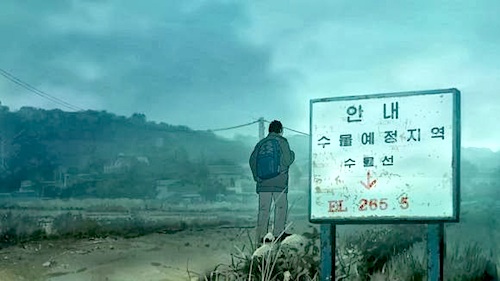
From "Fake."

With its acrid irony and complete lack of sentimentality, Fake is not likely to be embraced by Christian audiences. Yet, it is a deeply moral film. It is also unremittingly pessimistic, perhaps setting the world’s record for the most grimly naturalistic animated feature ever. Frankly, Yeon’s figures are not very expressive, perhaps showing slightly less definition than those in his feature debut, The King of Pigs. However, his characters very definitely have something to say. Set in a provincial small town scheduled to be demolished for the sake of a massive public works project, the film also has a distinctive, vaguely apocalyptic vibe that is hard to shake.

Parents should note, Fake is completely inappropriate for children. In addition to its very complex themes, there is considerable violence, harsh language, and all kinds of inhumanity directed at man and beast alike. However, the mature audiences for whom it is intended should find it a visceral, but surprisingly thoughtful film. Highly recommended for those who appreciate challenging adult animation (and Academy members), The Fake is now showing at the CGV Cinemas in Los Angeles.

LFM GRADE: A-

Posted on November 19th, 2013 at 11:46am.

LFM’s Jason Apuzzo & Govindini Murty at The Huffington Post: Young Man on the Run: Catching Up with Shia LaBeouf and Charlie Countryman

[Editor’s Note: the post below appears today at The Huffington Post.]

By Jason Apuzzo & Govindini Murty. Shia LaBeouf can’t keep still.

That’s what stands out when you meet the voluble 27 year-old star of the new indie thriller-romance Charlie Countryman, which opens in limited theatrical release and on VOD this Friday, November 15th. The hustling young man we’ve gotten to know in the Transformers and Indiana Jones movies – the fast-talking, nebbishy tough guy with a big heart, always improvising, always on the move – is very much the same guy in person.

Charlie Countryman premiered at Sundance earlier this year (back when it was called The Necessary Death of Charlie Countryman), where we talked to LaBeouf, co-star Evan Rachel Wood, and director Fredrik Bond at the film’s press day.

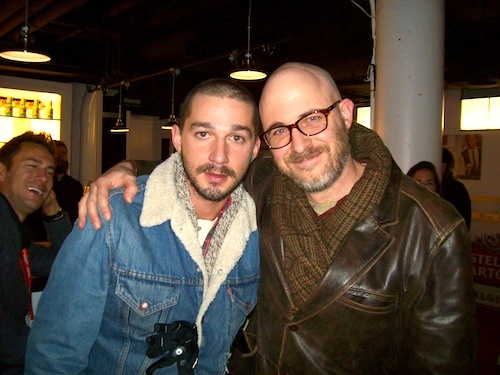
Govindini Murty and Shia LaBoeuf at Sundance 2013.

Charlie Countryman takes LaBeouf in a direction familiar to anyone who remembers him playing impulsive teenager Sam Witwicky in 2007’s Transformers: that of a sentimental hot-head on a hopeless quest for a girl, comedically improvising his way into and out of one scrape after another.

“It’s not a humongous departure from my real life,” LaBeouf said at the press day. “This is a guy who thinks with his heart, rather than his mind … and who doesn’t show a lot of caution toward consequences, which isn’t far from who I am.”

Charlie Countryman follows LaBeouf on a wild, hallucinogenic vision-quest through post-communist Bucharest as he pursues a world-weary femme fatale cellist named Gabi (Evan Rachel Wood), while battling over her with a pair of unhinged Euro-mobsters (Mads Mikkelsen and Til Schweiger). Infused with heart-on-your-sleeve sentimentality by director Fredrik Bond, the film is both a coming-of-age story for Charlie and a picaresque, ‘everyman’-style thriller reminiscent of the novels of Eric Ambler (The Mask of Dimitrios, Journey into Fear).

Rounding out the film’s impressive cast are Rupert Grint as one of Charlie’s drug-crazed buddies, Vincent D’Onofrio as Charlie’s depressive brother, and Melissa Leo as Charlie’s hippyish mother – with LaBeouf’s Indiana Jones co-star John Hurt providing narration.

Charlie Countryman‘s biggest star, however, may be Bucharest itself – which the film presents as an exotic, old world blend of high culture and low-life gangsterism, still adjusting to the post-Cold War world. LaBeouf’s nocturnal adventures in Bucharest – a darkly glamorous city that somehow seems trapped in a 1990s time warp – often feel like an MTV version of Joseph Cotton’s nighttime journeys through crime-ridden, post-War Vienna in Carol Reed’s The Third Man.

Shia LaBeouf and Jason Apuzzo at Sundance 2013.

LaBeouf lights up on the subject of Bucharest, gesticulating and going into one of his typical, animated riffs. “I arrived quite ignorant, you know – I’m an ignorant American,” he quips. “I haven’t really done much traveling beyond my work life. I never really picked up a Romanian book, or decided to study Romanian.

“But you get there, and you hear about [former Romanian communist leader Nicolae] Ceaușescu, you get to the [Revolution] Square, you see where the blood fell, talk to these people – you know, some people who still want communism, who are upset that it’s gone – and you don’t quite understand what that‘s about …

“I’ve heard people say that we have dated villains [in Charlie Countryman] – that’s because … Romania is dated – it’s 10 years behind. They’re still playing the ‘Thong Song’ in clubs,” he cracks. “It’s no joke, so this is part of the world of these dudes [the film’s gangster villains]. It’s not artificial – this is what we ran into.

“And it’s very sexy,” he smiles. Continue reading LFM’s Jason Apuzzo & Govindini Murty at The Huffington Post: Young Man on the Run: Catching Up with Shia LaBeouf and Charlie Countryman

The Story of Calvin & Hobbes: LFM Reviews Dear Mr. Watterson

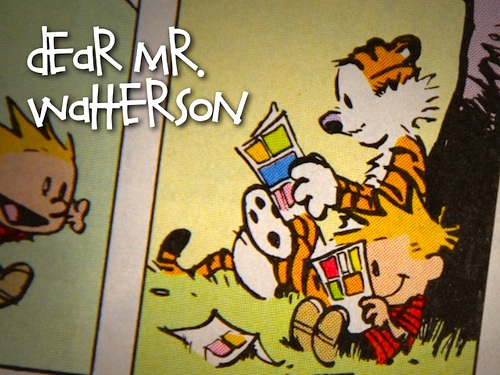
By Joe Bendel. Bill Watterson is sort of like the Salinger of syndicated comic strips. Despite the popularity of Calvin & Hobbes, he has shunned the media spotlight and steadfastly refused to license merchandise (even including stuffed Hobbes dolls). Yet, years after he inked his final panel, people still feel like they share a deep personal relationship with his characters. Director-editor Joel Allen Schroeder proclaims his love for the comic characters and invites others to do the same in the tribute-documentary, Dear Mr. Watterson, which opens this Friday in New York.

There will probably never be a Calvin & Hobbes Christmas special, so devotees of the Christopher Robin-like boy and his probably imaginary tiger will have to settle for Schroeder’s doc. Do not hold your breath waiting for the titular Mr. Watterson to sit down and remember when, either. Instead, Schroeder talks to a number of fans and fair number of Watterson’s fannish-sounding fellow cartoonists.

While that is all very good, it is not exactly earthshaking stuff. More interesting are the behind-the-scenes reminiscences of Watterson’s professional colleagues at his newspaper syndicate and his book publisher. What emerges is a portrait of an art form bordering on e-driven extinction. Sadly, viewers get a sense C&H was not the peak of daily comic strips, but the last great hurrah.

It is too bad Watterson’s participation was such an “as if,” because he rather sounds like someone with something to say. He is still remembered for a blistering and some say prescient address to a professional cartoonists’ assembly warning of the consequences of the commercialization of comic strips and the erosion of creators’ control. Bloom County cartoonist Berkley Breathed sort of fondly discusses the pointed letters Watterson once set him, not so gently calling him out for his Opus plush toys and other merchandising.

One of the open questions of Dear is whether the now defunct C&H strip will retain its cultural currency without the TV specials and various toys to drive awareness for younger readers. Schroeder and his talking heads are sure it will, because it is just so darn good, but clearly they are speaking out of optimism and affection.

Dear is a gentle film that celebrates the wholesome values and artistic integrity of Calvin & Hobbes, which is refreshing, but not particularly cinematic. At times, it almost plays like the DVD extra to a non-existent C&A animated feature. Pleasant and well intentioned (but almost terminally nice), Dear Mr. Watterson is mostly recommended for Calvin & Hobbes diehards and those who harbor daily cartooning ambitions when it opens this Friday (11/15) in New York at the Cinema Village.

LFM GRADE: B-

Posted on November 14th, 2013 at 3:32pm.

La Dolce Vita: LFM Reviews The Great Beauty, Italy’s Oscar Submission

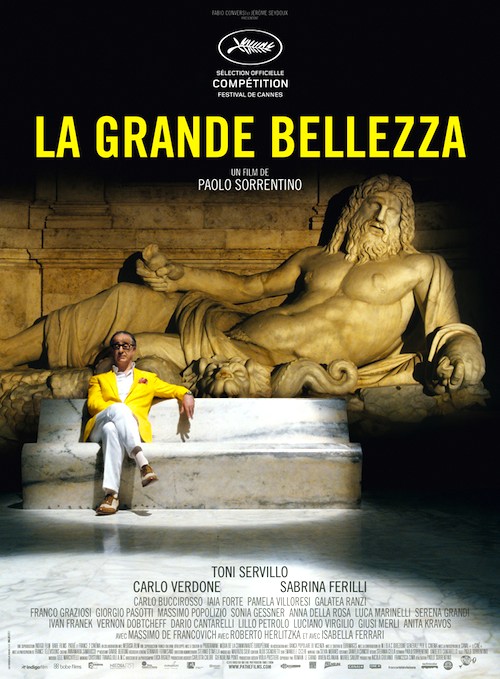
By Joe Bendel. Writers write, that’s what they do. Jep Gambardella still qualifies, just barely. After the publication of his acclaimed first novel, he chose to spend the rest of his career penning Vanity Fair-style celebrity profiles. It was much easier, but far less satisfying. Gambardella belatedly realizes this holds true for all aspects of his life in Paolo Sorrentino’s The Great Beauty, Italy’s official foreign language Oscar submission, which opens this Friday in New York.

It is Garbardella’s sixty-fifth birthday and his social circle is ready to party like they are really his friends. The magazine writer is in his element. However, he turns uncharacteristically pensive when he learns his great lost lover has passed away, perhaps still harboring undiminished feelings for him. Hoping to experience a similar passion, Gambardella commences a relationship with Ramona, the daughter of his old strip-club owner crony, who still works in the family business at the impressive age of forty-two. Perhaps there is some substance to their affair, but at the very least, her presence on his arm thoroughly scandalizes Rome’s high society.

A rapturous viewing experience, Great Beauty must be the most elegant looking and sounding film since Luca Guadagnino’s I am Love. Frankly, it takes considerable guts to make a film that so perilously invites comparison to Fellini’s La Dolce Vita, but Sorrentino has boldly gone there nonetheless. He masterfully maintains a mood that is palpably seductive and elegiac. Indeed, Great Beauty is likely to induce a midlife crisis in viewers, regardless of their age or accomplishments. Yet, it is an elusive cinematic statement that slips through your fingers whenever you try to analyze it.

Sorrentino’s frequent collaborator Toni Servillo gives the career performance of an accomplished career as Gambardella. Wonderfully urbane and devilishly witty, he nonetheless acutely expresses Gambardella’s each and every regret. This is Academy Award caliber work, but Great Beauty is so refined and mature it will probably be lucky just to make the foreign language cut.

Of course, Servillo is not laboring alone. As Ramona, Sabrina Ferilli’s earthy vulnerability perfectly complements Servillo’s cerebral angst, while the manic melancholy of Carlo Vendone as Gambardella’s writer-associate further heightens the Fellini-esque vibe, whereas Giovanna Vignola is simply incomparable as his acerbic editor, the diminutive Dadana.

Clearly, nobody shoots statuary and architectural edifices like cinematographer Luca Bigazzi. Similarly, the themes composed by Lele Marchitelli, as well as several shrewdly licensed selections from the likes of Arvo Pärt, provide a rich feast for the ears. Altogether, Great Beauty is a powerful and assured film on every level. Very highly recommended (especially to Academy members), it opens this Friday (11/15) in New York at the Lincoln Plaza Cinemas.

LFM GRADE: A

Posted on November 11th, 2013 at 2:48pm.