A Homecoming for Russians Artists: LFM Reviews Enter Here

By Joe Bendel. Ilya Kabakov does not really care how many millions of people Stalin murdered—more relevant to him is the way the Soviet state treated his mother like dirt. His intensely personal experiences under Communism profoundly shaped his conceptual work, created in collaboration with his wife, Emilia. After twenty years in the West, Kabakov finally returns to Moscow for an ambitious series of installations. Amei Wallach documents their mostly triumphant homecoming in Ilya and Emilia Kabakov: Enter Here, which opens this Wednesday at Film Forum.

Kabakov’s contemporaries all acknowledge the Moscow Conceptualists started with him. Like most of his colleagues, Kabakov paid the bills illustrating children’s books. It allowed him plenty of free time to pursue to pursue his own work – in secret, of course. Arguably, the young Kabakov was rather fortunate when the Leningrad Art School accepted him, at a time when both pupil and institution had been evacuated to Samarkand. However, his formative art school years remain a source of pain and anger for Kabakov.
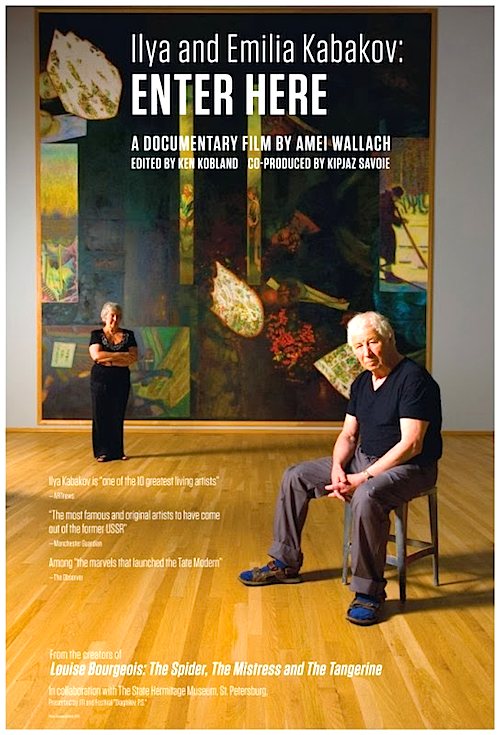
Years later, Kabakov’s mother agreed to his request for a written account of her difficult life. The narration of her words form the film’s strongest sequences, chronicling her hand-to-mouth years, working as the night watchman at his art school, living illegally in a converted water-closet, because she lacked the proper residency papers. Constantly evicted by bureaucrats and snitches, Kabakov’s mother was essentially homeless and shunned in the workers’ paradise. Her missive-memoir became the framework for Labyrinth, My Mother’s Album and its influence on other pieces is unmistakable.

While Ilya Kabakov clearly emerges as the senior partner, Emilia Kabakov seems perfectly content to serve as the more practical liaison with the business side of the art world. Twelve years his senior, Emilia Kabakov carries far less personal baggage from the Soviet years. However, it is rather eye-opening for her coming across an old informer’s journal with her family somewhat ominously identified as “the Jews.”

The Kabakovs’ brand of conceptual art is far more accessible than what might come to mind after watching the Herb & Dorothy documentaries. Unlike some of their colleagues, the Kabakovs’ work is clearly both intellectually and emotionally engaging, with their ironic use of Soviet symbols and the trappings of crummy everyday Russian life speaking volumes. Kabakov frequently incorporates his paintings into their so-called “total installations,” which further heightens their visual impact.

With an eye for telling details, Wallach and her crew nicely capture a sense of the viewing experience of the Kabakovs’ installations. Likewise, she also catches the artists, particularly Ilya, in reflective moods. Executed with sensitivity, insight, and a dash of style, Ilya and Emilia Kabakov: Enter Here is recommended for those who appreciate fine art and Russian history when it opens this Wednesday (11/13) at Film Forum.

LFM GRADE: B+

Posted on November 11th, 2013 at 2:45pm.
Getting Macro on the Micro Level: LFM Reviews Economic Freedom in Action

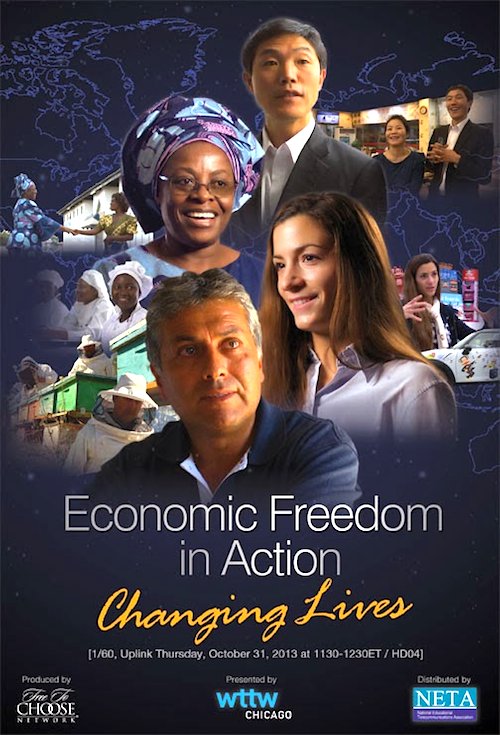
By Joe Bendel. Thanks to economic freedom, you can buy Paul Frank merchandise in Slovakia. The availability of monkey-face t-shirts might not sound like an epochal triumph, but it has made a world of difference for the Rybárikovás and their standard of living. Even more dramatic are the case studies of the North Korean defector providing start-up capital to his fellow refugees in the ROK and the Chilean beekeeper exporting queens to struggling European bee farms. Drawing upon these highly personal case-studies and the Fraser Institute’s annual report on world economic freedom, host-economist Johan Norberg argues that policies of economic liberty make the world a better place whenever they are adopted in Economic Freedom in Action: Changing Lives, which airs on Chicago’s WTTW this Thursday.

Written and directed by James & Maureen Castle Tusty, the filmmakers responsible for inspiring Singing Revolution, and produced in conjunction with the Free to Choose Network, Action follows the template established by Milton & Rose Friedman’s groundbreaking series, sprinkling manageable nuggets of analysis amid plentiful real world examples. Spanning the globe, Action starts in Africa, examining the country’s extraordinary turn-around from the perspective of Sylvia Banda.

Under Socialist president-for-life Kenneth Kaunda, Zambia was an economic basket case – but following his ouster, it has become one of the continent’s fastest growing economies, thanks to an ambitious privatization program. Banda was able to ride that wave. Starting with an unfurnished one-room restaurant, she now operates one of the nation’s largest food supply companies. Through capitalism, she has enacted a series of agricultural and hygiene reforms that the government and NGOs struggled to implement.

The contrast between economic liberty and authoritarianism is starkly demarcated on the Korean peninsula. While famine is an everyday fact of life in the tightly regimented DPRK, the ROK is a land of plenty, often leading to culture shock for defectors like Daesung Kim. To help his fellow refugees adapt, Kim started a venture capital firm that invests in their small enterprises. Once struggling to survive, those he works with now have a stake in South Korea’s economy and can provide entrepreneurial expertise if and when the North finally liberalizes its markets and political system.

Arguably, Kim is the bravest capitalist featured in Action. In contrast, the stakes were never so high for Katerina Rybáriková, but her story nicely illustrates the necessity of economic liberty in addition to political liberty. After the fall of communism, Slovakia still lagged behind most of Eastern Europe and ranked relatively low on the Fraser Institute’s index. However, a concerted program of privatization and property rights guarantees created the climate that allowed Rybáriková to successful pitch a Slovakian franchise to the Paul Frank corporate office.

One might expect Action to steer clear of Chile, yet it completely proves the thesis of Friedman’s Capitalism and Freedom, with political liberty duly following the establishment of economic liberty. While acknowledging the abuses of the Pinochet regime, Action charts the explosive growth following his economic reforms that remain largely unadulterated to this day. Thanks to the market-based economy, brothers John and Miguel Hernandez have been able to build their bee farm into a going pollination service and bee queen exporting concern, a business with particularly positive global ramifications, given environmental concerns regarding dwindling bee populations.

Chile and South Korean have consistently ranked high on the Fraser report, while Zambia and Slovakia have been recent up-and-comers. That begs the obvious question: how does America rank? For years, we usually held the second or third spot, but we have fallen in recent years, to number nineteen. Norberg and the Tustys do not engage in a lot of finger-wagging, but the significance of this tumble is hard to miss.

Indeed, Action is a remarkably sure-footed exploration of the real world impact of economic policies. By focusing on human stories it never comes across like an econ lecture or a ration of polemics. It is thoroughly convincing, but it is also really good television, taking viewers to places they rarely see in the mainstream media. Highly recommended, Economic Freedom in Action: Changing Lives airs this Thursday (11/14) on Chicago’s WTTW and can be seen in syndication on PBS stations throughout the month. It will also be available for online viewing courtesy of the Free to Choose Network.

LFM GRADE: B+

Posted on November 11th, 2013 at 2:20pm.

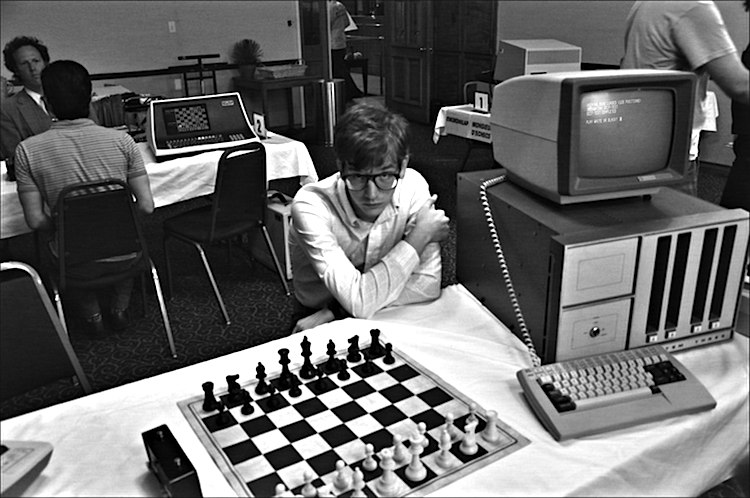
LFM’s Jason Apuzzo at The Huffington Post: Putting Computers in Their Place: Computer Chess & The Nerd Origins of Today’s Technopoly


[Editor’s Note: the post below appears today at The Huffington Post.]

By Jason Apuzzo. Computers need to be put in their place. They really do.

That’s why I’ve been looking forward to the DVD release this week of Andrew Bujalski’s cult Sundance hit Computer Chess. Computer Chess finally spills the beans about where these little monsters came from in the first place.

Every time I pick up a newspaper these days – I’m one of the twelve people left who still read physical newspapers – I read about how computers are spying on us, destroying jobs, or infuriating health insurance customers. Like a hungry Rottweiler off its leash, computers are getting out of control and tearing up the neighborhood.

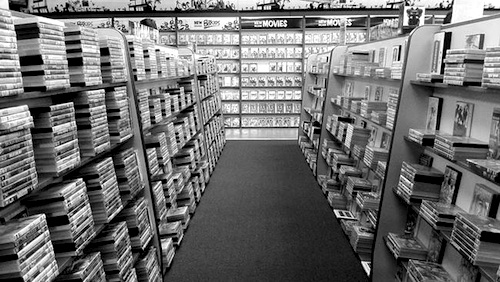
If you believe what you read, computers are also in the process of wrecking the book publishing and music industries, eliminating celluloid photography – and just this week computers claimed their latest victim, one near and dear to my heart: the local video store, as Blockbuster finally succumbed to laptops, smartphones and tablets as the preferred ways of renting all those movies you couldn’t afford to see (or were too embarrassed to see) when they were in theaters.

2013-11-08-VideoStoreaisle.jpg
The demise of the American video store.

No more video stores – who would’ve believed it, even just ten years ago? That means no more pimply teenagers to recommend midnight horror movies to me (“Sir, I definitely recommend C.H.U.D. over TerrorVision“), no more aimless browsing or listening to neighbors argue over which Steven Seagal movie to rent, no more cheap licorice sticks at the checkout counter.

I never thought I’d miss those things so much – but suddenly I do. And it’s all because of our ‘friend’ the computer. Computers are becoming like the Yankees during the ’90s: gobbling up everybody else’s talent, then telling us how good it is for baseball.

The propaganda over the wonders that computers supposedly bring to our lives is getting out of hand. In the very least, it’s out of proportion to the destruction computers are simultaneously causing – that ‘disruptive’ effect Silicon Valley gurus salivate over, like vampires at a blood drive.

So as Twitter – the company currently reducing our public discourse to snarky, 140-character outbursts – celebrates its gaudy IPO right now, I’d like to recommend a new movie out on DVD this week that casts digital technology in a very different light: Computer Chess. Continue reading LFM’s Jason Apuzzo at The Huffington Post: Putting Computers in Their Place: Computer Chess & The Nerd Origins of Today’s Technopoly

Because Life Wasn’t Weird Enough Without It: LFM Reviews The Visitor

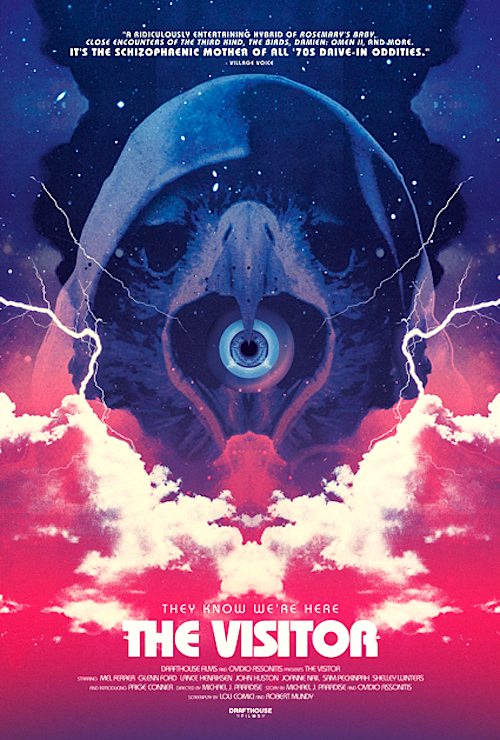
By Joe Bendel. Atlanta is a sinful city, where every damn street is called Peachtree. A cosmic warrior has come to straighten things out here. He will do battle with the pre-pubescent girl who has made the world such a crummy place in the ever-so strange 1979 Italian-produced sci-fi knock-off, The Visitor, directed by Giulio Paradisi as Michael J. Paradise, which has been re-mastered and re-released by Drafthouse Films.

In a dimension “beyond imagination,” a mysterious old man seeks out the remnants of the evil Sateen, a demonic entity he vanquished eons ago. Evidently, some of his old foe’s essence ended up on earth, specifically within Barbara Collins’s ancestors. She is one of the rare carriers who can give birth to his malevolent offspring. Unfortunately, she already has one child, the dreadful little Katy. Her boyfriend Raymond Armstead is pressuring her to get married and have more children, because he is part of an apocalyptic secret society that frequently holds awkward board meetings devoted to promoting evil. Collins resists, ostensibly for the sake of her freedom. However, she is also instinctively against anything Katy is for.

You might think the bad guys would do anything to protect the birthing abilities of the only woman who can deliver Sateen’s bad seeds. Well, obviously you are not part of an international satanic cult. Poor Collins is shot, partially paralyzed, run off the road, and attacked by a falcon. Yet, despite all the stress, her skin remains remarkably clean and radiant. As Armstead and Katy plot against her, the gaunt Jerzy Colsowicz arrives to do battle with Sateen’s spawn. That’s right, it’s a frail septuagenarian versus an eight year-old, so get ready to rumble.

It goes without saying The Visitor is a strange film. Everyone compares it to The Omen and Close Encounters, but Paradisi/Paradise probably rips-off The Birds more than anything else. For whatever reason, bird attacks seem to be the weapon of choice for good guys and bad guys alike. It is just plain baffling anyone thought this film could cash in on the late 1970’s sci-fi craze, but it boasts a truly once-in-a-lifetime cast, including John Huston (the John Huston), Lance Henriksen, Glenn Ford, Franco Nero (uncredited as the Christ-like figure), Shelley Winters, Switchblade Sisters’ Joanne Nail, Mel Ferrer, Sam Peckinpah (the Sam Peckinpah), and future Libertarian radio talk show host Neal Boortz. Get your head around that ensemble.

Frankly, Huston looks rather bemused in each of his scenes as Colsowicz and it is a good bet he never even bothered to watch the finished product. Ford and Winters soldier through like the old pros they are, playing the cop and the nanny, respectively. Eventual fan favorite Henriksen also shows an early affinity for scenery chewing as Armstead. In truth, aside from maybe Huston and Nero, nobody really phoned The Visitor in, but it is anyone’s guess what they thought they were doing in this convoluted, New Agey plot. There are times the film appears to be conceived as a showcase for Atlanta’s modernist architecture, which makes as much sense as any other explanation.

Visitor’s special effects are crude and confusing, even by 1970’s standards, but in its straight-forward dramatic scenes, the picture looks surprisingly slick. Naturally, even the music “borrows” from another film, but it must be conceded Franco Micallizzi’s riff on Strauss’ “Zarathustra” is oddly catchy, in a funky (arranger) David Matthews-Kudu Records kind of way.

If you don’t get The Visitor by now, you’re on your own. If you enjoy completely cracked cult cinema, this is your catnip. Impressive in its way, The Visitor demands to be seen to be believed. Recommended for those who can appreciate the sheer defiant spectacle of it all, The Visitor screens this weekend (11/8 & 11/9) at the IFC Center in New York.

LFM GRADE: B

Posted on November 5th, 2013 at 11:08pm.

Another Sleepless Night in Paris: LFM Reviews Paris Countdown

By Joe Bendel. Victor and Milan ought to stick to slinging drinks. Delivering a shipment of cash to a Mexican cartel predictably turns out to be really bad way to work off their debts. It leads to all kinds of problems in Edgar Marie’s Paris Countdown, which opens this Friday in New York.

It was all Milan’s fault and Victor is not about to forget it. Forced to accompany his partner to Juarez, Victor gets the worst of it when the Federales bust their hand-off. After a rough interrogation session, they are “convinced” to testify against their French contact, the psychotic Serki, whom the nightclub proprietors know will come looking for revenge if he ever gets out of prison. That is exactly what happens six years later.

Victor has not talked to Milan since their Mexican misadventure. He still bears the scars and the hearing aid from his close encounter with a power drill. Yes, he is carrying a grudge, so when Wilfried, his mobbed-up sushi restauranteur colleague, offers him the chance to set-up Milan, he matter-of-factly agrees. However, Victor finds betrayal is far more difficult once he comes face-to-face with his former friend again. Against his better judgment, Victor will flee into the night with Milan, trying to stay one step ahead of Wilfried’s henchmen and the slightly put-out Serki.

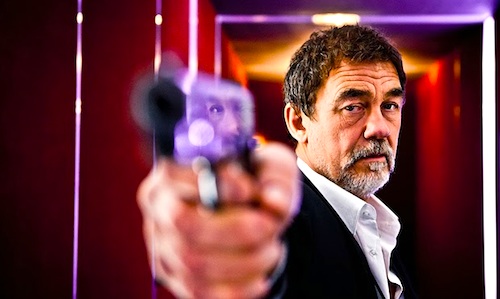
From "Paris Countdown."

Countdown is aesthetically reminiscent of several recent French noirs, including Frederic Jardin’s more action-oriented Sleepless Night and Philippe Lefebrve’s massively cool, character-driven Paris By Night. In terms of style, Countdown essentially splits the difference between the two. Frankly, it is not as accomplished as either, but it still has its merits. In fact, the world-weariness of its primary protagonists and general vibe of nocturnal angst are quite compelling. Neither Milan nor Victor is any sort of action hero. Clearly, both are physically past their prime, struggling to deal with their night of madness.

Olivier Marchal (the director of the similarly hardboiled 36th Precinct) is appropriately haggard yet appealing roguish as the exceptionally irresponsible Milan. Jacques Gamblin clearly has less fun as Victor, but he is convincingly nebbish as the sad sack. Unfortunately, Carlo Brandt’s Serki looks even older and more broken down than they do, making him a problematic villain.

As a thriller, Countdown has enough atmosphere and attitude to get the job done. For his feature directorial debut, Marie shows a competent command of the elements, but the MVPs are clearly Marchal and cinematographer Danny Elsen, who gives it a fitting Miami Vice-like sheen. Recommended for fans of French thrillers, Paris Countdown opens this Friday (11/8) in New York at the Cinema Village.

LFM GRADE: B

Posted on November 5th, 2013 at 11:05pm.

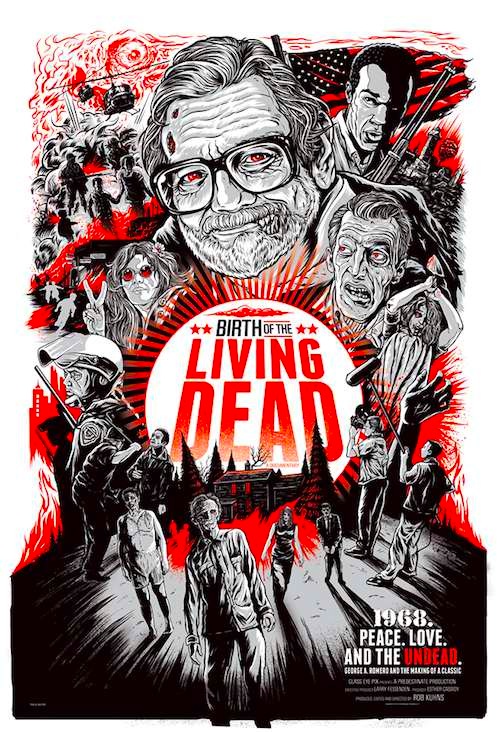
The Origin Story That Just Won’t Die: LFM Reviews The Birth of the Living Dead

By Joe Bendel. It came from Pittsburgh. That is where George A. Romero had carved out a business shooting television commercials for local clients. Of course, he harbored filmmaking ambitions. Eventually, his upstart debut would revolutionize horror cinema, spawning all kinds of controversy and imitators. Yet, at the time, Romero was not at all certain he would be able to complete production and post on the now classic The Night of the Living Dead. Rob Kuhns goes straight to the source for his behind the scenes look at the making and legacy of the zombie classic in The Birth of the Living Dead, which opens this Wednesday in New York at the IFC Center.

It has been over forty years since the original Living Dead was first released with little fanfare in an old school midtown grindhouse theater. Despite uniformly negative reviews (from the few critics who even bothered to cover it), Romero’s classic took on a life of its own. In fact, the entire city of Pittsburgh had already sort of rallied behind it, perhaps inspired by local late night creature feature TV host Bill Cardille’s weekly drumbeat of publicity (you can spot him late in the film as the newsman interviewing the sheriff). During production, the police department provided helicopters free of charge and many of Romero’s customers appeared as zombies.

One of the cool things about Birth is the way Romero vividly remembers each and every extra. Those who have seen the film countless times will be fascinated to learn how many cast members also performed crucial functions off-screen. Romero’s co-producer Russell Streiner (instantly recognizable as Barbara’s ill-fated brother) emerges as a particularly resourceful figure. Kuhns also includes an endearing stinger-tribute to the late Bill Hinzman, the first zombie who chases her into the farmhouse.

Visually, Birth is also fan-friendly, featuring Gary Pullin’s distinctive comic art to illustrate various stages of the production. It will further reassure diehards to know the doc comes via Glass Eye Pix, with Larry Fessenden on board as both a talking head and executive producer.

In a bizarre turn, Birth periodically visits a Bronx middle school, where a teacher uses Night of the Living Dead as part of his “Literacy through Film” course. Yes, this is a classic film with considerable subtext, but showing graphic depictions of cannibalism in the classroom is wholly inappropriate. Evidently, “de-sensitize them early” is the Board of Ed’s motto. Only in New York.

Kuhns is on stronger footing examining the wider cultural significance of Night. According to Romero, Ben the central POV character, was not originally written as an African American, but Duane Jones just nailed the audition. Nonetheless, the added implications of the final scene would have been hard to miss, especially since Romero was consciously incorporating images of 1960’s civil strife.

If you are a mature adult, at least old enough to vote, you really ought to be familiar with Night of the Living Dead. While Birth offers some shallow general political analysis of the late 1960’s, it specifically contextualizes Romero’s film quite adroitly. Recommended for zombie aficionados who want to deepen their Living Dead viewing experience, Birth of the Living Dead opens this Wednesday (11/6) at the IFC Center.

LFM GRADE: B

Posted on November 4th, 2013 at 6:37pm.