LFM Reviews So Young @ The New York Chinese Film Festival

By Joe Bendel. The Deng era is in full swing, so that means China is getting down to business, especially university students. A few still find themselves preoccupied by love, but reality will trump storybook endings in Red Cliff actress Vicki Zhao Wei’s smash hit feature directorial debut, So Young, which opens this year’s New York Chinese Film Festival.

When Zheng Wei first encounters Chen Xiaozheng, there is so much friction, it must be love. Frankly, she is not in the mood for romance. She only enrolled in their civil engineering university to be with her boyfriend from back home. Arriving to discover he has mysteriously dropped out, she carries on as best she can. For the most part, she gets on well with her three roommates, particularly Ruan Guan, a tragic beauty with an equally problematic boyfriend.

After a disastrous first meeting, Zheng initially declares war on Chen, but quickly recognizes her true feelings. Soon she starts pursuing the dirt poor scholarship student in a manner that rather embarrasses both him and her friends. Romance blossoms over time, but it will not last. Upon graduation, everyone splits up, eventually reconnecting years later as dissatisfied professionals in the big city.

From "So Young."

So Young sort of mirrors the college experience, flirting with outright preciousness during its early courtship scenes, meandering somewhat in the immediate aftermath of graduation, but coming together quite powerfully down the stretch. One could think of it as the Chinese St. Elmo’s Fire, but the drama is crisper and more honest, but the soundtrack is not nearly as catchy.

Yang Zishan anchors the film with unexpected grit, vividly illustrating how youthful pluckiness gives way to jaded toughness. She commands So Young, but Mark Chao counterbalances her rather effectively as the ever so reserved Chen. However, the film’s real discovery is Cya Liu as Zheng’s spirited tomboy-ish roommate Zhu Xiaobei, who makes the small but intriguing supporting role something special.

Somehow Zhao shoehorns a barrel full of subplots into a fairly brisk one hundred and thirty-one minutes. She precipitously changes the tone on a dime, but allows good scenes sufficient time to fully play out. Indeed, So Young is a fascinating corrective to Chinese language rom-coms, where love always wins out, such as the All’s Well Ends Well franchise. While not a complete downer, it certainly ends in an ambiguous place, which is cool. If not exactly perfect, So Young’s rough edges are sort of appealing overall. Recommended for fans of good looking melodrama, So Young screens as the 2013 New York Chinese Film Festival’s red carpet opening night selection this Tuesday (11/5) at Alice Tully Hall.

LFM GRADE: B-

Posted on November 4th, 2013 at 6:33pm.

LFM Reviews Ripples of Desire @ The San Francisco Film Society’s Taiwan Film Days

By Joe Bendel. Public health is a bit iffy on this Ming era floating island. Medical misconceptions will lead to some very bad decisions. Old fashioned passion and jealousy will only compound problems. Love and leprosy are contagious in Zero Chou’s Ripples of Desire, which screens during the San Francisco Film Society’s annual Taiwan Film Days.

White Snow is the most coveted courtesan in the House of Flowers, but she harbors a dark secret shared only with her sister, White Frost. Snow is in the early stages of leprosy. As the sisters contrive ways to withdraw her from daily courtesan life, Frost supplants her as the favorite of their madam. When the commerce-minded Moon discovers the truth, she commands Snow to seduce Wen, the new resident music teacher, to “transfer” her disease to him.

Obviously, it does not work that way. Regardless, Snow is not inclined cooperate, because of her burgeoning feelings for the awkward pedagogue. Meanwhile, Frost plays a dangerous game, spurning the affections of Scarface, her would-be lover-pirate, in favor of the well-heeled, but shallow Sir Li. Whole-heartedly assuming the femme fatale role, Frost concocts a scheme with Li and Scarface’s Master Hai to fake the tea merchant’s abduction, funding their new life with the anticipated ransom. However, Li’s wife, Lady Jen, disrupts the plan, unexpectedly arriving to handle the matter in person. Her courage and beauty make quite the impression on Master Hai, despite his pseudo-relationship with Moon.

From "Ripples of Desire."

Right, there will be no shortage of betrayals in Ripples. Given its cocktail of pirates, courtesans, and leprosy, it is safe to assume there will not be a lot of happily-ever-afters for anyone. Known for her lesbian-themed indie films, Chou branches out into more mainstream commercial territory here. For a historical epic, Ripples is unusually stripped down and small in scope, but the intimate scenes crackle with love and intrigue.

Ivy Chen and Michelle Chen are not actually related, but they certainly look like sisters, just as they did in the relentlessly sweet rom-com Hear Me (a prior Taiwan Film Days alumnus). The former is particularly impressive as the deeply complex Frost, while the latter trembles like a delicate orchid.

Of course, Simon Yam brings the appropriate swagger as Master Hai, but he also nicely ups the tragically romantic ante in his scenes with Li Xiaoran’s Lady Jen. Frankly, he is the MVP amongst the guys, easily outclassing pop star Jerry Yan and TV star Joseph Cheng.

At times, Chou over indulges the stylization at the cost of narrative clarity, but there is no mistaking the ardor and yearning. Indeed, it jerks the tears quite effectively. Recommended for fans of tragic historical romance, Ripples of Desire screened yesterday at the Vogue Theatre, as part of the SFFS’s Taiwan Film Days.

LFM GRADE: B

Posted on November 4th, 2013 at 6:30pm.

The Belgian Bluegrass Oscar Submission: LFM Reviews Broken Circle Breakdown

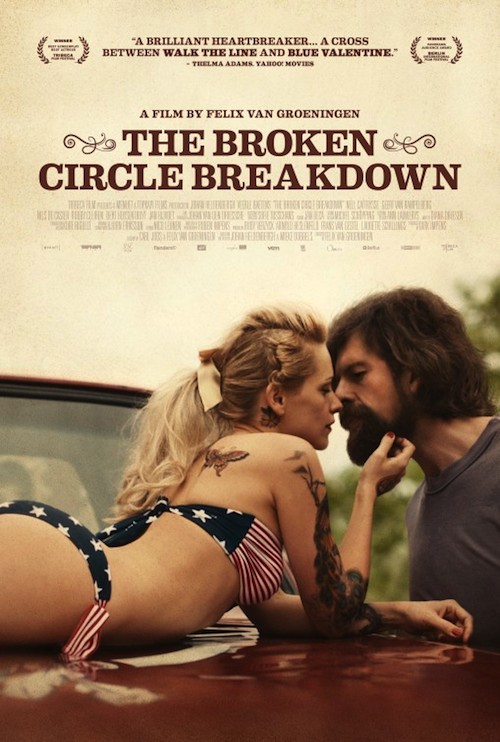
By Joe Bendel. He has a lot of facial hair, she is covered in tattoos. They are Belgian, but old time American roots music, particularly bluegrass, tells their painful tale. There will be banjos and tears in Felix van Groeningen’s The Broken Circle Breakdown, Belgium’s official foreign language Oscar submission, which opens today in New York.

As a single chap, Didier just puttered about his once grand country house when not performing with his bluegrass band. That was how he caught the eye of Elise, a tattoo artist with more personal ink than the general population of San Quentin. What starts out as a physical thing evolves into something musical when she joins the band as a vocalist. While actress Veerle Baetens’ voice is not showstopppingly powerful, she still sounds quite haunting performing Elise’s old school standards, like “Wayfaring Stranger.”

Eventually, Elise gets pregnant. After Didier’s brief freak-out, they settle into an idyllic family life together, until five year-old Maybelle is stricken with cancer. Elise and Didier try to keep it together for her sake, but the wheels are clearly coming off their relationship.

You might think a family tragedy like Circle would have no political axe to grind, but you would be wrong. Van Groeningen’s adaptation of lead actor Johan Heldenbergh’s stage play retains his “reason vs. faith” themes, presenting them in the most simplistic manner possible. Frankly, there is already widespread confusion regarding the differences between adult, amniotic, pluripotent, and the controversial embryonic stem cell treatments, but Circle does its best to muddy the waters even further.

Arguably, a case could be made Didier’s foaming-at-the-mouth outbursts of aggressive atheism undermine his character’s position, but that does not make them any more pleasant to sit through. Indeed, his utter inability to offer his daughter any form of spiritual reassurance is hard to buy. You just have to wonder why scene after scene made it to the final cut. Then they start singing and suddenly the film makes sense again.

Van Groeningen might only do one thing right throughout Circle, but he rather brilliantly uses song to express his characters’ inner turmoil. When Didier and Elise perform “If I Needed You,” it cuts to the bone. This could definitely be a case of the soundtrack eclipsing the source film’s popularity, as it just so happened for O Brother Where Art Thou?

Baetens and Heldenbergh sound great together on the bandstand and are uncomfortably real together, both in the throes of passion and when emotionally torturing each other. Young Nell Cattrysse is also quite compelling, giving some flesh-and-blood dimension to the ailing Maybelle.

The music and fundamental drama of Circle are so powerful, it is a shame the film has such an ADD compulsion to express a wider macro-level significance. Van Groeningen and Heldenbergh should have placed more trust in its micro essence. When it consents to jerk tears, it gets them flowing good, which is why it cannot be counted out in the foreign language Oscar derby. The Broken Circle Breakdown is a messy film, but it has its moments. Recommended with reservations for hardcore fans of bluegrass and Flemish cinema, it opens today in New York at the Landmark Sunshine.

LFM GRADE: C+

Posted on November 1st, 2013 at 12:17pm.

LFM Reviews Forever Love @ The San Francisco Film Society’s Taiwan Film Days

By Joe Bendel. It was known as Hollywood Taiwan and it sure was fun while it lasted. From the mid 1950’s to early 1970’s Taipei’s Beitou District was home to a scrappy Taiwanese Hokkien dialect film industry, until the big Mandarin change-over was mandated from above. The Beitou Roger Cormans cooked up about a thousand films give or take, but only two hundred have been properly preserved for posterity. The golden age of Hollywood Taiwan is fondly remembered in Aozaru Shiao & Kitamura Toyoharu’s nostalgic screwball rom-com Forever Love, which screens during this year’s edition of the San Francisco Film Society’s Taiwan Film Days.

Liu Chi-sheng was once the busiest screenwriter in Hollywood Taiwan, because scripts needed to be turned out fast. Volume was more important than nuance. Hardly anyone remembers his films anymore, but his granddaughter Hsiao-jin used to have her own private screenings at his now shuttered revival house. She has come to visit him in the hospital where he is recuperating from an athletic misadventure. In the mood to reminisce, Liu reveals to her how he came to marry her now Alzheimer’s-stricken grandmother, Chiang Mei-yeuh.

It all started with a characteristically goofy James Bond rip-off called Spy No. 7. When it opens to packed houses in Taipei, Liu’s boss, “Mr. Pig” orders him to write the sequel, Spy No. 7 on Monster Island, once again featuring the lovely but cold Chin Yueh-feng and the arrogant heel, Wan Pao-lung, Hollywood Taiwan’s superstars of the moment. Like so many young women of her age, Chiang has a massive crush on Wan. Despite a bad case of stage fright, she has a few advantages over her competition at the poverty row studio’s open casting call. She has genuine charisma and the right surname. Liu also takes an interest in her career, even though they start out on awkward terms, as is always the case with rom-coms.

It will be a great romance, culminating in a big tear-jerking finale, because anything else would not be true to Hollywood Taiwan. Along the way, there are plenty of double takes, miscommunications, and flat out pratfalls in Forever, but the film has a romantic soul. Indeed, Shiao and Kitamura (who also appears as Liu’s hard partying art director crony) make no secret of their affection the old Taiwanese cinema, reveling in its gleeful energy and love for love.

With gloriously silly black-and-white sequences and kiss-me-you-fool fireworks, Forever Love proudly empties its kit-bag for the sake of audience satisfaction. It is a rather endearing antidote for cineaste cynicism, steadfastly avoiding irony in favor of unrepentant romanticism. Granted, characters rattle all over the film like pinballs, but there are surprisingly touching low key moments too, such as those exploring young Liu’s relationship to the studio’s boozy veteran director and old Liu’s scenes with his granddaughter, a well cast Li Yi-jie, who looks and sounds like the spitting image of her grandmother Chiang in the 1960’s.

Lung Shao-hua brings Herculean dignity to the grumpy old Liu, enlivening the contemporary framing scenes. Blue Lan is a bit bland as his younger analog, but former pin-up model Amber An is sweetly innocent yet undeniably Betty Boop-ish as the younger Chiang. As Wan, Edison Wang hams it up like a champ, while Tien Hsin brings a bit of subtly to Chin, the ice queen.

Coincidentally but fittingly, Forever screens as part of Taiwan Film Days just as the former San Francisco International Film Fest selection Golden Slumbers opens in New York at the Anthology Film Archives. Davy Chou’s documentary is a moving elegy to a lost cultural legacy: the Cambodian cinema almost completely destroyed by Khmer Rouge. While Forever Love is far more upbeat and sparkly (thanks to Patrick Chou’s bold, candy-colored cinematography), it still wistfully honors the spirit and enterprise of Hollywood Taiwan. Recommended for those who love old school movie romances and the wonderfully idiosyncratic craftsmen who made them, Forever Love screens Saturday night (11/2) at the Vogue Theatre during the SFFS’s Taiwan Film Days.

LFM GRADE: B+

Posted on October 31st, 2013 at 11:04am.

The Long Shadow of the Holocaust: LFM Reviews Aftermath

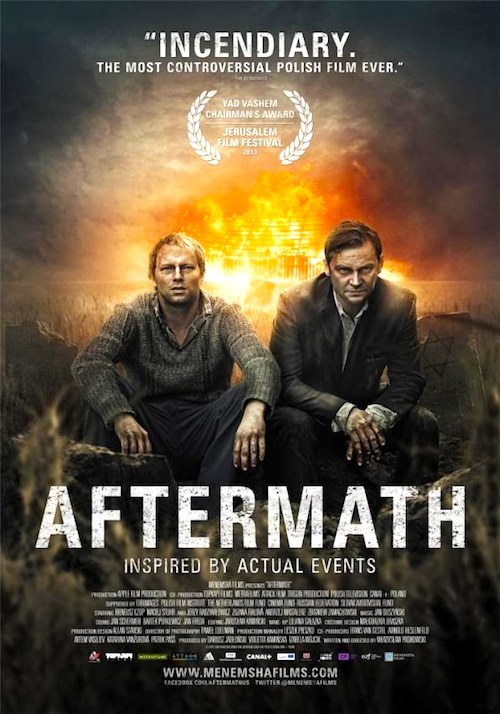
By Joe Bendel. It is a fact that there were more righteous gentiles from Poland than any other country. It is also a fact that many Polish survivors refused to return to the homeland after the war. There is a certain defensiveness that manifests itself when the Polish Holocaust experience is discussed. Using the term “Polish concentration camps” is sure to bring objections that these were German death camps they just happened to build in occupied Poland for reasons of logistics. This is a fair point. Nonetheless, it was a complicated period of history that Polish cinema has rarely addressed so defiantly forthrightly as writer-director Władysław Pasikowski has with Aftermath, which opens this Friday in New York.

The fate of Jewish Poles simply was not acknowledged during the old regime, so there was no cause to worry about potential consequences for past injustices. However, this was no longer necessarily the case after the fall of Communism. Such issues could not be further from Franek Kalina’s thought when he finally returned to the ostensibly sleepy hamlet of his birth. The elder Kalina brother immigrated on the eve of Martial Law and never looked back, until his sister-in-law unexpectedly arrived in Chicago. Evidently, something was wrong on the homefront, but her silence forced him to back his long deferred homecoming journey.

It is an awkward reunion to say the least. His brother Jozek is not especially talkative either, but Kalina eventually discovers why they have been shunned by the town. His brother has systematically collected the Jewish grave markers the National Socialists had used to pave a local thoroughfare and patch up certain municipal works, erecting a makeshift cemetery in a corner of the family field. This is not appreciated by their neighbors. Initially, the Kalinas assume they merely resent the unpleasant memories. However, the slowly discover the town’s damning hidden history.

For the well educated, Aftermath’s revelations probably do not sound so stunning on paper, but Pasikowski’s slow drip-by-drip revelations are brutally effective. This is the sort of film where viewers will find themselves surprised to be surprised. It is a bracing film that pulls no punches, yet there is redemption amid the denial and intolerance it depicts. In fact, there is something particularly moving about the rough hewn Jozek Kalina, compelled to seek out and restore the headstones out of a humanist impulse he is incapable of verbalizing.

Ireneusz Czop and Maciej Stuhr (the son of actor-director Jerzy Stuhr, renowned for his work with Krzysztof Kieślowski) convincingly look and act like brothers. Their fraternal rivalry takes on Biblical proportions, yet they clearly convey that instinctive bond. Aftermath is their shared dominion, but they receive some distinctive support, particularly from Danuta Szaflarska and Maria Garbowska, as elderly villagers who perhaps partly know the dark truths the Kalina Brothers seek.

Considering the great Andrzej Wajda (who co-wrote Katyn with Pasikowski) has heartily endorsed Aftermath, it should not be considered anti-Polish by any stretch. It is a tough, uncompromising film, but a little bit of soul-searching is a healthy exercise. In America, agonizing over our past sins is practically a national pastime. In contrast, European nations seem far more inclined to consign less than edifying historical episodes to the collective memory hole. There probably ought to be a happier medium. Aftermath absolutely does its part in that regard. Despite a ragged dramatic edge here or there, it is viscerally powerful as a whole. Recommended for those who appreciate outspoken contemporary dramas with a keen sense of history, Aftermath opens this Friday (11/1) in New York at the Cinema Village.

LFM GRADE: B+

Posted on October 30th, 2013 at 5:12pm.

Life as a Hemingway: LFM Reviews Running from Crazy

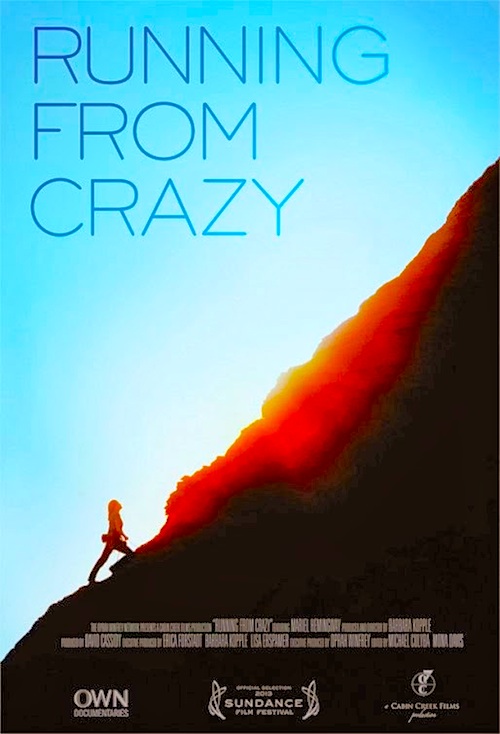
By Joe Bendel. If when asked who is the most interesting member of the Hemingway family you automatically reply “Mariel” then you must be either Barbara Kopple or Oprah Winfrey. Granted, she was terrific in Manhattan and has dealt with more family heartbreak than anyone should ever have to face. However, Kopple proves her larger than life grandfather Ernest and tragic sister Margaux are far more compelling figures in the self-helpy documentary Running from Crazy, which opens this Friday in New York, via the OWN documentary distribution arm.

Seven members of Hemingway’s family committed suicide. Mariel Hemingway never knew her grandfather, but she always had an extremely complicated relationship with Margaux, the middle sister. Probably the film’s strongest sequences chart Margaux Hemingway’s spectacular rise to fame as a supermodel and her frustrations with an acting career that never really took off. Her big break was supposed to be Lipstick, in which she had Mariel fittingly cast as her as her younger sister. When the film came out, all the good notices went to one sister and the bad notices went to the other.

Frankly, if you were not old enough to remember the Studio 54 era, most of the footage of Margaux as a media sensation will come as a revelation. In contrast, all we get of Papa is the same old stock footage. There is plenty of Mariel, though. Kopple follows her to benefits and awareness marches, as part of her ongoing efforts to de-stigmatize mental illness and support those who have also lost loved ones to suicide. Such dedication is admirable, but it does not make for great cinema.

Beyond her well intentioned outreach, Running includes far too much self-actualizing mumbo jumbo. In fact, Hemingway and her partner Bobby Williams seem to have some sort of New Age lifestyle joint venture, but it is impossible to tell what exactly they are selling, even though we hear plenty of his pitch.

If nothing else, Running will convince viewers that under no circumstances would they want to take a rock-climbing road trip with Hemingway and Williams. It would be better to be the dude in 127 Hours. There is absolutely no reason to force viewers to sit through all their bickering and bantering, but Kopple does so anyway.

Still, the archival scenes of Margaux Hemingway, including footage she shot for a prospective documentary on her grandfather, are truly compelling. Especially haunting are the interviews she granted ostensibly to trumpet her successful rehab efforts, but look so clearly like cries for help in retrospect. Mariel Hemingway kind of admits she missed the warning signs, but Kopple never pushes her on this or any other issue. As a result, the film often has the vibe of an infomercial for group hugs.

There are moments to Kopple’s starry-eyed film, but it is a disappointment by most cinematic and journalistic standards. Not recommended in theaters, interested readers should note that Running from Crazy will air on OWN next year, which is where it belongs. Regardless, it opens this Friday (11/1) in New York at the Angelika Film Center.

LFM GRADE: C-

Posted on October 30th, 2013 at 5:08pm.