LFM Reviews Dancing on the Edge; Premieres Sat. (10/19) on Starz

By Joe Bendel. Louis Lester’s band swings so hard, many of their fans assume he is an American, but he is really a born and bred British subject. Several high society types will take an interest in them, but that will not always be a good thing during the course of Stephen Poliakoff’s Dancing on the Edge, a six night mini-series beginning this Saturday on Starz.

Stanley Mitchell is a progressive jazz fan, but he is also a bit of an operator. He sings the praises of the Lester band, hoping his magazine Music Express will rise with their tide. While not to the manor born himself, Mitchell knows many of the right people, like Arthur Donaldson, a man of leisure who happens to appreciate real deal jazz. Through Donaldson’s connections and Mitchell’s glad-handing, the Lester band books some high profile gigs, eventually becoming the house band at the formerly staid Imperial Hotel.

For a while, it seems like everyone will enjoy the good life together, especially when the mysterious American tycoon, Walter Masterson, starts inviting the band to his lavish parties, along with the wealthy but somewhat emotionally codependent Luscombe siblings. The interracial romance brewing between Lester and Sarah, a photographer close to the Luscombes, obviously portends future trouble, but the erratic Julian Luscombe’s reckless pursuit of the band’s lead singer will lead to more immediate problems.

Chiwetel Ejiofor is about to become an Oprah superstar through 12 Years a Slave, but his turn as Lester is arguably his best work since Dirty Pretty Things. In many ways, it is a treatise on “cool” as a defense strategy and a personal aesthetic. Rigidly controlled, Ejiofor still shows us all the gears turning in his head. Arguably, the major historical influences on his Lester are the suave sophistication of Ellington (whose 1930’s small big band could be a model for the Lester outfit) and the not-so-passive aggressive aloofness of Miles Davis to come in later years.

In contrast, Matthew Goode gives Mitchell a slightly manic edge, nicely playing off the tightly wound Ejiofor in their smartly written scenes together. (If you’re asking whether he rings to someone who has written about and championed jazz, the answer is yes.) Probably nobody is more over-exposed for Anglophiles than Tom Hughes right now, but while he was conspicuously miscast in About Time, The Hollow Crown, and The Lady Vanishes, he is sort of perfect for the boyishly creepy Julian Luscombe. Like Hughes, John Goodman brings out the messy human dimensions of grandly indulgent Masterson, a role that could have easily descended into gross caricature.
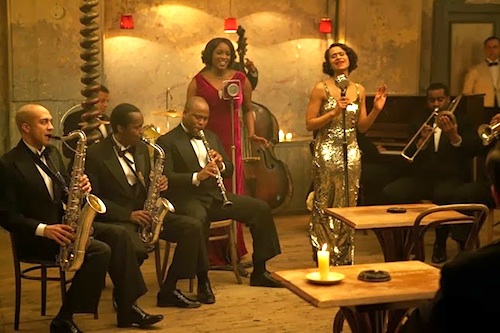
From "Dancing on the Edge."

In fact, one of writer-director Poliakoff’s great strengths is the manner in which he preserves some degree of audience sympathy for all his characters despite their often horrid actions. Shrewdly, he also maintains considerable ambiguity regarding certain relationships, instead of beating viewers about the head, as a less artful production might. Dancing does right by the music as well, featuring a soundtrack of original era appropriate swingers and ballads, recorded by real life working jazz and studio musicians, who also appear in character as the Lester band. If jazz advocates will have any gripe with Dancing it will be the lack of development for the musicians, besides Lester and his two vocalists.

Like the best of television, Dancing quickly hooks in viewers and keeps them emotionally invested throughout. Poliakoff captures the exhilaration of the after-hours jam, but also incorporates pointed references to the ominous rise of National Socialism, Britain’s lack of military preparedness, and the rather dubious character of the future temporary Edward VIII.

Nicely crafted in all respects, Dancing on the Edge is recommended for fans of swing music and British television when it premieres this Saturday (10/19) on Starz. As a note, the fifth installment is technically the finale, but an epilogue follows the next week (11/23), which purports to collect Mitchell’s aborted interviews with Lester. Initially, it seems to be a DVD-extra kind of thing, but it might conceivably set up a sequel series in its final moments.

LFM GRADE: A-

Posted on October 17th, 2013 at 9:49am.
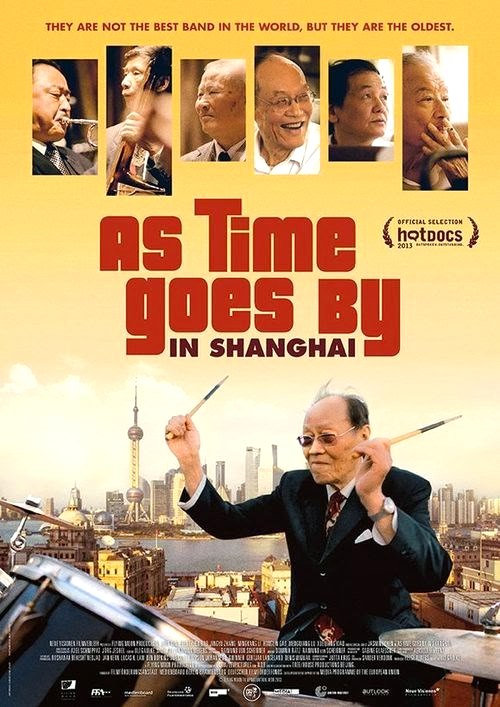
LFM Reviews As Time Goes By in Shanghai @ The Margaret Mead Film Festival

By Joe Bendel. Jazz musicians are forward-looking by temperament, constantly anticipating the next gig or recording. For a group of elderly Chinese swing musicians who endured the Cultural Revolution, living in the here-and-now rather than the past is not merely an aesthetic choice, it is a survival strategy. The Peace Old Jazz Band is Guinness-certified as the oldest continually performing band and they will finally have their spotlight moment in Uli Gaulke’s As Time Goes By in Shanghai, which screens during the 2013 Margaret Mead Film Festival at the American Museum of Natural History.

When five out of six band members are nicknamed “Old” (as in “Old Sun” or “Old Li”), it is pretty clear what you’ve got here. For the last twenty years, they have hit nightly at Shanghai’s Peace Hotel, following in the grand tradition of the big bands of the Swing Era. Accustomed to playing for dancers, most of the band is not inclined to start experimenting now. They might sound like “moldy figs,” but they have a right to stick to their thing. After all, the Cultural Revolution was a living nightmare for any musician performing decadent jazz and Western classical music.

When booked to play the North Sea Jazz Festival in Rotterdam, the Peace Old recruits a younger vocalist to perform standards as well as a few jazz renditions of traditional Chinese songs. Naturally, they shamelessly flirt with Yin “Yasmin” Chen—we would worry about them if they didn’t. Clearly, this gig will be a career zenith for the band, but they seem to take it in stride.

At first, As Time Goes By seems to be another documentary chronicling the late life triumphs of a group of plucky oldsters. However, it progressively deepens over time. The Peace Old musicians are understandably reluctant to talk about their experiences during the Cultural Revolution (after all, it never officially happened), but when Gaulke catches them alone, they start to open up and when they do it is heavy.

Frankly, the Peace Old’s technique is just kind of okay overall, but Holy Cats, do they play with feeling. While it is difficult for them to talk about their experiences verbally, it all comes out through their instruments. Gaulke mostly has the good sense to focus on the band and stay out of the way, but his transition shots capture a sense of the less affluent side of go-go Shanghai. The Peace Old can relate to both worlds, but do not quit fit into either.

As Time Goes By is deeply moving, both in musical and personal terms. It is rare to find a film that speaks so directly to both the gigging life and the residual collective emotional baggage of the Cultural Revolution, but it certainly does. Gulke’s doc should particularly resonate with working musicians in any major city. Wonderfully wise and bittersweet, As Time Goes By in Shanghai is very highly recommended.  A highlight of this year’s Margaret Mead Fest, it screens this Saturday (10/19) at the AMNH.

LFM GRADE: A

Posted on October 16th, 2013 at 10:25am.

LFM Reviews All is Lost

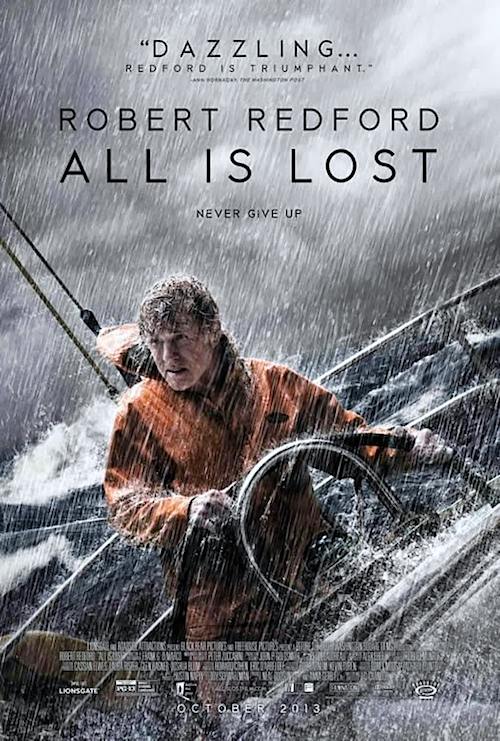
By Joe Bendel. There is an old man and the sea—sans marlin. There is no tiger, either. Instead, it is an errant workaday cargo container that leads to a mortal and existential crisis in J.C. Chandor’s All is Lost, which opens this Friday in New York.

“Our Man,” as he is simply billed, is in the midst of a solo cruise through the Indian Ocean when his small yacht is struck by said container. He wakes to find his boat taking on water and the electronics, including the radio, shorted out. He is able to patch up the gaping hole and bail out most of the water, but lasting damage has been done. Sailing blindly as a result, Our Man unknowingly proceeds towards a Sebastian Junger-level storm.

Considering it arrives so soon after Ang Lee’s Oscar winning Life of Pi, viewers might assume Lost is just more of the same. However, there is a muscular leanness to Chandor’s film that frankly compares favorably to its predecessor. All the New Age allegories and comforting sentimentality are stripped away, leaving a mere man to face the elements alone.

On one level, Chandor’s screenplay is relatively simple, with almost no dialogue to be heard from start to finish. Still, despite the limits of the water-bound location, Chandor dexterously introduces one darned thing after another to torment his sole character. Being the one and only face of a film is always a considerable challenge, but the shockingly haggard looking Robert Redford (showing his full seventy seven years) rises to the occasion. Rather than acting out and raging against fate, he vividly portrays the man’s slow deflation, which is far more compelling over time.

If not as visually arresting as Pi, Lost fully conveys the cold, damp, claustrophobic crumminess of Our Man’s precarious situation. Technically, it is quite an accomplished film, with particularly credit due to the Tahoe, the Tenacious, and the Orion, the three vessels that sailed their last as stand-ins for Our Man’s ill-fated Virginia Jean.

If nothing else, Lost should convince viewers not to look in the middle of the Indian Ocean if they want to go find themselves. It is surprisingly gripping stuff, buoyed by a remarkably disciplined performance from its craggy star. Recommended for those who appreciate a realistic man versus the elements survival story, All is Lost opens this Friday (10/18) in New York at the Angelika Film Center.

LFM GRADE: B+

Posted on October 15th, 2013 at 12:17pm.

LFM Reviews This Ain’t No Mouse Music @ The Margaret Mead Film Festival

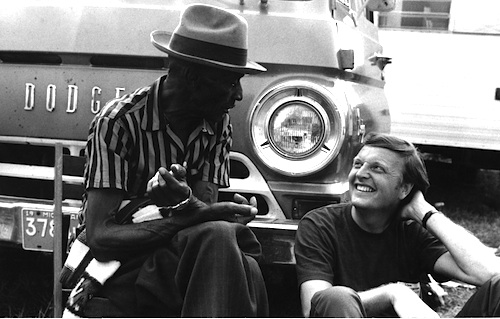
By Joe Bendel. Chris Strachwitz was born to an aristocratic family in Lower Silesia, but WWII drastically altered his destiny, turning him into the song-hunting heir of Alan Lomax. News that the advancing Soviet army was summarily executing “capitalists” convinced his family to emigrate west. Encountering New Orleans Jazz and Delta Blues as an American teen, he subsequently founded Arhoolie Records (named after a form of field holler Lomax recorded) to seek out and preserve the earthy sounds that spoke to him. Fifty years later, Strachwitz looks back on it all in Chris Simon & Maureen Gosling’s This Ain’t No Mouse Music, which screens during the 2013 Margaret Mead Film Festival at the American Museum of Natural History.

“Mouse Music” is a vague term Strachwitz uses for the sort of slick, mass produced music he can’t abide. His musician friends cannot really define it either, but they know you don’t want to be it. Like Lomax, Strachwitz did much of his recording in the field, tracking down many of the real deal Blues, Cajun, Creole, Cajunto, and Appalachian musicians that had slipped through the modern world’s cracks. The first time out, he hit major pay dirt, “discovering” Mance Lipscomb. Thanks to Arhoolie, artists like Big Joe Williams, post-“Hound Dog” Big Mama Thornton, Mississippi Fred McDowell, Michael Doucet, and Clifton Chenier would find a dedicated national audience.

From "This Ain’t No Mouse Music."

During his travels, Strachwitz met and collaborated with filmmaker Les Blank (to whom Mouse Music is dedicated) and became a family friend to scores of musicians. Evidently, Strachwitz largely picked up the Bay Area politics surrounding him, but Simon and Gosling mostly steer clear of potentially divisive subjects. However, they cannot resist including the story of how Strachwitz obtained publishing rights to Country Joe McDonald’s “I Feel Like I’m Fixin’ to Die Rag.” Evidently, the folk-rocker needed to lay down the future Woodstock ditty quickly and was referred to Strachwitz’ living room-studio by friends. In lieu of payment, Strachwitz accepted publishing rights, proving former Silesian aristocrats are better businessmen than hippies.

Simon and Gosling keep up with the only slightly manic Strachwitz quite well, conveying a good sense of the man and his label’s roster of artists.  While not everything Arhoolie releases will be to everyone’s tastes, the depth and breadth of it is quite impressive. Indeed, there is something very Whitman-esque about Strachwitz’s far-ranging pursuit of this roots music. The doc also provides a nice Blues fix, which is tough to get through mainstream media outlets. Recommended for fans of unvarnished musical Americana, This Ain’t No Mouse Music screens this Friday (10/18) as part of this year’s Margaret Mead Film Festival at the AMNH.

LFM GRADE: B

Posted on October 15th, 2013 at 12:14pm.

LFM Reviews The Prime Ministers: The Pioneers, Featuring the Voices of Sandra Bullock, Michael Douglas & Leonard Nimoy

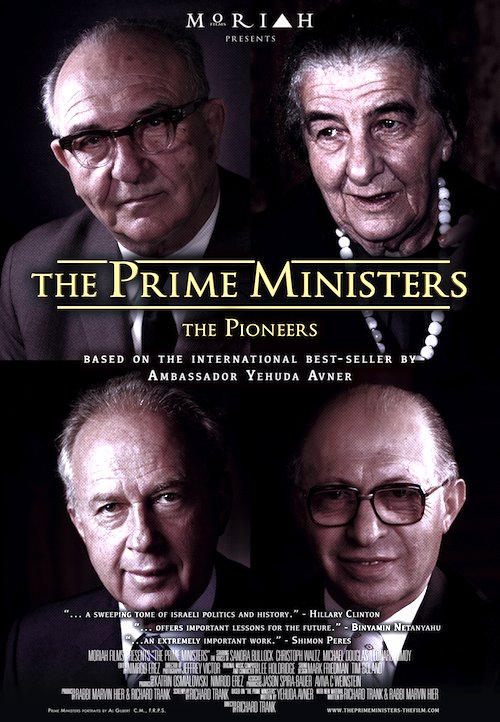
By Joe Bendel. It is not sufficient to merely declare yourself a would-be state. Any governing authority must establish the rule of law. This was never a problem for the State of Israel (its neighbors are a different story). It started at the top, with Prime Ministers who guided the fledgling nation through periods of profound crisis. Ambassador Yehuda Avner witnessed this tumultuous history first hand as a trusted aide to Prime Ministers Levi Eshkol, Golda Meir, Yitzhak Rabin, Menachem Begin, and Shimon Peres. Drawing upon Avner’s insider history, Richard Trank chronicles the Eshkol and Meir years in The Prime Ministers: The Pioneers, which opens this Friday in New York.

Given the wit and verve Avner shows during his interview segments, viewers might assume he was in grade school when he served as Eshkol’s speech writer and English correspondent. However, he was there, in the field, when the State of Israel was first declared. Becoming a young but trusted member of Eshkol’s inner circle, Avner was on-hand for the planning sessions during the Six Days War. Begin was also present, forcefully advocating that Israel take advantage of the crisis to liberate the Old City of Jerusalem. Although cautious, Eshkol recognized the historic opportunity presenting itself and acted decisively.

Where the Six Days War was an unqualified triumph for the Israeli military, the Yom Kippur War initially threatened the very existence of Israel. Yet, Golda Meir rallied the country. In desperate need of military aid, she turned to the Watergate-embroiled Richard Nixon, who authorized a massive emergency airlift. The Western European parties in the Socialist International were not so responsive, refusing to allow the American transports to refuel en-route to their embattled fellow member state. Fortunately, Israel survived, allowing Meir to publicly shame her socialist colleagues.

As the first of a two part documentary series (co-produced by Trank and Rabbi Marvin Heir), Pioneers focuses on Eshkol and Meir, but Begin and Rabin appear in brief but significant supporting roles. Considering Gravity’s continuing box-office dominance, a new Sandra Bullock movie ought to be major news, but her voice-over work as Meir is probably not likely to get the attention it deserves. Regardless, she well captures the Prime Minister’s humanity and resoluteness.

Likewise, it is great to at least hear Leonard Nimoy again, vividly bringing Eshkol’s words to life. Christoph Waltz, who narrated the writings of Theodor Herzl in Trank’s valuable It is No Dream, also nicely gives voice to Begin. Frankly, Pioneers is quite a big name production, with Michael Douglas rounding out the voice cast as Rabin and Emmy winning composer Lee Holdridge penning and conducting the score.

As a subsidiary of the Simon Wiesenthal Center, Moriah Films is a film production company parents and teachers can trust to portray history accurately. Like their previous productions, Pioneers is authoritative yet acutely aware of the human element underlying great geo-political events. One hopes Pioneers and Trank’s promised follow-up will eventually be widely available for high school and college viewing, because it provides the sort of comprehensive history of Israel students deserve, but are not getting from today’s media or academia. Yet, thanks to Trank’s brisk pacing and Avner’s engaging personality, Pioneers is never a dry or distancing viewing experience. Highly recommended for anyone fascinated by the great leaders of the Twentieth Century, The Prime Ministers: the Pioneers opens this Friday (10/18) in New York at the Quad Cinema.

LFM GRADE: B+

Posted on October 14th, 2013 at 2:14pm.

Girl Power in Myanmar: LFM Reviews Miss Nikki and the Tiger Girls @ The 2013 Margaret Mead Film Festival

By Joe Bendel. What chance does “Girl Power” have in a country where “people power” has yet to take hold? Myanmar’s first girl group will find out. As the military government slowly and ever so reluctantly releases its hold on the country, the music of Me N Ma Girls might perfectly underscore the changing times. The growing pains of the girl group and their nation are captured in Juliet Lamont’s Miss Nikki and the Tiger Girls, which screens during the 2013 Margaret Mead Film Festival at the American Museum of Natural History.

Australian expat Nicole “Nikki” May came to Burma with her oil-and-gas man significant other seeking adventure. The former dancer’s plan to form a group loosely modeled on the Spice Girls would take on wider cultural significance than she originally realized. It is hard to imagine the climate in which the group now known as Me N Ma Girls was assembled. Colored wigs were outlawed by the government and the only songs that could be legally performed were adapted western imports. Essentially, creativity was forbidden. The mere act of performance was considered closely akin to working in a go-go bar. Yet, somehow the five young women got the gist of May’s vision.

You might think a country without freedom of speech would not have to worry about scum-sucking agent-producers, but you would be wrong. His name is Peter Thein and after dropping the fab five for not being “pretty enough” (huh?) he threatened to sue the women if they continued to use the name “Tiger Girls.” They are so better off without him.

From "Miss Nikki and the Tiger Girls."

Lamont nicely establishes the personalities of each of the former Tiger Girls: Wai Hnin, Kimmy, Ah Moon, Htike Htike, and Cha Cha. They include devout Buddhists and Christians, as well as one representative of the northern Chin minority. One even happens to be the daughter of a retired senior officer. Arguably, they are a microcosm of Burmese society and they become more outspoken in their music following the release of Aung San Suu Kyi.

By documentary standards, MN & TG is practically a movie musical. Lamont often incorporates music video style interludes that are rather catchy and shrewdly convey the individual struggles of each woman featured. Indeed, the film starkly defines the very real stakes for the group. This is not Fame in Myanmar, with five plucky kids following their dreams. For most of Me N Ma Girls, it is about providing for families on the brink of ruin.

There is a lot of serious drama in MN & TG, but there is also some optimism and a lot of upbeat pop music. May certainly learns more than she bargained for, but her notion Burma could use the energy and idealism of a group like Me N Ma Girls has been vindicated by time. It is a fascinating story Lamont documents with unflinching honesty. To see what the band has since produced, check out the aptly titled “Girl Strong” on YouTube or iTunes. For a vivid sense of where they came from, seek out Lamont’s Miss Nikki and the Tiger Girls. Highly recommended, it screens Thursday (10/17) as part of this year’s Margaret Mead Film Festival at the AMNH.

LFM GRADE: B+

Posted on October 14th, 2013 at 2:11pm.