PBS Goes to Comic-Con: LFM Reviews Superheroes: A Never-Ending Battle; Premieres on Tues., 10/15

By Joe Bendel. For many kids, comic book collecting provided lessons in duty and sacrifice as well as their first practical experience with the laws of supply and demand. Ironically, just as the bottom fell out of the collectible market, the intellectual property value of Superhero franchises climbed to all time highs. This Tuesday, PBS chronicles the development of the costumed crime fighter in American culture with the three-part, one-night special broadcast of Superheroes: A Never-Ending Battle, co-written by Michael Kantor & Laurence Maslon.

There will always be a demand for Action Comics #1. In fitting superhero style, part one, Truth, Justice, and the American Way begins with the origin story: the first proper comic book appearance of Superman. Created by Jerry Siegel and Joe Shuster, the Man of Steel almost immediately captured the public imagination. Siegel and Shuster churned out adventures like assembly line employees, with all rights to their iconic creation retained by the company, DC Comics. Eventually, Siegel and Shuster will re-enter the narrative, like long lost characters resurrected to shake up the heroes’ universe.

Without question, part one is dominated by DC. This is the Golden Age of comics, when patriotic superheroes like Wonder Woman and Captain America brought the full force of their powers to bear against the National Socialist war menace. There was no question whose side they were on.

However, superheroes face an identity crisis in part two, Great Power, Great Responsibility. After pulling no punches against America’s enemies, do-gooder child psychologists started a hand-wringing campaign against comic book violence. The majors formed the self-regulating Comics Code Authority and watered down their content to conform to the new guidelines. Still, an upstart company was able to appeal to a new generation with a roster of characters who had to navigate real world problems as well as battle super villains. That would be Marvel.

Naturally, Stan the Man Lee is a prominent presence throughout Never-Ending. He was a game-changer. However, Steve Ditko is given rather short shrift for his contributions, including co-creating Spiderman and Doctor Strange. (It is an unfortunate omission many might suspect is motivated by the Objectivist influence reflected in Ditko’s later work). On the other hand, Great Power pays proper homage to the bold modernist style of Jim Steranko that re-invigorated the pages of Nick Fury, Agent of S.H.I.E.L.D.

Superheroes truly arrive when technology can finally do them justice on the big screen. Part three, Anyone Can Be a Hero, identifies Richard Donner’s Superman as the first and still perhaps the best-realized example. It also celebrates edgier storylines while dismissing the recent decline in comic book sales as an unavoidable consequence of the E-Book age. Yet, the comic industry’s rather Hollywood like agnostic response to post-September 11 terrorism, which part three covers in extensive detail, could just as easily be depressing single copy sales. Would Captain America have been as popular in the 1940’s if he never fought the Axis?

It is not an idle question. As one commentator argues, it is the regularity of comics that prevents these characters from becoming ossified artifacts, like The Shadow or Mandrake the Magician. Ironically, the movie business seems to get the appeal of these characters today better than many of their daily custodians.

Breezily directed by Kantor, Never-Ending is like a greatest hit package, delivering plenty of television and film clips for fans. It features a first class battery of expert talking heads, including many of the medium’s most influential artists and writers, including Steranko, Joe Simon, Len Wein, Louise Simonson, Jim Lee, Denny O’Neil, Todd McFarlane, Jerry Robinson, and Chris Claremont. Liev Schreiber is also a perfect choice to narrate, as an experienced voice-over performer and an alumnus of the Wolverine series, but the video-backdrops he periodically strolls through looks like the old In Search of show’s set updated for the Comic-Con crowd.

Obviously, Superheroes: A Never-Ending Battle is an attempt to broaden PBS’s audience. It hits all the necessary bases, but its biases periodically peak through. It is cool to hear from so many comic luminaries on national television, but there is still room for a definitive Ken Burns-style history of the American superhero. Recommended for casual fans looking for something easy to digest (and diehards eager to pick it apart), all three installments of Superheroes air this Tuesday (10/15) on most PBS stations nationwide.

LFM GRADE: C+

Posted on October 14th, 2013 at 2:06pm.

LFM Reviews Camille Claudel 1915

By Joe Bendel. Camille Claudel is a woman of extraordinary associations. She was the sister of playwright Paul Claudel, the mistress of Auguste Rodin, and was once erroneously thought to be the lover of Claude Debussy. In the cinema, she has been played by Isabelle Adjani and now Juliette Binoche, but in reality, she led a deeply troubled life. Bruno Dumont picks up with Claudel two years after her family institutionalized the sculptor, dramatizing three anesthetizing days leading up to her brother’s visit in Camille Claudel 1915, which opens this Wednesday at Film Forum.

Her brother blames the artistic temperament and perhaps he is right. Regardless, his sister clearly suffers from paranoia and a persecution complex. Unfortunately, her commitment rather vindicates the latter. Since she is convinced her food is constantly poisoned by her multitude of enemies, Claudel has special dispensation to cook her own meals. Given her mostly calm demeanor, the sisters give her relatively free reign at Ville Evrard and even recruit her reluctant help with more quarrelsome patients. Nevertheless, if you ask her about her situation you will get an earful.

1915 is easily Dumont’s most accessible film in years, but it still bears the hallmarks of his aesthetic severity. If you hum a few bars of anything during the film, you will become the soundtrack. Color is also rather scarce. However, there are plenty of static shots framing Claudel as her spirit slowly ebbs away.

Having previously invited sympathy for the Devil with Hors Satan and suggested all devout Christians are a wink and a nod away from becoming Islamist suicide bombers in Hadewijch, Dumont will not surprise anyone with his unforgiving view of Paul Claudel, the devout Catholic dramatist. He sharply contrasts the ascetic austerity of the writer with the more sensual feeling of the sister. Yet, given his affinity for extremity, the rigidly disciplined Claudel ought to be more in his wheel house.

Jean-Luc Vincent duly plays Frere Paul as the cold, clammy caricature Dumont requires. It hardly matters. He is a distant second fiddle to Binoche’s title character—a role perfectly suited to her strengths. Nobody could better convey the roiling passions submerged beneath her glacial exterior or convincingly erupt in pained outrage when provoked. She is a force to be reckoned with, nearly undermining Dumont’s feminist-victimization narrative. Somehow thanks to Dumont’s powers of persuasion, 1915 was filmed with real nursing home patients playing Claudel’s fellow residents and their nurses playing the nuns, adding further dimensions of authenticity and exploitation into the mix.

Ironically, it is the work of Paul Claudel that is most ripe for re-discovery (as the Black Friars Repertory demonstrated in New York with their Claudel revival project), whereas reproductions of the sculptor’s La Valse are widely available. Regardless, Binoche delivers a remarkable performance in an otherwise flawed film. Best reserved for her loyal admirers and hardcore French art cinema enthusiasts, Camille Claudel 1915 opens this Wednesday (10/16) at Film Forum for all of New York.

LFM GRADE: C+

Posted on October 14th, 2013 at 2:01pm.

Growing Up the Hard Way in Busan: LFM Reviews Tough as Iron

By Joe Bendel. In a port city like Busan, there are two kinds of jobs for a disadvantaged lunkhead like Gang “Iron Head” Chul. He currently works as a longshoreman, but the local syndicate will make him an offer he should refuse. Unfortunately, it might be the only way he can pay for his mother’s surgery in Ahn Kwon-tae’s bare-knuckled coming of age drama Tough as Iron, which opens tomorrow in New York.

Even when he was alive, Gang’s dad was not much of a father. As a result, he formed a close emotional bond with his mother that persists even though her mind is slipping into the early stages of dementia. Gang often finds himself thrust into some form of public spectacle through her misadventures. During one such display, he catches the eye of Suji, a bohemian photographer traveling across the country. She enjoys the sort of freedom he can only dream of.

Also through happenstance, Gang manages to save the life of Sang-gon, the local mob boss. This hardly endears him to the gangster’s erratic brother and self-styled bodyguard, Hwee-gon. A childhood chum working as a foot soldier in the mob tries to discourage Gang’s involvement, but the loyal son has exhausted every other option to fund his mother’s operation. As tensions mount between Korean criminal subsidiary and their Japanese Yakuza patrons, a disposable outsider like Gang could be very useful to gangster brothers.

From "Tough as Iron."

Ahn almost seamlessly combines the young-man-finding-himself story with a street-smart gangster beatdown, staying true to both genres, while giving each equal weight. The Busan seafront also nicely fits both hemispheres of the film, serving as a picturesque backdrop for Gang’s tentative courtship of Suji, but looking appropriately gritty for the waterfront action. Occasionally, the mother-son relationship flirts with outright melodrama, but it always remains firmly tethered to reality.

As Gang, Yoo Ah-in powers the film like a locomotive. Intense and charismatic, yet convincingly meat-headed, he creates a keenly human, fully realized portrait of a young, imperfect man under tremendous stress. Hong Sang-soo regular Jung Joo-mi is also appealingly independent and down-to-earth as Suji. While not exactly subtle, Kim Sung-oh delivers some marvelously twitchy villainy as Hwee-gon, the stuttering thug. Kim Hae-sook (so awesome opposite Simon Yam in The Thieves) is a bit showy as Mother Gang, but she still nicely turns the quiet moments with Yoo.

It is a strange observation to make of a Korean film, but the Yakuza characters certainly compare quite favorably to their Busan counterparts (but describing Iron as pro-Yakuza would still be a stretch). Regardless, Gang’s character and Yoo’s performance give Iron real heart and grit. Highly recommended, Tough as Iron should equally appeal to cineastes and genre enthusiasts when it opens tomorrow (10/11) in New York at the AMC Empire and in LA at the CGV Cinemas.

LFM GRADE: B+

Posted on October 10th, 2013 at 3:53pm.

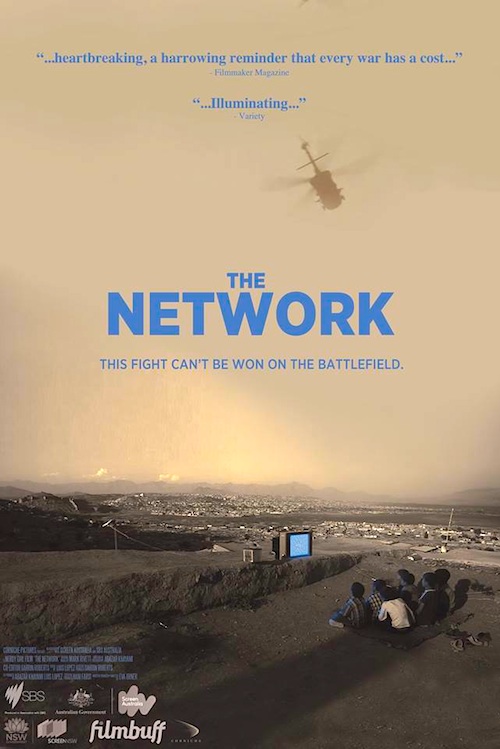
Afghanistan Live and Direct: LFM Reviews The Network; Now Available on VOD

By Joe Bendel. TOLO TV is like the Al Jazeera of Afghanistan, except it is critical of terrorism. Founded by Saad Mohseni, his brothers Zaid and Jahid, and their sister Wajma to be an agent of change, TOLO TV is the first and largest media outlet in Afghanistan. For three months, filmmaker Eve Orner documented the Mohsenis and many of their 900 employees at work and on their guard in The Network, which releases on VOD platforms today.

If TOLO TV sounds familiar, you might remember Havana Marking’s Afghan Star, the behind-the-scenes look at the pop idol reality show produced by that station. Marking followed the travails of a particular contest who faced death threats for modestly swaying to her music. Several years later, contestants regularly show off a few non-twerking moves and often appear sans head trappings. This constitutes progress and it was made possible by TOLO.

Growing up in exile as a result of the Soviet invasion, the Mohsenis, especially London-born Saad, are clearly entrepreneurs on a mission. Arriving in Kabul with waves of returning expats, they shared the general euphoria following the fall of the Taliban. Perceiving a need and an opportunity, they started the radio station that would eventually blossom into the TOLO mini-empire. It was a risky venture, because there was absolutely no media whatsoever in the country at the time. None. Zero. The Islamist Taliban had forbidden such a sacrilege. As one TOLO reporter dramatically recalls, the only sanctioned form of entertainment during the regime were public executions. Yet despite the years of doing without, the Afghan people immediately took to TOLO’s offerings.

On one hand, The Network is a success story, charting TOLO’s growth as a business and a cultural phenomenon. However, an uneasy pessimism hangs over the film. The Mohsenis and their employees openly fear the consequences when the western military powers cut-and-run. After all, TOLO personnel have definitely become targets of the Taliban and their allies. Orner documents many of the tight spots they just barely survived. Ironically, some of the most tragic episodes were instances when TOLO staffers were literally caught in the crossfire.

Arguably, Saad Mohseni is a media visionary. Yet, TOLO often walks a fine line to avoid angering the Islamist element. Their answer to Dr. Phil is particularly problematic, but one could make a case that the open criticism expressed by TOLO’s female employees of his “just be virtuous” advice is a promising sign. Granted, their melodramas look rather cheesy, but not as amateurish as the grade-Z Pashto films gonzo documentarian George Gittoes produced. TOLO also challenges many pre-conceptions viewers might hold, especially with regards to the success they have had with their anti-terrorist cop show, partly underwritten by the U.S. embassy.

Indeed, there is little anti-American sentiment in The Network, per se, and there is absolutely no nostalgia for the Communist regime. This is fascinating stuff, with far reaching social, economic, and geopolitical implications. Orner captures plenty of telling moments and conveys a good sense of the increasingly uncertain vibe in-country. It is a smart doc that is all muscle and no fat. Highly recommended for Middle East watchers and strategic thinkers, The Network is now available for VOD viewing.

LFM GRADE: B+

Posted on October 8th, 2013 at 11:05am.

LFM’s Govindini Murty at The Huffington Post: How Women Can Save the World by Telling Epic Stories in the Movies

[Editor’s Note: the post below appeared yesterday at The Huffington Post.]

By Govindini Murty. A Wonder Woman fan film that blazed across the Internet this week has women everywhere cheering the possibility of a female superhero movie. It also raised the intriguing question: what might our culture be like if we had more grand, epic movies about the lives of women? And what if women filmmakers were writing and directing them?

As women filmmakers, we’ve been told to accept small stories, low budgets, and modest expectations. But what if we have much larger visions? What if we want to make blockbuster movies with heroines who are full of valor, keen intelligence, and a desire to change the world?

And what if women’s epic movies could change the world – by providing the uniting narratives that can overcome the division and fragmentation of our civilization today?

This past week I had the pleasure of speaking on this subject at Social Media Week LA’s “Power Women in Entertainment” panel. (You can see the full video from the event above.) We had a bright and enthusiastic audience, and as often at such events, the recurring question came up: how do we correct the ongoing imbalance in women’s representation in media and entertainment?

We all know the dismaying numbers: only 5% of the top 100 studio films are directed by women, 4.2% of Fortune 500 companies are run by women, 3% of all tech companies are started by women (and yet they are 35% more profitable than those started by men), 27% of top media management jobs are held by women, and only 27% of on-screen movie roles are played by women (a number not changed substantially since the 1920s!).

I suggested to the audience that the best way we as women could overcome these inequities was by focusing on the excellence of our work – and by taking on big stories and using digital technology to deliver big results.

2013-10-03-JLawrenceHungerGames.jpg
From "The Hunger Games."

My co-panelists Rachael McLean of JuntoBox Films (an innovative film company co-founded by Forest Whitaker), Sarah Penna of Big Frame, and Jesse Draper of Valley Girl outlined how they were working toward these goals. We agreed that we needed many more women entrepreneurs and entertainment creators to make these efforts stick.

In the film world, this means insisting that women be given the opportunity to write, direct, and act in the major movie properties that have the potential to achieve the greatest box office success.

The excuse that Hollywood executives give that women-led movies don’t make good business sense is pure nonsense. Research studies show that the chief determinant in the box office success of a movie is not the gender of the director or lead actor – but the size of the budget and the breadth of the film’s release.

Therefore, when a woman is given a significant budget and a tent-pole property to direct, she has as great a chance of success as a man given a similar-level project. Examples of such profitable female-directed tent-pole movies include Catherine Hardwicke’s Twilight ($392 million worldwide box office, launched a $3.34 billion franchise); Jennifer Yuh Nelson’s Kung Fu Panda 2 ($665 million worldwide); and Phyllida Lloyd’s’s Mamma Mia! ($609 million worldwide on a budget of $52 million).

Recent female-starring successes include Alice in Wonderland ($1.02 billion worldwide) and The Hunger Games ($691 million worldwide on a budget of $78 million). Women are also the leads in five of the ten highest-grossing domestic films of all time, adjusted for inflation: Gone With the Wind (the highest-grossing film of all time, with $1.64 billion in domestic box office), The Sound of Music ($1.16 billion domestic), Titanic ($1.1 billion domestic), Snow White and the Seven Dwarfs ($889 million domestic), and The Exorcist ($902 million domestic). One could also argue that women play a major role in the success of other top-ten grossing films like Dr. Zhivago and The Ten Commandments, with their significant and strong female roles.

2013-10-03-MarieCurie3.jpg
Scientist Marie Curie.

But how do we empower more women to direct, write, or star in such blockbuster movies? Further, how do we enable more women to found the next big media company, or come up with the next great tech innovation?

My belief is that women can help themselves achieve these goals by adopting broad and ambitious visions. Further, these visions must be founded on a firm foundation of deep, humanistic knowledge, a willingness to step out from the pack and lead, and creativity in crafting epic, inspiring narratives. Continue reading LFM’s Govindini Murty at The Huffington Post: How Women Can Save the World by Telling Epic Stories in the Movies

LFM Reviews AKA Doc Pomus

By Joe Bendel. Doc Pomus was one of the first legit white blues singers and he had some legitimate blues. However, he would make his lasting mark on the music business as a songwriter. The man who brought soul to the Brill Building is affectionately profiled in Peter Miller & Will Hechter’s A.K.A. Doc Pomus, which opens this Friday in New York.

The man born Jerome Solon Felder might not sound like much of a blues or R&B vocalist, but soulful African American music just spoke to the young Jewish boy stricken with polio. After serendipitously discovering his talent, Felder redubbed himself “Doc Pomus,” embracing music as a calling he could still pursue. Unfortunately, he was not exactly the major labels’ idea of a front man, but he could write a tune.

You will know his songs, even if you don’t know his name. Without Pomus, the world would not have “Lonely Avenue,” “Viva Las Vegas,” “This Magic Moment,” “There Must Be a Better World,” or “Save the Last Dance For Me,” the Ben E. King hit that serves as the film’s touchstone song.

Conceived and co-produced by Pomus’s daughter, Sharyn Felder, AKA is an unusually revealing look inside the creative psyche. Incorporating Pomus’s uncomfortably candid journals (read by Lou Reed), Miller and Hechter create an unflinching portrait of an artist prone to severe bouts of depression. The Felder family participated in force, with Pomus’s daughter Sharyn, his Broadway actress ex-wife, and his brother Raoul Felder, the celebrity lawyer, all discussing their relationships with the larger than life songwriter. Plenty of his musical colleagues and admirers also duly pay their respects, including Ben E. King, Dion, and Jimmy Scott, whose career Pomus posthumously rejuvenated. Nearly forgotten by the industry, Scott was signed by Sire Records after his moving performance at Pomus’s memorial.

AKA is often a deeply personal film, but its musical analysis is still pretty on target, especially the defense of the soulfulness of Pomus’s “Sweets for My Sweet,” as performed by the Drifters (James Moody also recorded a wonderfully funky instrumental version with Gil Fuller’s big band). Well assembled and surprisingly frank, it is a good cut above most installments of American Masters. Recommended for fans of the blues and American pop music, A.K.A. Doc Pomus opens this Friday (10/4) in New York at the Village East.

LFM GRADE: B

Posted on October 3rd, 2013 at 5:11pm.