By Joe Bendel. He is like an Old West daguerrotypist capturing the faces of the vanishing frontier, except this barnstorming photographer travels through Tibet. Viewers will watch him work in Hu Wei’s Butter Lamp, which screens during Shorts Program 2 at the 51st New York Film Festival.
At first it looks rather surreal. A quick succession of Tibetan nomads assembles for family photos shot in front of the photographer’s wildly anachronistic fake backdrops, such as Disneyland and the Great Wall of China. Every time the shutter clicks Hu skips ahead to the next family. The older nomads still don traditional formal dress and wield their prayer wheels, but in each subsequent photo sessions, the younger, impatient generation more frequently wears blue jeans and western sportswear.
While the format is simple, Butter offers a shrewd commentary on globalization and the deliberate marginalization of Tibetan culture. While an elderly woman will prostrate herself before the image of Potala Palace, most of the photographer’s customers chose something reflecting a more consumerist lifestyle. Yet, some customs are still observed.
Straddling the boundaries between dramatic narratives, documentaries, and cinematic essays, Butter Lamp is visually inventive and decidedly zeitgeisty (particularly at a time when the Tibetan language is struggling for survival, per government policy). Patrons on a New York budget may not feel Hu’s fifteen minute film alone justifies the price of a ticket, but it is an accomplished production, well worth acknowledging. It screens this Sunday (10/6) and next Thursday (10/10) as part of the 2013 NYFF’s Shorts Program 2.
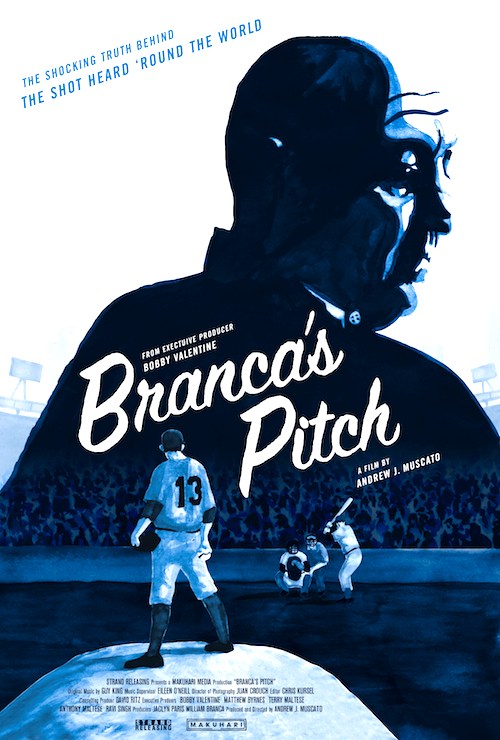
By Joe Bendel. In its heart of hearts, baseball is a neurotic sport. The best games, decided in the late innings, all come down to a simple question—who will choke, the pitcher or the batter? The statistics always favor the pitcher, but fans live in constant hope of that dramatic walk-off home run. We have been conditioned to it after seeing so many of them over the years. None is as indelible in sports fans’ collective memory as the ninth inning game-winner Bobby Thomson hit off Ralph Branca to secure the 1951 National League pennant for the New York Giants—the so-called “Shot Heard ‘Round the World.” However, Branca had not cracked. He made his pitch: high and inside, a terrible home run ball. Thomson just knocked it out anyway.
There is more to this story than fans realized, but Branca had to live with the results just the same. Viewers will learn the truth behind baseball’s most iconic game and how it changed the three-time All-Star’s life in Andrew J. Muscato’s documentary profile, Branca’s Pitch, now available on DVD from Strand Releasing.
For years, every time Thomson’s home run was replayed on television, Branca grinned and bore it, like a good soldier. A family man with a prosperous life insurance business, Branca’s post-baseball career was considerably more successful than most of his contemporaries, but that one moment in 1951 dogged him nonetheless. Finally, Branca decided to tell his story, enlisting the help of prolific ghostwriter David Ritz.
You might very well have some of Ritz’s work on your shelf. Originally inspired by Billie Holiday’s Lady Sings the Blues, Ritz has somewhat specialized in co-writing the memoirs of jazz, blues, and R&B artists like Jimmy Scott, Ray Charles, Buddy Guy, Nathalie Cole, and B.B. King. Ritz also happens to be a Brooklyn guy, so he and Branca get along famously.
In addition to a sports doc, Pitch also explores the largely overlooked relationship between a famous memoirist and their ghostwriter (or credited co-writer in Ritz’s case). Cynically, we often assume this is a rather cold-bloodedly commercial relationship, but a genuine friendship blossoms between Branca and Ritz. At one point, Ritz describes Branca’s voice as quite intelligent and well educated, but still a little bit “street,” which seems to fit the co-writer’s sensibilities like a mitt.
Ritz and Muscato both convey a sense that Branca can go days or even months without thinking of the fateful pitch, but as the macro years pass, he still bitterly resents being defined by that one pitch, especially since facts have since come to light suggesting that the Giants late season surge just wasn’t cricket. (Well reported in numerous sources, readers can reference Joshua Prager’s The Echoing Green for specific details, or wait for Pitch to reveal all in due course.) He is both at peace with the past and deeply outraged—a contradiction Ritz argues he is wholly entitled to.
Executive produced by oh-so former Mets manager Bobby Valentine, Pitch nicely captures baseball’s influence on American culture and the cathartic relief Branca experiences when his side of the story finally enters the public discourse. It is a sports doc, but also a publishing story. Recommended for baseball fans and New Yorkers of all stripes, Branca’s Pitch is now available for home viewing from Strand Releasing.
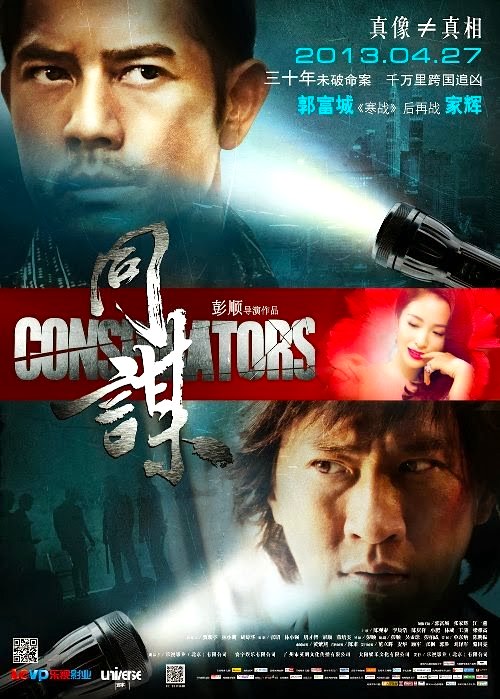
By Joe Bendel. They say lawyers who represent themselves have fools for clients. Evidently, the same holds true for private detectives. This is especially true of Chan Tam, the so-called “C+ Detective,” who has never inspired much confidence with his sleuthing skills. He will enlist a local gumshoe in Malaysia for a highly personal case in Oxide Pang’s The Conspirators (a.k.a. The Detective 3), which screens during the San Francisco Film Society’s annual Hong Kong Cinema film series.
As the dubious hero of Pang’s Detective franchise, Tam has considerable history as a character, but the only backstory viewers need to know Pang establishes in about five seconds. The C+ Detective’s parents were murdered by the drug cartel they may have once worked for in some capacity, so Tam has come for revenge. Since Thailand is his base of operations, he has retained the services of Zheng Fong-hei, a skilled but asthmatic martial artist, who is considerably better at his job than Zheng.
As soon as Zheng starts helping Tam track down persons of interest, dead bodies start popping up. It is dangerous to be an old friend of the family like the mysterious Chai. Before long, both detectives are marked for murder. However, the soon-to-be late Chai’s daughter might know where to find the MacGuffin Tam lost before he even knew he had it.
Pang is not Johnnie To, but he can still stage an effective action scene, capitalizing on one-time Royal Hong Kong police officer Nick Cheung’s chops. In fact, Conspirators has a murky, morally ambiguous atmosphere that is quite evocative of 1970’s genre films. It is also rather entertaining to see watch Cheung’s Zheng and Kwok’s Tam engage in a battle of hardnosed seething. Cheung takes the honors, but Kwok hangs with him, revisiting what has become his signature character of the last decade or so. Shaw Brother alumnus Chen Kuan Tai and Bullet Vanishesstandout Jiang Yiyan also add further noir heft to the supporting ensemble.
The crime story mechanics of Pang’s screenplay, co-written with his brother Thomas and Ng Mang-cheung, are all rather workaday, but the execution on screen is quite strong. Old pros Cheung and Kwok deliver the goods as the action co-leads, while Pang drenches everything with pseudo-John Woo visual style. The results are highly entertaining. Recommended for fans of dark revenge thrillers, The Conspirators screens this coming Sunday (10/6) as part of the SFFS’s eagerly awaited Hong Kong Cinema series.
By Joe Bendel. Tourists visiting Prague’s Rudolfinum concert hall will find themselves in Jan Palach Square. The newest public square in the Old Town quarter, it was known as Square of Red Army Soldiers during the grim era of Communism. An earnest university student, Palach sacrificed his life to re-awaken opposition to the Soviet occupation of 1968 (those very same Red Army Soldiers), eventually becoming a galvanizing symbol of the Velvet Revolution.
Polish filmmaker Agnieszka Holland was also studying in the then-Czechoslovakia when Palach self-immolated on Wenceslas Square. She shared the feelings of inspiration, frustration, and rage that swept across the country in the days that followed. The tenor of those oppressive times is masterfully captured in Holland’s Burning Bush, a highly cinematic three-night miniseries produced for HBO Europe, which screens during the 51stNew York Film Festival.
Watching a man ignite himself into flames is a disturbing sight, as Holland shows viewers in no uncertain terms. Unfortunately, Palach does not die immediately, but lingers on life support for three days. Having left multiple letters of protest, there was no question why Palach did what he did. As he hoped, the student movement is emboldened to call for a general strike. The government swings into full panic mode, fearing more will follow his example. The Party’s heavy-handed techniques do not sit well with Police Major Jireš, but his ostensive subordinate is more than willing to do the dirty work he assumes will advance his career.
As months pass, Palach’s fragile mother, Libuše Palachová, becomes the target of a ruthless harassment campaign. When a hardline member of parliament publicly slanders Palach at a regional CP conference, the Palach family decides to file suit, but finding a lawyer willing to accept their case is a difficult proposition. Eventually, Dagmar Burešová agrees to take the case, but it will cost her family dearly.
Although Palach appears relatively briefly in Burning Bush, his absence is felt keenly throughout. He is the missing man—the ghost at the banquet. However, his mother and her advocate are very much of the world as it was, and must carry on as best they can. Frankly, Burning Bush will be nothing less than revelatory for many viewers. Typically films dealing with the Prague Spring and subsequent Soviet invasion end in 1968, with a happier 1989 postscript frequently appended to the end. However, Holland and screenwriter Štĕpán Hulík train their focus on the nation’s absolutely darkest days.
A onetime protégé and close collaborator of Andrzej Wajda, Holland has vividly addressed the Communist experience with films like The Interrogationand To Kill a Priest, while also finding tremendous American success directing leading-edge HBO programs like The Wire and Treme. On paper, Holland sounds like the perfect director for this project, yet she manages to exceed expectations with a clear-cut career masterwork.
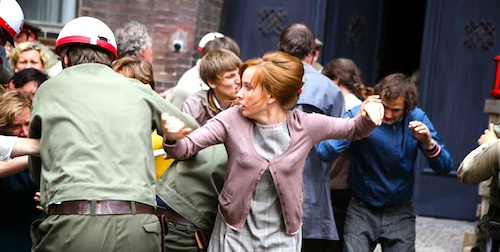
From "Burning Bush."
There is considerable scale to Burning Bush, but it is intimately engrossing. Viewers acutely share the fear and pain of the Palach family and marvel the Bureš family’s matter-of-fact defiance. Somehow Holland simultaneous builds the suspense, as Burešová methodically exposes the Party’s lies and deceits, as well as a mounting sense of high tragedy, as secret police rig the system against her.
Jaroslava Pokorná’s turn as Palach’s mother is not merely a performance, it is an indictment viewers will feel in their bones. It is a convincingly harrowing portrayal of a woman nearly broken by the Communist state. Likewise, Petr Stach conveys all the inner conflicts roiling inside Jiří Palach, the brother forced to hold himself together for the sake of his family (and arguably his country). Ivan Trojan’s increasingly disillusioned Major Jireš adds further depth and dimension to the film. Although it is the “glamour” role, Tatiana Pauhofová still scores some impressive moments as Burešová, particularly with Jan Budař as her husband Radim Bureš.
Chosen by the Czech Republic as its official foreign language submission to the Academy Awards, Burning Bush is either excellent cinema or outstanding television, depending on how chose to categorize it. Although its 234 minute running time might sound intimating, it is a blisteringly tight and tense viewing experience. An important but deeply moving work, itis the one true can’t miss selection of this year’s NYFF, especially since its length makes it such a challenge to program. At this point only stand-by tickets are available, but it is worth trying your luck when the exceptional Burning Bush screens this Friday (10/4) and the following Wednesday (10/9).
By Joe Bendel. In 2009, when the MV Maersk Alabama was hijacked by Somali pirates, it was carrying 5,000 tons of African relief supplies. No matter how desperate the poverty of its outlaw assailants might have been, waylaying the ship would not make the world a better place. This detail is acknowledged (but hardly belabored) in Paul Greengrass’s serviceable Captain Phillips, which opened the 51stNew York Film Festival over the weekend.
The facts of the Maersk Alabama case are well known and Greengrass sticks to them relatively faithfully. Although an experienced merchant officer, Captain Richard Phillips is a little uneasy about his Oman to Mombassa cargo haul, for good reasons. Their route will take them past the Somali coast, soon after the release of a heightened piracy advisory.
Of course, the ship is attacked by pirates—twice. The first time, Phillips’ well drilled crew foils their assault through evasive maneuvers and improvised trickery. Unfortunately, they cannot shake Abduwali Abdukhadir Muse and his three criminal accomplices the next day. However, the crew fights back admirably, preventing the pirates from assuming operational control of the vessel. Yet, in a frustrating twist of fate, Captain Phillips is taken hostage aboard the Maersk Alabama’s lifeboat.
As a tick-tock hijacking thriller, CP is not bad at all, but it suffers when compared to Tobias Lindholm’s recently released A Hijacking, which is the superior film in every respect. Frankly, Greengrass’s film can be divided into two halves, the first be considerably stronger than the second. CP is indeed quite riveting when following Phillips and his hidden crew as they sneak about and devise ways to communicate with each other.
Oddly though, the film slackens somewhat once the action moves to the lifeboat. The tension ought to increase in such a considerably more confined space, but Greengrass cranks up the deterministic angst to such an extent, it starts to undercut the suspense. Captain Phillips almost serves as a Greek chorus, warning Muse it will all end in tears.
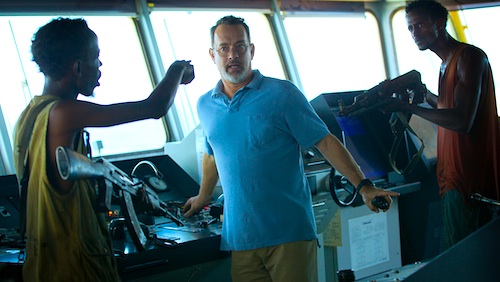
From "Captain Phillips."
Still, Muse’s already much quoted and scoffed at rejoinder “maybe in America” (as in maybe you western capitalists have other options besides piracy) poorly serves the rest of the film. It is not nearly as didactic as that soundbite suggests, making its inclusion in trailers an utterly baffling marketing decision. Greengrass bends over backwards to portray Muse and his cohorts as the pawns of shadowy masterminds, who have abandoned them to their fate. Somehow, though, he never spells out their possible connection to al-Qaeda linked al Shabaab and he certainly isn’t about to get into the whole Islam thing.
Despite an inconsistent New England accent, Tom Hanks finds the appropriate balance of world weariness and Yankee gravitas for the title character. He goes all out down the stretch in hopes of another little gold statue, with interesting if imperfect results. Barkhad Abdi also deftly walks his tightrope, expressing Muse’s erratically violent nature as well as his metaphorical (and literal) hunger pains.
Yet, the real stars of CP are the imposing Maersk Alabama (or rather the nearly identical Maersk Alexander, which serves as its stand-in) and the U.S. Navy. The ships (including the USS Truxtun, doubling for the USS Bainbridge) look awe-inspiring and the Navy SEALs are cool, calm, and deadly professional. Even though the Navy employs forms of deception, not once will reasonable viewers question the actions they take.
Greengrass shows a tremendous facility for shooting in and around the hulking ships and making the complicated chain of events perfectly clear and easy to follow. As a technical feat, the movie is hugely impressive. Yet it lacks the insight and soul-draining intensity of its Danish counterpart. Reasonably taut and tight, Captain Phillips is still a good sight better than Green Zone would lead you to suspect. Recommended on balance, Captain Phillips opens wide October 11th, after kicking off this year’s NYFF.
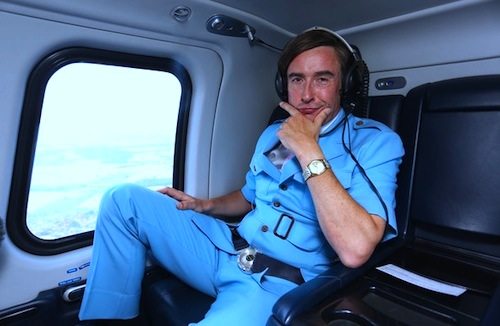
By Joe Bendel. Alan Partridge could be described as the Ted Baxter of North Norfolk, except he is more self-centered and less self-aware. The alter-ego of comedian Steve Coogan is wildly popular in the UK, but more of a cult thing here in America. Regardless, cinema obviously represented the next logical step for the name brand franchise established through radio, TV, books, and webisodes. North Norfolk’s smarmiest broadcaster finally gets the attention he craves with Declan Lowney’s Alan Partridge (a.k.a. Alan Partridge: Alpha Papa), which screens during the 51stNew York Film Festival.
As fans know all too well, Partridge currently hosts Mid-Morning Matters on North Norfolk Digital with Sidekick Simon. Initially, the shallow blowhard thinks little of it when a Clear Channel-like conglomerate acquires the station, rebranding it the “SHAPE.” However, when Partridge agrees to speak to the new management on behalf of his nervous colleague, Pat Farrell, he learns either he or his supposed friend will face the corporate axe. Of course, Partridge unsubtly stabs Farrell in the back.
The pink-slipped Farrell takes the news rather badly, returning to the station with a shotgun for a spot of hostage taking. Assuming the best of his two-faced pal, Farrell demands Partridge act as the go-the-between as a police stand-off ensues. Finding himself in the media spotlight, Partridge is determined to capitalize on this career opportunity, but as always, he fumbles and bumbles at every step.
From "Alan Partridge."
If you like Partridge, the Partridge film delivers plenty, but the laugh lines are pretty much exclusively reserved for Coogan’s “bête noire” (as he referred to his signature character during the film’s NYFF press conference). It is often very funny, but it very definitely stays within the Partridge Zone. After all, satisfying the existing fan-base is the most pressing objective for any TV franchise crossing over to the big screen, which should certainly be the case here. Fear not, Partridge never develops a conscience or any sense of decorum.
Co-written by Coogan and his frequent collaborator Armando Iannucci, with Neil Gibbons, Rob Gibbons, and Peter Baynham, the film raises the stakes from previous Partridge outings, what with the hostage crisis and all, while staying true to its roots. Naturally identified as conservative in past incarnations (because that is so conducive to success with the BBC), the big-screen Partridge wisely eschews politicized humor in favor of broad physical comedy and the comeuppance of public humiliation.
Coogan still clearly enjoys the Partridge shtick and Lowney maintains a snappy energy level throughout. Although Colm Meaney gets second billing as Farrell, he does not have much opportunity to exercise his considerable comedy chops (ironically showcased quite nicely in Terry George’s hostage comedy renamed The Stand-Off, post-Tribeca). It is Partridge’s show and don’t you forget it. Enjoyably shameless overall, Alan Partridge is recommended for series fans when it screens again next Monday (10/7) at Alice Tully Hall as a main slate selection of the 2013 NYFF.