LFM Reviews Le Week-End @ The New York Film Festival

By Joe Bendel. Thanks to the Chunnel and relaxed EU customs, it is relatively easy for a late middle-aged British couple to pop over to Paris for a romantic getaway—unfortunately. Just because you can doesn’t mean you should, but they make the trip nonetheless. The pent-up resentment will flow freely in Roger Michell’s Le Week-End, which screens during the 51st New York Film Festival.

Old lefty lit professor Nick Burrows’ only success in life was marrying his wife Meg, but she never lets him forget she was and still is well out of his league. The magic ran dry quite a while ago, but recent pressures have only made matters worse. For Nick, this sentimental trip will be a desperate attempt to renew their relationship, but his wife may have different ideas. Probably the last person he needs to run into would be Morgan, his vastly more successful former hipster protégé, yet that is exactly what happens.

Week-End is very definitely a writer’s film, completely driven by its often caustic dialogue. It seems like screenwriter Hanif Kureishi takes sadistic pleasure from old put-upon Nick’s discomfort, forcing him into one dignity-stripping conversation after another. This necessarily means Meg gets most of the film’s sharpest wince-inducing lines.

Frankly, you have to sympathize with poor Nick on some level. A mere ninety minutes of Meg’s withering banter is exhausting, so the prospect of a lifetime of marriage with her makes the head reel. Still, Kureishi maintains the consistency of their voices and scores a number of rueful laughs.
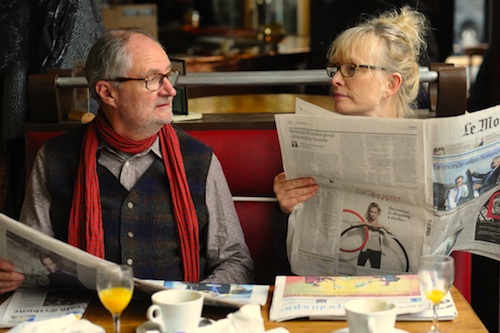
From "Le Weekend."

Perhaps the viewers’ best friend during Week-End is Jeremy Sams, whose elegant jazz-influenced score (featuring trumpeter Freddie Gavita) gives us something warm and agreeable to hold onto. Even though they are radically dissimilar films, the combination of muted trumpet and Parisian streets by night immediately calls to mind Louis Malle’s Elevator to the Gallows and its Miles David soundtrack.

As Meg Burrows, Lindsay Duncan wields Kureishi’s cutting lines like a scimitar. Yet Jim Broadbent’s hang-dog face draws Michell’s focus like a magnet. They spark like crazy together, but it is still hard to believe the extreme emotional disparity of their union. To lighten the mood, Michell turns Jeff Goldblum loose as Morgan, lifting all restraints on his schticky mannerisms with rather amusing results.

It is pleasant to soak up Weed-End’s Paris locations while listening to the moody but swinging score. In a way, it provides a tart rejoinder to films like Marigold Hotel and Quartet, reminding audiences seniors are not always cute. Well crafted but somewhat over-written, Le Week-End is recommended for fans of talky relationship films when it screens again next Monday (10/7) at the Walter Reade Theater, as a Main Slate selection of this year’s NYFF.

LFM GRADE: C+

Posted on September 30th, 2013 at 5:40pm.
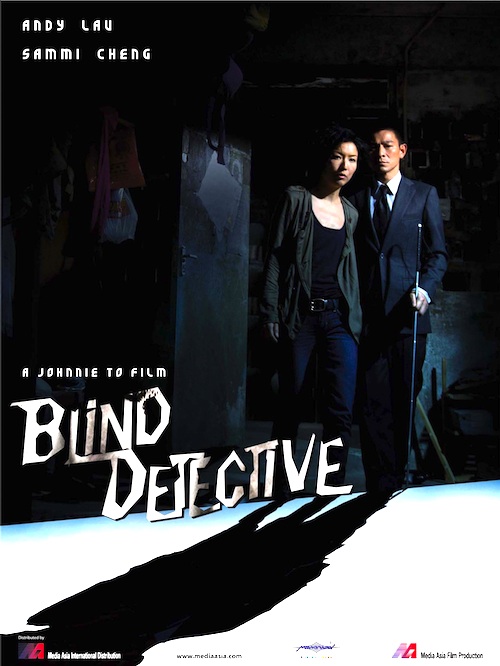
LFM Reviews Blind Detective @ The San Francisco Film Society’s Hong Kong Cinema Series

By Joe Bendel. He is sort of a consulting detective, whose bedside manner is about as warm and friendly as Holmes at his chilliest. Chong “Johnston” Si-teun has a sizeable ego and an even larger chip on his shoulder, but he is not without empathy—for the dead. Somehow, he still might find love with a far less deductive copper (his personal Lestrade) in Johnnie To’s genre blender, Blind Detective, which screens on the opening night of the 2013 edition of the San Francisco Film Society’s annual Hong Kong Cinema series.

Johnston’s sudden onset of blindness forced him to retire as police detective, but he still solves crimes for a living. He now relies on reward bounties, particularly those still valid for cold cases. Impressed by his results, Inspector Ho Ka-tung retains his services to find her long missing high school friend, Minnie. She has always been good with firearms and martial arts, but the cerebral side of detective work has always troubled her. Promising to teach her his methods, Johnston moves into her spacious pad, but immediately back-burners Minnie’s case in favor of several expiring bounties.

The half-annoyed Ho indulges Johnston for a while, eventually embracing his extreme re-enactment techniques. Blind arguably reaches its zenith when Johnston and Ho recreate a grisly murder conveniently set in a morgue, strapping on helmets and whacking each other over the head with hammers. If you ever wanted to see the Three Stooges remakes Silence of the Lambs, To delivers the next closest thing. Of course, their search for Minnie soon percolates back to the surface, when Johnston starts to suspect she fell victim to a serial killer preying on broken-hearted young women.

Much like the old cliché about the weather, if you don’t like the tone of Blind Detective, just wait five minutes, because it will change. You do not see many films incorporating elements of romantic comedy, slapstick farce, and dark serial killer thrillers, probably for good reason. To gives roughly equal weight to all three, yet it all hangs together better than one might expect.

Sammi Cheng is a major reason Blind works to the extent that it does. It is great to see her Inspector Ho act as the film’s primary action figure and her radiant presence lights up the screen. She develops decent chemistry with Andy Lau’s Johnston, but he looks profoundly uncomfortable in the intuitive curmudgeon’s skin. However, To fans will be relieved to hear Lam Suet duly turns up as a fugitive gambler hiding out in Macao.

To also delivers plenty of bang for the audience’s bucks in the third act. There are some distinctly creepy bits and a fair amount of suspense. On the other hand, a drawn out subplot involving Johnston’s long held crush on a dance instructor chews up plenty of time but serves little purpose except to telegraph the feelings beginning to stir between the odd couple detectives.

Thanks to two well executed showdowns, Cheng’s winning performance, and some evocative Hong Kong locales, Blind Detective chugs along steadily enough for a while and picks up mucho momentum down the stretch. Recommended for To fans and those with a taste for comedic mysteries, Blind Detective screens this Friday night (10/4) at the Vogue Theatre as part of the SFFS’s 2013 Hong Kong Cinema series. Action aficionados should also check out Chow Yun-fat’s massive return to form in Wong Jing’s The Last Tycoon screening Saturday (10/5) and Sunday (10/6) at the same venue.

LFM GRADE: B-

Posted on September 30th, 2013 at 5:37pm.

LFM Reviews The Missing Picture @ The New York Film Festival

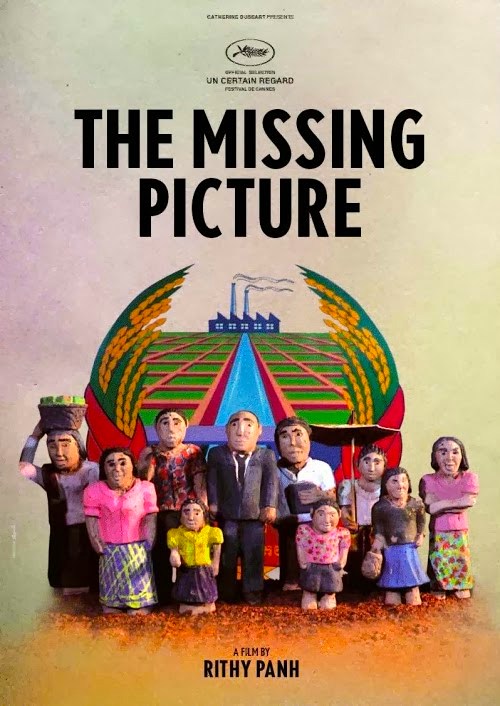
By Joe Bendel. According to estimates, the Maoist Khmer Rouge regime executed ninety percent Cambodia’s creative artists and performers. During their reign of terror, the nation’s once thriving film industry was also literally decimated. Decades later, a filmmaker and a sculptor combined their talents to chronicle Cambodia’s years of madness with unusual power and grace. Rithy Panh is arguably the foremost documentarian chronicling the crimes of the Khmer Rouge, but to tell his family’s story he enlisted the skills of French Cambodian artist Sarith Mang. Where once there were no surviving images, Mang’s carved figures bring the tragic past back to life in Panh’s The Missing Picture, which screens during the 51st New York Film Festival.

While the Khmer Rouge churned out plenty of propaganda, they were more circumspect in documenting their own crimes. That left plenty of holes for Panh to fill in, as his title suggests. With the help of Mang’s coarse yet eerily expressive clay figurines, Panh recreates the torturous conditions he somehow lived through, but which claimed the lives of his parents, nephews, and little sister, one by one.

Panh’s decision to use Mang’s figures and richly detailed diorama backdrops might sound bizarrely hyper-stylized, but it is shockingly effective. Frankly, the scenes depicting the horrifying death of Panh’s sister are nothing less than devastating. It is an unlikely approach, but it directly conveys the emotional essence of the circumstances.

To better understand the extent of what was lost, Panh periodically looks back at happier, pre-Khmer Rouge days, as well. Again, he compellingly evokes of tactile sense of those innocent times. Viewers can practically smell the spices at the neighborhood parties as they listen to a hip local rendition of Wilson Pickett’s “Midnight Hour.”

Rarely has a documentary ever been so exquisitely crafted. Each and every one of Mang’s figures is a work of art, perfectly lit and lensed by cinematographer Prum Mésa to bring out their full eloquence. Composer Marc Marder supports the visuals with what might be the most mournful film score since Schindler’s List. It is a film that resounds with raw pain and defiant honesty (aside from a dubious bit of moral equivalence regarding western capitalism, probably tossed out to mollify festival programmers).

Not a film to be shrugged off, The Missing Picture holds viewers completely rapt and haunts them for days after viewing. Recommended for a considerably wider audience than traditional doc watchers, it screens this coming Monday (9/30) at the Beale Theater and Tuesday the eighth at the Gilman as an official selection of the 2013 NYFF.

LFM GRADE: A-

Posted on September 27th, 2013 at 3:20pm.

LFM Reviews Fifi Howls from Happiness @ The New York Film Festival

By Joe Bendel. Given his darkly surreal imagery and his penchant for destroying his own work, there is definitely something Kafkaesque about the late Iranian expatriate artist Bahman Mohasses. For years he had removed himself from the world. Yet, he was ready, perhaps even eager to talk when Mitra Farahani tracked him down for her documentary profile, Fifi Howls from Happiness, which screens during the 51st New York Film Festival.

Mohassess is clearly out of step with the current Islamist regime in Iran. It seems his large scale nude statues were not compatible with the post-Revolutionary standards of “decency.” He also happened to be gay, but in a defiantly politically incorrect way (marriage was not exactly a priority for him). However, his first extended period of self-imposed exile began shortly after the Shah’s ascendency.

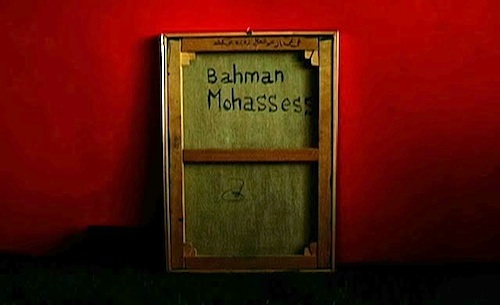
Eventually, Mohassess returned to his homeland, where the Shah’s wife became one of his leading patrons. A far cry from a fundamentalist, Mohassess still gave the Islamic Revolution a fair chance, but eventually tired of the gauche scene. Before he left, Mohassess destroyed a significant portion of his oeuvre, taking only a few pieces with him (most notably including the painting that supplies the title of Farahani’s film).

On one hand, Mohassess’s actions echo the existential self-negation of a Dostoyevsky character, yet at other times one suspects it is all a calculated attempt to create mystique. It almost seems like Mohassess has been waiting for someone like Farahani to take his bait. Regardless, she develops a considerable rapport with the artist, but never sounds nauseatingly fawning.

From "Fifi Howls from Happiness."

While not quite deleted from Iranian history books, Mohassess’s place in the nation’s collective consciousness is decidedly ambiguous, which makes Fifi a valuable cinematic record. Clearly, there are still Mohassess collectors, like Rokni and Ramin Haerizadeh, prominent Iranian artist-brothers working in Dubai. Through Farahani, they visit Mohassess to commission what may or may not be his last great artistic statement.

Since Fifi is almost entirely shot in Mohassess’s residential hotel, the film is visually somewhat static. Still, it is fascinating to see the stills of his work, accompanied by his artist commentary, especially considering most of said pieces no longer survive. Farahani cleverly incorporates her subject’s unsolicited directorial advice, ironically following it to the letter. Her extended allusions to Balzac’s The Unknown Masterpiece and Visconti’s The Leopard also add literary flair.

Indeed, Farahani earns great credit for working with and around Fifi’s inherent limitations. Mohassess is a difficult subject, who never sounds like he is really “for” anything or anyone, not even himself. Yet, Farahani does him justice, convincing the audience he is an odd character to visit, but one well worth saving from the memory hole. Recommended for connoisseurs of art documentaries and Mohassess’s work, Fifi Howls from Happiness screens tomorrow (9/28) and Tuesday (10/1) at the Gilman Theater as part of the Motion Portraits section of the 2013 NYFF.

LFM GRADE: B

Posted on September 27th, 2013 at 3:12pm.

LFM Reviews Afternoon of a Faun—Tanaquil le Clercq @ The New York Film Festival

By Joe Bendel. She changed the way George Balanchine thought about ballerinas. Essentially, that means she changed ballet. Tanaquil Le Clercq’s life took a unfortunate turn worthy of her tragic characters, but she would have a third act. Nancy Buirski surveys her entire life and art in Afternoon of a Faun: Tanaquil le Clercq, which screens during the 51st New York Film Festival.

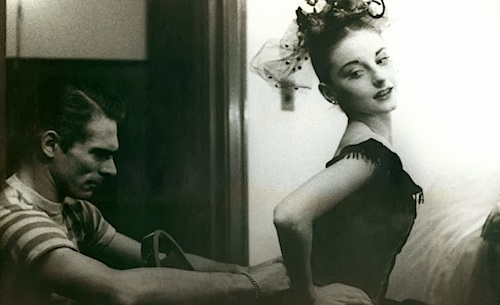
A cosmopolitan prodigy, Le Clercq was discovered by Balanchine while she was a difficult student at School of American Ballet. According to her friends, the legendary choreographer first encountering her sulking about the halls after her teacher ejected her from class. Her sophisticated looks certainly caught his eye. Although her height and long limbs were unusual for dancers at that time, Balanchine started tailoring his ballets to her strengths. Soon she was his featured dancer and wife. Then disaster struck.

Ironically, Le Clercq had danced in a special polio-themed March of Dimes fundraiser performance shortly before she was stricken with the disease herself. She would never dance or even walk again. However, she would eventually re-emerge as a teacher at Dance Theatre of Harlem. As for her relationship with Balanchine—it was complicated.

Frankly, it would have been easy for Buirski to cast Balanchine in a villainous light, but Faun is rather remarkable for its evenhanded and forgiving treatment of the dance titan. Taking its lead from Le Clercq’s closest friends, Faun gives him credit for supporting her when she most needed help and eventually re-starting some sort of intimate relationship with his former muse. It was indeed complicated, but maybe not so much for Jerome Robbins, her fair weather ambiguously romantic friend.

From "Afternoon of a Faun—Tanaquil le Clercq."

Buirski’s sympathetic depiction of Balanchine reflects the humane spirit of film as a whole. While it is eventually destined for American Masters, the elegant and often elegiac dance footage elevates its cinematic-ness. Buirski calls on a relatively small cast of talking heads, but they each clearly knew Le Clercq very well. Perhaps most moving are the remembrances of Jacques d’Amboise, Le Clercq’s partner for many of her defining performances.

Viewers will be surprised at the emotional punch Faun packs. Granted, Buirski follows the tried-and-true documentary filmmaking approach, but she marshals all her elements with considerable style and understanding. The participation of co-producer Ric Burns and project advisor Martin Scorsese should further reassure film snobs. A satisfying viewing experience, Afternoon of a Faun is recommended for dance connoisseurs and anyone with a taste for cultural documentaries. It screens this coming Monday (9/30) at the Walter Reade, as well as the 11th and 13th, as part of the Motion Portraits section of the 2013 NYFF.

LFM GRADE: B+

Posted on September 27th, 2013 at 3:09pm.

LFM Reviews The Wind Rises @ The New York Film Festival

By Joe Bendel. Jiro Horikoshi is a Studio Ghibli character Tony Stark would approve of. He was the engineer responsible for designing Imperial Japan’s Model Zero fighters, but he was a dreamer rather than an ideologue. At least, that is how Hayao Miyazaki re-imagined Horikoshi’s private persona in his fictionalized manga, which he has now adapted as his final film as a director. Spanning decades of Japan’s tumultuous pre-war history, Miyazaki’s The Wind Rises is also a deeply personal film that screens as a main slate selection of the 51st New York Film Festival.

As a young student, Horikoshi yearns to fly, but he realizes his spectacles make it nearly impossible for him to become a pilot. Borrowing an aviation magazine from an encouraging teacher opens up a new path for the earnest lad. Through its pages he learns of Italian aircraft designer Gianni Caproni, who becomes his inspiration. Setting his sights on an engineering career, Horikoshi regularly meets Caproni in his dreams and reveries, where they share their mutual passion for flight.

Circumstances of history will conspire to make Horikoshi’s life eventful. His first day as a university student is marked by the catastrophic earthquake of 1923, which will resonate profoundly with contemporary viewers. Yet, out of that tragedy, Hirokoshi meets and temporarily loses the great love of his life.

Despite his intelligence, Japan’s stagnant economy offers few opportunities for Horikoshi when he graduates. He joins Mitsubishi at a time when the company appears to be on its last legs. Gambling its future on military contracts, the company sends Horikoshi to Germany, hoping he can help them reverse-engineer whatever the Junkers will let him see. Of course, he will be able to raise their game substantially.

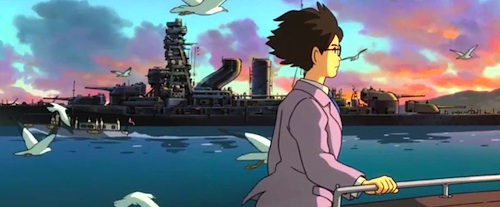
From "The Wind Rises."

In no way, shape, or manner does Miyazaki justify Japan’s militarist era, but he has still taken flak from both sides of the divide over Wind. Frankly, it presents a gentle but firm critique of the Imperial war machine. At one point, Horikoshi is even forced into hiding, designing the military’s fighter planes while he evades the government’s thought police. Indeed, such is a common experience for the best and the brightest living under oppressive regimes. Yet, Miyazaki is just as interested in Horikoshi’s grandly tragic romance with Naoko, a beautiful artist sadly suffering from tuberculosis. Horikoshi makes a number of choices throughout the film, every one of which the audience can well understand.

Given its elegiac vibe, Wind makes a fitting summation film for Miyazaki. Covering the immediate pre-war decades, it compliments and engages in a wistful dialogue with Gorō Miyazaki’s post-war coming of age tale From Up on Poppy Hill (co-written by the elder Miyazaki). One can also see and hear echoes of master filmmakers past, such as Ozu and Fellini, throughout the film. Any cinema scholar surveying Miyazaki’s work will have to deal with it at length, but it still happens to be a genuinely touching film.

After watching Wind, viewers will hope the real Horikoshi was a lot like Miyazaki’s (and the same goes for Caproni). Miyazaki seriously examines the dilemmas faced by his protagonist while telling a lyrical love story. Visually, the quality of Studio Ghibli’s animation remains undiminished, but the clean lines of Horikoshi’s planes and the blue open skies lend themselves to simpler images than some of his richly detailed classics. Regardless, The Wind Rises is an unusually accomplished film that transcends the animation genre. Highly recommended for all ages and interests, it screens this Saturday (9/28) and next Friday (10/4) at Alice Tully Hall (stand-by only), as part of the 2013 NYFF.

LFM GRADE: A

Posted on September 24th, 2013 at 1:42pm.