My Lucky Star: LFM Reviews Zhang Ziyi’s Sophie Returns

By Joe Bendel. It is hard for a comic book artist to navigate a Sex in the City world, especially a hopeless romantic like Sophie. At least her work provides her an outlet for her frustrations, but not a steady income. However, Sophie will finally meet her real life international man of mystery in My Lucky Star, Dennie Gordon’s stand-alone sequel to Sophie’s Revenge, which opens this Friday in New York.

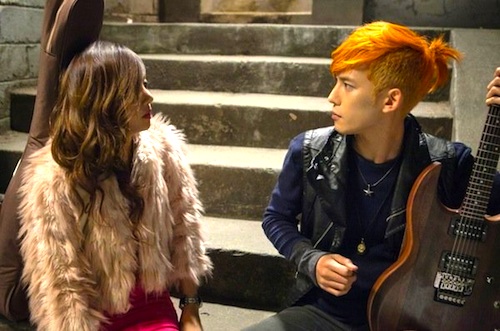
Sophie is a talented artist, but the world’s worst travel agent. Her day job boss tells her so, frequently. When she wins the “My Lucky Star” sweepstakes’ luxury vacation to Singapore, her man-eating friends convince her to take the plunge. As soon as she arrives, the clumsy knockout stumbles into the arms of David Yan, who happens to be the spitting image of her comic book super spy. He also happens to be in the same line of work—a fact Sophie is painfully oblivious to.

Before long, Sophie’s attempts to pursue Yan put her smack dab in the middle of a caper involving a massive stolen diamond. It happens to be perfect for refracting a WMD laser, which is why the notorious Black Widow arms dealer is out to acquire it. Yes, she is also hot and Yan happens to have some complicated history with her. The indomitable Sophie will have to knuckle down if she is going to win the man of her dreams and save the world (or at least Bermuda).
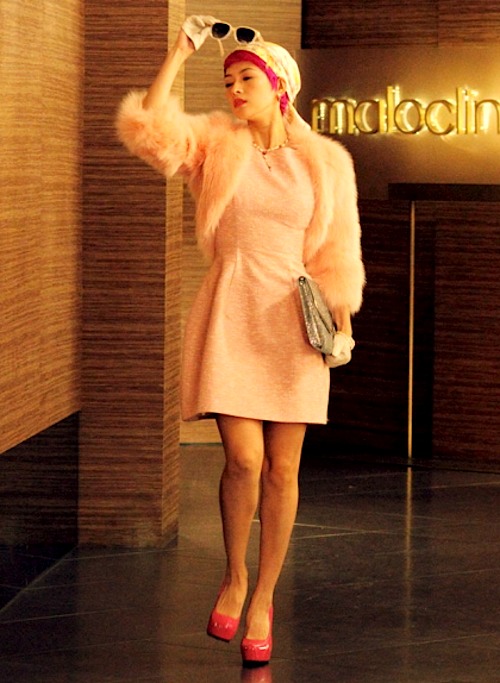
From "My Lucky Star."

The first domestic Chinese production helmed by an American woman (Gordon, best known for Joe Dirt and her DGA Award winning work on Tracey Takes On), Lucky incontrovertibly establishes Zhang Ziyi looks cute in a gondolier’s costume. You might have suspected as much, but here’s the proof. In fact, she has more wardrobe changes than Anne Hathaway hosting the Oscars. That is really what this film is all about: fab clothes, the picturesque opulence of Singapore and Macao, and a spot of vicarious romance.

Sophie’s Revenge was a monster hit in China, so producer Zhang’s title character is back to feed the appetite she helped create (but viewers need not be familiar with the first film to follow the second). However, for American audiences, it is rather ironic to see her playing a lovelorn klutz so soon after her exquisitely tragic, massively butt-kicking turn in Wong Kar Wai’s The Grandmaster. She is clearly versatile—and quite appealing in both very different films.

Wang Leehom, the American-born Taiwanese pop idol, is a game straight man, looking credible enough in his action sequences. Ruby Lin and Chen Yao also return from Revenge, adding attitude and sex appeal as Sophie’s BFFs. However, Terri Kwan sort of steals the show as the Black Widow.

Indeed, aside from an overbearing boss here and a henchman there, everyone in Lucky is outrageously good looking. This is definitely escapist fare. However, fans of Revenge will miss Sophie’s unapologetically macabre animated fantasies. Gordon doubles down on the slapstick humor instead, which, ironically, does not travel as well. Never particularly deep or memorable, My Lucky Star offers up plenty of sugary confections for the eye and a dash of plucky empowerment. If that suits your movie going purposes, it opens this Friday (9/20) in New York at the AMC Empire, courtesy of China Lion Entertainment.

LFM GRADE: C+

Posted on September 17th, 2013 at 11:50am.
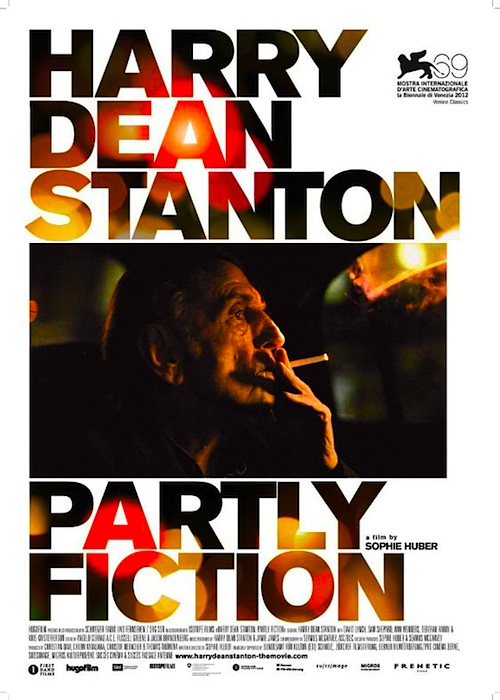
LFM Reviews Harry Dean Stanton: Partly Fiction

Harry Dean Stanton: Partly Fiction Official Trailer from Adopt Films on Vimeo.

By Joe Bendel. He has some of the coolest credits ever, including Alien, Escape from New York, Red Dawn, Repo Man, and Wild at Heart. However, appearing as himself is a role he is not so comfortable with. As a result, Sophie Huber’s documentary treatment, Harry Dean Stanton: Partly Fiction is a rather impressionistic portrait that opens this Wednesday in New York.

Stanton is not the sort of fellow to sit down in front of a camera and commence name-dropping, but Huber, his friend and colleague, knew that coming in. Foregoing the conventional approach, she scored at least one coup. Up until now, Stanton declined offers to record his traditional vocals and harmonica playing, but she was able to capture many of his intimate performances. Frankly, that alone should constitute a respectable cinematic legacy for Huber.

Indeed, Stanton’s voice is truly mesmerizing on old time favorites like “Blue Bayou,” “Blue Moon,” “Just a Closer Walk With Thee,” and the positively eerie closing rendition of “Danny Boy.” Stanton’s clear affinity for songs of loneliness and loss marries up perfectly with Huber’s portrait of a haunted backwoods Zen master.

Unfortunately, the scenes without music lack the same quiet power. At times, Huber merely tries of soak up the ambiance of Stanton’s life, which gets a bit snoozy. The lack of any standard biographical treatment also occasionally leads to frustration, as when Stanton off-handedly comments on the unforgettable wildness of his years living with Jack Nicholson and hanging with Marlon Brando. Right, we can only imagine.

Huber incorporates some commentary from Stanton’s famous friends, perhaps most notably David Lynch, whom we see visiting with his chum. She also includes some film clips, relying heavily on Wim Wenders’ Paris, Texas, openly inviting audiences to conflate Stanton with his pseudo breakout role.

There are few outright scoops in Fiction, aside from Stanton’s disclosure (now widely remarked upon) that he once dated Rebecca De Mornay, before she made Risky Business and got involved with Hollywood’s favorite Scientologist. Who knew? One gets a sense Stanton guards a treasure trove of such revelations, but Huber never tries to dig them out. Still, the film has a stylishly evocative look, thanks to cinematographer Seamus MacGarvey’s striking black and white sequences.

Huber might leave many of Stanton’s fans scratching their heads, but at least they will know their man can sing. Periodically beautiful, Harry Dean Stanton: Partly Fiction is for diehard fans of Stanton and those who appreciate Americana folk songs when it inexplicably opens this Wednesday (9/11, probably the last date anyone would want to go to the movies) in New York at the Village East.

LFM GRADE: B-

Posted on September 10th, 2013 at 12:34pm.

The Comic Book That Dreams Are Made Of: LFM Reviews Electric Man; Now Available on DVD

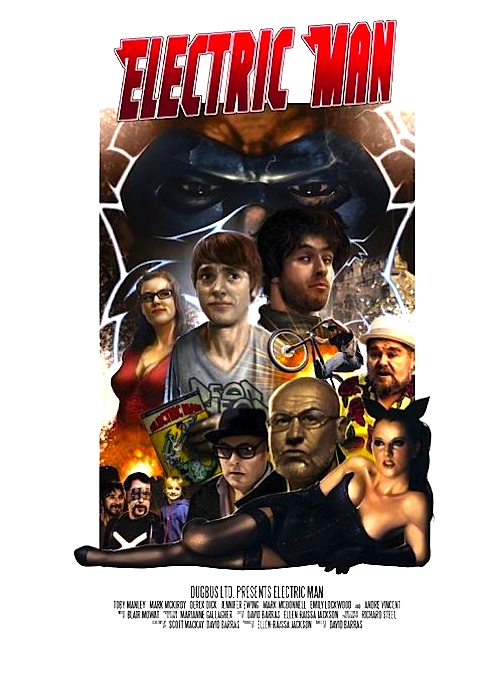
By Joe Bendel. Nobody opens a comic shop to make their fortune or impress women. The co-owner of Deadhead Comics in Edinburgh is doing particularly poorly on both scores, but his knowledge of early superheroes will help him navigate a caper involving an ultra-rare comic in David Barras’s Electric Man, which releases today on DVD, with a VOD launch to follow this Friday.

Jason “Jazz” Archer is the responsible one. His partner Wolf is the unlikely goofball ladies man. They were kind of sort of making a go of it with their comic shop, but now find themselves on the hook for 5,000 pounds worth of repairs. That sum is simply beyond their means, but they carry on hoping lightning will strike out of the blue, which it does.

Electric Man (a.k.a. Edison Bolt) predated the Man of Steel by one year. A gritty depression era hero (whose origin story is related in the cool motion comic opening credit sequence), his premiere issue regularly fetches 100,000 pounds at auctions. At their latest comic show, someone stashed a stolen copy of Electric Man #1 in their boxes. Hoping for a business-saving finder’s fee, Archer attempts to track down the rightful owner. The trail leads him to Lauren McCall, the mysterious daughter of a wealthy collector, her thuggish uncle, and a slightly cracked American Electric Man fanatic.

Electric is an affectionately knowing valentine to geeky cult culture, choked full of clever references and a generous helping of local Edinburgh color. Shot for pocket change, its cast is a bit of a mixed bag, but Toby Manley is engagingly earnest as Archer. Likewise, Jennifer Ewing (online host of Crazy Sexy Geeks) has the right look and presence of a comic convention femme fatale. As the scheming Uncle Jimmy, Derek Dick (a.k.a. Fish) looks and sounds like he could have stepped out of a Ken Loach movie, which is a good thing in this context. Unfortunately, Mark McKirdy is rather annoyingly shticky as Wolf, never convincingly realizing his supposed scruffy charms on-screen.

Despite the occasional limitations of cast and resources, Electric is a light hearted romp that consistently inspires gentle chuckles rather than gut-busting laughs. A refreshing respite from special effects, gross out humor, and grimy social realism, Electric Man should amply please its target ComicCon demographic. Recommended for comic readers and fans of understated indie comedies, Electric Man is now available on DVD and hits VOD this Friday (9/13), via FilmBuff’s platforms.

LFM GRADE: B

Posted on September 10th, 2013 12:30pm.

It’s Tough to Be a Girl in the Kingdom: LFM Reviews Wadjda

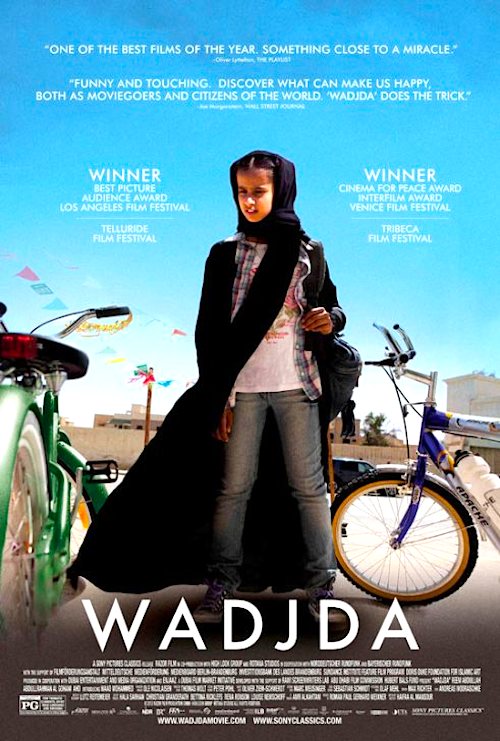
By Joe Bendel. In a country where women are forbidden to drive cars and movie theaters are prohibited, this is obviously a significant two-fer. Not only is it considered the first feature film produced entirely in Saudi Arabia, it was also directed by a woman. (It should be noted that the film was partly backed one of the prince’s companies, lest you suspect that the Zionist conspiracy was working overtime.) It might not drag Saudi Arabia into the modern world, but at least Haifaa Al Mansour’s Wadjda is a good film well worth seeing when it opens this Friday in New York.

Ten year old Wadjda’s attends a hardline Islamist girls’ school that has little to teach beyond the Koran. Bless her heart, she is a terrible student, but obviously much more interesting than her docile classmates. Everyone is rather surprised when she enrolls in the school’s Koran reciting competition, but she has plans for the prize money. She is determined to buy the sparkling new green bicycle that caught her eye.

Of course, biking is strictly not allowed for girls. After all, those narrow seats might rob them of their virtue. Seriously, that is the justification. Nevertheless, Wadjda convinced her neighborhood friend Abdullah to secretly teach her how to ride his bike. Thanks to the circumstances of her family life, she will have plenty of time to spend with him. Her loving mother works on the other side of town, forced to rely on her surly driver to shuttle her back and forth. In contrast, Wadjda’s father is an infrequent presence in her life. He lives with his mother, who seems to be plotting a second marriage for her son. Wadjda’s mother lives in fear of this nuclear option.

Wadjda is a gentle coming of age story, but it is bursting with telling moments. Perhaps the greatest eye-opener is the extent to which women, such as Wadjda’s shrewish head mistress Ms. Hussa, enable and promote their society’s institutionalized misogyny. Time and again, Wadjda’s mother faces major dramas over what would be mere day-to-day chores for women in the west, because of her gender restrictions. It is also hard to see what use Wadjda’s Islamist education will ever be, but that is obviously the whole point.

Nonetheless, both Wadjda and Abdullah (played by Waad Mohammed and Abdullrahmin Algohani, respectively) represent the promise of youth. Given her extensive screen time, Mohammed is particularly impressive, largely carrying the film with aplomb, but they are both immensely likable, blessed with natural screen charisma. Watching their chemistry develop gives viewers hope, but they are only two kids.

While Wadjda the film is understandably small in scope, there are considerable stakes involved for mother and daughter alike. Monsour tells a timely and compelling story with a sure directorial hand and a sensitive touch.Indeed, the indomitable Wadjda is a remarkably engaging character who ought to win over art house audiences. Highly recommended, particularly for those interested in global women’s rights issues, Wadjda opens this Friday (9/13) in New York at the Lincoln Plaza Cinema.

LFM GRADE: A-

Posted on September 9th, 2013 at 3:44pm.

A Tale of Russian Orphans: LFM Reviews The Dark Matter of Love @ The 2013 Toronto International Film Festival

By Joe Bendel. Over 300 so-called “Pipeline Babies” have become the new face of Putin’s Russia. Often special needs children, they had already met and begun forming relationships with their presumptive American parents. However, as they waited for the paperwork to be finalized, the Putin regime banned American adoption as the latest salvo in his neo-Cold War. With no realistic prospects of Russian adoption, it is the children who will suffer the most as a result, but looking after the weak and the vulnerable was never the Russian strong man’s priority.

Admirably, the filmmakers behind a new film documenting the complicated adjustment process for three of the final (as of now) Russian orphans adopted by an American family are using the Toronto premiere of their film to shine a spotlight on the Pipeline Baby issue. Masha, Marcel, and Vadim are not Pipeline children, but the Diazes might sometimes wish they were during the rocky course of The Dark Matter of Love, which screens during the 2013 Toronto International Film Festival.

Adopting one child is a considerable undertaking. Taking on three at once is rather daunting. Recognizing the potential challenges (at least on an intellectual level), the Diaz family enlisted scientific help. Dr. Robert Marvin and his associate Nicole Millirin will monitor and counsel the family, reviewing video footage that would become part of this film. Masha is a classic case of the emotionally guarded orphan who erects nearly impenetrable protective walls around herself. In contrast, the younger twins, Marcel and Vadim, indulge in the sort of histrionic acting out also commonly observed in recently adopted children. Altogether, they are quite a handful, leaving the Diaz parents little time for their biological teenage daughter, Cami.

Throughout much of the second act, viewers will be reminded of what they say about good intentions. Nonetheless, Marvin and Millirin offer the family some very constructive feedback. The authoritative Marvin also provides the audience a lucid thumbnail sketch of the evolution of developmental psychology over the last fifty-some years. Looking a bit like Max von Sydow’s sensitive younger brother, Marvin is a reassuring presence who adds quite a bit to the film.

Frankly, the documentary might have benefited from a bit more of Marvin and Millirin. While the Diazes are clearly good people with strong values, ninety-three screening minutes is a long time to spend with them. Indeed, Dark Matter could easily be whittled down to an hour for a later PBS broadcast.

Despite some painful moments, Dark Matter will leave viewers largely optimistic regarding the Diaz children’s future. It certainly never offers any inadvertent justification for Putin’s iron-fisted American adoption ban. Considering Masha and the twins were adopted just before the decree was passed, it is perfectly logical and appropriate for McCarthy and her colleagues to take up the Pipeline Baby cause as part of their awareness campaign. Millirin has even sacrificed some privacy by announcing she happens to be a lesbian adoptive mother, in protest of both the Russian government’s adoption ban and their harsh new anti-gay laws. It is rather incredible how much there is to be alarmed by in Putin’s Russia, such as the continuing persecution of dissenting activists, like Pussy Riot. What a perfect spot to hold the Olympics.

Recommended for those interested in its family development issues, The Dark Matter of Love screens again today (9/9) and Friday (9/13) as part o this year’s TIFF. Concerned viewers can also sign an online petition on behalf of the over 300 affected children here.

LFM GRADE: B-

Posted on September 9th, 2013 at 3:38pm.

Life in a North Korean Sleeper Cell: LFM Reviews Secretly Greatly

By Joe Bendel. In North Korea, loyalty is only for the little people. In contrast, the state owes them nothing for their faithful service and sacrifice. A trio of DPRK sleeper spies learns this lesson the hardest way possible in Jang Cheol-soo’s Secretly Greatly, which the Korean Cultural Service will screen for free this Tuesday in New York.

Won Ryu-hwan is one of the most lethal commandos ever forged by the North Korean military. Folks in a sleepy South Korean town know him as Bang Dong-gu, the village idiot. To maintain his deep cover, Won follows a strict regimen, such as regularly being seen in public doing both number one and number two. It is a real bummer for Won when the lovely Yu Yu-ran sees him doing his duty (if you will), but at least he will have some comrades to commiserate with when two new sleepers arrive in town.

Lee Hae-rang is supposed to be a hipster-rocker, but he cannot play the simplest of chords. However, he is well connected as the illegitimate son of a high ranking general. On the other hand, Ri Hae-jin makes a convincing high school student, because he is still a teenager. Of the three, only Ri has seen any action, carrying out the assassinations of several defectors.

With the change at the top of the regime, the sleeper agents suddenly look like a potential liability, resulting in a general self-termination order. Of course, Won will do anything his government demands, but first he has the gall to ask for some assurance the Party will take care of the beloved mother he has not seen for years. Right, do you want the bad news first or the really bad news. Regardless, his old commander Kim Tae-won has been dispatched to personally handle the three newly dubbed “traitors.”

Based on a web-comic, Secretly is unusually forthright about the nature of the Communist North. Characters often refer to work camps as a punishing fact of life. Yet, it also portrays the soul crushing impact of the lifetime of propaganda Won has absorbed and still desperately clings to. Nevertheless, the first half of the film mostly hits comedic notes, often approaching outright slapstick.

From "Secretly Greatly."

Of course, when the DPRK turns on its former heroes, the film pivots into much darker territory. When it is finally go time, action coordinator Park Jeong-ryul delivers some spectacularly cinematic but seriously down-and-dirty fight scenes. Bear in mind, Secretly was a blowout hit at the Korean box office, so you can also expect some tragedy down the stretch, but that is also rather realistic. Pyongyang does not do happily-ever-afters.

Kim Soo-hyun fully commits himself to Dong-gu’s cringy humiliations, perhaps even overdoing it a tad. Still, he is a credible action figure when Won gets down to business. Park Ki-woong is a bit more restrained as would be rocker Lee, while Son Hyun-joo is all kinds of badness as the conspicuously scarred military heavy. Although is a small supporting role, Lee Chae-young also has some fine moments as the town tramp, nicely bringing out Dong-gu’s inner tensions.

Secretly has no illusions about the dehumanizing nature of the DPRK, but it is not so crazy about the ROK government, either. Arguably, the most sympathetic figure of officialdom is Kim Soo-hyuk, the unreconstructed but fundamentally decent cold warrior charged with capturing the sleeper spies. Altogether it is a strange mix of broad comedy, gritty action, and cynical intrigue that works far better than it might sound. Recommended for fans of spy vs. spy beatdowns, Secretly Greatly screens tomorrow (9/10) at the Tribeca Cinemas, free of charge, courtesy of the Korean Cultural Service in New York.

LFM GRADE: B+

Posted on September 9th, 2013 at 3:35pm.