Crows and the Great Cycle of Life: LFM Reviews Tokyo Waka

By Joe Bendel. They love their kaiju monster movies in Japan. Perhaps that has prepared Tokyo to live with the aggressive, non-indigenous Jungle Crows that have made themselves at home there in recent years amongst the tall buildings. Japan’s Buddhist and Shinto traditions also help residents find a balance with their winged neighbors. The mega-city’s people and crows inspire John Haptas & Kristine Samuelson’s docu-essay Tokyo Waka, which opens today at New York’s Film Forum.

Crows have long played a role in Japanese culture. Evidently, loud speakers still broadcast a time-honored tune at 5:00, warning children at play it is time to go home with the crows. A recurring figure in art and legend, a crow is even the mascot of the national football (soccer) team. However, these transplants are a crow of a different order. Known to whisk away small mammals, they have forced Tokyo zookeepers to erect protective barriers for their prairie dogs (seriously). They have even been known to take a peck at humans whom they don’t like the looks of.

Although Waka is generally meditative in tone, some of the crow footage is kind of creepy. Haptas and Samuelson speak to residents of all walks of life, who are forced to interact with the black birds. Not surprisingly, some of the most insightful comments come from a Buddhist priest, whose temple goldfish fell victim to one of the brazen crows. He never begrudges them for following their nature. After all, it is all part of the great cycle of life.

We also hear from zoologists, city bureaucrats charged with crow population control, and students who have survived crow attacks. Together they piece together a mosaic of Tokyo. Even with the risk of angry crows, it is an attractively cinematic picture (lovely shot by Haptas and Samuelson), incorporating Shinto shrines and the giant commercial neon signs. The homeless woman representing tent dwellers in the park is a good case in point. While surely there are unfortunate economic reasons for her situation, she seems to have partly embraced the Bohemian aspects of it. Indeed, making the most of a difficult situation is arguably quite compatible with Buddhist and Japanese values.

Quiet and thoughtful, Tokyo Waka is still rather peppier than one might expect. Co-directors-producers-cinematographers-editors Haptas and Samuelson capture some striking images of the city and its crows. Stylistically, it is not unlike Jessica Oreck’s Beetle Queen Conquers Tokyo, though it does not have quite the same charm. Running just a tad over an hour, it is certainly easy to digest. Recommended for students of Japanese culture and bird watchers, Tokyo Waka opens today (8/28) at Film Forum, programmed with the bonus short film, Catcam.

LFM GRADE: A-

Posted on August 28th, 2013 at 12:46pm.

LFM’s Govindini Murty Talks Ben Affleck as Batman @ HuffPost Live

LFM’s Govindini Murty participated in a HuffPost Live segment yesterday on the subject of Warner Brothers’ announcement that Ben Affleck will be playing Batman in the forthcoming Man of Steel sequel.

Our thanks to the HuffPost Live team for inviting Govindini to participate.

Posted on August 27th, 2013 at 9:22am.

A Shy, Quiet Brand of Urban Fantasy: LFM Reviews Abigail Harm

By Joe Bendel. Visitors come to New York from nearly everywhere, perhaps even including the fairy realm, or some such place. One mousy New Yorker will open her home and perhaps her heart to a decidedly foreign visitor when the Korean fable of the Woodcutter and the Nymph (that shares common elements with the Swan Maiden and Selkie myths) gets a quietly modern makeover in Lee Isaac Chung’s Abigail Harm, opening this Friday in New York.

Shy and retiring, Abigail Harm reads to the blind because she does not like to be seen. Her garrulous father was also a storyteller, but her relationship to the old man was complicated in ways we will never understand. One fateful night, she shelters a strange fugitive, who seems to believe he is a mystical being trapped in our world because someone stole his robe. To thank Harm, he gives her directions on where to similarly entrap one of his fellow visitors, who will become her faithful lover as long as she keeps his stolen garment in her possession.

While Harm is ordinarily quite taciturn, she is rather talkative compared to the strange visitor she ensnares. Yet, a romantic relationship duly develops between them. Nonetheless, questions regarding the sustainability and legitimacy of it all seem to nag at Harm’s subconscious.

Born to play misfits, Amanda Plummer (who is currently appearing on the New York stage in an excellent staging of Tennessee Williams’ eerie Two Character Play) suggests a lifetime of angst and insecurity without revealing any of Harm’s secrets. She stirs viewer empathy, but subtly suggests there is something damaged and maybe a little bit off about her.

From "Abigail Harm."

As her visitor, Tetsuo Kuramochi expresses much without dialogue, but his character still largely remains a cipher during the course of the film. However, Will Patton makes the most of his brief appearance as Harm’s agitated visitor, giving the film its most substantial jolt of energy, as well as performing the narration, which elegantly evokes a sense of once-upon-a-time.

There is no getting around the film’s deliberately paced artiness and its defiantly unsatisfying third act. Nonetheless, it remains one of the smartest urban fantasies of the year. It gracefully hints at cosmic goings on, lurking in plain sight on the streets and subways we use every day (the Union Square station, in this case), without cribbing the adolescent melodrama of the Buffy and Twilight franchises. Adults will find it a welcome antidote to Mortal Instruments and similar copies of copies.

Although it is headed to a very different destination, Abigail Harm would be an appropriate companion film to John Sayles’ Secret of Roan Inish. Strangely, it is also thematically compatible with The Two Character Play, a surreal two-hander about alienation and confinement. Recommended for those who appreciate more demanding manifestations of the fantastic, Abigail Harm opens this Friday (8/30) in New York at the Quad Cinema.

LFM GRADE: B

Posted on August 26th, 2013 at 12:44pm.

Cuba, Unvarnished: LFM Reviews Una Noche

By Joe Bendel. There are two Cuba’s: one for well-heeled Euro tourists, and one for Cubans. When the two worlds mix, it often means trouble for the locals. One Cuban teen understands that only too well. Indeed, he has all kinds of reasons to flee the police state on a ramshackle raft and a hurried prayer. Shot on location in Cuba, yet somehow still reflecting the country’s tragic real life circumstances, Lucy Mulloy’s Una Noche will transport audiences to the island dictatorship when it opens tomorrow in New York.

Raul is more or less a delinquent, but it is hard to judge him harshly once you know his backstory. After years of servicing the tourist trade, his aging prostitute mother has contracted AIDS. Despite all that great free healthcare, Raul is still forced to buy her medicine on the black market. Always skirting the law, he has finally attracted serious police attention. He and his mate Elio had planned to try their luck with the Florida Straights in due time, but Raul’s wanted status compels him to move up the timetable.

It will be hard for them both to leave Lila. Elio has always had an unusually close and supportive relationship with his younger sister. In contrast, Raul hardly knows her, but he has carried a torch for the Tae Kwon Do student from afar. Nevertheless, they are prepared to depart by themselves, until the intuitive teen crashes their party.

Una Noche could be considered a case of life imitating art imitating life. The narrative was inspired by the story of a harrowing attempted crossing that would be spoilery to relate in detail. Subsequently, two of Mulloy’s three diamond-in-the-rough principles eventually defected to America while en route to participate in Una Noche’s Tribeca press junket. It is not hard to see why, from Mulloy’s documentary-like street scenes.

It is not just the generally decrepit and unsanitary conditions of life outside the tourist enclaves that is so oppressive in Una Noche. Mulloy captures the secret police at work, conveying all the fear and anxiety they generate. When asked at a special screening why the Cuban government would allow permits for such an honest and unflattering production, she speculated they were perversely pleased with the tragic ending, seeing it as a tool to promote submission to state authority. It is hard to argue with her line of reasoning, especially given the extent of her first hand experience.

Mulloy, a legitimately independent filmmaker, guides her earnest young cast through some first rate performances. Perhaps Dariel Arechaga (the one who showed up on time at Tribeca) makes the strongest, edgiest impression as Raul, the nervy live wire. Although it is a more tightly controlled performance, Anailín de la Rúa de la Torre is not far behind him as the slow burning Lila. Convincingly repressed, Javier Núñez Florián’s Elio is perfectly solid in the more subservient, less showy role of the trio.

Do not be put off by the “Spike Lee Presents” business. Mulloy admirably holds up a mirror to the reality of Cuba today. Unfortunately, she risks undermining the film with some creepy sexual matter that might come across like overkill to some viewers, whereas others might consider it a strange attempt to fetishize the characters’ desperate poverty. As a result, Una Noche can only be recommended for mature adults. However, those who can handle an occasional bit of grossness should definitely check it out. Intense and forthright, Una Noche opens tomorrow (8/23) in New York at the IFC Center.

LFM GRADE: B

Posted on August 22nd, 2013 at 10:50am.

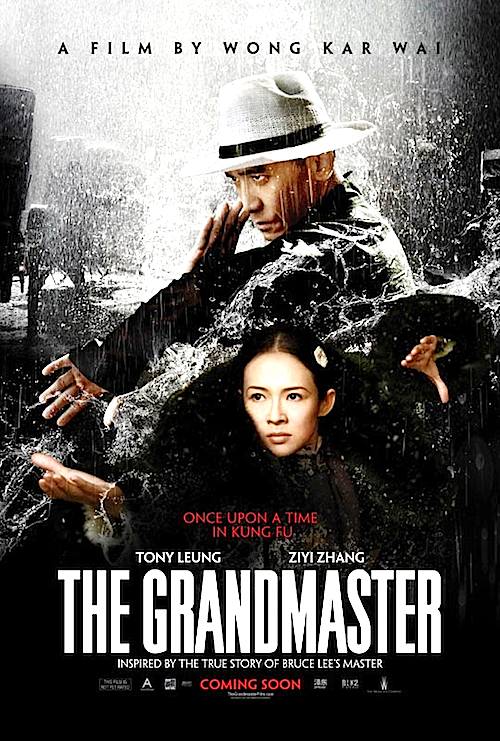
LFM Reviews Wong Kar Wai’s The Grandmaster

By Joe Bendel. Ip Man has become a transcendent hero. All the films and stories about him are true, even when they contradict each other, because we need his example of heroic humility. Ip was a master of the southern style of kung fu known as Wing Chun. Settling in Hong Kong after the Communist takeover, he became the city’s most prominent martial arts teacher. He often lived a hand-to-mouth existence, but he attained a measure of immortality through his celebrated student, Bruce Lee. Posterity will not be so kind to the northern school, for classically tragic reasons revealed in The Grandmaster, Wong Kar Wai’s eagerly anticipated take on Ip Man, the man and the legend, which opens this Friday in New York.

Born to a life of privilege, Ip Man has become the leading proponent of the Wing Chun school of kung fu. For Grandmaster Gong Baosen of the northern 64 Hands school, Ip is a fitting sparring partner for his grand retirement tour. In observance of custom, challenges are made and met with grace. However, Gong’s intensely loyal daughter Gong Er is determined to take matters further. When she and Ip spar, it makes a profound impression on them both. No longer mere rivals, an ambiguous but palpable mutual attraction develops between them. Ip plans to travel north to see Gong and her 64 Hands style again, but the Japanese invasion rudely intervenes.

The occupation years will be difficult for both non-lovers. Ip and his wife Zhang Yongcheng will mourn their children who succumb to starvation, while Gong Er watches in horror as Ma San, her father’s last great pupil-turned Japanse collaborator, usurps the 64 Hands. Years later, Ip Man and Gong Er will meet again in Hong Kong, but their wartime decisions will continue to keep them apart.

Considering how long fans have waited, it is almost impossible for Grandmaster to live up to expectations, but happily it comes pretty close. Although separate and distinct from the Ip Man franchise distributed by Well Go USA, “Little” Tony Leung Chiu Wai has the perfect look and gravitas for the celebrated master, nicely finding his niche as the experienced leading man Ip Man, in between Donnie Yen’s young, confident Ip and Anthony Wong’s elder statesman Ip. Pushed and prodded by Wong, Leung arguably does some of his best martial arts work yet, but he also conveys the essence of the acutely disciplined Ip.

As good as Leung is, Ziyi Zhang more or less takes over the picture and that’s totally cool. She even gets the big pivotal fight scene, which delivers in spades. A haunting and seductive presence, she brings out genuinely Shakespearean dimensions in Gong.

As a martial arts film, Grandmaster offers plenty of show-stopping sequences, clearly and fluidly staged with only a hint of the extreme stylization that marked Wong’s Ashes of Time Redux. Surprisingly, though, the film is as much a lyrical epic of love and yearning. Indeed, the snowy northern climes and train station settings call to mind Doctor Zhivago more than Enter the Dragon. Of course, Wong fully understands the power of a passing glance and incidental touch, exquisitely conveying the perverse satisfaction of denial.

The Grandmaster is a very good film that should please genre fans and art house audiences in equal measure. It is probably the Ziyi Zhang, Tony Leung, and Wong Kar Wai collaboration we have hoped for since 2046. A sensitive but muscular portrait of Bruce Lee’s great master, it is a worthy addition to the Ip Man canon. Highly recommended, The Grandmaster opens this Friday (8/23) in New York at the Angelika Film Center and the AMC Empire.

LFM GRADE: A

Posted on August 21st, 2013 at 2:48pm.

From the Harbor to the Boardroom: LFM Reviews Floating Island; Available Now on Blu-ray/DVD

By Joe Bendel. Bo Wah Chuen’s chronicle is somewhat like the flipside of a James Clavell novel.  The adopted son of “Tanka” boat people, Bo would become the first Chinese Taipan of the British Imperial East India Company—sort of. Issues of identity will hound the Horatio Alger character throughout Yim Ho’s “based on a true story” Floating City, which releases on DVD and Blu-ray today from Well Go USA.

Images of Hong Kong’s hardscrabble harbor community have become iconic, but they always represented the bottom rung of the Crown Colony’s social ladder. As a mixed race baby adopted by a Tanka family, Bo was the lowest of the low. His mother was ethnic Chinese. His father was not. At the time, Bo’s adoptive parents projected the need for another son to work with his father. However, his parents proved to be more fertile than the early 1960’s economy. As a result, several of Bo’s younger siblings are sent to a Christian orphanage while the family struggles to right itself.

Bo’s path to success will not be a straight uphill climb. He will drop out of elementary school several times, when already a young man of working age. His fortunes will turn when the East India Company hires him as an office boy. Yet, even then it will take years for his virtue to be rewarded, as he labors under Dick Callahan, a ridiculously caricatured lout, who oozes racism from every sweaty pore. Nonetheless, Bo will eventually catch the eye of the last British Taipan and earn the confidence of Fion Hwang, a mover-and-shaker who will tutor him in the particulars of Hong Kong power politics. It all leads to feelings of increasing inadequacy for his shy Tanka wife Tai, especially the part about the glamorous Hwang.

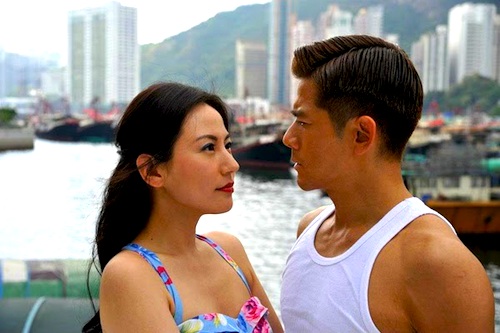
As the future Taipan, Aaron Kwok does not look the least little bit British, let alone a full half, despite the bizarre red tinting applied to his hair. Regardless, this just might be the role of career. Frankly, many who closely follow Asian cinema might be surprised the Cantopop star had it in him. Even though he is stuck rhetorically asking “who am I?” far too often, he gives a slow burning, fully dimensional performance as the driven outsider of outsiders. Kwok and Yim walk quite the fine line, never allowing Bo to sell out his self-respect, yet maintaining a distinctly flexible approach to his corporate superiors.

From "Floating City."

Beyond Kwok, Floating’s ensemble is a mixed bag, leaning more towards the positive side of the ledger. Both Josie Ho and Nina Paw are quite touching as Bo’s younger and older adoptive mother, respectively. Annie Liu is also a smart, luminous presence as Hwang, but you have to wonder what kind of expat dive bar they go to in order to recruit western actors like this. Egads, can’t any of them pull off a simple line reading?

Over the course of the film, Floating‘s anti-British biases get a bit tiresome, but its treatment of Christianity is considerably more nuanced. In fact, Yim and co-writer Marco Pong clearly suggest it greatly contributes to the perseverance of Bo’s sainted mother.

Ultimately, comparisons to Clavell are rather apt, considering Floating’s large cast of characters and decades-spanning narrative. It has its flaws, but Kwok is a far more memorable Taipan than Bryan Brown or Pierce Brosnan (at least the former had Joan Chen’s support). Many cineastes will forgive the clunky bits, taking satisfaction from HK New Wave veteran Yim’s return to ambitious, large scale filmmaking. Worth checking out as a rags-to-riches tale with considerable local color, Floating City is now available for home viewing options from Well Go USA.

LFM GRADE: B-

Posted on August 21st, 2013 at 2:35pm.