The Sort-of-True Tall Tale of Ward Allen: LFM Reviews Savannah

By Joe Bendel. Ward Allen was like a grown-up version of Huck Finn.  The heir to one of Savannah’s largest plantations, Allen willingly renounced a life of privilege for a wild and woolly existence supplying fresh game to the city’s markets.  Unfortunately, the march of progress will not heed the angry editorials penned by the “Buffalo Bill of the River” in Annette Haywood-Carter’s Savannah, which opens this Friday in New York.

The Oxford educated Allen had a talent for blasting ducks out of the sky. Christmas Moultrie was a close second. Savannah’s last child born into bondage, Moultrie had a long history with Allen’s family that evolved into a close camaraderie with Ward. While this rather puzzles some of Allen’s would-be peers, his open defiance of modern game regulations often leads to more pressing problems with the law. Despite his roguish carousing, Allen catches the eye of Lucy Stubbs, the headstrong daughter of Savannah’s least amused old money family.

Sadly, Allen was not cut out for the modern world, as viewers can easily deduce from the flashback structure. Still, he left behind some colorful stories that Moultrie never tires of retelling in his twilight years. In fact, those anecdotes formed the basis of John “Jack” Eugene Cay Jr.’s Ward Allen: Savannah River Market Hunter, the historical monograph on which Savannah is partly based. Initially the Cay Family’s guide on river excursions, Moultrie forged a close relationship with the Cays that led to Savannah the film, co-produced and financed by Cay’s son, John.

Considering both Cays appear as characters in the wrap-around segments, it will be tempting for critics to dismiss Savannah as a vanity adaptation of a vanity publication, but there is more to it than that. Frankly, it is an intriguing example of how tall tales and legends are passed down and codified in the digital age. The relationship between Moultrie and both Allen and the Cays is also quite touching. The near total lack of racial tension, aside from a flashback to Moultrie’s childhood, is obviously difficult to buy, but Savannah’s apolitical stance is frankly rather refreshing.
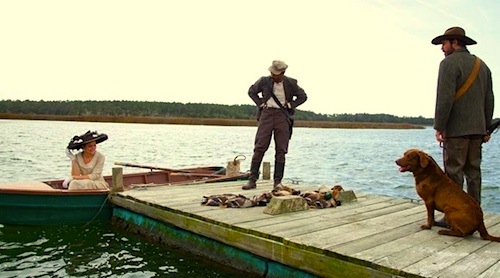
From "Savannah."

It is also easy to understand why Haywood-Carter was attracted to Allen as a historical and dramatic character. Temperamentally too much of an anarchist to be considered a Southern Agrarian, Allen’s advocacy of a more natural, less mechanized lifestyle may well resonate with contemporary audiences (who do their hunting and gathering at Whole Foods).

Jim Caviezel is surprisingly charismatic as the reckless, larger than life Allen. A bit of a departure for the Person of Interest star, he clearly seems to enjoy Allen’s boozing and bombastic Shakespeare quoting. Hal Holbrooke also appears to be having a ball as Judge Harden, the acerbic jurist who passed the bar and was appointed to the bench only to spend most of his career trying Allen for hunting season violations.

Evidently the circumstances surrounding Allen’s marriage are the best sourced elements of the film, but they are also the dullest. Nevertheless, Jaimie Alexander plays her with some welcome attitude and backbone. However, Chiwetel Ejiofor’s Moultrie mostly just stands about, looking vaguely pained by Allen’s self-destructive behavior. On the other hand, he contributes the eerie blues rendition of “Wade in the Water” heard over the final credits.

The American South is often shortchanged by Hollywood films that too often reduce the culturally fertile region to a burning cross. The reality was much more complicated than that. At least Haywood-Carter and her co-screenwriter Kenneth F. Carter take a stab at a more balanced portrayal, but the results are certainly mixed. Mainly recommended for those looking for the PBS Masterpiece Classic version of History Channel’s swamp people reality programming, Savannah opens this Friday (8/23) in New York at the AMC Empire, as well as theaters throughout the southeast.

LFM GRADE: C+

Posted on August 21st, 2013 at 2:32pm.

John Fahey & Nels Cline: LFM Reviews Guitar Innovators

By Joe Bendel. John Fahey knew the blues. He eventually published his academic thesis on Skip James and “re-discovered” real deal bluesman Bukka White. He could also play the guitar, combining a legit blues attack with an avant-garde harmonic sensibility. Never a commercial sensation, Fahey developed a cult following. The idiosyncratic guitar master consistently defied arbitrary genre distinctions, as does Nels Cline (probably best known for his work with Wilco). Despite their stylistic differences, both musicians make an apt pairing in First Run Features’ Guitar Innovators, a theatrical double feature of two mid-length documentaries opening this Friday in New York.

The late Fahey’s chaotic life offers plenty of grist for James Cullingham’s In Search of Blind Joe Death: the Story of John Fahey. The longer of the two films, Death surveys the guitarist’s life and his prolific but under-distributed musical output. The artist who playfully adopted the “Blind Joe Death” moniker had nearly as many distinctive creative periods as Picasso, including a sojourn through the world of old school New Orleans jazz. Apparently, he had a rather traumatic childhood, which Cullingham addresses briefly and diplomatically (rather raising more questions than he answers). However, he fully embraces Fahey’s image as an artistic eccentric, including plenty of viewer-friendly anecdotes as part of his portrait.

Including short animated interludes and talking head segments with The Who’s Pete Towsend and Fonotone Records’ Joe Bussard, Death is strong on biography, but is oddly stingy when it comes to the actual music. It will convince viewers that Fahey was important and influential, but might not move a lot of CDs and downloads for his heirs. Still, it represents a rare cinematic fix for blues fans. (LFM GRADE: B+)

Steven Okazaki’s Approximately Nels Cline personally introduces viewers to the American experimental jazz and rock guitarist, but it is not intended as an exhaustive study. Instead, it captures Cline’s creative process in the studio with several simpatico colleagues. The free improvisation and electronic instrumentation of Cline’s group sounds worlds removed from Fahey blues-roots music, but their choice of time-honored folk songs like “Black is the Color” nicely parallels Fahey’s modernist approach to traditional fare.

Cline also recruits an enormously talented ensemble, including the unusually versatile jazz trumpeter Ron Miles, who brings an In a Silent Way kind of vibe to the session. Violinist-vocalist Carla Kihlstedt also sounds quite haunting on their dramatic rendition of “Color.” We also hear the more abstract side of Cline when playing with keyboardist-programmer Yuka Honda (who also happens to be his wife). At half an hour, it should not overwhelm aesthetically conventional ears, especially given the warm, handsome look of the performance footage shot by cinematographer Dan Krauss at the storied Fantasy Studios.

Death documents a fascinating life, while Approximately records some striking music in the making, but both films speak to each other in intriguing ways. Shrewdly packaged by First Run, both documentaries are highly recommended separately or together as the Guitar Innovators double bill, which opened last Friday (8/16) in New York at the Cinema Village. (LFM GRADE: A-)

LFM DOUBLE-BILL GRADE: B+

Posted on August 19th, 2013 at 8:14pm.

A Supernatural Shaft: LFM Reviews Abandoned Mine

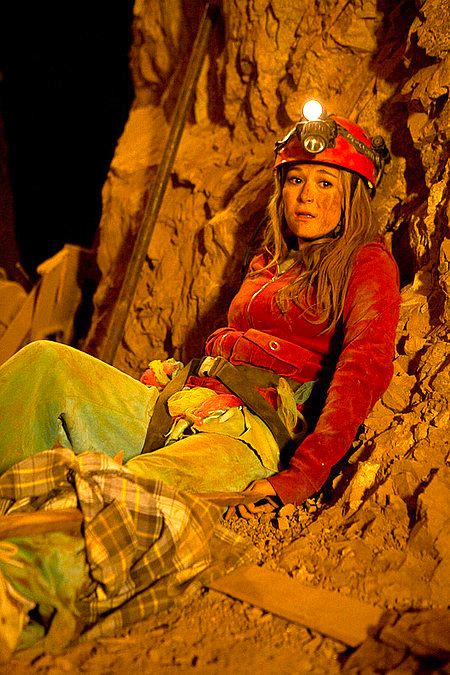
By Joe Bendel. There are bureaucrats at the Interior Department who will have nightmares after watching this film. The rest of us should sleep pretty soundly. Four college-aged knuckleheads will indeed follow through on their wildly ill-conceived subterranean Halloween plans in Jeff Chamberlain’s Abandoned Mine, which had special one night only screenings in fourteen select cities and also kicked off a week long Hollywood engagement set for this week.

Brad is a former high school quarterback who never left his sleepy home town. His ex-girl friend Sharon temporarily left for college, but now she is back. While she was gone, he took up with her best friend, Laurie—and why not? Laurie is the one that is afraid of spiders, while Sharon is the one played by Alexa Vega from Spy Kids. Aside from that, they are pretty much interchangeable.

From "Abandoned Mine."

Brad has the really clever idea to get the old gang together and party Halloween night away in the old Jarvis Mine. Of course, he plans to punk his friends and videotape the results. The mine’s notorious history should have them primed for his pranks. Old man Jarvis and his two young daughters were murdered there by his own miners, doing the bidding of his partners in San Francisco. Considering everyone knows what happened, it clearly was not a well executed crime. Nonetheless, they say the spirits are restless in the Jarvis Mine.

Without question, the creepiest part of Abandoned are the eerie old photos of evil looking miners seen during the opening sequence. They set quite an evocative tone. Unfortunately, it is impossible to care about the dull, clueless characters, who really ought to know better – particularly our protagonist, Brad, who deserves a swift back-handed slapping. Only Charan Prabhakar projects any sense of an individual personality as Ethan, the first generation Indian honors student tagging along.

Mercifully, Abandoned is not a found footage film, per se. Chamberlain only occasional shows the audience flashes of their surviving video in befuddling snippets. To his credit, he also largely avoids the graphic gore, gratuitous nudity, and explicit language often found in horror films. Perhaps the audience is supposed to provide it instead.

Regardless, it is impossible to get around how jaw-droppingly stupid Brad’s plan is. Kids, you should never play around in deserted mines, even in broad daylight. It is especially foolish to do so during Halloween night, when emergency services are always stretched thin. Just sort of generic, Abandoned Mine will underwhelm genre fans. For diehard Vega fans, it screens for a week (8/15-8/22) at the Arena Cinema in Hollywood, U.S.A.

LFM GRADE: D+

Posted on August 19th, 2013 at 5:55pm.

Hold That Cough: LFM Reviews Flu

By Joe Bendel. It is easy to understand why pandemic thrillers might strike a chord with Korean audiences. Watching a few SARS and Bird Flu outbreaks rip through our hemisphere would grab our attention, too. A year or so after unleashing Park Jung-woo’s Deranged, CJ Entertainment breaks out the hazmat suits again with Kim Sung-su’s Flu, which opened last week in Los Angeles.

Dr. Kim In-hae ought to have been more gracious when daring fireman Kang Ji-koo pulled her out of the massive sinkhole that gave way beneath her car. Unfortunately, infectious disease specialists are not always very warm and fuzzy. Her bedside manner will not improve when she learns what a human trafficking ring inadvertently smuggled into the country: a highly contagious mutated strain of avian flu.

From "Flu."

Through an unlikely set of circumstances, Kang befriends Dr. Kim’s adorable but demanding daughter, Mi-reu, in hopes that will pay dividends with her mother. As a result, when the health authorities lock-down the bustling Seoul suburb of Bundang, Kang becomes Mi-reu’s protector. Unfortunately, she seems to be developing a cough.

As in Deranged, human nature takes a nasty turn when confronting a virulent form of microscopic mortality. However, Deranged’s parasitic McGuffin manifested itself in a more intriguing way than this titular flu. Those afflicted in Bundang simply start to cough, break out in rashes, and die—except for the mysterious survivor of that fateful human cargo container.

It is all kinds of manipulative, but the relationship between Kang and young Kim is still highly effective. As the former, Jang Hyuk nicely balances grit and swagger, while Park Min-ha is cinematically cute and surprisingly natural on-screen as Mi-reu. Superstar Soo-ae is also appropriately intense as Dr. Kim. Alas, most of the authorities are just cardboard cut-out villains. Regrettably, this is especially true of the distinctly anti-American portrayal of various Yankee military and medical advisors, most notably the ruthless Schneider (not uncommonly a Jewish surname, adding an additional layer of awkwardness to the film). Only Ma Dong-seok’s Jeon Kook-hwan, a military officer turned rogue provocateur, is a worthy heavy.

Flu operates on an impressive scale, incorporating some big set pieces and a way-over-the-top climatic stand-off. In contrast, Deranged more trenchantly explores the perils of the mob mentality running riot. (Indeed, it is the superior outbreak movie.) A better melodrama than a viral thriller, Flu is just sort of okay overall. Mostly for Soo-ae fans and hot zone junkies, Flu opened last Friday (8/16) in Los Angeles at the CGV Cinemas and opens September 6th in New York (Queens) at the AMC Bay Terrace.

LFM GRADE: C

Posted on August 19th, 2013 at 8:06pm.

A Woman’s Plight in Afghanistan: LFM Reviews The Patience Stone

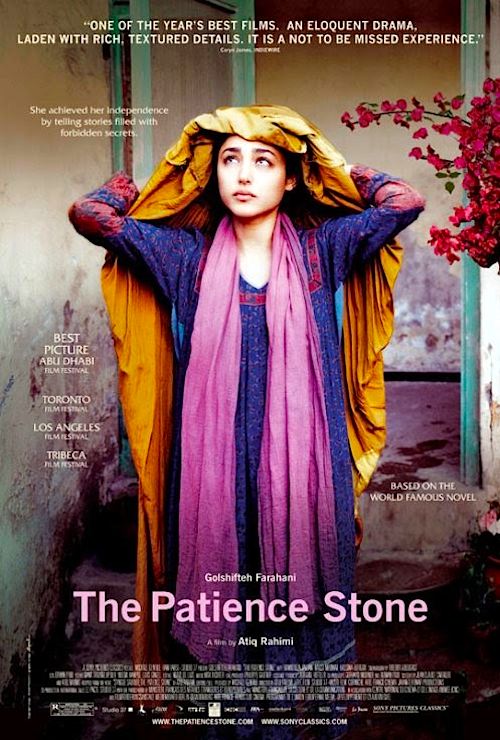
By Joe Bendel. For a woman in Afghanistan, an incapacitated husband is both dangerous and liberating. The unnamed man was never much of a husband, at least as westerners would understand the term, but he will finally become a good listener in Afghan expatriate Atiq Rahimi’s The Patience Stone, which opens this Wednesday in New York.

It was a loveless arranged marriage. Her grizzled old husband acquired her when she was really just a child. At least he was not around much during the early years of their marriage. Instead, he was off fighting whomever, only periodically returning to lord over her. Over time, they had two daughters, but they never “learned to love each other.” Yet, when a tawdry dust-up leads to a bullet in his neck and a subsequent coma, she loyally tends to her former tormentor.

Sending their children to live with their worldly aunt, the woman spends her days maintaining their battle-damaged home and watching over her comatose husband. She must keep him hidden from sight, lest the roving bands of warlords recognize her defenseless position. Unfortunately, a small contingent of soldiers eventually barges in, with the intent of forcing themselves on her. Understanding the perverse nature of her country’s misogyny, she claims to be a prostitute, causing most of them to lose interest. As her aunt explains, those sharing their virulent Islamist mentality take manly pride from raping virgins, but are repulsed by sexually experienced women.

However, the shy one eventually sneaks back, hoping to hire the woman’s services. She does not exactly agree at first, but they soon share intimate encounters on a regular basis. In fact, she starts to enjoy them, both as a sexually liberating experience and a passive aggressive salvo against her husband. She does indeed confess each assignation to him, as well as the rest of her deepest, darkest secrets. He has become her “Patience Stone,” the mythological vessel that retains all the sorrow the owner divulges, until it finally shatters.

What a lovely corner of the world this is. Women are treated like chattel, forced to wear burqas, and consequently blamed for the predatory behavior of men. Atiq’s film, based on his French language Prix Goncourt winning novel, quite boldly examines the pathological sexism of Islamist society. If it sounds vaguely homoerotic when the young soldier confides to the woman his commander puts bells on his feet and makes him dance in the evenings, it should. Atiq is rather circumspect in his handling of this issue, essentially using it to establish the woman’s sense of compassionate outrage. Fair enough, but there is only so much of that which can easily fit in to an intimate chamber drama such as Stone.

Essentially, Stone is a two-hander, but the second hand spends nearly the entire film in a persistent vegetative state. Fortunately, Golshifteh Farahani, the Iranian exile based in Paris (seen in Chicken and Plums and in Ridley Scott’s mullah-offending Body of Lies), is extraordinarily compelling as the woman, largely carrying the film on her shoulders. It is a profoundly vulnerable yet surprisingly sensual performance, likely to equally inspire her fans and outrage the theocrats in her Iranian homeland. Still, Mossi Mrowat has some quietly powerful moments as the young, naïve soldier.

True to the limits of the woman’s world, Stone has a two-set, four-character staginess that it just cannot shake loose. Nevertheless, it powerfully crystallizes all the anguish and rage pent-up inside exploited women like Atiq’s protagonist. He and Farahani might be exiles, but with Stone they vividly hold a mirror up to their respective societies. Recommended for those concerned about the state of women’s rights in the Islamic world and fans of Farahani, Patience Stone opens this Wednesday (8/14) at New York’s Film Forum.

LFM GRADE: A-

Posted on August 12th, 2013 5:31pm.

LFM’s Govindini Murty Talks with Elysium‘s Diego Luna @ HuffPost Live

LFM’s Govindini Murty participated in a HuffPost Live segment yesterday with Mexican actor Diego Luna, who co-stars with Matt Damon and Jodie Foster in this weekend’s new sci-fi spectacle Elysium, directed by Neill Blomkamp.  Luna was first introduced to American audiences in the critically acclaimed Y Tu Mama Tabien.

Govindini comes on to the segment about 23 minutes in, and asked Luna several questions about what it was like for him to work in the sci-fi genre, and how he prepared for Elysium.  Our thanks to the HuffPost Live team for inviting Govindini to participate.

Posted on August 7th, 2013 at 1:06pm.