LFM Reviews I Have to Buy New Shoes @ The 2013 Japan Cuts

By Joe Bendel. A young photographer finds romance where he least expects it: Paris. Sure, it is the City of Lights, but he assumed his short sight-seeing trip would only entail some brotherly chaperoning. Instead, he spends some ambiguous quality time with an attractive older Japanese woman in Eriko Kitagawa’s I Have to Buy New Shoes, which screens tonight as part of the 2013 Japan Cuts: The New York Festival of Contemporary Japanese Cinema.

Sen Yagami only came to Paris at the insistence of his younger sister, Suzume. However, she contrives a way to ditch her indulgent brother along the banks of the Seine before they even reach their hotel. She has plans of her own, involving her long-distance artist boyfriend. This is rather inconvenient for Yagami, since he does not even have their hotel information. Fortunately, a broken heel precipitates a meet-cute with expat magazine editor Aoi Teshigahara, at the expense of his ground-up passport.

Initially, Teshigahara helps him navigate Paris as a friendly fellow countryman abroad, but a mutual attraction slowly grows between them. Surprised and confused by their feelings, Teshigahra and Yagami engage in a halting courtship dance that is refreshingly chaste compared to most films. Nonetheless, Yagami will not see much of his hotel, wherever it might be.

Following in the tradition of Brief Encounter, Shoes has already been widely compared to Linklater’s Before trilogy as well as the 1990’s Japanese television work of Kitagawa and producer Shunji Iwai. Yet, this is a much quieter film, saying more with a look than a page self-consciously clever dialogue. The title may sound like chic lit, but Kitagawa maintains a vibe of mature sadness that is anything but.
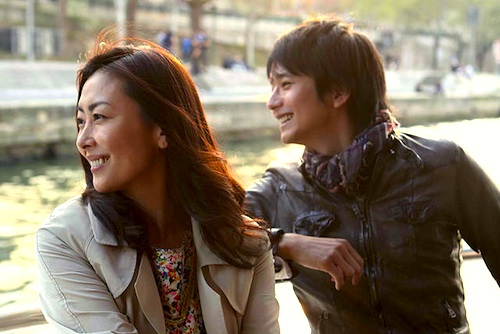
From "I Have To Buy New Shoes."

It is impossible to overstate what Miho Nakayama brings to the film as Teshigahara. A long time Paris resident herself, she is a smart, sophisticated, and beautiful presence throughout the film. Yet, when she lowers the dramatic boom, it is simply devastating. Poor Osamu Mukai’s Yagami is just no match for her, even though he has some nice moments expressing the younger man’s very real disappointments in life. He is no boy toy, not by any stretch. Mirei Kiritani also brings unexpected depth to seemingly coquettish Suzume late in the third act.

Just about every scene of Shoes has a subtle surprise, yet invariably rings true. It is a classy package, capitalizing on the Parisian backdrops and sparingly incorporating Ryûichi Sakamoto’s evocative piano themes in just the right moments. Above all else, it is a stunning showcase for Nakayama that would elevate her to the absolute top tier of international stardom in a more just world. Very highly recommended for those who appreciate intelligent, grown-up relationship films, I Have To Buy New Shows screens tonight (7/18) as this year’s Japan Cuts continues at the Japan Society.

LFM GRADE: A

Posted on July 18th, 2013 at 1:19pm.
Analog Dreams of a Digital Future: LFM Reviews Computer Chess

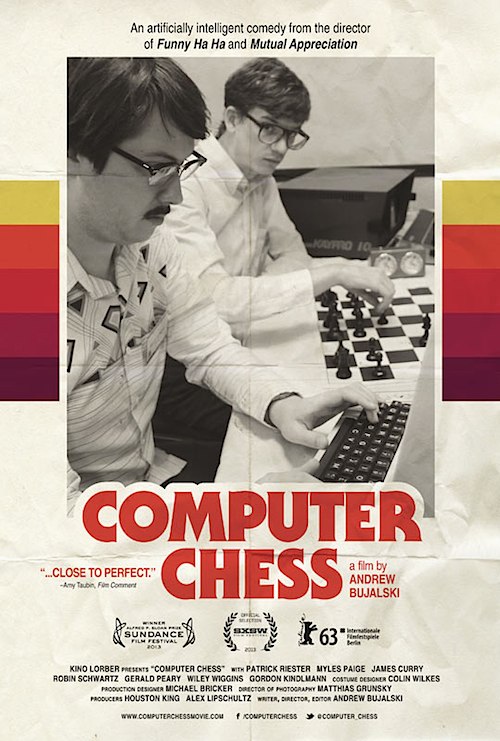
By Joe Bendel. In 1980, all music was analog. So was just about everything else. Computers were generally recognized as the coming thing, but they were still too large, bulky, and slow to be a part of most peoples’ daily lives. However, these zero-point-zero generation computers could be programmed to play chess. A motley assortment of early computer pioneers will pit their chess programs against each other in Andrew Bujalski’s retro Computer Chess, which opens this Wednesday at Film Forum.

In a tacky suburban chain motel, some of computer science’s shabbily dressed elite have come together for a computer chess tournament. The winner will face off against the arrogant human host, Pat Henderson, who has never lost a match to a machine—at least not yet. He and his opening night panel predict that will end by 1984, a year rife with significance. The defending champs from Cal Tech are still the presumed favorites, but their TSAR program is acting decidedly buggy. It is so bad, the project director, geek superstar Dr. Tom Schoesser, hastens his arrival for an emergency diagnostic session.

Things seem to be going well for the MIT contingent, with Shelly Flintic receiving an inordinate amount of attention as the first woman team-member in the competition. In contrast, nobody wants to deal with the prickly, borderline homeless Michael Pappageorge, even if he is a mad genius.

Bujalski fully embraces the technology of the era, shooting Chess in black-and-white, on now archaic late 1970’s video cameras. The film is even rougher and grainier than viewers will expect, yet Bujalski’s nostalgic vision will win them over. Indeed, it is clear throughout the inspired first four-fifths of Chess that the game of chess is really just a stand-in for innumerable AI applications to come. We can also recognize Pappageorge as the sort of social drop-out who either became the Bill Gateses of the world, or more likely remained marginal figures, haunting tech clearance auctions, buying bizarre obsolete hardware to continue building their mad visions.

Myles Paige arguably deserves award consideration as Pappageorge, finding pathos in his obnoxious behavior. Texas-based film editor Robin Schwartz also gives Chess some soul as Flintic, one of the few competitors with any facility to make human connections. University of Chicago professor Gordon Kindlmann’s Schoesser has a knack for making his theory-heavy dialogue sound smart and accessible, while in his on-screen debut, film critic Gerald Peary chews the scenery nicely as the pompous Henderson.

Considered one of the godfathers of Mumblecore, Bujalski now demonstrates how handy it is to have some plot and an underlying concept supporting a film. Still, he overplays his hand in some respects. Initially, the hippie-dippy encounter group sharing the motel is a rather brilliant piece of era-appropriate cultural satire that could have been lifted from 1980’s uber-zeitgeisty Serial. However, whenever Bujalski contrives ways for the two groups to intersect, the forced comedy falls flat. Likewise, the genre payoffs he offers late in the third act are head-scratchers that make little sense in the film’s overall context.

Frankly, Chess works best when suggesting TSAR might just be the not so distant ancestor of WarGames’ Joshua and 2001’s HAL 9000. Nonetheless, Bujalski presents a consistently compelling time-capsule that captures the innocent fascination and single-minded commitment to innovation that drove the digital revolution. A sly period production with a keen understanding of early computing, Computer Chess is recommended for Wired readers when it opens this Wednesday (7/17) at New York’s Film Forum.

LFM GRADE: B

Posted on July 16th, 2013 at 10:58pm.

LFM Reviews PostHuman @ The 2013 Comic-Con International Independent Film Festival

By Joe Bendel. We might be in for a dystopian future, but there are those among us who won’t go down without a fight, perhaps including Terrance the hacker. He will demonstrate his talents to a mysterious woman and potential audiences for further and longer exploits when Cole Drumb’s animated short film PostHuman screens at the 2013 Comic Con International Independent Film Festival.

Evidently, the beautiful but deadly Kali was once an involuntary test subject in a secret government ESP lab. She intends to rescue her last surviving fellow guinea pig, with Terrance’s help at the keyboard, while his faithful dog Nine looks on. There’s your backstory, now it’s go time.

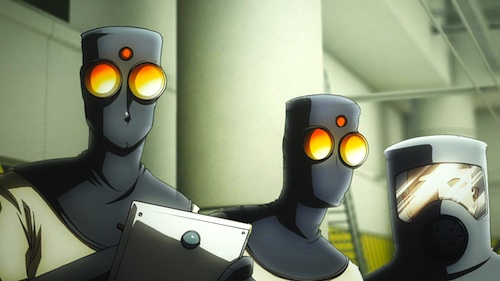
PostHuman is the perfect short for fans of the original Heavy Metal movie and magazine, both in terms of the hardboiled action and Kali’s wardrobe. It is short, but it is violent, in a good anti-authoritarian sort of way. Co-produced and co-edited by Jennifer Wai-Yin Luk, PostHuman is a muscular film with a striking anime-ish look that could easily serve as the prelude for a longer film or an ongoing series, like the 21st century indie version of a backdoor pilot.

From "PostHuman."

There are three reasons Comic-Con attendees should queue up for PostHuman. It is short, so it will not take too much time away from standing in other lines. It is action-driven, so it is easily processed. Perhaps most notably, it also stars the voice of geek pin-up Tricia Helfer from Battlestar Galactica.

PostHuman is a cool short film that hopefully leads to future follow-ups. It is exactly the sort of screening that press attending Comic-Con should be covering.

Fans on-the-ball enough to have gotten their tickets in the ten minutes they were on-sale, and then organized enough to arrange lodging, should check out whatever they wish and get plenty of guilt-free swag. However, they should also bear in mind that fanboy favorites like Christopher Nolan were once indies (those who were in front of the curve on Following probably feel pretty smart now), and that the CCI-IFF has a lot of talented filmmakers who have the potential to become big names – definitely including the team behind PostHuman. Highly recommended, it screens this Thursday (7/18) in San Diego, along with Dawn Brown’s charmingly nostalgic House of Monsters and Lee Dae-hee’s surprisingly bittersweet and mature Padak, as part of Comic Con’s 2013 Independent Film Festival.

Posted on July 16th, 2013 at 10:57pm.

LFM Reviews The Rooftop @ The 2013 New York Asian Film Festival; Opens Friday, 7/19

By Joe Bendel. That’s right, “Wax” is the word. Named for his hair styler, Wax is a singing kung fu motorcycle gang member, who is out to win the heart of the innocent ingénue. There will be dancing, fighting, and swooning in Jay Chou’s The Rooftop, the closing night film of the 2013 New York Asian Film Festival (and also part of the Well Go USA spotlight), which opens theatrically in New York this Friday.

Wax and his bowling biker buds live in the Rooftop section of Galilee, under the shadow of the huge outdoor billboards. They do not mind the scenery, though. In fact, they are rather fond of the one featuring Starling, a budding starlet and supermodel. Wax’s three stooges, Tempura, Egg, and Broccoli refer to her as “Sister-in-Law” to needle the big smitten lug. Everyone assumes nothing will ever come of his impossible crush until the day Wax picks up some part-time stuntman work getting the snot beat out of him on the set of her next picture.

Of course, she notices him. As their chaste courtship heats up, William (the one-named), Starling’s mobbed-up movie star patron, contrives to sabotage their romance. We know he is bad news because he is an associate of Red, one of Tempura’s unfriendly rent-collecting rivals working for the corrupt housing authority. That’s right, some of the villains are Taiwanese HUD bureaucrats, albeit decidedly more flamboyant than our homegrown variety.

From "The Rooftop."

For his second outing in the director’s chair, pop idol and action super-star Chou channels his inner Baz Lurhmann, unleashing a kaleidoscope of colors and staging big, flashy, razzle-dazzling musical numbers. Clearly not afraid of a little sentiment, Chou indulges one big melodramatic set piece after another. One minute Wax and Starling are strolling through a carnival, next they are dancing in the rain, and shortly thereafter they stare into each other eyes in his quaint rooftop neighborhood as fireworks explode in the background. It’s all good.

Chou and the radiant Li Xinai look like an attractive couple and develop some half decent romantic chemistry together. She even does some legit acting in her own scenes. However, the crafty old HK vet Eric Tsang often steals the show as Dr. Bo, the lads’ martial arts mentor and local snake oil salesman. Alan Ko also has his moments as Tempura, the enforcer trying to go straight. Unfortunately, the shticky comic relief delivered by Egg and Broccoli becomes embarrassing over time.

Still, Rooftop has a few gags that will have viewers laughing in spite of themselves. Truly, this is kitchen sink filmmaking. Chou throws it all in, including a way over the top framing device. Yet, Mark Lee Ping Bin, considered one of the world’s finest cinematographers for his work on films like Norwegian Wood, makes it all look bright and sparkly. If you want spectacle, Chou has your spectacle right here. Recommended for those who thought The Great Gatsby was too staid and did not have enough martial arts, The Rooftop officially closed this year’s NYAFF last night, but will open this Friday (7/19) in New York at the AMC Empire.

LFM GRADE: B-

Posted on July 16th, 2013 at 10:57pm.

LFM Reviews Thermae Romae @ The 2013 New York Asian Film Festival + The 2013 Japan Cuts

By Joe Bendel. When in Rome, do as the Japanese do. Time-travelling Roman architect Lucius Quintus Modestus unwittingly adopts this strategy. Sure, you might think he looks more Japanese than Roman, but there is no need for pedantry when Hideki Takeuchi’s Thermae Romae screened this weekend as a co-presentation of this year’s Japan Cuts and the New York Asian Film Festival.

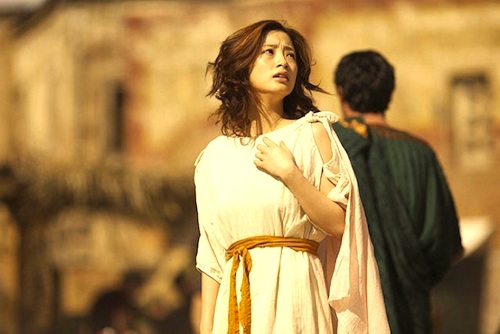
Nursing his wounded pride at a Roman civic bath, the recently fired Modestus is inexplicably pulled through the drainage system into modern day Japan. Initially contemptuous of the old-timers soaking in the neighborhood bath, the man has to admit their facilities beat anything Rome has to offer. It all rather overwhelms his Roman pride, while his chiseled looks overwhelm aspiring manga artist Mami Yamakoshi. After causing a great deal of naked commotion, Modestus quickly returns to his era, just as mysteriously as he left it. Soon he is the toast of Rome, applying the innovations he observed in Japan.

His new found fame earns Modestus the ear of the stern but wise Emperor Hadrian and his thoughtful counselor, Antoninus. Of course, the Emperor’s hedonistic adopted son Ceionius is a different story. Each time Modestus needs inspiration for a major commission, he somehow finds his way back to Japan and Yamakoshi, whether it be at the upscale bathroom showroom where she works part-time or at her mother’s rustic mountain spa. Eventually she will be pulled back to classical Rome with him, just in time for a major imperial power struggle.

From "Thermae Romae."

Based on a popular manga series that also spawned a short-lived anime incarnation, Thermae Romae has plenty of pratfalls and fish-out-of-water humor, but the cast plays it surprisingly straight. In fact, Masachika Ichimura and Kai Shishido play Hadrian and Antoninus as if they thought Sir Derek Jacobi might be popping round the set in his I, Claudius costume.

Hilariously stone-faced Kore-eda regular Hiroshi Abe does not really have that option, given how much time Modestus must run about in his altogether. Still, he conveys a sense of the architect’s principled rectitude, even when embroiled in truly outrageous situations. In a role original to the film, Aya Ueto is likable enough as Yamakoshi, but she is saddled with a problematically passive character. There are plenty of Euro-looking Romans as well, dubbed into perfect Japanese to keep the madness chugging along at full steam.

Partly filmed in Italy’s celebrated Cinecitta studio, Thermae’s period production scenes frankly look better than they needed to. It also observes the conventions of time travel movies, without getting bogged down in them. Lightweight but entertaining, it is a goofy romp that avoids all the cheap excesses of recent “Blank Movie” spoofs. Recommended for fans of time travel and manga-inspired films, Therma Romae will screen during this year’s Fantasia Film Festival, but Japan Cuts and the New York Asian Film Festival had it first.

LFM GRADE: B-

Posted on July 16th, 2013 at 10:56pm.

Don’t Hock What You Can’t Afford to Lose: LFM Reviews Pawn Shop Chronicles

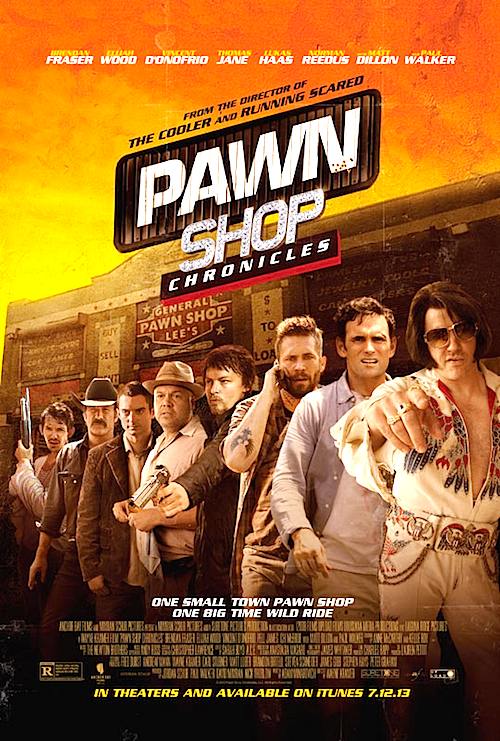
By Joe Bendel. How did we get so pathetically starved for entertainment as a society that we made reality TV stars out of pawn shop dudes? At least this slightly macabre anthology film puts hock shops back in their properly sleazy place. Everyone doing business at the General Lee Pawn Shop will be getting the shaft, but it will be fate and human nature doing the dirty work in Wayne Kramer’s Pawn Shop Chronicles, which opened Friday in New York.

Alton and his crony Johnson sit about the store grunting and guffawing, pausing to deal with the occasional pawn. Each transaction will cause big time trouble and regret for the General Lee’s walk-ins, like Vernon the meth head, who hocks his shotgun right before meeting up with his white supremacist buddies, Raw Dog and Randy, to hold-up their dealer. Of course, they are rather disappointed in his short-sightedness.

On paper, “The Shotgun” sounds like a cheap bit of hicksploitation, but it features some of the wickedest dialogue in the film, which Paul Walker and Kevin Rankin chew on with proper relish. Gleefully embracing cartoonish violence and a bizarre redneck brand of tolerance, PSC arguably puts its strongest foot forward first.

“The Ring” also has its exploitation merits, but viewers should be warned that it is the most explicit and disturbing installment of the film. Making amends for Crash, PSC’s pretentious evil twin, Matt Dillon plays a newlywed who chances into the General Lee, only to discover his presumably late first wife’s custom ring in the display case. Following the chain of wrongful ownership takes him into the lair of Johnny Shaw, the latest serial killer to be played by Elijah Wood.

Despite a sly riff on the crossroads legend, “The Medallion” is PSC’s weakest link. Seriously, a little bit of Brendan Fraser shticking up the joint as Ricky Baldoski, the low rent Elvis impersonator, goes a long, long way. Eventually, strands of the previous stories will transect this Faustian tale, but first viewers must sit through an extended gag involving the town’s rival barbershops that feels like it runs longer than The Winds of War.

Many have long awaited the film that features Wood, Lukas Haas, and DJ Qualls, but since they never appear here in the same scene together, we still cannot definitely say they are not one and the same person. Vincent D’Onofrio and Chi McBride are mildly amusing in the General Lee framing segments, but it is Walker, Rankin, and Dillon who are the film’s overachievers.

Much like a chaotic pawn shop, the inspired and the stupid comfortably sit side-by-side in PSC. To his credit, Kramer (in a radical departure from his excellent more-or-less feature debut, The Cooler) helms the madness with considerable energy and absolutely no shame. On balance, b-movie connoisseurs will enjoy checking it has appeared on VOD. It has also opened theatrically in New York at the AMC Empire and in Colorado at the AMC Westminster Promenade.

Posted on July 15th, 2013 at 9:32am.