Post-Dystopia Depression: LFM Reviews A Better World @ The 2013 Brooklyn Film Festival

By Joe Bendel. Think of this as what happens after the famous 1984 Apple commercial. Big Brother has fallen. Unfortunately, Henry Dremmel is no Winston Smith. Adjusting to a post-dystopian world will be difficult for him in Sacha Feiner’s short film A Better World, which screens during the 2013 Brooklyn Film Festival.

Dremmel the tool, works for the Domestic Denunciation Program. All day he monitors security cameras, reporting even the slightest deviations from the norm. One fateful night, Dremmel wakes to the sound of fireworks. The regime has fallen. Freedom has broken out, but the Denunciator cannot handle it. He prefers the structure of his drab, harshly regimented former existence.

Audiences are unlikely to see a film more explicitly associating the compulsive need for security with oppressive statism in a month of Sundays. What’s even more mind-blowing is that it hails from Belgium, the EU’s happy host nation. Regardless, writer-director Feiner really cuts to the heart of the matter. Dremmel is not an odious villain. A pathetic figure, he is the final victim of a de-humanizing collectivist system.

From "A Better World."

A Better World is also quite an impressive looking production. Olan Bowland’s bleak, washed-out cinematography and Julia Irribaria’s imposing sets create a perfectly Orwellian environment. Almost a prop himself, Vincent Kohler is appropriately cringey and clammy as Dremmel.

Despite its twenty-four minute running time, A Better World has more to say than most features. A genuinely challenging work (especially for Williamsburg hipsters), it is one of the best dystopian films of any length to hit the festival circuit. Very highly recommended, it screens this coming Monday (6/3) and Wednesday (6/5) as part of the 2013 Magnetic edition of the Brooklyn Film Festival.

Posted on May 31st, 2013 at 12:05pm.
LFM Reviews Kumpanía Flamenco Los Angeles @ The 2013 Dances With Films

By Joe Bendel. Maybe there’s still yet hope for Los Angeles: the city is home to a small but vibrant flamenco scene. Of course, nobody is making much money—quite the contrary. The musicians, vocalists, and dancers all simply share a passion for the music. Katina Dunn documents their musical camaraderie in Kumpanía Flamenco Los Angeles, which screens this afternoon during the “Sweet Sixteen” edition of Dances With Films.

Flamenco originated in the tightly knit Roma community of Seventeenth Century Spain. Musicians and dancers from other cultures have been drawn to the music, but according to one vocalist, only Spaniards can sing Flamenco with the right accent. (Yes, he happens to be a Spanish expat.) Regardless of authenticity issues, the Los Angeles Flamenco community is distinctly diverse. Many local Hispanic musicians have adopted the music as their own – including Joey Heredia, a professional drummer comfortable crossing stylistic lines, whose impressive credits include work with Tania Maria, Poncho Sanchez, and Diane Reeves.

From "Kumpanía Flamenco Los Angeles."

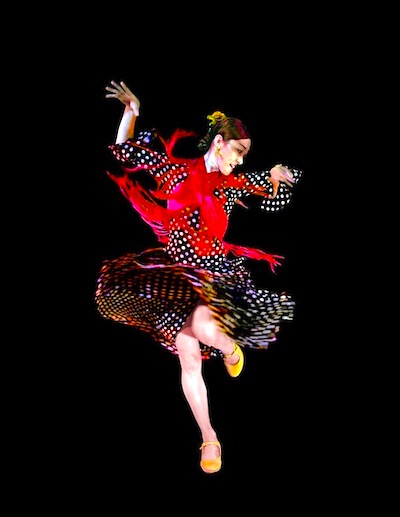
Japanese artists are also well represented in KFLA. Kyoto native Jose Tanaka is not just a leading guitarrista and composer, but clearly serves as a leader holding the community together. However, if one star truly emerges from the film, it would have to be Bailaora (dancer) Mizuho Sato. A striking performer with flawless technique, her sequences will hold viewers spellbound. She also provides real insight into the Flamenco aesthetic, especially when explaining how the demur nature of the presentation is part of what makes it all smolder.

Dunn nicely conveys the scene’s vibe and gives interested viewers an easy starting point to check out the assembled artists live—namely, the Fountain Theatre. Her selective but clever use of archival footage adds fitting context as well. She does right by the music, which is the most important thing.

While not reaching the lofty heights of Fernando Trueba’s Calle 54 (the true gold standard of music performance docs), KFLA is still quite a dynamic and engaging film. At just a whisker over an hour, it will leave most viewers wanting more. Appealing to the eyes and ears, Kumpanía Flamenco Los Angeles is recommended for general audiences when it screens this afternoon (5/31) as part of the 2013 edition of Dances With Films, in Hollywood, California.

LFM GRADE: B

Posted May 31st, 2013 at 12:04pm.

Kung Fu in The New China: LFM Reviews Dragon Girls @ The 2013 Brooklyn Film Festival

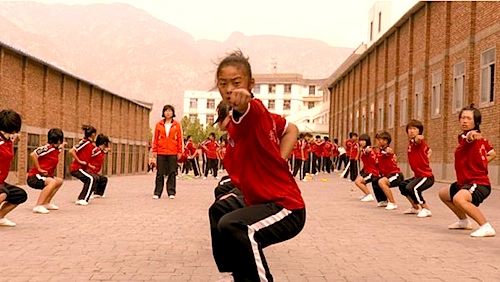
By Joe Bendel. Will one of these girls be the next Michelle Yeoh?  Possibly, but none of them seems to harbor such lofty aspirations. Regardless, they all train harder than most professional athletes in hopes of earning a better life for their families (shouldn’t that be the other way around?). Inigo Westmeier observes the rigorous routine of the Shaolin Tagu Kung Fu School’s students in Dragon Girls, which screens during the 2013 Brooklyn Film Festival.

For these mostly poor provincial students, kung fu school can lead to better military and police jobs than might otherwise be available to them. Unfortunately, the seven day training regime does not leave much time for the kids to be kids. The Shaolin Tagu School accepts both boys and girls, but Westmeier devotes about ninety percent of his attention to the latter, focusing on three particular girls with complicated family circumstances.

Much like the apparently abusive Shanghai Circus School documented by Guo Jing & Ke Dingding, life at Shaolin Tagu does not look like a lot of fun. On the other hand, at least it offers the girls some camaraderie. Given the realities of life for poor rural girls (such as the protagonist of Wang Bing’s Three Sisters), things could arguably be worse for the students. Still, the sanctimonious headmaster is obviously cutting corners with respects to sanitation and nutrition. Yet the most trying aspect for most of the girls is the lingering sensation of abandonment. Clearly, the school functions as an alternative to an orphanage for many essentially absentee parents.

Westmeier captures his three primary POV figures at their most open and vulnerable moments. Frankly, it is often difficult watching them struggle physically and emotionally, because they are really just kids. The extent of the headmaster’s authoritarian indoctrination is nearly as disturbing, if not more so.

From "Dragon Girls."

Despite all the issues the film raises, seeing the collective student body of 35,000 in action is admittedly impressive. For an observational style doc, there is a heck of a lot of spectacle in Dragon Girls. These kids are good—but the monks in the Shaolin monastery next door are probably better. As one might expect, they are less dogmatic and far more Zen-like in their approach to martial arts. Westmeier tellingly contrasts the two so-close-yet-so-far-apart Shaolin institutions without belaboring the point.

Dragon Girls further testifies to the vast class divisions demarcating today’s China. It might be tough viewing, but it is an honest reflection of reality. The extent to which Westmeier melds the social issue documentary with martial arts cinema is also rather notable. Recommended for fans of both genres who can handle some unvarnished truth, Dragon Girls screens this Saturday (6/1) at Windmill Studios and the following Thursday (6/6) at IndeiScreen as part of the “Magnetic” 2013 Brooklyn Film Festival.

LFM GRADE: B+

Posted on May 30th, 2013 at 4:27pm.

A Very Private Apocalypse: LFM Reviews The Wall

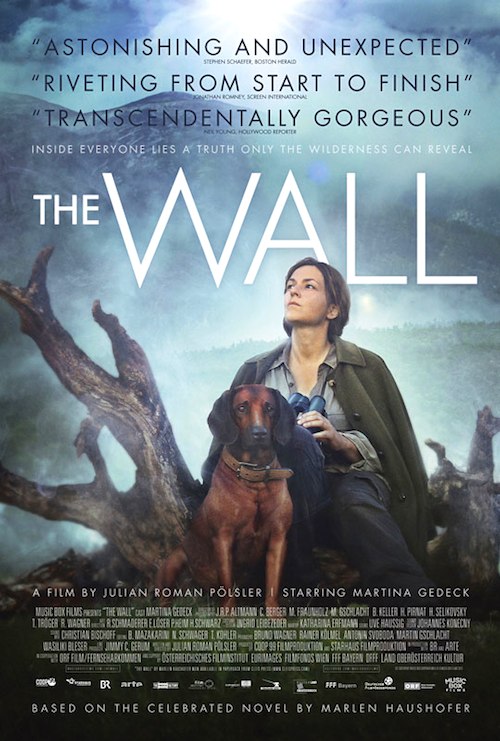
By Joe Bendel. When the television adaptation of Stephen King’s Under the Dome hits the airwaves, fans will duly wonder where he gets his ideas from. Hmm, maybe Christoffer Boe’s Allegro or Marlen Haushofer’s Die Wand. Of course, both predecessors are much more introspective in nature. Indeed, viewers witness a very private apocalypse in Julian Pölsler’s adaptation of Haushofer’s 1963 novel, The Wall, which opens this Friday in New York at the IFC Center.

A woman is holidaying with friends in an Austrian mountain lodge. Her hosts drive into town for supplies and never return. Venturing out the next morning she discovers an invisible barrier blocking the road. Scouting the mountainside, she discovers that the strange wall encircles her. She can see people on the other side, but they appear frozen in place. Time seems to only pass on her side of the wall, but it passes very slowly.

Told in flashbacks via the unnamed woman’s journal entries, The Wall consciously echoes Robinson Crusoe. With no Man Friday, the woman develops a close bond with the couple’s dog, Lynx. Indeed, it is largely her rapport with animals that keeps the woman engaged in her solitary world.

Obviously, The Wall implies much about man and our unbalanced relationship with nature. The English language voice-overs are often rather heavy-handed (and clash with the limited subtitled German dialogue) but the film’s vibe and rhythm are eerily evocative. Viewers will feel like they are getting a true taste of what it would be like to be the last sentient person on Earth.

Shot over the course of several seasons, Pölsler and his battery of cinematographers fully capitalize on the stunning scenic vistas that utterly dwarf the lone woman. Carrying the film almost single-handedly, Martina Gedeck (co-star of the modern classic The Lives of Others) gives a remarkably assured performance. Mixing depression and empowerment, it might be the purest cinematic portrayal of existential living. However, it is also worth noting Pölsler’s own dog Lynx is quite the performer in his own right.

The Wall may well be a rebuke of patriarchy and industrialization, but it still works rather well as a survivor’s story. Admittedly, it is deliberately paced (for obvious reasons), but the overall effect is hypnotic. Recommended for those who appreciate apocalyptic and allegorical cinema, The Wall opens this Friday (5/31) at the IFC Center.

LFM GRADE: B

Posted on May 30th, 2013 at 4:26pm.

LFM Reviews Sunny @ New York’s Korean Movie Night

By Joe Bendel. If Rizzo were dying of cancer, surely Frenchie would reunite the Pink Ladies. Such is the position married and well-to-do Im Na-mi finds herself in. Some members of the girl gang are happy to get back together, but others are harder to find in Kang Hyeong-chul’s monster hit Sunny, which screens tonight as part of the Korean Cultural Service’s free Korean Movie Night in New York.

While not exactly a life of quiet desperation, Im leads a sheltered existence that is not wholly fulfilling. Since her husband and daughter are too busy to visit her mother-in-law in the hospital, she upholds their obligations. During one such visit, she chances across the room of Ha Chun-hwa, the leader of the clique dubbed “Sunny.” When Im’s family moved to Seoul from the countryside, Ha took the shy teen under her wing. As we watch in flashbacks, most of Sunny quickly fell in line, but not Jung Su-ji, the moody prospective model.

When not rumbling with other girl gangs, Sunny practiced their choreography. However, they were never able to perform their big number, for reasons that will eventually be revealed. Hmm, anyone smell some unfinished business here?

In a Korean film, when a character is introduced with a fatal illness in the first act, it is a cinch there will be an emotional funeral coming down the pike. This goes way beyond Chekhov’s gun. Without a big weepy payoff, audiences would want their money back. Not to be spoilery, but Sunny delivers the goods.

Yes, this is a chick flick, but it is an admittedly well crafted film. Employing some surprisingly striking transitions for each temporal shift, Sunny is more visually stylish than it probably needed to be. In fact, Nam Na-yeoung won the best editing honors at Daejong Film Awards for good reason. As the narrative unfolds, it pulls you in – despite viewers’ macho or hipster resistances.

From "Sunny."

Yoo Ho-jeong plays grown-up Im with admirable restraint, never overplaying the gilded cage empowerment card. Likewise, Shim Eun-kyung is earnest and awkward as teenaged Im. Yet both Jin Hee-kyung and Kang Sora really outshine the ensemble as the ailing adult and fearless teenaged, Ha, respectively. Although hardly a teen herself, singer Min Hyo-rin has her moments as the high school ice queen, Jung. As for her adult counterpart, that is really the question driving Sunny’s third act.

If Cyndi Lauper floats your boat and you prefer Boney M’s version of the title song over Bobby Hebb’s original, than Sunny’s unabashedly 1980’s soundtrack will be your catnip. The ways screenwriter-director Kang interjects and darts around the May 1980 democracy protests also gives the film a bit of seasoning. He certainly conveys his point of view, without waving the bloody shirt. Sunny is shamelessly manipulative and sentimental, but it does exactly what it sets out to do. Recommended for those looking to celebrate sisterhood, it screens tonight (5/28) at the Tribeca Cinemas—free of charge, courtesy of the Korean Cultural Service in New York.

LFM GRADE: B-

Posted on May 28th, 2013 at 12:30pm.

The Irish Rep Revives The Weir

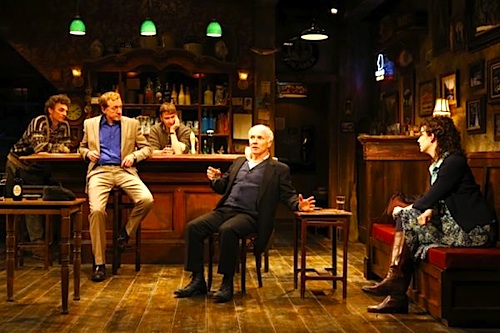
By Joe Bendel. Is it the booze or is it the blarney? The two go together for the patrons of a remote Irish pub. However, their ghostly tall tales take an unexpectedly serious turn in the Irish Repertory Theatre’s revival of Conor McPherson’s The Weir, which officially opened last Thursday night in New York.

Brenden’s pub is a quiet, out-of-the-way spot, aside from the dreaded nights when busloads of German tourists descend on the barkeep like locusts. Jack, the pugnacious mechanic, and the morose mother’s boy Jim have come to spy on Finbar Mack, the local wheeler-dealer as he attempts to charm the village’s newest resident. Valerie is a woman and therefore of interest to everyone present.

The former Dubliner seems genuinely interested in the history of the area and the legendary fairy road that supposedly runs through Brenden’s public house, opening the door for a series of ghost stories. Initially they seem like campfire fare, but they have a profound effect on her. It seems she has her own deeply tragic story to tell that will echo and amplify the uncanny elements of their prior anecdotes.

McPherson is a great writer, with a flair for dialogue and a wonderfully sly approach to the telling of a tale. His mature, humanistic handling of supernatural themes comes as a welcome antidote to the adolescent angst of Twilight and the like. McPherson’s dramas, most certainly including the Olivier award winning The Weir, are also Irish to the bone, making them perfect vehicles for the Irish Rep. Indeed, The Weir boasts some wickedly droll “pub” humor. Yet, despite the heavy portents, it is shockingly endearing. While there are definitely spooky components, at its core The Weir speaks to the therapeutic benefits of getting pie-face hammered and talking malarkey.

From "The Weir."

The Weir is a true ensemble piece, but Jack the diehard Guinness man gets the big, climatic monologue and Dan Butler (probably best known as Bulldog on the Frasier show) absolutely kills with it. He masterfully expresses all of Jack’s bluster and his deepest regrets. In contrast, the hospitable Brenden might be the least showy role, because he is the only character who does not have his own personal yarn to spin (remember, it is a bartender’s job to listen). Still, he gets most of the funny bits, which Billy Carter makes the most of. He also develops some subtle-as-a-dew-drop chemistry with Tessa Klein’s Valerie.

A strong five-handed cast all around, John Keating and Sean Gormley add earthy color and character as Jim and Mack, respectively. Listening to their eerie camaraderie is a finely staged pleasure.  Director and Irish Rep co-founder Ciarán O’Reilly seamlessly guides the memorable production through McPherson’s subtle tonal shifts. Patrons should know coming in it runs straight through without an intermission, but ushers will remind you about a thousand times before it starts. Highly recommended, The Weir runs through July 7th as part of the Irish Repertory Theatre’s 25th anniversary season.

Posted on May 28th, 2013 at 12:29pm.