Casks & Caskets: LFM Reviews Blood of the Vine Seasons 1 & 2

By Joe Bendel. Murder and vino have always gone together, ever since Montresor offed Fortunato in “A Cask of Amontillado,” so who would make a better amateur sleuth than an enologist (wine expert)? For a vintner accused of murder, Benjamin Lebel is the man to call in Blood of the Vine, seasons one and two, now available as two separate 2-DVD sets from MHz Networks.

In the series opener, Tears of Pasquin, the Bordeaux based Lebel puts the moves on an attractive colleague, France Pelletier. She is mature enough to consider his assistants, Mathilde and Silvère, wet-behind-the-ears kids, but she is still young enough to look good on his arm. Over the next two seasons, she will become accustomed to having romantic dinners and weekend getaways interrupted by murder.

Pasquin happens to be one of the series’ more intriguing crime stories. What appears to be a serial killer case ultimately involves the nasty legacy of Vichy era collaboration. That still seems bold for French television. Pasquin also introduces Lebel to Commander Barbaroux of the Bordeaux police force, who is admittedly befuddled by the rare bottles of Pasquin left at multiple murder scenes. He calls in Lebel as a consultant, but quickly has misgivings.

Loyal Silvère looks different in Le Coup de Jarnac, but replacement Yoann Denaive and the rest of the regulars will stick around for the balance of the first two seasons. Hired to audit the storied Aludel cognac distillery divided by feuding siblings, Lebel and his assistant receive a rather frosty reception at the chateau. However, Lebel is quite welcome at the tavern in town co-owned by his old flame, Shirley. Unfortunately, the legendary mixer and friendliest Aludel heir falls victim to an untimely accident.

From "Blood of the Vine."

Vine often features well known guest stars (at least to French audiences), such as Marisa Berenson, the co-star of films like Barry Lyndon and Cabaret, as well as a one-time guest host of The Muppet Show. As Shirley, she and series star Pierre Arditi have a nice wistfully flirtatious thing going on.

Likewise, Margaux’s Robe features another notable guest star, Arditi’s daughter Rachel, playing Lebel’s daughter, Margaux. Recently, returned from New York, Margaux Lebel has accepted a PR job with a new Chateau owner who is absolutely, positively not a member of the Russian mob. When sabotage kills Margaux’s co-worker-lover and badly injures her, the Soviet educated Swiss mogul puts pressure on Lebel to solve the case quickly or he will do it his way, which adds a good twist to elegant sleuthing.

Fittingly, the first season ends with one of the better crafted mysteries, while also challenging Lebel’s loyalties. When a former assistant’s struggling chateau is beset by a suspicious outbreak, Lebel comes to investigate. Knowing the grand dame who once fired him covets their land, Lebel pays a visit to the regal Mme. Newman. Both Arditi and Judith Magre (probably best known for Louis Malle’s The Lovers) clearly relish their affectionately acid-dripped banter.

Season two begins with A Question of Brandy . . . or Death. Once again, Lebel and his assistants have been hired to assess a struggling distillery. In this case, it is the Baron Castayrac who expects Lebel to simply sign off on his insurance claim, but the enologist does not play that game. Pretty much every key element of the series comes into play in this episode, with a union boss of questionable repute thrown in as an added bonus. Continue reading Casks & Caskets: LFM Reviews Blood of the Vine Seasons 1 & 2

MoMA’s Chinese Realities Series: LFM Reviews Though I Am Gone

By Joe Bendel. Wang Qingyao’s words have an eerie resonance. He is determined that his wife’s murder during the Cultural Revolution will not be denied or forgotten by the guilty and embarrassed parties. Despite his personal pain, he documented his family’s tragedy with remarkable thoroughness. It is an acutely personal story, but one with national significance for China that unfolds in Hu Jie’s Though I Am Gone, which screens during MoMA’s Chinese Realities/Documentary Visions film series.

During the Cultural Revolution, Beijing schools were the incubators of the institutionalized insanity. Unfortunately, Wang’s wife was a middle school vice principal in the wrong city, at the wrong time. When the Red Guards began terrorizing the country, their children followed their lead. Even though Bian considered herself a loyal Communist since before 1946, she was forced to endure physical beatings and public humiliations on a daily basis. Fearing for her family’s safety, Bian resigned herself to the torments. One day, the students took it too far and rather than taking her to the hospital literally one block away, they just threw her out like a sack of garbage.

Her husband was not on hand to witness the torture she endured. It only would have made things worse for her. However, the trained journalist photographed her battered body and saved evidence of her ordeal, including the blood and excrement soaked clothes she wore during her final hours. Years later, an anonymous source came forward to give him an exact accounting of the events. Not surprisingly, though, only Bian’s fellow victims agreed to participate in Hu’s documentary.

From "Though I Am Gone."

As a filmmaker, Hu’s approach is as simple and straight forward as it can be. Even eschewing soundtrack music, he focuses his camera on Wang and his photographs, allowing the man to tell her story in his own words. He also incorporates archival recordings of the state sanctioned madness as well as personal testimony from Bian’s colleagues.

Speaking of the need to bear witness, Wang Qingyao echoes sentiments often heard in Holocaust survivors’ oral histories. When he eventually produces a photo of the smoke coming from the chimney of the crematorium where his wife’s remains were incinerated, the symmetry becomes profoundly unsettling. While Hu maintains an intimate focus on Bian’s story, he masterfully conveys a sense of how truly representative it was of rampant, widespread horrors.

On a technical level, Though I Am Gone is a simple film, but it is emotionally devastating. This is an incredibly brave expose of events the Party would prefer to forget. Highly recommended for general audiences, particularly including middle school aged students, Though I Am Gone (also distributed by dGenerate Films) screens this coming Tuesday (5/28) and the following Saturday (6/1) as part of Chinese Realities at MoMA.

LFM GRADE: A

Posted on May 23rd, 2013 at 12:37pm.

The Other White Meat, on The Black Market: LFM Reviews A Pig Across Paris

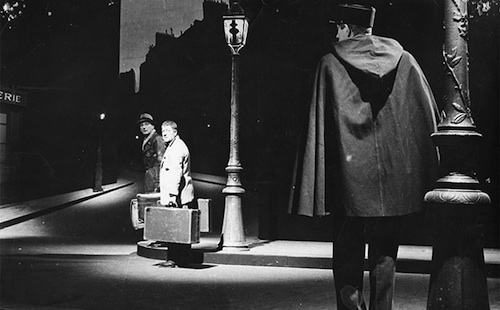
By Joe Bendel. This little piggy is supposed to go to the black market. It is Marcel Martin’s job to take him, but he cannot schlep four suitcases fully loaded with pork goodness on his own. He will have some dubious help from a mysterious stranger in Claude Autant-Lara’s classic A Pig Across Paris, which opens this Friday in New York at Film Forum.

Martin was once a taxi driver, but the German occupation has been bad for business – what with the curfews, rubber and gasoline rationing, and constant military patrols. Technically, he is unemployed, but Martin still provides for his somewhat out of his league wife through black market gigs. Skeptical of her fidelity, Martin button-holes Grandgil, a stranger he suspects of being her lover. When satisfied this is not the case, he recruits the stout fellow to help him carry his freshly slaughtered baggage across town.

Much to his surprise, his new companion more or less takes over the operation. He is resourceful but somewhat reckless. They bicker like an old married couple and the leaking baggage draws a pack of appreciative dogs, but somehow the two men proceed to navigate the nocturnal world of air raids and police check points. Yet, irony is always waiting just around the corner for them.

A Pig Across Paris (a.k.a. Four Bags Full, a.k.a. La traverse de Paris) is one of those films that almost got away. Surprisingly, it was a hit in France, but at the time, it snuck in and out of American theaters like a black-marketeer with a side of bacon stuffed in his trousers. Happily, it now returns to circulation with a newly translated set of subtitles. There is indeed a reason the Nouvelle Vague enfants terribles singled out Pig as one of their few worthy French predecessors. Autant-Lara’s depiction of occupied Paris is far bolder and more barbed than really any of the films they produced in the 1960’s.

From "A Pig Across Paris."

Adapted from a short story by Marcel Aymé, Pig presents a full spectrum of cowardly and/or opportunistic behavior. This is the black market after all, not the resistance. Indeed, the latter are nowhere to be found. As befitting Autant-Lara’s lefty inclinations, rather pronounced class differences emerge between the two men.

They are well paired though. As the more well-heeled Grandgil, Jean Gabin is both appropriately manly, in a Spencer Tracy kind of way, but also convincingly sophisticated and rather condescending. Likewise, Bourvil (as André Robert Raimbourg billed himself) perfectly balances broad comedy with tragic pathos as the increasingly put-upon Martin. They are one of the great big screen odd couples.

There are a lot of funny bits in Pig, but it never whitewashes the era. Frankly, Autant-Lara’s film is not so far removed from Jean-Pierre Melville’s Army of Shadows, both in terms of their morally ambiguous milieu and quality of execution. Highly recommended for general audiences, A Pig Across Paris opens this Friday (5/24) in New York at Film Forum.

LFM GRADE: A

May 21st, 2013 at 1:59pm.

Marriage, Korean-Chinese Rom-Com Co-Production Style: LFM Reviews A Wedding Invitation

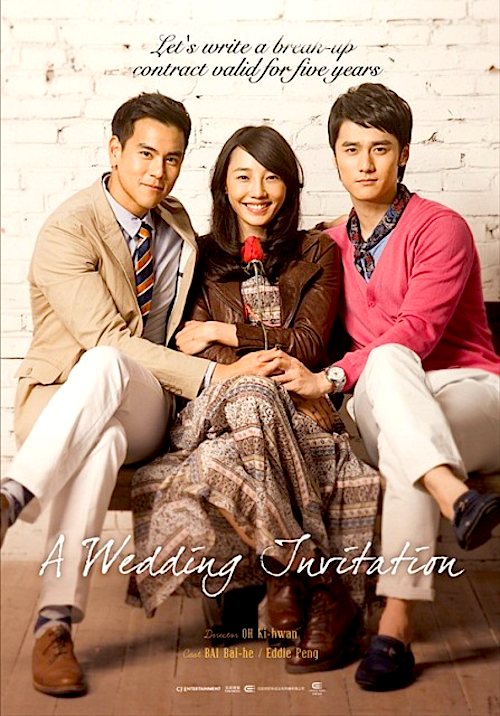
By Joe Bendel. Love means never having to ask: “where have you been for the last five years?” When dumping Li Xing, He Qaio Qaio thought they needed time to establish their careers. If they were still single five years later, then they should get married at that point. However, a lot can happen in five years, including his eleventh hour engagement to the boss’s daughter. As you might have guessed, He will try to win back her soul mate in Oh Ki-hwan’s A Wedding Invitation, which opens this Friday in New York.

Yes, you probably think you have seen this film before, just with a less attractive cast. He Qaio Qaio does indeed travel to Beijing, ostensibly to celebrate Li Xing’s wedding, but really with the intent to seduce and disrupt. She even enlists her gay best friend to pretend to be her lover, in hopes of making Li Xing jealous. Oh, but not so fast. In its third act, Invitation veers into three hanky territory, doing what commercial South Korean cinema does best.

Frankly, if you want to enjoy the guilty pleasure of a weepy melodrama, you have to look east. Hollywood does not do Affairs to Remember anymore. Everything has to be ironic or quirky these days. A multinational co-production, Wedding features a Mainland and Taiwanese cast and a largely Korean crew on the other side of the camera.

It is a division of labor that works relatively well. As He, the luminous Bai Bai-he is initially exasperating in the Julia Roberts portion of the film and then heartbreaking in the Il Mare-esque conclusion. Although Eddie Peng is no stranger to the rom-com genre (having been totally overshadowed by Shu Qi in Doze Niu’s Love, for instance), he really comes into his own with his work as Li Xing. While suitably earnest, there is also an edge to his Top Chef contending leading man turn. Pace Wu (a.k.a. We Pei Ci) does not get much dramatic heavy lifting, but she is far more charismatic than comparably inconvenient fiancées in rom-coms past.

In the opening screwball section, viewers are likely to wince at the flat-footed He, but down the stretch they are guaranteed to get a little misty-eyed for her. Sure, that is all very manipulative, but audiences will feel like they have been through a lot with these characters. Oh, the rom com specialist, deftly manages the frequent flashbacks and keeps the proceedings pleasantly pacey. Recommended for those not afraid of a little sentiment (or a lot), A Wedding Invitation opens this Friday (5/24) at the AMC Empire in New York and the AMC Metreon in San Francisco.

LFM GRADE: B-

Posted on May 21st, 2013 at 1:59pm.

MoMA’s Chinese Realities Series: LFM Reviews San Yuan Li

By Joe Bendel. It could be called a vanguard village. Now entirely encircled by Guangzhou’s urban sprawl, San Yuan Li was once a hotbed of resistance during the Opium Wars. However, drug abuse and other social pathologies have recently become comparatively more advanced there. Yet, new and old China persist, side-by-side each other. A team of artists document the neighborhood’s daily facts of life in Ou Ning & Cao Fei’s San Yuan Li, which screens with Huang Weikai’s Disorder as part of MoMA’s Chinese Realities/Documentary Visions film series.

Industrialization has left a questionable mark on the village. In rapid succession, the audience sees the cramped narrow alleys, dingy sweatshops, haunted looking factories, and the hardscrabble laborers toiling along the river. These are literal “fly-over People,” living beneath the constant approach of airliners. In contrast, viewers also encounter the modern consumerist class (often at booty level), as well as the young color guards and traditional performers representing the ideals of previous eras.

With its frenetically quick cuts and driving soundtrack, San Yuan Li is far more accessible than the term “experimental documentary” would suggest. Although shot in a very stylish black-and-white, the film is sort of like a National Geographic photo spread with a postmodern sensibility and an elevated social awareness. The net effect is often rather hypnotic. While not quite as pointed as Disorder, they are quite a compatible pairing, collectively clocking in at about one and three-quarter hours.

From "San Yuan Li."

Still, there are plenty of telling images throughout San Yuan Li. Indeed, any appearance of Mao portraiture is now ironic, haunting either the go-go capitalism or mounting class inequities unleashed by the Party. Yet, there is also dignity in the faces of average citizens, particularly the diverse selection of work teams captured late in the film.

Neither documentaries have narrative structures per se, but they both convey a vivid sense of contemporary China. As it happens, both San Yuan Li and Disorder are distributed by the dGenerate films, the invaluable specialists in independent Chinese cinema. Highly recommended for China watchers who want to do exactly that, they screen together this Wednesday (5/22) and the following Monday (5/27) as Chinese Realities continues at MoMA.

LFM GRADE: B

Posted on May 20th, 2013 at 2:19pm.

MoMA’s Chinese Realities Series: LFM Reviews Yumen

By Joe Bendel. That hardly took long. An oil boomtown in the 1990’s, Yumen is now a deserted ghost town—literally so if you believe some of the stories told by stragglers. Regardless, viewers certainly get a vivid sense of contemporary China’s “burn rate” in Huang Xiang, Xu Ruotao & J.P. Sniadecki’s Yumen (trailer here), which has its North American premiere tomorrow during MoMA’s ongoing Chinese Realities/Documentary Visions film series.

According to one disembodied voice-over, the abandoned hospital is and was haunted by the spirit of an infant. She once saw it with some friends, one of whom still bears a scar from the encounter. Another man also remembers the hospital, having frequently visited an ambiguously sickly woman there. These remnants of Yumen’s glory days are like ghosts themselves, often filmed like ant-like specks shuffling through the surreal post-industrial landscape.

The directorial trio consistently plays games with the doc format, incorporating what sound like staged reminiscences and showing the seams in between their 16mm reel changes. Nonetheless, there is no mistaking the reality of the northwest Gansu town. It is simply impossible to recreate ruins of such scale on an indie budget. It looks like Pripyat outside of Chernobyl, just without the background radiation (as far as we know).

From "Yumen."

For what it’s worth, the woman’s ghost story is kind of creepy. Yet more to the point, the intertwining memories and images clearly illustrate the pain and dislocation resulting from the death of a community, even one not especially beloved by its residents, such as Yumen.

Yumen is an impressive looking film, but even at its sixty-five minute running time, it feels a smidge stretched. Certain visuals start to repeat themselves and a late scene rather overindulges in globalist irony, as one of their POV figures strolls through a nearby open air market singing along to Springsteen’s “My Hometown.” As a multi-millionaire and self-appointed spokesman of the proletariat, Springsteen might actually be the perfect voice for today’s China, but the sequence just feels too long and stagey.

If you want to get a good look at Yumen this film is probably your best option, because the government is not likely to sponsor tours there anytime soon. It is not for everyone, but it should fascinate those with a taste for more experimental documentaries in the spirit of Disorder and San Yuan Li. Recommended for aesthetically adventurous China watchers, Yumen screens this Monday (5/20) at MoMA, presented in-person by Sniadecki, the former American expatriate filmmaker, whose previous credits include Chaiqian and Sognhua, two similarly naturalistic observations of Chinese daily life.

LFM GRADE: B-

Posted on May 20th, 2013 at 2:18pm.