Martial Arts On-Stage: LFM Reviews Deadly She-Wolf Assassin at Armageddon!

By Joe Bendel. Revenge is a family business for the characters of Lone Wolf and Cub. This is not exactly an official stage adaptation, but fans of the manga and films will recognize certain elements. The Rogue Assassin’s young Boy did indeed choose the sword over the ball. However, they might just meet their match in the form of the titular nemesis in Fred Ho & Ruth Margraff’s musical martial arts stage-production, Deadly She-Wolf Assassin at Armageddon!, which officially opened this weekend at La MaMa’s Ellen Stewart Theatre.

Once, the Rogue Assassin was the Shogun’s Kaishakunin, until the Imperial councilor, Iyagu of the ruthless Yagyu clan, convinced the old tyrant to turn against his loyal executioner. Iyagu’s assassins succeed in killing his wife, but the Shogun’s betrayed “second” escapes with his infant son. This proves to be a costly escapade. For ten years, the Rogue Assassin cuts through the Imperial assassins and ninjas like butter, depleting the Shogun’s treasury and undermining his ruling authority.

Rather sick of it all, the Shogun imports three super assassins from abroad, at considerable cost to Iyagu’s face. Not inclined to take matters lying down, the old conspirator plays his trump card, unleashing the She-Wolf Assassin. Raised from infancy to be Iyagu’s personal La Femme Nikita, her fate is mysteriously intertwined with that of the renegade father and son.
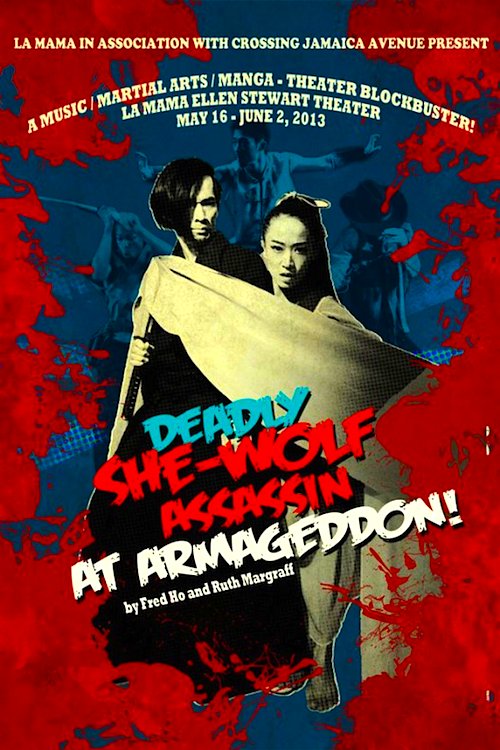
Much fighting ensues, impressively choreographed by lead actor Yoshi Amao for swords and Emanuel Brown (Electro in Broadway’s Spider-man: Turn Off the Dark) for martial arts beatdowns. The resulting spectacle is musically accompanied by the Afro Asian Music Ensemble, under the direction of conductor-multi-reed player Masaru Koga, performing Fred Ho’s funky Lone Wolf-inspired score. Incorporating elements of electric bass and baritone sax driven blaxploitation soundtracks and traditional koto and shakuhachi music, Ho’s themes are hip and propulsive, yet still fit the Jidaigeki action on-stage.

Unfortunately, Ho’s hardcore leftist ideology does not serve the story as well. Frankly, the Uncle Sam assassin caricature is just laughably didactic. A chicken fried colonialist, Colonel USA is hardly representative of the inward looking American foreign policy during the Edo era (1603-1868). Frankly, it is a bit of agitprop street theater that does not fit the otherwise dignified Noh-esque production.

Regardless, the stagecraft of She-Wolf is quite impressive. The lighting and smoke are suitably moody and the spare set is rather evocative. Likewise, the costumes provide the right period look without interfering with the fight choreography.

The cast holds up their end, too. Yoshio Amao is all kinds of brooding badness as the Rogue Assassin, but Ai Ikeda does him one better as the steely She-Wolf. Takemi Kitamura also shows some dramatic flair and action cred as She-Wolf’s sister (the most substantial of her three roles).   As is standard practice, two young actors rotate as the Boy. Bradley Fong showed real presence in the part Sunday afternoon, never drowning amid all the stage effects and melee unleashed around him. (His alternate, Jet Yung is surely quite good, as well.) With Perry Yung’s Iyagu chewing the scenery with admirably villainous glee, it is a strong ensemble all around.

This is one of the better martial arts themed productions to grace New York’s independent stages in a fair amount of time and the music is always very cool. There are certain awkward excesses to She-Wolf, but that is sort of par for the course in New York’s theater world. Hopefully, Mr. Ho is happy with director Sonoko Kawahara’s muscular staging, considering the program’s sad note regarding his ill health. Recommended for martial arts fans and soul-world fusion jazz listeners, She-Wolf Assassin at Armageddon! runs through June 2nd at La MaMa’s Ellen Stewart Theatre.

Posted on May 20th, 2013 at 2:17pm.

American Master: LFM Reviews Mel Brooks: Make a Noise; Premieres on PBS Monday, 5/20

By Joe Bendel. He has only helmed eleven feature films, but he defines the art of tasteless comedy. Mel Brooks more or less invented the movie spoof genre, before the Wayanses thoroughly discredited it. Now the Emmy, Grammy, Oscar, and Tony Award winner gets the American Masters treatment in Robert Trachtenberg’s Mel Brooks: Make a Noise, which airs this Monday on PBS stations nationwide.

As the 2,000 Year Old Man, Brooks has quite a career to look back on. His first big break came on television as a writer for Sid Caesar’s Your Show of Shows, the classic sketch comedy showcase that would later serve as a model for the nostalgic Peter O’Toole dramedy My Favorite Year, which Brooks’ company produced. He subsequently made a name for himself with the aforementioned comedy act he developed with Carl Reiner, but a handful of classic movies would establish Brooks as a brand name.

Logically, Trachtenberg devotes considerable time to The Producers, Blazing Saddles, and Young Frankenstein, adding reminiscences from Brooks regulars like Gene Wilder and Cloris Leachman. He also includes some fitting archival footage of Marty Feldman, Madeline Kahn, and of course Anne Bancroft. Clearly, they shared one of the few true show business romances. Yet, to his credit, Brooks sounds quite gracious when discussing his first wife.

A young Mel Brooks.

Brooks must be an exceedingly difficult interview subject, but Trachtenberg’s persistence is impressive. From time to time, he also surprises Brooks with the insight of his questions, as when he asks the writer-director when he first became aware of Hitler (who plays such an unusual role in Brooks films like The Producers).

There are not a lot of surprises in Noise, nor does Trachtenberg delve shockingly deeply into Brooks’ psyche. Nonetheless, he nicely captures the comedy giant’s dichotomies. Viewers see a smart, thoughtful man with a talent for fart jokes. We understand he is a private individual by temperament, but has a healthy disregard for his own public image. Overall, it is a highly watchable profile that should entertain Brooks’ many fans when it airs this coming Monday (5/20) as part of the current season of American Masters on PBS.

LFM GRADE: B

Posted on May 17th, 2013 at 11:09am.

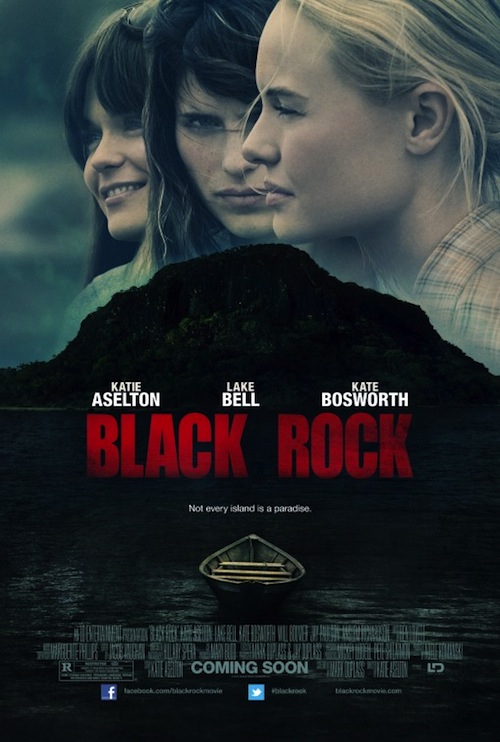
This Trip is No Fun: LFM Reviews Black Rock

By Joe Bendel. Who goes camping on a remote coastal Maine isle during the off-season? Psycho killers and their made-to-order victims, that’s who. There is nothing inherently wrong with a traditional slasher movie set-up, but the execution is decidedly problematic throughout Katie Aselton’s Black Rock, which opens today in New York.

Sarah has tricked her childhood friends Abby and Lou into joining her on a camping trip, in hopes that they will bury the hatchet. Years ago, Lou bedded Abby’s boyfriend. Still nurturing her resentment, the soon-to-be divorced Abby is not ready to forgive and forget. When they run into three hunters, the thoroughly annoyed Abby gets sloppy drunk and flirty with Derek, the alpha male, who rather misconstrues her attentions. This leads to all kinds of trouble.

When one of the sullen hunters tells the women what a hero Derek was in Iraq, no matter what they said at the court martial, we know what kind of movie we’re in for. Yes, that’s right, they are unhinged veterans. You might have thought the sleazy psycho Vietnam Vet exploitation film was an embarrassing relic of the 1970’s, but evidently Aselton and her husband-screenwriter Mark Duplass are determined to revive it. Yes, this is how the Duplass household would like to thank all our men and women in uniform: by suggesting they are an inch removed from Richard Speck. Really, you shouldn’t have.

Oddly, the first ten minutes or so show a flash of promise thanks to some caustically catty dialogue. That promise is short lived. By the time the bound women goad the craziest of the crazies into letting them go so they can hunt them down like real men, audience emotional detachment should reach one hundred percent. Nor does Rock have the guts to go all in with its gender-based victimization and retribution themes, a la I Spit on Your Grave. Instead, Aselton and Duplass basically follow the Most Dangerous Game template, chapter and uninspired verse.

To be fair, Kate Bosworth has some nice moments as the somewhat likably goofy Sarah. However, Aselton and Lake Bell largely blend together as Abby and Lou (or Lou and Abby). As their three antagonists, Jay Poulson, Will Bouvier, and Anselm Richardson never transcend their characters’ cookie-cutter stereotypes. Of course, they are not supposed to.

As a horror film, Black Rock is a bore. Yet, it has the potential to be something far worse. It is easy to see unsavory elements repurposing the exploitation flick to demonize American servicemen. After all, we know the Frankfurt terror attack was inspired by Brian De Palma’s Redacted and for weeks the administration blamed Benghazi on a YouTube video. A disappointment on every level, Black Rock is not recommended for anyone under any circumstances when it opens today (5/17) at the Village East.

LFM GRADE: F

Posted on May 17th, 2013 at 11:08am.

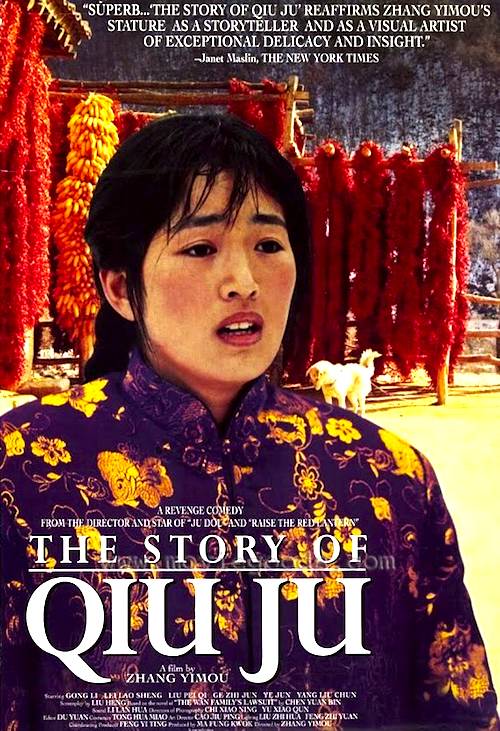
MoMA’s Chinese Realities Series: LFM Reviews The Story of Qiu Ju

By Joe Bendel. It is hard to get around the symbolism of it all when a local village official deals a swift kick to a peasant’s family jewels. Technically, that is not considered proper behavior, but getting justice from the Party is a tricky undertaking. However, his pregnant wife is determined to extract an apology in Zhang Yimou’s The Story of Qiu Ju, which screens tomorrow as part of MoMA’s Chinese Realities/Documentary Visions film series.

A Golden Lion award winner at Venice, Zhang adapted Chen Yuanbin’s novella with a documentarian’s eye for realistic detail—hence its inclusion in MoMA’s current retrospective. Following Qiu Ju’s quest for redress, her Story makes a fitting companion film to Zhao Liang’s Petition (also screening at MoMA), even though it is considerably more ironic and less harrowing. Regardless, justice was clearly an elusive proposition in 1990’s China (and remains so today).

During a stupid argument, Wang Shantang applied said kick to Qinglai. While problematic under any circumstances, injury to Qinglai’s reproductive organ carries far greater implications for the couple due to China’s population control policies. Should Qiu Ju miscarry, they could be permanently out of luck. Regardless, Wang is not apologizing, so Qiu Ju presses her case up the administrative ladder, with little support from the sulking Qinglai.

Needless to say, Chinese officialdom is rather inclined to circle the wagons around one of its own. There is indeed a pronounced Kafkaesque element to the film. Yet, Qiu Ju is no standard issue victim. Her indomitable spirit is rather ennobling, in marked contrast to the typically depressing protagonists of Sixth Generation social issue dramas and some of their Fifth Generation forebears. Likewise, there is an unusual gender reversal afoot, in which Qiu Ju trudges from town to city for the sake of her principles, while the emasculated Qinglai hobbles about their cottage.

In a radical change-up from her glamorous image, Gong Li (an outspoken critic of Chinese censorship) looks, sounds, and carries herself like an out-of-her-depth peasant woman. Yet, her Qiu Ju has a quiet fierceness and an affecting innocence that are unforgettable. Likewise, Kesheng Lei’s Wang makes a worthy antagonist. It is one of those slippery performances that are hard to either categorize or forget.

The Story of Qiu Ju is a significant film in Zhang’s canon and the development of Chinese cinema in the 1990’s. In a way it bridges the Fifth and Sixth Generations, despite its multi-award winning star turn from the still charismatic Gong Li. It certainly focuses a withering spotlight on contemporary China’s bureaucracy and legal system. Highly recommended for China watchers and Gong Li fans, The Story of Qiu Ju screens tomorrow night as part of MoMA’s Chinese Realities.

LFM GRADE: A

Posted on May 16th, 2013 at 10:14am.

Smile, It’s An Official Australian-Chinese Co-Production: LFM Reviews 33 Postcards; Opens Friday 5/17, Also Available on VOD

By Joe Bendel. There is a debate whether sponsor-a-child programs are truly beneficial or counterproductive. This film is more likely to confuse the issue rather than clarify it. Be that as it may, viewers looking for a good cry will probably find it in Pauline Chan’s 33 Postcards, which opens this Friday in New York.

Mei Mei (“Little Sister”) never really knew the parents who abandoned her at the orphanage. While she watched as many other girls were adopted, she always remained. At least she had one thing going for her: the Australian sponsor covering her school tuition. When the Orphanage choir books an Australian tour, she is excited to finally meet Dean Randall. Yet, for some strange reason he never responds to arrange a meeting.

Playing hokey, Mei Mei eventually tracks Randall down—in prison. It seems he is not a park ranger after all. On the bright side, he is up for parole soon, assuming he survives the prison protection racket. Being a trusting sort, Mei Mei falls in with Carl, the son of Randall’s old boss. Actually, he is not such a bad kid, but trouble is inevitable in their world.

While one might argue Postcards presents both the pluses and minuses of sponsorship programs, it pretty unequivocally suggests that the Australian prison system is ridiculously mismanaged. Regardless, it is impossible to root against the pure-of-heart Mei Mei. There is something about her earnest innocence that harkens back to China’s propaganda films of yore. Yet, Zhu Lin’s performance has such sincerity and charisma she will keep even the most jaded viewers totally invested throughout the film. It is a breakout turn that deservedly won her the Rising Star Award at the Shanghai International Film Festival.

Realizing there is no way he can outshine his young co-star, Guy Pearce doubles down on understated reserve. Nonetheless, they develop real chemistry together, even though their scenes together are largely confined to the prison visiting room. Unfortunately, as Randall’s public defender, Claudia Karvan (Padme’s elder sister in Revenge of the Sith) just stands around condescendingly, as if she is trying to decide if she really wants to be part of the movie or not. However, Lincoln Lewis (a great actor’s name) is kind of not bad as Carl.

Is 33 Postcards manipulative? Good gosh, yes, but the winning Zhu Lin carries it like a champion, while getting a quiet but effective assist from Pearce. Recommended for those who appreciate well executed sentimentality, 33 Postcards opens this Friday (5/17) in New York at the AMC Village 7 and is also available through Gravitas Ventures’ VOD platforms.

LFM GRADE: B-

Posted on May 15th, 2013 at 11:35am.

LFM Reviews Halima’s Path @ The 2013 Bosnian-Herzegovinian Film Festival

By Joe Bendel. Supposedly, Tito held Yugoslavia together as one big happy family. Nonetheless, a late 1970’s episode of ethnic-religious strife eventually causes unimaginable anguish for a Bosnian mother decades later. Her story, inspired by, but not directly based on a documented historical incident, vividly illustrates the painful legacy of war in Arsen Ostojić’s Halima’s Path, which screened last night as part of the narrative feature competition at the 2013 Bosnian-Herzegovinian Film Festival in New York.

Having lost her husband Salko and son Mirza during the war, Halima has been unable to complete the grieving process while their remains are still unaccounted for. However, a breakthrough appears to have been made. Her husband has been recovered. Perhaps her son will be, too. The international team just needs her DNA to match to her son, but she seems strangely reluctant to comply.

Flashing back to 1977, Safija is also in a very difficult position. She lives in a Muslim village and is pregnant with the child of Slavomir, a Christian boy from the nearest Serb village. Her father does not take the news well, beating her severely. After Slavomir violently intervenes, he is quickly dispatched to Germany, for fear of reprisals. He will return, though. Indeed, everyone’s lives will become knotted together in Halima’s bitter tale.

Given the wartime issues Path addresses, it is important to note that Ostojić is in fact a Croatian filmmaker, working with a Bosnian screenwriter, Fedja Isovic, and a Serbian co-producer. While most of the cast is either Croatian or Serbian, nearly all had family ties to Bosnia-Herzegovina (including Srpska, where the film has yet to screen, for obvious reasons). Yes, Isovic’s screenplay unambiguously depicts Bosnian-Serb war crimes. Yet ironically, during the first act, it is Serbian characters, most notably Slavomir’s father, who exemplify tolerance. Of course, war changes people and countries, as viewers see in dramatic terms.

From "Halima's Path."

It would be a mistake to dismiss Path as just another film about the war and its aftermath. While it is intimate in its focus, the substantial portion set in 1977 gives it a much wider historical scope. Nor does it rely on stock characters or simplistic moralizing. At its moments of reckoning, Path is most closely akin to classical tragedy in the Sophoclean tradition.

Perhaps more to the point, it also happens to be an excellent film, anchored by the devastating power of Alma Prica’s honest and dignified lead performance. It is remarkable, award caliber work. Sarajevo native Miraj Grbić (recognizable to some as Bogdan in Mission Impossible: Ghost Protocol) also gives a finely nuanced performance as Halima’s brother-in-law, a character who suggests it is possible to become more humane with age, even after suffering the loss of loved ones.

Ostojić is best known for the black-and-white neo-noir A Wonderful Night in Split (co-starring Coolio), but with Path he drastically cranks down the auterist impulse, subordinating style to character and narrative. As a result, Path is visually lean and spare, communicating directly to receptive viewers. More commercial than film scouts have heretofore recognized, Halima’s Path has picked up numerous audience awards thus far. Strongly recommended, it was one of the clear highlights of this year’s Bosnian-Herzegovinian Film Festival in New York.

LFM GRADE: A

[Editor’s Note: Halima’s Path won the Golden Apple Audience Award at the festival.]

Posted on May 13th, 2013 at 11:32am.