Eckhart vs. Kurylenko: LFM Reviews Erased; Opens Friday (5/17), Also on VOD

By Joe Bendel. For the CIA, no good deed goes unpunished. When they finally take on a Hollywood-approved villain, it causes the violent destruction of their Belgian station. A former agency operative and his estranged daughter will have to figure out why in Philipp Stölz’s Erased, which opens this Friday in New York.

Ben Logan is a security consultant doing contract work for Halgate, a soulless multinational corporation. Unfortunately, he is too good at his job. After inadvertently uncovering something incriminating, Logan suddenly finds his office has been emptied, his bank account and email wiped clean, and his recent coworkers lying in the morgue as John Does. Only a timely bit of bad parenting saves Hogan and his daughter, Amy, sending them to the emergency room during that fateful night, instead of to their flat.

Logan does not know his daughter very well. He only assumed custody after the death of his ex-wife. Perhaps life on the run will help bring them together. However, he knows Anna Brandt only too well. He used to report directly to the corrupt CIA official—and he wasn’t working as a security analyst. He has “special” skills. That is why she will have to take charge of the manhunt personally.

Despite Brandt’s betrayal, Erased depicts the CIA in a reasonably positive light. As a policy, the agency is conscientiously working against the bad guys, rather than with them. Sure, Logan obviously worked for some kind of CIA hit squad, but based on the events that unfold, the agency seems to have a legit need for such specialists. Even Brandt has her moments down the stretch.
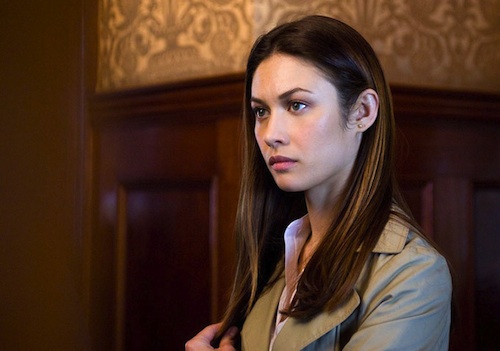
Olga Kurylenko in "Erased."

The fact that Brandt is played by Olga Kurylenko does not hurt, either. Smart and chic, she is more of a super-spy than a femme fatale, but she is always a worthy antagonist. Indeed, this might be Kurylenko’s year, following-up her starring role in Malick’s To the Wonder with a nice villainous turn. Some enterprising distributor ought to pick-up her powerful Chernobyl drama Land of Oblivion.

For his part, Aaron Eckhart makes a credible square-jawed hard-nose, carrying off his action scenes pretty well. As Amy, Liana Liberato is slightly less grating than she was in the clumsy Nic Cage vehicle Trespass. At least that constitutes progress. Unfortunately, Stars War alumnus Garrick Hagon (Biggs Darklighter, sans moustache) largely phones it in as bland corporate baddy, James Halgate.

Erased (a.k.a. The Expatriate, a much cooler title) is indeed a bit of a departure from Stölz’s previous German language historical dramas, the so-so Young Goethe in Love and the superior North Face, but he shows surprising affinity for the material. Granted, screenwriter Arash Amel never cooks up anything truly new and different, but Stölz’s execution is polished and pacey. Not bad by B-movie standards, Erased opens this Friday (5/17) at the Village East and is already available through Radius-TWC’s VOD platforms.

LFM GRADE: C+

Posted on May 13th, 2013 at 11:30am.
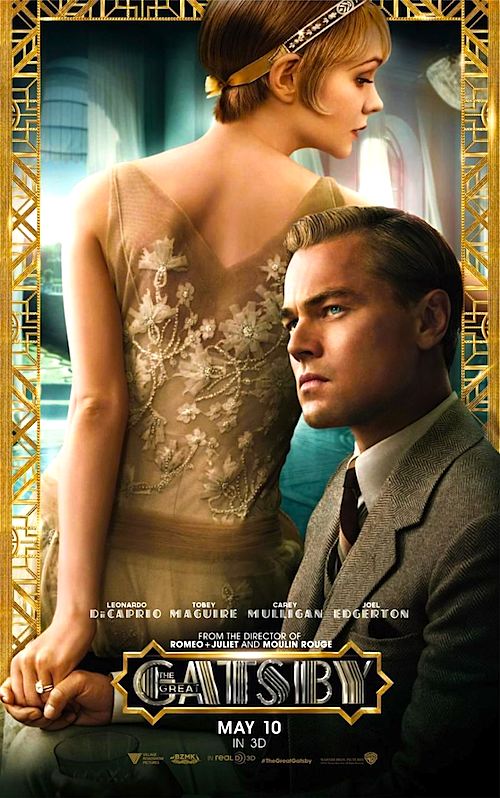
Luhrmann Punches Up Fitzgerald: LFM Reviews The Great Gatsby

By Joe Bendel. This is not the Long Island of Ed Burns movies. As everyone should remember from high school English class, East Egg is where the old money elite are ensconced and West Egg is where the nouveau riche frolic the nights away. They are so close, yet so far away. This is still the case in Baz Luhrmann’s brassy 3D adaptation of Fitzgerald’s moody classic, The Great Gatsby, which opens across the country today.

Mystery man Jay Gatsby throws extravagant parties in his West Egg mansion in hopes his old flame will someday wander in. Daisy Buchanan now lives with her husband, Tom, an old moneyed philandering bully. Gatsby hopes her nebbish cousin Nick Carraway, living in the hobbit cottage next to his estate, will help him woo her back. A lot of drinking ensues as the eyes of Dr. T.J. Eckleburg’s faded billboard look down on man’s folly. At least it’s a heck of a party.

Let’s be frank, Luhrmann is a West Egg filmmaker if ever there was one. Once again he empties his kit bag of ostentatious razzle dazzle, anachronistic music, and a singular fusion of pop culture irony with syrupy melodrama. To his estimable credit, Luhrmann never tries to crank up the novel’s modern “relevancy.” Gatsby and his gangster associate Meyer Wolfshiem are not reconceived as sub-prime lenders, nor do any characters’ untimely deaths coincide with the 1929 stock market crash.

Instead, Luhrmann is the sort of director who might step on the set and proclaim: “you know what this scene needs? More dancing flappers.” To an extent, we should all be able to buy into that. You can dismiss Luhrmann’s style as shtick, because it is, but it is his shtick. However, on some level, he still has to hold together a narrative and guide his cast. The latter is rather problematic, starting at the top.

Aside from his gloriously over the top entrance, set to the crescendo of Rhapsody in Blue, Leonardo DiCaprio is profoundly wrong as Gatsby. This is the great Byronic brooder of proper upstanding American literature, but you would hardly know it here. Chipper and shallow, DiCaprio’s Gatsby is like the Gatsby Gatsby always wanted to be. This is rather disastrous given Luhrmann’s surprising faithfulness to Fitzgerald’s storyline.

Perhaps even more head-scratching is the choice of Carey Mulligan to play Daisy Buchanan, especially considering her eerie resemblance to DiCaprio. Is Luhrmann offering a subversive commentary on the characters’ narcissism when they stare into their beloved’s eyes and see themselves reflected back? Or is it just a case of careless casting? Regardless, it is quite creepy to watch them rekindling their romance. Far from a femme fatale, her Buchanan is just plain mousy.

On the other hand, poor Tobey Maguire has been taking it in the shins from critics, but his “gee whiz” persona is perfectly suited to Nick Carraway. Likewise, many were thrown for a loop by the announcement that the great Indian actor Amitabh Bachchan would play Wolfshiem, but that voice could sell anything. Next time, let’s make him Gatsby.

Who would have been better suited for the title role? Seriously, how about Robert Downey, Jr.? Take into account the similarities between Tony Stark and Jay Gatsby: both are conspicuous consumers and relentless re-inventers.  They have rather ambiguous wartime experiences and are smitten with ghostly pale blondes. Of course, we can instantly believe Downey has been to some very dark places. DiCaprio, not so much.

For his next project, Luhrmann ought to do a legitimate Busby Berkeley musical. His big, sprawling musical bacchanals really are a lot of fun to behold. Unfortunately, the rest of the film is sabotaged by the inappropriate leads and a complete abandonment of the novel’s dreamy ambiguity. Big and loud, Luhrmann’s The Great Gatsby is what you would expect, never transcending the Moulin Rouge! template. For those who want to see Fitzgerald this way, it is now playing pretty much everywhere with a movie screen, including at the Regal Union Square in New York.

LFM GRADE: C+

Posted on May 10th, 2013 at 10:26am.

LFM Reviews Children of Sarajevo @ The 2013 Bosnian-Herzegovinian Film Festival

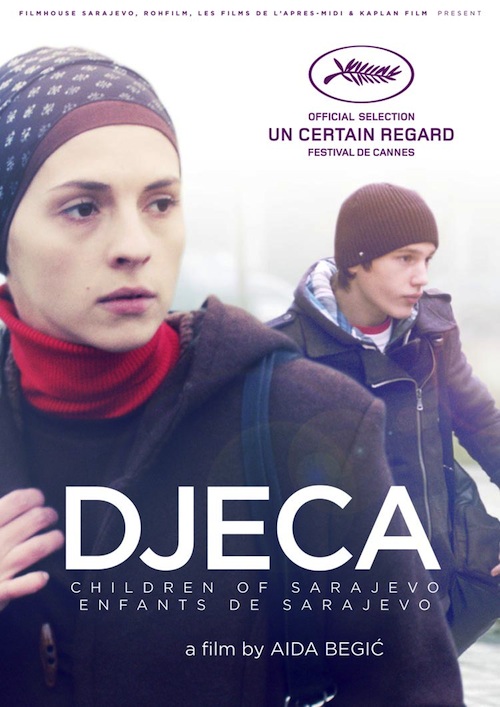
By Joe Bendel. War is not conducive to stronger family values. It is not great for the economy, either. One Bosnian woman will struggle with both aspects of the war’s trying aftermath in Aida Begić’s Children of Sarajevo, which opens the 2013 Bosnian-Herzegovinian Film Festival in New York tonight at the Tribeca Cinemas.

Rahima and her younger brother Nehim are war orphans. Although they spent the better part of the war in separate orphanages, she has temporarily assumed custody. However, busy-body social workers constantly torment her with their condescending intrusions. Working semi-off the books in the kitchen of a mobbed-up restaurant, she is in a difficult position, made more difficult by Nehim’s behavioral issues. Things only get worse when he gets into a fight with a politician’s son.

Begić clearly establishes exactly how Rahima’s tribulations are fundamentally rooted in the recent war, without ever belaboring the point. Slowly, we learn that Nehim only started acting out in response to the mockery he faced at school when she began wearing the headscarf that she adopted as a source of solace. Similarly, we gradually come to understand the severity of Rahima’s post-traumatic stress as she goes about her daily routine.

“Routine” is the correct word. Children is a quiet, intimately observed drama that fully captures the monotony of Rahima’s struggle. We revisit the same stretch of her decaying urban environment, time and again. This might peel off some antsier viewers, but Begić fully captures the realities of life for marginalized survivors like Rahima.

As Rahima, Marija Pikić subtly conveys multitudes of anger and desperation, often relying solely on body language or a fleeting glance. When late in the third act when Rahima privately removes her headscarf, viewers will realize the truly chameleon-like nature of the striking Pikić’s performance. Ismar Gagula certainly makes a convincingly petulant teenager, but Nikola Đuričko leaves a more lasting impression as Tarik, Rahima’s would be suitor of ambiguous character.

Periodically, Begić eerily incorporates archival footage of the Siege of Sarajevo, underscoring the lingering influence of the war. Implying much, she relies on viewers to fill in considerable gaps, yet she methodically leads us into some very dark places. Although Children unquestionably qualifies as “art cinema,” it showcases some powerful work from Pikić and Begić. Recommended for adult attention spans, Children of Sarajevo screens as the feature part of Program 1, launching the 2013 BHFF tonight (5/9) in New York.

LFM GRADE: B

Posted on May 9th, 2013 at 1:27pm.

Open Up a Can of Cultural Exchange: LFM Reviews Java Heat; Available Friday, 5/10 on IFC VOD

By Joe Bendel. Cultural Exchange is a beautiful thing. A Muslim police officer will teach a mysterious American to wear a Batik to formal Indonesian affairs. He will return the favor by indoctrinating his reluctant by-the-book ally in the finer points of American buddy-action movies. Get ready to learn what’s good for you in Conor Allyn’s Java Heat, which screens ‘round about midnight this weekend at the IFC Center.

The Sultana was poised to succeed her father the Sultan as one of Java’s most influential and respected leaders. Unfortunately, she is killed by a suicide bomber. As viewers learn during Lt. Hashim’s interrogation, American Jake Travers was suspiciously close to the action—and he was not wearing his Batik. Hashim scolds the suspect that he ought to know better as a visiting Southeast Asian Studies scholar. “Art history,” Travers counters. Do not be surprised if this exchange is repeated maybe once or twice.

Of course, Travers is not really an academic and the terrorists are absolutely, positively not Muslims. Instead, the bad guy is Mickey Rourke, sporting the most bizarre, ethnically ambiguous accent you will ever want to hear. Give him credit, though – he maintains its impenetrable consistency.

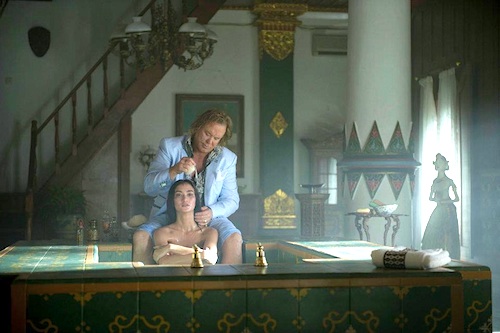
From "Java Heat."

Java is not what you would call subtle cinema. Father and son co-writer-co-producers Rob and Conor Allyn could have easily titled it “Muslims are not Terrorists: featuring Kellan Lutz’s abs.” Before long the term “doth protest too much” should echo through most viewers’ heads.

Still, there is stuff that works here. Ario Bayu totally delivers the intense cop-on-the-edge goods as Hashim. Likewise, Atiqah Hasiholan’s Sultana lends the film some classy charisma. Always a dependable spectacle, Rourke is truly a three-ring circus of villainy as the unclassifiable Malik. Even Lutz soldiers through relatively competently, exceeding expectations for a Twilight franchise alumnus.

Cinematographer Shane Daly gives it all a suitably mysterious sheen, particularly the climax at the great Borobudur temple. In general, the action sequences are credibly produced, if somewhat conventional. Frankly, Java Heat would be an impressively scrappy genre programmer if only it were not so determined to interrupt the flow with teaching moments. Recommended mostly for Rourke’s loyal fans (and God bless them), Java Heat begins a week of screenings tomorrow (5/10) at the IFC Center and is also available via IFC Midnight’s VOD platforms.

LFM GRADE: C

Posted on May 9th, 2013 at 1:26pm.

LFM Reviews Sightseers

By Joe Bendel. Chris is the Charles Kuralt from Hell. He is determined to show his new girlfriend the British roadside attractions he adores, like the Keswick Pencil Museum—and woe unto those who despoil their tourist experience. They will pay dearly in Ben Wheatley’s macabre comedy Sightseers, which opens this Friday in New York.

The British call redheads like Chris “gingers.” Think of him as a Ginger Baker, except slightly more stable. This road trip together will be an important step for Tina’s efforts to break away from her mother’s domination. She is also mourning her recently deceased little yapping dog. Chris wants everything to be just right for her, so the loutish behavior of a fellow tram museum visitor brings out the worst in him.

Chris plays off his first murder as an innocent accident. However, Tina soon becomes an active accomplice in his killing spree. Before long, things are completely out of hand. It all adds quite the new wrinkle to their relationship.

Sightseers could safely be described as a dark comedy. If you are totally fine with the desensitizing violence of Nicolás López’s Aftershock, but would prefer a more cartoonish presentation, this film is in your power zone. Based on the comedy act developed by co-writer-co-leads Alice Lowe and Steve Oram, Sightseers is not shy about mining laughs from grisly terrain. In fact, the tone is much lighter than Wheatley previous film, Kill List, despite the superior body count. Nonetheless, the murderous everyday banality of Chris and Tina is in keeping with the themes and vibe of his prior work.

From "Sightseers."

As Chris and Tina, Oram and Lowe offer an object lesson in comedy as psychological therapy. Oram deftly plays off serial killer archetypes while also showing a facility for physical comedy. Yet, it is Lowe who really taps into deep, disturbing places. They are funny, but you have to wonder about their childhoods.

Essentially, Sightseers is Two for the Road remade with Misery’s Annie Wilkes and a far less dapper Hannibal Lector. To their credit, Oram and Lowe keep one-upping the madness, so it never feels like the same gruesome joke repeats over and over again. Gleefully misanthropic, Sightseers definitely delivers the cult movie goods. Recommended accordingly, it opens tomorrow (5/10) in New York at the Landmark Sunshine.

LFM GRADE: B

Posted on May 9th, 2013 at 1:25pm.

A Wuxia Tale for Verona: LFM Reviews The Assassin’s Blade; Now on Blu-ray/DVD

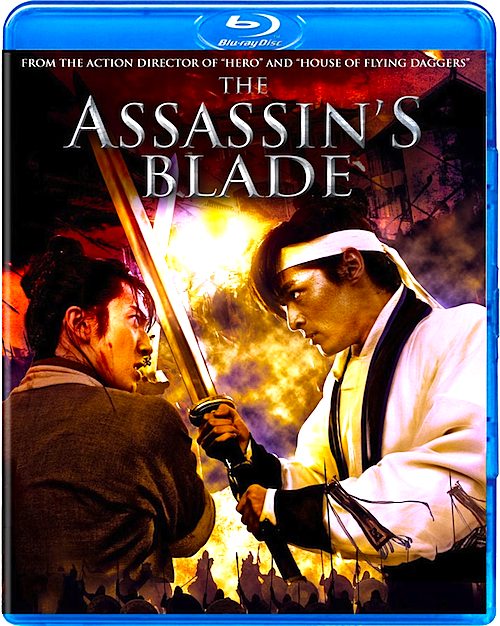
By Joe Bendel. When they became sister cities, Verona and Ningbo (in east Zhejiang province) exchanged statues of Romeo & Juliet and Zhu Yanzhi & Liang Zhongshan, popularly known as the Butterfly Lovers. While the comparison between the two star-crossed couples was always apt, Jingle Ma cranks up the Shakespearean elements in The Assassin’s Blade, his romantic adaptation of Butterfly Lovers legend, which releases today on DVD and Blu-ray from Well Go USA.

Zhu has always led a sheltered life, but she longs to see the world. Suddenly she will have a bit of an opportunity. She is to study with the Soul Ease martial arts clan in a retreat high in the mountains. The order does not accept women, so she will have to pass as a man. Only her father’s old friend, Soul Ease’s healing practitioner, Herbal Head, knows her secret. Although they start off on the wrong foot, she soon forms a close bond with “Big Brother” Liang, the master’s top student.

It is all particularly confusing for him, given his inability to see through her clever disguise. Yet, viewers fully realize that they are predestined for each other, having appeared in each other dreams for years (though always seen from behind and slightly out of focus). Just when they start to get somewhere, her childhood friend “Brother” Ma Wencai appears to take Zhu home where news of their arranged marriage awaits. That’s just not going to work, especially considering Ma’s rather ruthless approach to love and war.

The first half of Blade channels Shakespeare’s comedies, particularly Twelfth Night’s cross-dressing romance. The pendulum swings to tragedy during the second half, directly invoking Romeo & Juliet. There is even a mysterious little McGuffin causing no end of complications. There was a time when Hollywood had a golden touch with romantic weepers, but these days Hong Kong and Chinese wuxia epics hold the overwhelming competitive advantage. Blade is a perfect example. Though viewers will suspect how it all must end, the film keeps us hoping otherwise – and audiences will likely be thoroughly satisfied by the poetic closing. It also delivers some pretty impressive swordplay, emphasizing the human weaknesses of the combatants -instead of making them nearly invulnerable supermen.

It is darn hard to believe that anyone could confuse Charlene Choi with a man. Regardless, as Zhu she is both vivacious and sincere. Wu Chun broods like mad opposite her and brings sufficient credibility to his action duties. Unfortunately, Hu Ge’s Brother Ma’s in-betweenness makes him too merciless to identify with, but too pathetic to cheer for his downfall.

While director Ma (perhaps best known as the cinematographer on some of Jackie Chan’s best known films) emphasizes the tale’s high literary tragedy, he keeps the pacing brisk and the action muscular. It all has a classy look in the tradition of Zhang Yimou epics that should appeal to fans of historical romance as much as martial arts fanatics. Recommended to general audiences as a thin edge of the wuxia wedge, The Assassin’s Blade (a.k.a. The Butterfly Lovers) is now available for home viewing from Well Go USA.

LFM GRADE: B+

Posted on May 7th, 2013 at 2:16pm.