LFM Reviews When Sunny Gets Blue @ The 2013 Columbia University Film Festival

By Joe Bendel. Musicians are like athletes. An injury can potentially end a brilliant career. Like Evan Horne, the protagonist of Bill Moody’s jazz mysteries, Jonathan Clay is a pianist struggling with injured hands, who suddenly finds himself involved with the criminal element in Oded Naaman’s When Sunny Gets Blue, which screens in New York as part of the 2013 Columbia University Film Festival, an annual showcase for Columbia MFA students’ thesis films and screenplays.

Clay is not a good patient. Suffering from acute carpal tunnel syndrome, he is frustrated by the slow rehabilitation process. In fact, he has given up on physical therapy. When he returns from a session of self-pitying and boozing, he is surprised to find a woman in his apartment. She is there to warn him about the thugs who show up shortly thereafter.

Yes, her name is Sunny, as in the title Jack Segal & Martin Fisher standard that seems to have great meaning for Clay. It is a good one, recorded by the likes of Dexter Gordon, Sarah Vaughan, and Nat King Cole, but it is not exactly overplayed and fits the vibe of Naaman’s film quite well. (The credits inspired by Blue Note Records graphic designer Reid Miles are also a nice touch.)
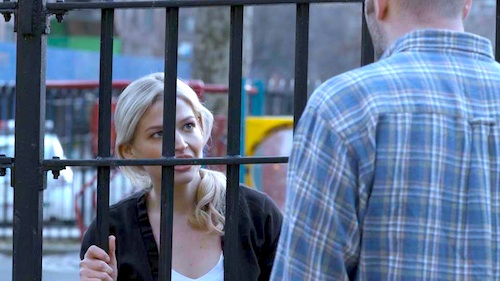
From "When Sunny Gets Blue."

Indeed, Sunny has a hip sensibility that should please jazz fans. In a strange way it manages to be both ambiguous and completely satisfying. Naaman deftly establishes a distinctive mood that is too light-hearted to be called noir, but too dark to be considered anything else. It certainly fits the jazz life, as does Jonathan Monro’s standout performance. He gets a convincing case of the blues, yet remains sincere and grounded, even when doing some odd things. As someone who knows a lot of musicians, his performance always feels right to me.

A great short film, the nineteen minute When Sunny Gets Blues is an Indiewire Project of the Week that actually panned out. It should serve as quite a positive representative for Columbia as it gets festival play. Highly recommended for jazz fans and film programmers, When Sunny Gets Blue screens this Saturday (5/4) as part of the Columbia Film Festival’s Program D at the Walter Reade Theater.

LFM GRADE: A

Posted on May 2nd, 2013 at 11:28am.
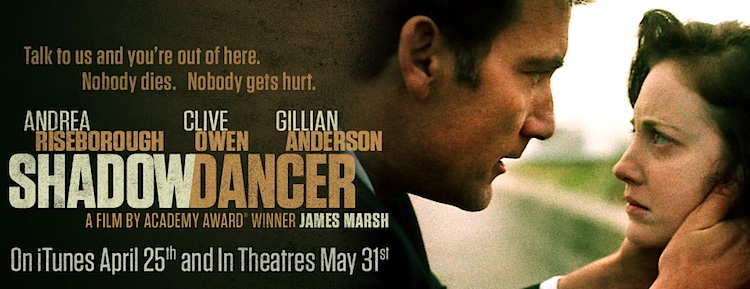
A Gripping and Timely Look at Terrorism: LFM Reviews Shadow Dancer; In Theaters May 31st, Available on Amazon, iTunes Now

By Patricia Ducey. Shadow Dancer takes place in 1993 Belfast during the fitful, bloody denouement of the conflict referred to delicately as The Troubles. In the opening minutes, we meet Colette McVeigh as a child. She sends her little brother out for cigarettes, when her father told her to go, and the boy is killed in a British/IRA crossfire.

The film then jumps to 1993 as the adult Colette, now played by Andrea Riseborough, steps into the London Tube, apparently going to work. After an uneventful ride, she alights and dashes towards street level, but not before leaving her purse on an empty staircase. We know, after Boston, in a shock of recognition, that this is a bomb. She escapes through a maze of maintenance tunnels, only to be grabbed outside by two men and hustled into a car.

But Colette is no lamb; she is a hardened IRA “volunteer” now and knows what will follow. As the agents drive her through London, she quietly disappears into herself, preparing for the expected interrogation. After all, her mission in London represents a new IRA tactic: by wreaking violence on the mainland, they hope to destroy the British people’s resolve to remain in Ireland, at all. This entire sequence is almost silent, which amps the suspense even further; no conversation or music distract from Colette’s cool, expressionless face as she hurries to complete her mission and then prepare for arrest.

The two agents deliver her to Mac (Clive Owen), the MI5 interrogator, and he tries to break her. He offers her the family dossier. In it she finds the forensic report from the killing of her little brother, the act which has radicalized her and her two surviving brothers. But the report identifies the bullet as coming from a known IRA weapon. In a rush, she pushes away the file — and the truth? — against a rising moral revulsion that she has never totally extinguished.

Finally, Mac presents her an ultimatum: return to Belfast and inform on her famous IRA family, or go to prison for decades and watch her little son delivered up to the foster care system. Of course, she relents, and the real suspense begins.

Continue reading A Gripping and Timely Look at Terrorism: LFM Reviews Shadow Dancer; In Theaters May 31st, Available on Amazon, iTunes Now

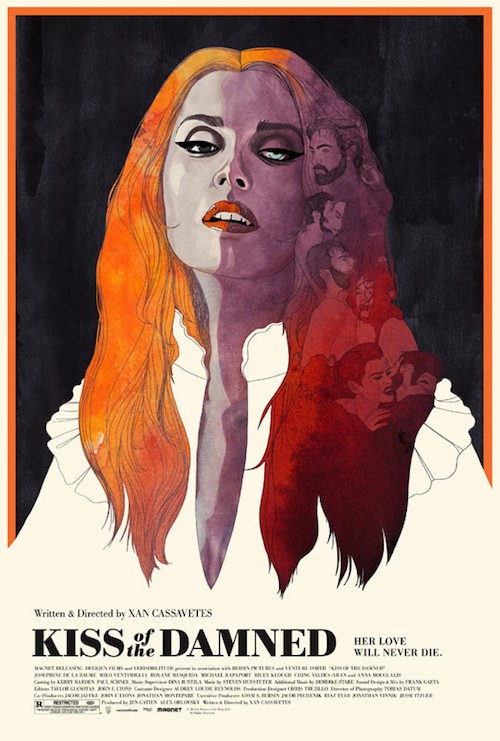
Euro Undead Vamping it up in America: LFM Reviews Kiss of the Damned; In Theaters May 3rd, Available on Amazon, iTunes Now

By Joe Bendel. Vampires are Old World creatures. They do not fit in so easily in America, or at least a big crowded city like New York. This is especially true of the reckless Mimi, who creates all sorts of complications for her sister Djuna and her undead sibling’s recently turned lover in Xan Cassavetes’ Kiss of the Damned, which opens this Friday in New York.

Most vampires keep to themselves, making do with animal blood. Of course, the human kind is the good stuff, but developing a taste for it is dangerous. Mimi has done just that. In contrast, Djuna is content living a quiet nocturnal existence in the isolated mansion owned by Xena, the grand dame of vampires. Then one night, she catches Paolo’s eye in a throwback video store (a vestige of the old).

Despite her concern for his well being, sparks fly between her and the slacking off screenwriter. She soon brings him over to the undead, so they can un-live happily ever after. Unfortunately, Xenia sends her blood-lusting sister Mimi to dry out with the blissful couple shortly thereafter. Not surprisingly, having an unstable nymphomaniac with a taste for human blood in their midst puts a strain on pretty much everything.

Yes, Xan Cassavetes is the daughter of John Cassavetes and Gena Rowlands. As one might expect, she knows her art cinema. While she is not afraid of a little blood, she patiently sets the scene and establishes her characters before getting down to the business end of vampirism. The result is an uber-stylish, devilishly indulgent film. Fittingly, cinematographer Tobias Datum renders it all with an evocative retro-Hammer color palette, luxuriating in shades of red.

As Djuna, Joséphine de la Baume is captivatingly elegant and sensual. Milo Ventimiglia is a bit stiff as Paolo, but Roxanne Mesquida’s Mimi is quite the hot undead mess. She just radiates trouble whenever she is on screen. Yet, the unlikely Michael Rapaport nearly steals the show in his brief but riotous appearances as Paolo’s crass agent.

Polished and seductive, Kiss of the Damned has a Euro art house sensibility, but it still delivers the goods for vampire fans. Clearly inspired by the Italian masters, Cassavetes demonstrates an appreciation of the look and form of the genre. Highly recommended for connoisseurs of continental horror and vampire films, Kiss of the Damned opens this Friday (5/3) in New York at the Landmark Sunshine.

LFM GRADE: B+

Posted on April 30th, 2013 at 1:19pm.

LFM Reviews Out of Print @ The 2013 Tribeca Film Festival

By Joe Bendel. How can folks get up every day and go to work in book publishing? I ask myself that very question about five times a week. Yet despite frequent doomsday forecasts, the industry lumbers on. Perhaps e-books will be either the deliverance or the destruction of the business, but for now they are a mid-sized Schumpeterian disruption. Vivienne Roumani takes stock of what it all means in her documentary Out of Print, which screened as part of the Tribeca Talks post-screening discussion series at the 2013 Tribeca Film Festival.

At the heart of OOP and Ben Lewis’s thematically related Google and the World Brain lies the question whether the digitization of knowledge is a democratizing or monopolistic endeavor. The jury is still out, but in the case of the big G, you really have to wonder. Roumani touches on the Google settlement, but if there is a corporate bogeyman in OOP, it is Amazon’s Jeff Bezos, at least when she talks to Authors’ Guild president Scott Turow.

Is the giant e-tailer cheapening the value of e-books through its pricing and merchandizing? Turow certainly has thoughts on the matter. As an interview subject, Turow is an intelligent and authoritative figure. For his part, Bezos seems to be trying to humanize his image, which is a shrewd long-term strategy, in marked contrast to the deafening silence from Google in Lewis’s doc. Indeed, Roumani gained entrée to a number of highly influential market leaders and thinkers, even including the late great Ray Bradbury (appearing primarily as an expert on libraries, but adding unspoken significance to the discussion as the author of Fahrenheit 451).

There are a number of issues raised by the film that were largely glossed over by the post-screening experts, such as the fundamental issue of storage. As Roumani points out, DVDs and hard drives have a life expectancy that can be measured in years, not decades. Simply assuming someone will figure out something more lasting is not a great strategy. Yet for the filmmaker and at least  a few of her fellow panelists, the effect of the digital revolution on reading habits is even more significant. Some seriously wonder whether the majority of kids today will have sufficient interest and attention to read a full book from the beginning to the end.

Roumani nicely balances prognostications of doom and gloom with optimism for the shape of things to come. At fifty-five minutes, Out of Print is a well paced and organized overview of an industry in flux and the wider resulting social and cultural implications. It is a handy primer, but Google and the World Brain remains a more in-depth and pointed examination of the same fundamental issues. Given its timeliness, it should draw considerable interest on the festival circuit and merits public broadcast consideration.

LFM GRADE: B-

Posted on April 30th, 2013 at 1:18pm.

LFM Reviews Recollections @ 2013 Tribeca Film Festival + San Francisco International Film Festival

By Joe Bendel. To the lazy news media, the sight of damaged photographs randomly scattered by the Tōhoku earthquake and tsunami merely functioned as convenient visual shorthand for the enormity of it all. However, some Japanese photographers and volunteers recognized in them an opportunity to serve and comfort instead. Nathanael Carton documents the efforts of Project Salvage Memory to find, restore, and return lost family photos in the short film Recollections, which screens this Thursday at the San Francisco International Film Festival, following hard on the heels of its run at the 2013 Tribeca Film Festival.

The images say it all. The scarred remembrances of once vibrant family lives are heartbreaking to behold. Carton nimbly walks a fine line, capturing their devastating emotional resonance without feeling ghoulishly exploitative. Indeed, the real heart of the film involves the (primarily young) volunteers who set out to console those grieving loved ones. It might have started as a simple gesture, but the Project has since recovered over 75,000 photos.

Clearly the restitution process has tremendous significance for the survivors. Obviously the photographs facilitate closure, particularly as the focal point for funerals and subsequent memorial services. Yet not surprisingly, the Project founder Carton interviews is unflaggingly modest when speaking of his work.

At just under thirteen minutes, Recollections is an informative but moving quietly film. Highly recommended, Carton’s acutely sensitive documentary was one of the best shorts at this year’s Tribeca. For those in the Bay Area, it also screens this Thursday (5/2) as part of the Shorts 1 programming block at the 2013 SFIFF.

LFM GRADE: A

Posted on April 30th, 2013 at 1:17pm.

LFM Reviews Eastwood Directs: The Untold Story @ The 2013 Tribeca Film Festival; Premieres on TCM May 30th

By Joe Bendel. Clint Eastwood often argues that jazz and westerns are America’s two great indigenous art forms. Inadvertently, he thereby makes a strong case that he is one of America’s most preeminent artists. Tribute was paid to the actor-director-composer at the 2013 Tribeca Film Festival over the weekend with the world premiere of film critic and biographer Richard Schickel’s Eastwood Directs: The Untold Story, followed by a special Tribeca Talks interview with Eastwood conducted by Darren Aronofsky (see a clip above).

Eastwood Directs will be included in Warner Brothers’ upcoming Clint Eastwood 40-Film Collection on DVD and the similarly titled 20-Film Collection on Blu-ray. It will also air on TCM. As one might expect, it combines talking head interviews with brief film snippets from Warner’s Eastwood library – and it is hard to begrudge the film’s hagiographic treatment of an icon like Eastwood. Clearly he is a serious figure if he attracts commentary from the likes of Martin Scorsese, Steven Spielberg, Brian Grazer, and Meryl Streep. It is also especially nice to see Gene Hackman reminiscing about the film Unforgiven. Someone like Eastwood ought to find a part interesting enough to get Hackman back in the game.

Directs largely focuses on Eastwood’s special talent for directing his fellow actors, giving considerable attention to his big Oscar winners, for obvious reasons. There are some nice stories and testimonials, especially from Streep, his co-star in Bridges of Madison County. While Schickel does not spend much time on Bird, he still covers Eastwood’s longstanding passion and support for jazz in reasonable detail. Though not exactly a jazz film per se, Play Misty for Me gets its due, even though it is not a Warner property (the picture of Eastwood with Erroll Garner is a nice touch).

In fact, Misty provided one of the more telling anecdotes during Eastwood’s post-screening conversation with Aronofsky. When asked about technology, Eastwood (who still prefers film but is resigned to digital’s inevitability) spoke of his brief use of “instant replay” capabilities on his directorial debut, but quickly banished it from the set when he saw the cast and crew obsessing over it.

In Eastwood Directs, Scorsese identifies Eastwood as the living link between old school Hollywood and the modern age. It is easy to see what he’s getting at. Unfortunately, Aronofsky’s skills as an interviewer did not match the insights of Shickel’s interview subjects. However, Eastwood did his best to fit anecdotes to the broad, open-ended questions and generally just offered up his gravelly-voiced Zen master-blues piano player persona to the appreciative audience.

There is something truly American about self-reinvention – and again, this is something Eastwood exemplifies. From Rawhide through the Leone westerns and critically underappreciated Dirty Harry films to his Cannes and Oscar celebrated films as a director, Eastwood has charted an independent course, while remaining within the studio system and maintaining his popular appeal. Recommended for his fans, Eastwood Directs will be included on Warner Brothers’ collections releasing June 3 and will run on TCM May 30th. The Eastwood interview is also available for streaming for those unable to attend the 2013 Tribeca Film Festival in-person.

LFM GRADE: B

Posted on April 29th, 2013 at 3:20pm.