Stephen Fung Brings the Family Values: LFM Reviews Tai Chi Hero

By Joe Bendel. “Pushing Hands” style kung fu is an important Chen family tradition. For complicated reasons, Chen village is forbidden to teach their kung fu to outsiders. While they do not break this rule, they bend it considerably in Stephen Fung’s Tai Chi Hero, which opens this Friday in New York.

Yang Lu Chan, “the Freak,” sought to learn Chen-style kung fu to balance his karma and counteract the mutant berserker horn on his temple sapping his vital energy. Of course, everyone said no, but the earnest plodder kept trying. However, when Yang nearly dies defending Chen village from invaders, the Master’s daughter, Chen Yu Niang, takes pity on Yang, marrying him into the clan.
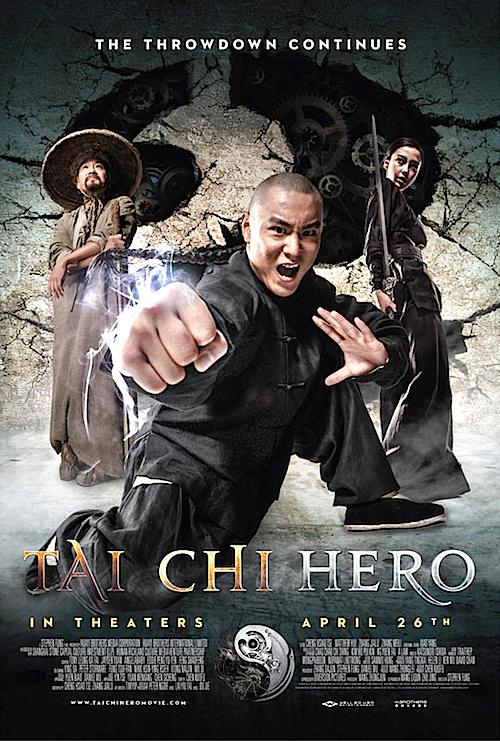
Initially, it is not much of a marriage, but he sure takes to Master Chen’s instructions. Yang should most likely live and thrive, but the future of Chen village is soon threatened again. Teaming up with a rogue British officer and the Chinese Imperial army, Yu Niang’s ex Fang Zijing (a Chen village outsider himself) means to capture Master Chen and his daughter and son-in-law. They are willing to give themselves up for the sake of the village, but not without a fight, which is spectacular.

In his follow-up to Tai Chi Zero, Fung doubles down on the steampunk trappings, introducing Master Chen’s prodigal son Zai – who never properly paid his kung fu dues, but has these flying machine inventions, a la Da Vinci’s Demons. While Hero lacks the breakneck lunacy of Zero, it is surprisingly warm and endearing. This is the family values installment of the franchise, featuring reconcilements between fathers and sons and wives and husbands—and it all works somehow. Of course, there is also the massive showdown with the Imperial Army.

Jayden Yuan comes into his own as the innocent Yang this time around, nicely portraying the maturation of the Freak’s character and his kung fu. Angelababy does not quite have as much screen time in Hero, which is a pity considering how charismatic she is as Yu Niang. Still, she has some dynamic action sequences in the big battle and should become a truly international superstar on the basis of her work in the franchise.

“Big” Tony Leung Ka Fai keeps doing his Zen thing as Master Chen and he’s as cool as ever. Somewhat bizarrely, though, as Duke Fleming, Swedish actor Peter Stormare (who has been reasonable comprehensible in English language features like Fargo and The Big Lebowski) seems to be channeling the sort of weird, affected sounding white-devil heavies of kung fu movie tradition.

Tai Chi Hero is nearly as much outrageous fun as Zero, but it has more heart. With the final film of the trilogy in the pipeline, Fung’s Tai Chi series should become a fan favorite. Enthusiastically recommended for martial arts fans, Tai Chi Hero opens this Friday (4/26) in New York at the AMC Empire.

LFM GRADE: B+

Posted on April 24th, 2013 at 2:42pm.
LFM Reviews Reporting on the Times: The New York Times and The Holocaust @ The 2013 Tribeca Film Festival

By Joe Bendel. In the 1930’s, Walter Duranty, The New York Times man in Moscow, systemically misreported or ignored Stalin’s crimes, including the notorious show trials and the Ukrainian famine. He is considered an unfortunate but isolated case. Yet, throughout the war, the Times consistently buried stories about the Holocaust. Emily Harrald examines the “Paper of Record’s” questionable coverage (again as a discrete phenomenon) in the documentary short Reporting on the Times, which screens as part of the History Lessons short film program at the 2013 Tribeca Film Festival.

Harrald’s opening graphics speak volumes. From 1939 to 1945, the Times ran 23,000 front page stories—11,500 of which were about World War II. 26 were about the Holocaust. What is most disturbing is the nature of the coverage that did run, typically relegated to the middle of the paper. Midway through European round-up pieces, the Times would matter-of-factly report on the “liquidation” of the ghettoes, with no illusions regarding what that euphemism meant.

Rather bizarrely, Harrald spends a good portion of Reporting excusing the Times’ dubious Holocaust reportage. Viewers will never forget publisher Arthur Hays Sulzberger was himself Jewish, but presented a fully Americanized and secularized image to readers and the press, partly out of concern over the rise of anti-Semitism. Perhaps this explains why he would be personally reluctant to run front page stories on the plight of European Jewry. However, he employed a full editorial staff to make sure the paper did not bury its lede.

Throughout Reporting, moral clarity is provided by a Holocaust survivor whose mother was convinced the world would come to their aid once they knew the magnitude of the National Socialists’ crimes. For whatever reason, the Times obviously did not do its part. Yet, when considered in light of Duranty’s Moscow dispatches, the under-reporting of the Holocaust appears more systemic than Reporting would like to consider. Harrald’s film earns credit for beginning the conversation, but its interpretations of media history are far from definitive. It screens again today (4/23), Friday (4/26), and Sunday (4/28) as part of the History Lessons short film block at this year’s Tribeca Film Festival.

LFM GRADE: C

Posted on April 23rd, 2013 at 1:42pm.

From Peru to Polynesia, the Hard Way: LFM Reviews Kon-Tiki

By Joe Bendel. In 1947 memories of WWII were still fresh, especially in once occupied Norway. However, the reckless courage of a Norwegian explorer would inspire not just his homeland, but generations of adventurers around the world (reportedly including American test pilots and astronauts). Thor Heyerdahl and his crew set sail from Peru to Polynesia without any modern technology in Joachim Roenning & Espen Sandberg’s Kon-Tiki, which opens this Friday in New York.

Although naturally restless, the time Thor Heyerdahl and his first wife Liv spend living among the Marquesas is quite happy. During this period, Heyerdahl becomes convinced the South Pacific islander’s original ancestors ventured east from Latin America rather than west from Asia. Yet, the academic establishment dismisses his theory (sadly, not excluding the fuddy-duddies at the Brooklyn Museum). Having absolute conviction in his research, Heyerdahl sets out to prove it – by sailing over 4,000 nautical miles from Peru on a balsawood raft, using no modern instruments except a radio to inform the media of their progress.

Somehow Heyerdahl recruits a crew of his countrymen for his dubious mission, including a dying-on-the-inside expat engineer and a conscience-plagued veteran of the resistance. They also have a parrot. The plan is pretty simple: launch the Kon-Tiki into the Pacific and hope the currents carry it to Polynesia. Of course, those waters are far from empty. Heyerdahl’s crew will contend with sharks, whales, and the greater dangers of stormy weather and dwindling supplies.

Filmed in both English and Norwegian versions, Kon-Tiki is old fashioned in a good way. It celebrates rather than apologizes for the daring-do of Heyerdahl and his mates. These are not average men, but they are unquestionably mortals. Watching Roenning & Sandberg (best known for the stirring war drama Max Manus) present their courage and camaraderie without hipster irony is quite refreshing.

Kon-Tiki also looks great, particularly the shark and whale sequences. The clarity of the underwater cinematography is quite striking, as is the sense of scale. Frankly, this is the perfect film for viewers intrigued by Life of Pi’s premise but put-off by its New Agey-ness.

It is well worth noting Kon-Tiki was produced by Jeremy Thomas, whose name in the credits means something to discerning viewers, having shepherded ambitious films like The Last Emperor, Merry Christmas Mr. Lawrence, and 13 Assassins through development to art house screens. Similarly, Kon-Tiki is an international production that is large in scope.

Nonetheless, it is easily accessible, not merely because of the English dialogue (which the Norwegian actors handle relatively well). This is a classic sea-faring adventure, vividly rendered by a talented cast and crew. Recommended for general audiences, particularly those who fondly remember Heyerdahl’s bestselling book and 1951 Academy Award winning documentary, Kon-Tiki opens this Friday (4/26) in New York at the Paris Theatre uptown and the Landmark Sunshine downtown.

LFM GRADE: B+

Posted on April 22nd, 2013 at 12:50pm.

LFM Reviews Honeymoon Suite @ The 2013 Tribeca Film Festival

By Joe Bendel. The Opposite House probably did not pay a promotional allowance, but it will get a heck of a plug at this year’s Tribeca Film Festival. That is because one of the short films commissioned by the chic Beijing boutique hotel was selected for the festival. It is not hard to see why. Zao Wang’s Honeymoon Suite is a small delight screening as part of the Deadbolt program at this year’s Tribeca.

This will be the first time Ally, the Opposite’s new guest services manager, will be on-duty while the mysterious Mr. Hirschfield stays in his regular titular room. He visits like clockwork once a month, for one night only. Even though his secret is revealed early in the film, it should not be spoiled ahead of time for those who do not guess. It is safe to say he is kind of a handful, in a genre sort of way.

The director certainly does his job, making the Opposite look like quite the hip, elegant space. He also cast a first-rate ensemble. As Ally, Zou Han-hong comes across like a smart professional, but she also has some rather touching moments down the stretch. She certainly makes you want to check into the Opposite.

Poor Cary Woodworth is largely buried under surprisingly impressive make-up effects, so give him credit for being a good sport. Nadia Hatta and Xi-tian also make an endearing mother-daughter tandem in the room beneath Hirschfield’s, with the latter providing some very cute reaction shots.

Man, if only all commercials were this fun, then we would be getting somewhere. Regardless of its origins, genre fans will be charmed by Honeymoon Suite. Recommended for general audiences, it screens as part of the 2013 Tribeca Film Festival’s Deadbolt shorts block tonight (4/22), Saturday (4/27), and Sunday (4/28).

LFM GRADE: A

Posted on April 22nd, 2013 at 12:48pm.

LFM Reviews Michael H, Profession: Director @ The 2013 Tribeca Film Festival

By Joe Bendel. Austrian art-house titan Michael Haneke won just about every award there was to be had for his latest film, Amour, including the Oscar and the Palme d’Or. Yet Haneke’s vision is so uncompromising that his work is often more appreciated in retrospect than enjoyed in the moment. This makes Haneke a logical candidate for documentary survey treatment, despite the auteur’s reluctance to answer questions that might establish definitive interpretations of his films. Yves Montmayeur rises to the challenge with Michael H, Profession: Director, which screens as part of the World Documentary Competition at this year’s Tribeca Film Festival.

Fittingly, Montmayeur begins with Haneke’s “greatest hit,” observing the director at work on Amour. However, he demonstrates a bit of visual flair, showing Haneke blocking out Jean-Lois Trintignant’s nightmare sequence as if it were really him in the scene. Trintignant and his Academy Award nominated co-star Emmanuelle Riva both praise the specificity and clarity of Haneke’s direction, but suggest he is quite the demanding helmer.

Essentially working in reverse chronological order, Montmayeur then takes stock of White Ribbon, strongly emphasizing Haneke’s return to his German mother tongue. It seems an important point, particularly in light of the film’s themes. It also makes one think of Haneke in literary terms, following in the tradition of non-native language writers like Conrad and Nabokov. Indeed, Haneke might be the right filmmaker to finally crack the Conradian adaptation nut.

Some of the interviews and the generous sampling of film clips will motivate viewers to catch up with Haneke’s past work. On the other hand, Montmayeur basically gives away the ending of Funny Games – but if you are going to spoil a Haneke film that is probably the one to do it for. In addition to Amour’s co-leads, Haneke regulars Juliette Binoche and Isabelle Huppert add insights into working with the distinguished director. He certainly attracts some of the best in the business, not that Haneke likes to think of filmmaking in such commercial terms.

Haneke can be very eloquent when discussing his work. His remarks at last year’s NYFF press conference were uncharacteristically helpful for those us looking to get a handle on Amour. Even though Haneke will brusquely dismiss questions he does not wish to answer, Montmayeur gets him talking on general subjects in ways that illuminate his entire oeuvre. That is really quite the trick.

Throughout Profession one gets a clear sense of Haneke’s pessimistic conception of human nature as well as his artistic integrity. While he is a fascinating filmmaker to spend time with, it is hard to say how rewarding the documentary will be to viewers completely unfamiliar with his work. Respectfully recommended for Haneke’s admirers and critics alike, Michael H, Profession: Director screens again Thursday (4/25), and Saturday (4/27) during the 2013 Tribeca Film Festival.

LFM GRADE: B

Posted on April 22nd, 2013 at 11:37am.

LFM Reviews Frankenstein’s Army @ The 2013 Tribeca Film Festival

By Joe Bendel. Okay, it’s a little creepy, but animating dead bodies has obvious military advantages. The National Socialists would be just the sort to develop such technology. In fact, the grandson of a certain controversial scientist has apparently cobbled together quite a monstrous division of soldiers in Richard Raaphorst’s Frankenstein’s Army, a midnight selection of this year’s Tribeca Film Festival.

Dimitri is a graduate of Soviet film school filming a small recon squad in the field. Less than thrilled to be shepherding the would-be documentarian and his nebbish assistant, the commanding officer busts their chops every chance he gets. Everyone is on edge since radio contact with headquarters was cut-off. Suddenly, a mysterious distress call lures them to a remote monastery, whose occupants were gruesomely murdered by a mysterious force. You can probably guess where things are headed from here, even if the Commies can’t.

The potential midnight movie appeal of Nazis vs. re-animated freaks needs no explanation, but Frankenstein’s Army is poorly served by its found footage structure. That it is in color frankly makes no sense. Hardcore cineastes will also be disappointed that Dimitri, the Soviet Tarantino, never nods towards the work of Eisenstein or Vertov that should supposedly have inspired him, not that this will be foremost in the minds of late night patrons. However, they will notice when he “cheats” with the conceit.

On the other hand, Raaphorst is on pretty solid ground in the manner he depicts the Red Army. Hardly liberators, they are more like marauders, committing war crimes against the local peasantry that the commander not so discretely censors. Likewise, it becomes clear that their Soviet masters do not care about the soldiers’ safety. In fact, they have a secret agenda in the whole horrific affair.

The Frankenstein monsters are also quite inventive in a ghoulish way, looking like a rogue’s gallery of Silent Hill creatures decked out in Nazi regalia. While Karel Roden has plenty of genre cred, his mad doctor’s character is sadly underdeveloped. There is an intriguing hint of a backstory involving the Frankenstein family’s complicated relationship with the German state, but Raaphorst never fully capitalizes on the Frankenstein legacy (after all, if he is the grandson, then Basil Rathbone’s Baron Wolf von Frankenstein must be his father, right?).

Army’s gory effects and make-up are definitely first-rate.  Cult movies fans looking for a few grisly thrills should find it adequate, but those hoping for more given its historical context will probably be disappointed. Earning points for its realistic portrayal of the Soviet war machine, Frankenstein’s Army is recommended for Silent Hill franchise fans (which it so resembles) when it screens again tonight (4/20) during the 2013 Tribeca Film Festival.

LFM GRADE: C+

Posted on April 20th, 2013 at 2:44pm.