An Od(d)yssey of Post-Communist Bulgaria: LFM Reviews The Boy Who was a King

By Joe Bendel. It is impossible to imagine Pu Yi, China last boy emperor, successfully standing for election as the country’s head of state. Yet, that is exactly what happened in post-Communist Bulgaria. Andrey Paounov kind of-sort of tells the remarkable story of Simeon Saxe-Coburg-Gotha, a.k.a. Simeon II, in The Boy Who was a King, which screens this Thursday as part of Disappearing Act V.

Born in 1936, Simeon II reigned from 1943 to 1946. It was a short but eventful period. Deposed by a dubious Communist backed referendum, Simeon II went into exile. A successful businessman who married a member of the Spanish aristocracy, the King (or Tsar) continued to speak out against Communist oppression during the Captive Nation years. When the Soviet system collapsed, he did not immediately return to Bulgaria, but he accepted a Bulgarian passport.

Much to the King’s own surprise, many Bulgarians placed their hopes for a better government in the former monarch. Eventually, he reluctantly assumed the position of Prime Minister when his vaguely Ross Perotish center-left party was overwhelmingly swept into power. Simeon promised to restore public integrity in 800 days. What happened during his administration? Politics.

Paounov gives viewers a thumbnail recap of Simeon’s life, but his approach is more impressionistic than authoritative. More often he turns his camera on eccentric or marginalized Bulgarians, some of whom still harbor monarchist sentiments. Others are deeply disillusioned by the former PM, including one who was inspired to get a rather crude, painful looking crown tattoo in Simeon’s honor. There’s a good argument for the separation of tattoos and state.

At times, Paounov’s approach is downright weird, as when he follows a coyote donated by Simeon’s sister from the taxidermist through the streets of Sofia to the Natural History Museum. Other times, there is method in his stylistic madness, as when he observes a meeting of the Bulgarian Communist Party held in a crummy state constructed flat. Consisting of six or seven bitter old prunes whose claims about Simeon appear patently false based on everything Paounov has previously shown the audience, it seems unlikely the hammer-and-sickle will rise again in Bulgaria anytime soon.

Frustratingly, Boy never gives viewers enough information to pass judgment on Simeon as an elected statesman. He certainly has a regal bearing, though. Indeed, the film’s most intriguing episodes explore the way Simeon’s roles as republican and royal complimented each other. Sometimes fascinating and other times bemusing, The Boy Who was a King is recommended for viewers with a taste for idiosyncratic documentaries when it screens (free of charge) this coming Saturday (4/20) as Disappearing Act V continues at Bohemia National Hall on Manhattan’s Upper Eastside.

LFM GRADE: B-

Posted on April 16th, 2013 at 8:22am.
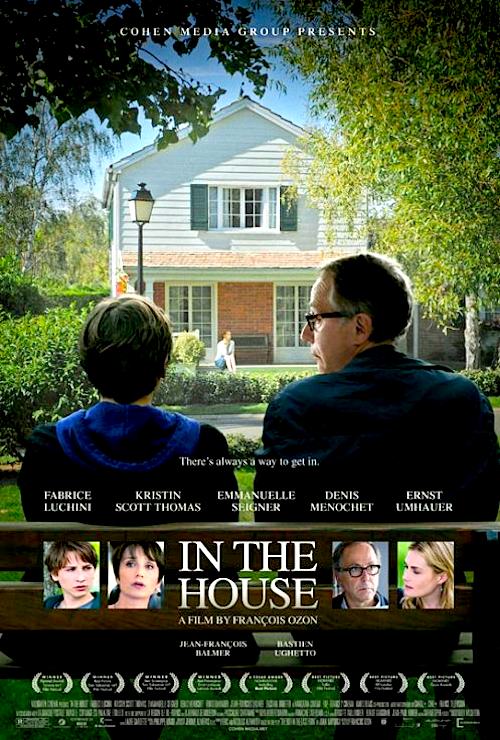
LFM Reviews François Ozon’s In the House

By Joe Bendel. Germain did not become a teacher to coddle teenagers’ self-esteem. He wanted to teach great French literature. That probably sounds nobler than it is in practice. In fact, the after-school tutoring he offers a talented pupil leads to unlikely scandal in François Ozon’s In the House, which opens this Friday in New York.

Germain begins the new academic year with his usual pessimism, but Claude Garcia’s first composition catches him off guard. It displays a voyeuristic fascination and caustic condescension toward his classmate, Rapha Artole, and the lad’s family. It also happens to be well written: B+. Using his natural talent for mathematics, Garcia insinuates himself into the Artole household as Rapha Junior’s trig study partner. After each visit, he writes what he claims are non-fiction accounts of the Artoles, but Germain analyzes as if they are part of a developing story.

It is hard to tell just how much of Garcia’s forays into the Artole house are truth or fiction, because the whole point is to keep the audience guessing. Ozon masterfully adapts Juan Mayorga’s play, toying with truth and reality in nearly every scene, yet keeping the film firmly rooted in its characters and their relationships. At times, it comes across like a comedy in the Annie Hall tradition, but it becomes steadily darker as the psychological gamesmanship intensifies.

Germain is the sort of arrogantly urbane character Fabrice Luchini was born to play. Perfectly exhibiting the cutting wit of a failed novelist, he could be the high-handed French cousin of Fraser Crane. Yet, it is really up to Ernst Umhauer’s Garcia to make it all work. He is convincingly creepy as the young master manipulator, but he also memorably expresses Garcia’s youthful insecurities at key moments.

The brilliant teacher-student tandem is backed-up by a big name French cast, including Emmanuelle Seigner (Mrs. Roman Polanski), playing against type as Rapha’s mother. A desperate housewife of an entirely different sort, she is surprisingly earthy and vulnerable. In contrast, Kristin Scott Thomas elevates the role of Germain’s gallerist wife Jeanne above a mere I-told-you-so commentator with her elegance and sly screen presence. Whenever you see KST on-screen you know you are in for something smart and sophisticated.

Ozon has similar credibility. Frankly, it is remarkable how postmodern In the House is on the page, yet how absorbing it is on the screen. Masterly controlling the mood and thoroughly undercutting one viewer assumption after another, Ozon wraps it all up in a note of near perfection. Very highly recommended for fans of French cinema and KST, In the House opens this Friday (4/19) in New York at the Lincoln Plaza Cinema.

LFM GRADE: A

Posted on April 16th, 2013 at 8:20am.

Steel Cage High School Reunion: LFM Reviews Fists of Legend

By Joe Bendel. Like Steven Seagal in Under Siege, Lim Deok-kyu is a cook, not a fighter. He once knew his way around a boxing ring, but those days are over – at least until a hard-charging producer recruits him for a mixed martial arts reality show. Much to his surprise, he will grapple with some old friends in Kang Woo-suk’s Fists of Legend, which is now playing in New York.

Lim’s boxing career ended on a sour note. It was complicated, as we will learn in a series of flashbacks. The middle-aged one-time high school legend tries to be a good single father to his daughter, but he is having trouble making ends meet with his noodle restaurant. Reluctantly, he agrees to appear on Hong Gyu-min’s program pitting notable former school yard brawlers against each other. Of course, Lim starts notching up victories, including an early “W” against his old chum Shin Jae-suk.

The teenaged Lim and Shin ruled over two high schools together with their running mates Lee Sang-hoon and Son Jin-ho. Lim largely dropped out sight, while Shin became a small time gangster. Lee resigned himself to a career as the well-heeled Son’s corporate yes-man, bitterly resenting the constant humiliations. As they often do, events will conspire, forcing Lee onto the show to face Lim. However, the champ quickly sours on his new found fame. Nonetheless, he will be one of the fan favorites for the show’s tournament of champions.

Essentially, Fists combines the sensitive juvenile delinquent drama (like Green Fish for example) with a MMA smackdown. Action director Jung Doo-hong’s fight scenes in both time frames are cinematic and convincingly brutal. Evidently, actor Yu Jun-sang had to be rushed to the emergency room during filming, which is always a promising testimonial for an action film.

Hong Sang-soo admirers will probably be surprised to see the auteur’s regular surrogate in such an action driven role, but Yu clearly gave it his all. As Lee, he is also quite strong on the dramatic end, as well. While Hwang Jung-min navigated plenty of mayhem in New World, his work as Lim is still an impressive shift of gears. He totally nails the world-weary earnestness viewers demand from their Rocky figures. As the Ringo of this Fab Four, Shin could have easily become a caricature, but Yoon Jea-moon invests him with surprising dignity and presence. Of the quartet, only Jung Woong-in’s entitled Son is an underdeveloped stock figure.

The Rocky comparison is hardly accidental. “Eye of the Tiger” is heard throughout the film and audiences are sure to take a strong rooting interest in Lim and his daughter. However, screenwriter Jang Min-seok nimbly sidesteps the big climatic fight cliché, with a smart, almost intimate finale.

Nevertheless, Fists brings more pain than the average wuxia or gangster conflagration. It is not for the overly sensitive, but MMA and boxing fans will feast on its steel cage beatdowns. Recommended for fans of contemporary martial arts films with a hint of media criticism, Fists of Legend is now playing in New York at the AMC Empire.

LFM GRADE: B

Posted on April 16th, 2013 at 8:19am.

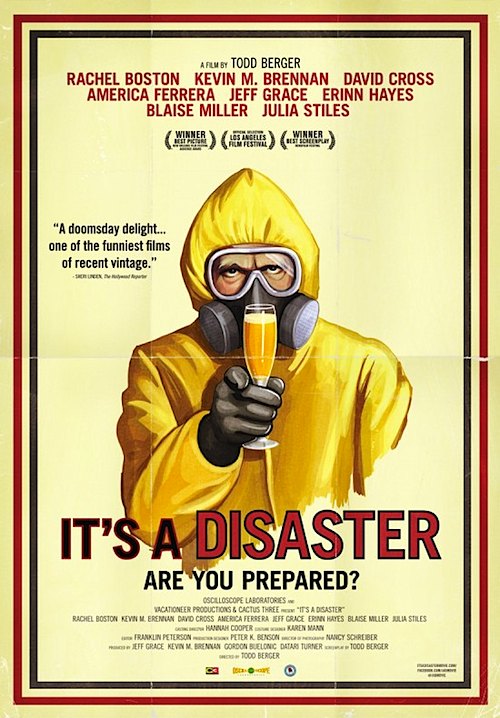
Vegan Brunch Apocalypse: LFM Reviews It’s a Disaster

By Joe Bendel. The world will soon be destroyed, but annoying hipsters remain eternal, like cockroaches. A small circle of friends (or frienemies) will brunch on vegan stew and saran gas in Todd Berger’s It’s a Disaster, which opens today in New York.

Hamlet might say that the regular couples’ brunch hosted by Emma and Pete Mandrake is a custom “more honored in the breach than the observance.” Nobody really enjoys them, but they feel obligated to attend. Glenn Randolph is about to find out why. He is new to the group, having only dated the romantically luckless Tracy Scott for a few weeks. Before the scrupulously unidentified terrorists or whatever strike, the Mandrakes drop their own bomb, announcing their plans to divorce.

The already tense mood is hardly improved when cable, internet, and wireless service all go on the blink. Eventually, the self-absorbed couples get the inkling something might be amiss, leading to a mad search to find an old fashioned terrestrial radio.

Even though Disaster is essentially a comedic sketch drawn out to feature length, the first two thirds are consistently amusing. Berger wryly skewers his consumerist yuppie couples, walking a fine line in their characterization. They are neither too likable for the audience to be overly concerned about their impending doom, nor so unpleasant we resent spending eighty-eight minutes in their company.

Unfortunately, Disaster craters in the home stretch, mean-spiritedly bludgeoning evangelicals. Satire is only really funny when it is based on a thorough understanding of the subject getting the business. Frankly, it seems like all Berger knows about the Rapture he gleaned from a Left Behind trailer.

Up to a point, David Cross is quite amusing as Randolph and the persistently under-appreciated Julia Stiles displays some nice comic timing as Scott. Rachel Boston and Kevin M. Brennan also show an aptitude for broad, slightly risqué material. America Ferrera and Jeff Grace have plenty of shtick as the perennially engaged Hedy Galili and Shane Owens, but they never look or sound like a convincing couple and generally lack presence on-screen. On the other hand, Erinn Hayes and Blaise Miller are completely believable as the bickering Mandrakes, but Berger largely shortchanges them on zingers.

The unfathomable stress of Armageddon could be a telling crucible to examine human nature in all its extremes and banalities. Yet, like Abel Ferrara’s 4:44 Last Day on Earth, Disaster largely squanders the potential opportunity. There are a fair amount of laughs and some clever gags in the film, but it will leave many viewers will a sour after-taste. Recommended only for full of themselves David Cross fans, It’s a Disaster opens today (4/12) in New York at the Village East and in Brooklyn (naturally) at the Nitehawk Cinema.

LFM GRADE: C+

Posted on April 12th, 2013 at 9:32am.

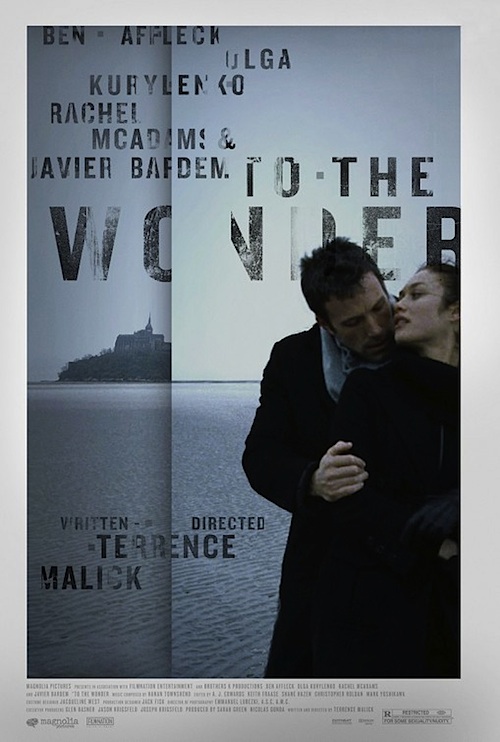
LFM Reviews Terrence Malick’s To the Wonder

By Joe Bendel. It seems eerily fitting that Terrence Malick’s To the Wonder would be the final film reviewed by the auteur’s longtime champion, Roger Ebert. It is rather more surreal to think Olga Kurylenko commenced production on Malick’s latest in 2010, the same year she worked on the forthcoming but already infamous mermaid potboiler Empires of the Deep. Yet, any new film from Malick is a cinematic event in its own right. The director’s admirers will find it is very much a Malickian statement, except perhaps more so, when To the Wonder opens tomorrow in New York.

Neil and Marina meet in France and fall deeply in love. He is a visiting American. She is a Ukrainian single mother. Intending to start a new life together, she and her daughter Tatiana move into his Oklahoma home, where the wind comes sweeping down the plain. Their dreamy ardor persists for a while, but soon fissures develop in their relationship. Eventually, Marina and Tatiana return to Europe. She and Neil eventually feel compelled to make another try, but this time her daughter stays with her (unseen) father. Despite the support of the equally alienated Father Quintana, the couple’s issues persist.

Just under two hours, Wonder is practically a short subject by Malick’s standards. However, he makes absolutely no stylistic concessions. Frankly, it is more like a series of tableaux than a movie, even of the art house variety. Framing lovely images is a hallmark of Malick’s work, so his striking vistas should come as no surprise. Yet, at some point, moving pictures really ought to, you know, move.

Throughout Wonder, Malick’s favored perspective on Ben Affleck’s Neil is the back of his head, which is obviously deliberately distancing. Yet, in a way it suits the reserved and reticent Oklahoman. Even as Malick and his characters seemingly strain to shut viewers out, cracks of profundity occasionally open up in the film. In one particularly heavy moment, Father Quintana counsels Neil it is always difficult to be the one who loves less than their partner. Indeed, Neil has plenty of guilt to process without the consolation of Marina’s emotional reveries. There’s something for the daytime talk shows to chew on.

Naturally, Father Quintana has lost (or at least misplaced) his faith. Nonetheless, it is a deeply sympathetic portrait of a man of the cloth. Malick unflinchingly captures his loneliness and the imperfect solace he finds in service to others. Javier Bardem might not dig into such deep and dark places as he did for Biutiful, but he still conveys a sense of a man with a long, complicated history.

Since nobody is really granted a substantial backstory, it is incumbent on the cast to evoke the sense their pains and regrets are rooted in something real and universal. That is a real strength for Bardem. Whereas Affleck is supposed to be cold and aloof, Olga Kurylenko is also surprisingly effective and affecting as the passionately needy Marina.

Viewers who lose patience with Wonder are not shallow philistines. Malick de-emphasizes plot and character development in favor of imagery and in-the-moment impressionism. It is slow and at time pretentious. Yet, at the fleeting junctures where it all comes together, it is like the epiphany produced by an audacious free jazz performance. Dashed demanding, To the Wonder is mostly recommended for hardy Malick followers when it opens tomorrow (4/12) in New York at the Walter Reade Theater uptown and the Landmark Sunshine downtown.

LFM GRADE: B-

Posted on April 11th, 2013 at 10:29am.

Leonardo Decodes an Ancient Mystery: LFM Reviews Da Vinci’s Demons; Series Premieres on Starz, Friday 4/12

By Joe Bendel. Could Leonardo Da Vinci have been a member of a Persian mystery cult? The Sons of Mithras certainly seem to know him, even if he does not recognize them. The Vatican is also keenly aware of the Maestro, but he wants no part of the Church. However, it is not Da Vinci’s artistry that interests the Pope’s men. They believe he will lead them to the Book of Leaves, a mysterious volume of Faustian knowledge that serves as the MacGuffin of Da Vinci’s Demons, a new speculative historical series debuting this Friday on Starz.

Created and co-written by executive producer David S. Goyer (co-writer of the Dark Knight trilogy), Da Vinci’s Demons could be called a Da Vinci Code for Da Vinci. Throughout the series, he will be solving puzzles that are part of a larger ancient mystery. He must also navigate contemporary intrigues (circa 1476). Although hardly obsequious to the Medici family, Da Vinci is a proud Florentine, because the Republic is such an exemplar of Renaissance ideals. Of course, the Pope hates the city-state for exactly the same reason.

Seeing opportunity in crisis, Da Vinci offers his services to the Magnifico as a war engineer. Naturally, he makes all sorts of enemies in the process. He also accepts a commission to paint the portrait of Lorenzo’s mistress, Lucrezia Donati. She was already cheating on her husband with de Medici, whom she also starts to cheat on with Da Vinci. Indeed, there will be a fair amount of sneaking in and out of bedchambers and outright scandal in Demons.

Laura Haddock as Lucrezia Donati in "Da Vinci's Demons."

There are light fantastical elements in Demons, but it is closer in tone to shows like Rome and Spartacus, with a protagonist who could be the spiritual cousin of Benedict Cumberbatch’s Sherlock Holmes. We even see the world from a similar stop-time perspective through his eyes. Tom Riley takes a bit of getting used to as Da Vinci, but he grows on viewers (at least over the course of the first four episodes). He nicely captures that Sherlockian charismatic arrogance, which is quite entertaining when done right.

Demons also benefits from two attractive yet steely women characters to counterbalance its murderous cardinals and randy artists. Laura Haddock’s Donati brings a sultry noir vibe to the series, while Lara Pulver (Irene Adler in BBC’s Sherlock) is an intriguing master of realpolitik as Clarice Orsini, Mrs. de Medici. Despite his resemblance to Adrien Brody, Blake Ritson also makes a first class heavy as the Pope’s enforcer, Count Girolamo Riario.

Frankly, Da Vinci’s Demons seems to have about as low an opinion of the Church as Reelz’s World Without End, but at least the nefarious clerics enjoy their villainy. In contrast, the Ken Follett’s evil Brother Godwyn always looks slightly nauseous. Indeed, a little moustache-twisting and teeth-gnashing is always enjoyable. Combined with a Dan Brown-esque mystical backstory and some almost steampunky set pieces, Da Vinci’s Demons brings a lot to the table. It is an entertaining series that picks up steam, becoming more addictive as it progresses. Recommended for fans of Rome and The Da Vinci Code, Da Vinci’s Demons premieres this Friday (4/12) on Starz.

LFM GRADE: B

Posted on April 10th, 2013 at 12:39pm.