By Joe Bendel. It is easy to do the jazz dichotomy thing for Erroll Garner. He was nicknamed “The Elf,” but he had a giant sound on the piano. During his lifetime, he was one of the most visible jazz artists on television and in concert halls, yet he has been largely overlooked by recent filmmakers attempting to tell the jazz story (do the initials K.B. ring a bell?). For a documentarian, the latter point is a golden opportunity. Atticus Brady capitalizes on the wealth of archival footage and the admiration of friends and colleagues the pianist-composer left as his legacy in the documentary-profile Erroll Garner: No One Can Hear You Read, which releases on DVD today from First Run Features.
In the latter half of the Twentieth Century, if you had only one jazz LP in your collection, it was probably Brubeck’s Time Out, Miles Davis’s Kind of Blue, or Garner’s Concert by the Sea (all released by Columbia, by the way). He was enormously popular, playing venues like Carnegie Hall, paving the way for Wynton Marsalis and the rise of curated jazz programming in the 1980’s.
Read nicely establishes Garner’s remarkable success and his roots in the Pittsburgh jazz scene that also produced Ahmad Jamal, Mary Lou Williams, and Stanley Turrentine. However, with his very title, Brady emphasizes Garner’s status as perhaps the last great ear-trained, non-music reading jazz greats. It is true, but it hardly seems like the fundamental essence of the man. Indeed, Steve Allen argues Garner had a remarkable harmonic sense and was woefully underappreciated as a composer. Of course, just about everyone knows at least one Garner standard: “Misty,” the inspiration for countless romances and Clint Eastwood’s directorial debut, Play Misty for Me (which happens to be screening this Friday and Saturday at the IFC Center).
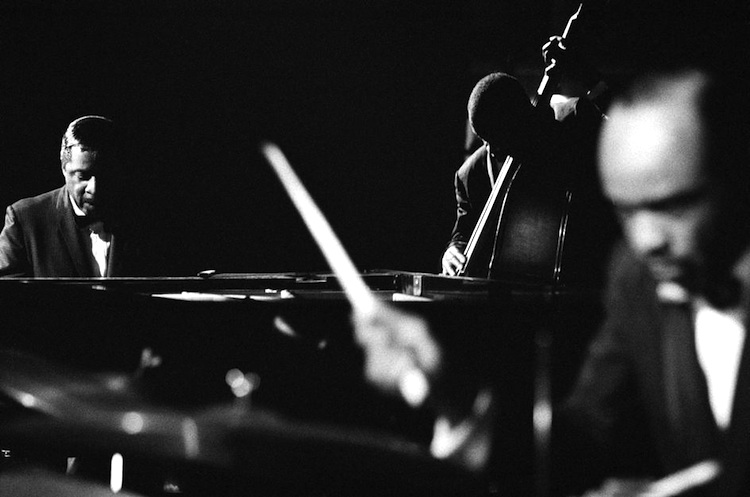
Jazz great Errol Garner (left).
Brady talks to a number of colleagues and experts with both musical credibility and name recognition, including Jamal, Allen, the other Allen (Woody), former Garner sideman Ernest McCarty, and Dick Hyman. More importantly, Brady has confidence in his subject, letting clips of Garner in action play for considerable lengths of time. That is the good stuff, after all.
Granted, Read never reinvents the jazz documentary, but who really wants that anyway? Brisk and entertaining, the hour-long Erroll Garner: No One Can Hear You Read is recommended for jazz lovers and general audiences as an introduction to the man and his music. It is now available for home viewing from First Run Features.
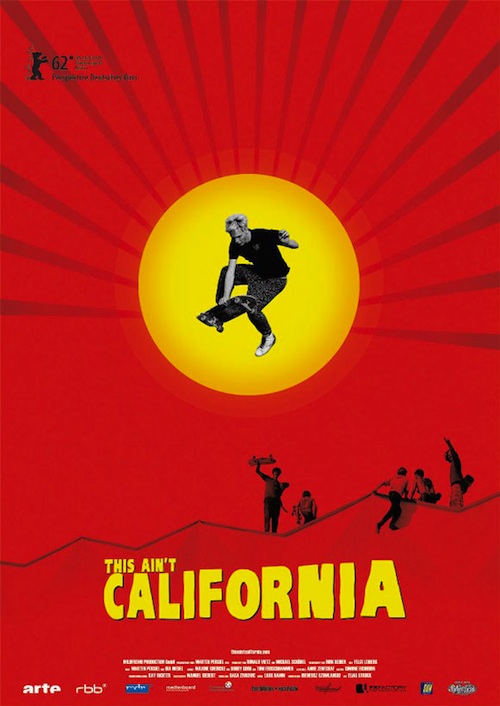
By Joe Bendel. The architecture of East Berlin was a crime against art. Yet, for skateboarders, all that monstrous concrete was practically a workers’ paradise. The East German skater subculture gets the full documentary treatment and then some in Marten Persiel’s This Ain’t California, which opens this Friday in New York.
Athletics were a big deal in the GDR, but a scruffy skateboarder like Denis “Panik” Paraceck was nobody’s idea of a Katarina Witt. He was supposed to be an Olympic swimmer, but his rebellious nature and flair for daredevil stunts drew him to the skater scene. Although the Stasi constantly spied on Paraceck and his cronies, the East German sports bureaucracy eventually tried to co-opt the movement when they discovered the burgeoning sport had its own circuit of international competitions. It seems Paraceck initially tried to play ball, but he quickly chafed under their authority. However, there is also a strong likelihood he never existed in the first place.
While TAC is structured as an elegy to Paraceck, a little digging raised serious questions about the film’s cross-its-heart-and-swear-to-die veracity. Evidently, Persiel now uses the term “documentary tale” and speaks of the broadening meaning for the genre. This is not an isolated case. After garnering considerable festival attention, Michal Marczak admitted At the Edge of Russia was kind of, you know, staged. (Considering I noted how surprising it was Russia granted a Polish filmmaker access to a remote military base as well as the cinematic look of his subjects, I would argue my review holds up pretty well in retrospect).
Regardless, the underground East German skater community is an established fact. It seems safe to assume they were on the business end of Stasi surveillance and the PR conscious Party probably did try to recruit them for propaganda purposes. As for the rest of TAC, you tell me.
In fact, some of the animated interludes are obviously intended to instill a fable-like vibe. Had Paraceck really burned down the GDR’s skater training facilities, it is doubtful he would have lived to see unification. Rather, Paraceck functions as a scapegoat-like creation myth of unification. Supposedly locked in a Stasi prison cell when the wall came down, he missed all the festivities. By the time he was released, Persiel and their cohorts had already moved on with their unified lives, leaving him behind.
There is definitely a measure of truth to TAC, but it is a fair question to ask how much. If nothing else, Persiel captures the milieu of the GDR era. Paraceck or those for whom he serves as a composite did not want to become political activists. Nonetheless, they became de-facto dissidents simply by careening about atop a small board with wheels. Visually striking, TAC combines talking head reminiscences, stark animated sequences, and some impressive archival skating footage (that may well have been recreated by Persiel and a cast of contemporary skaters). Recommended for those fascinated by the failed Communist experience (but as what I have no idea), This Ain’t California opens this Friday (4/12) in New York at the Maysles Institute Cinema.
By Joe Bendel. You can always count on distillers for a lyrical turn of phrase. In their parlance, the vintage whiskey lost in the barrel to evaporation is called the “Angels’ share.” It is hard to anticipate how much those angels will partake. This opens the door for an unlikely scheme in Ken Loach’s working class comedy The Angels’ Share, which opens this Friday in New York.
Robbie has a temper and a pregnant girl friend. The former almost gets him sent to prison, but the latter helps keep him out. Sentenced to community service, Robbie falls under the supervision of Harry, an understanding middle-aged volunteer. Through Harry’s friendship, Robbie discovers he has a nose, if not necessarily a taste for fine malt whiskey. He also learns of an upcoming auction of one of the rarest vintages ever distilled in Scotland. With the dubious assistance of three losers from his community service, Robbie intends to nick a bit of the angels’ share.
The widely accessible Share follows in the tradition of Loach’s Looking for Eric. It is a crowd-pleasing comedy, but it remains faithful to the filmmaker’s proletarian aesthetic. Indeed, Loach takes his time, establishing his characters and their lack of prospects before launching into the caper. Yet, it is nowhere near as didactic as his socialist social issues dramas, which is a major reason why Share is so much more entertaining.
While looking the part of a troubled young man, Paul Brannigan has genuine screen presence as Robbie. The audience can sense there is a real fire within him, in both good and bad ways. John Henshaw is also quite appealingly down-to-earth and humane as Harry. Veteran character actor Roger Allam (recognizable from Endeavour, The Thick of It, and Parade’s End) adds a welcome splash of roguish sophistication as the mysterious whiskey broker, Thaddeus. Unfortunately, Robbie’s three co-conspirators largely come across like recycled stock characters from previous Loach films, but even at their most exaggerated, they cannot undermine the film’s charm.
The stakes are considerable and the milieu is rather grim throughout Share. Yet, it is an enormously satisfying, perfectly titled film. A “feel good movie” does not adequately describe it. “Feel giddy” comes closer. Naturalistic yet uplifting and consistently funny, The Angels’ Share is enthusiastically recommended for general audiences even more than for Loach’s usual admirers when it opens this Friday (4/12) in New York at the Lincoln Plaza Cinema.
[Editor’s Note: the post below appears today on the front page of The Huffington Post.]
By Jason Apuzzo & Govindini Murty. If a hallmark of great art is its ability to transcend the limited circumstances of its creation, then there is no more heartbreaking realization of this than the 1944 performance of Giuseppe Verdi’s Catholic Requiem by Jewish prisoners at the Nazi concentration camp Terezín. The story of Terezín and of the Requiem is told eloquently in director Doug Shultz’s powerful new documentary Defiant Requiem, which premieres this Sunday, April 7, on PBS at 10 p.m. ET/PT (check listings for additional screenings on local PBS stations).
It was at Terezín in 1944 that imprisoned Czech conductor Rafael Schächter led a chorus of his fellow Jewish prisoners — most of them doomed to the gas chambers at Auschwitz — in brazenly performing Verdi’s Requiem before the very Nazis who had condemned them to death. One of the most complex and demanding of chorale works, Verdi’s 1874 Requiem was originally intended as a musical rendition of the Catholic funeral mass. Rafael Schächter took Verdi’s music and transformed it into a universal statement, one proclaiming the prisoners’ unbroken spirit and warning of God’s coming wrath against their Nazi captors.
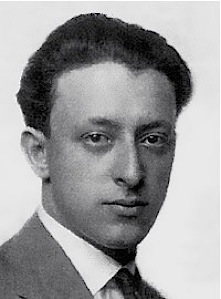
Conductor Rafael Schächter.
Defiant Requiem tells two parallel stories: the first takes place during World War II, when Jews throughout Europe were rounded up by the Nazis and sent to Terezín as part of an elaborate deception to convince the world that Germany treated its prisoners humanely. Among those arrested and dragged to Terezín in 1941 was the young Rafael Schächter, a courageous and steadfast Czech opera-choral conductor.
Distinguished American conductor Murry Sidlin, who discovered the history of Schächter and the Terezín performers in the ’90s, and who went on to found and conduct the Defiant Requiem concerts, notes in the film that “Schächter would have emerged as a great conductor” had his life not been cut short by the Nazis.
Within the confines of Terezín, Schächter lifted the spirits of his fellow inmates by creating a musical program for them to perform — a program that inspired an astonishing outburst of cultural activity, which would eventually include almost a thousand different performances of chamber music and operas, oratorios and jazz music, theatrical plays, and some 2,300 different lectures and literary readings. Included in this were 16 performances of Verdi’s emotional and musically challenging Requiem. As Terezín survivor Zdenka Fantlova explains in the film: “Doing a performance was not entertainment. It was a fight for life.” She later adds, “If people are robbed of freedom, they want to be creative.”
This flurry of activity within the walls of the prison camp — achieved under the most trying possible circumstances of starvation, disease, and abject cruelty — would culminate in a performance on June 23, 1944, of the Requiem in front of the camp’s Nazi brass, visiting high-ranking SS officers from Berlin, and gullible Red Cross inspectors brought in to verify that the prisoners were being well treated.
It was at this point that Verdi’s Requiem, with its dark, apocalyptic Dies Irae (“Day of Wrath”) choral passage — evoking the Last Judgement — and equally harrowing Libera me (“Deliver me”) passage took on connotations that Verdi could hardly have imagined. Serving as both a spiritual catharsis for the prisoners, and as a prophecy of the Nazis’ ultimate fate, the Requiem was immediately transformed by Schächter and his fellow prisoners into an anthem of divine supplication and retribution. Indeed, shortly after this final performance, both Schächter and most of his choir would be sent to Auschwitz.
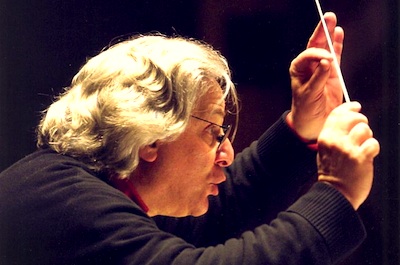
Conductor Murry Sidlin.
Defiant Requiem‘s second, parallel story takes place in 2006, as Murry Sidlin brings a full orchestra and the Catholic University of America’s chorale ensemble — along with surviving members of Schächter’s chorus — back to Terezin to perform the Requiem once more, this time in tribute. (Sidlin continues to conduct such tribute performances of the Requiem, with concerts scheduled for The Lincoln Center on April 29 and Prague’s St. Vitus Cathedral on June 6.)
The journey to Terezín is clearly a spiritual quest for Sidlin (who has since founded The Defiant Requiem Foundation), who views the modern performance of the Requiem at Terezín as the completion of something begun seventy years before. As Sidlin says at one point in the film: “I brought the Verdi here because I want to assure these people [Schächter and the deceased prisoners] that we’ve heard them.” Sidlin’s staging of the Requiem in the now unassuming confines of Terezín is powerful and gripping — and serves, one senses, as the perfect tribute to Schächter and his fellow performers.
Highlighting the role that individuals can play in keeping important cultural history alive, it was Sidlin’s discovery of the book Music at Terezín in the late ’90s, and his subsequent championing of the concert series, that has brought the otherwise forgotten history of Rafael Schächter and the Terezín Requiem performances back to life. It is a culmination both of Sidlin’s passion for music and of his own personal history; Sidlin’s grandmother and many of her closest relatives were murdered outside Riga, Latvia by Nazi SS assassination squads during World War II.
By Joe Bendel. If a future generation ever really wanted to create their own unique identity they would study hard, eagerly join the work force, and compulsively save. Of course, hedonism is more fun – especially when there is a hipster filmmaker around to pretend you invented the dissolute lifestyle. True to the Bret Easton Ellis tradition, Alexandra McGuinness casts a glossy eye on the London smart set in Lotus Eaters, which opens tomorrow in New York.
Except for Alice, nobody in her circle of frienemies has ever held a proper job. She happens to be a model. She would like to transition into an acting career, but that looks unlikely for reasons of talent (or lack thereof). Everyone else spends all their time doing drugs, having sex, and playing mind games with each other. This especially includes her not-so reformed heroin-addict on-again-off-again boyfriend, Charlie. She would like to make it work with him, but he seems too self-destructive even by her friends’ standards. As a result, she starts responding to the duller but wealthier Felix. His ex is none too pleased, whereas master manipulator Orna seems to enjoy the chaos.
All critics seem to agree on how striking Gareth Munden’s Herb Ritts-inspired black-and-white cinematography is, which is all well and good. As a screen drama, though, Lotus is pretty much a mess. The characters are dull, the situations predictable, and the tone is ridiculously self-important. At least McGuinness is not afraid to cut lose. Frankly, by the third act, Lotus seems be deliberately parodying itself and other pretentious art films, concluding with an outrageously over-the-top finale that will either cause your jaw to drop or your sides to ache. That might not be what McGuinness was going for exactly, but at least it makes the film distinctive.
As Alice, the waifish Antonia Campbell-Hughes tends to blend into the white backgrounds unobtrusively. Likewise, the Byronic bad boy thing folksinger Johnny Flynn does as Charlie gets old quickly. Strangely, a lot of the flavor comes from the supporting cast. While some are rather clunky, Cynthia Fortune Ryan is an intriguing presence as Orna while Jay Choi adds some mischievous flair as Lulu.
Oddly enough, Lotus Eaters is really quite a retro viewing experience. It is all about its surface sheen and neo-new wave soundtrack. Had it come out in the 1980’s it would have been a sensation, but three decades or so later just feels like empty sound and spectacle. Recommended for fans of Mommie Dearest and similarly overwrought cult oddities, Lotus Eaters opens today (4/5) in New York at the Village East.
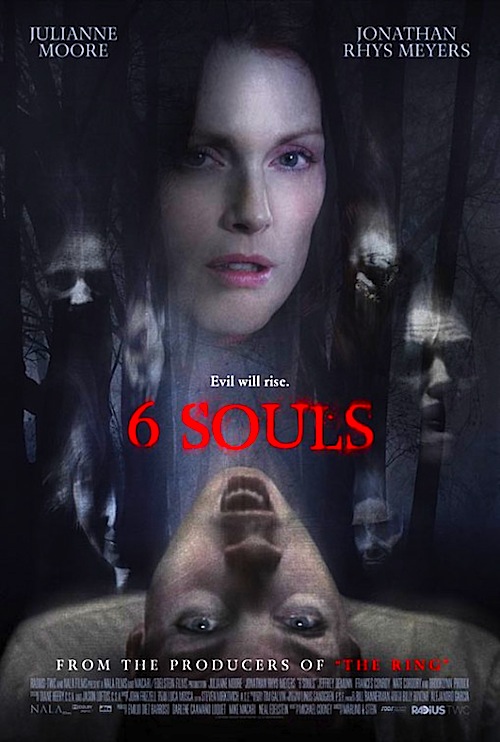
By Joe Bendel. There is nothing like eternity to teach atheist materialists a thing or two. A malevolent supernatural entity is out to demonstrate the soul’s existence to those who unfortunately lack faith in Måns Mårlind & Björn Stein’s 6 Souls, which opens this Friday in New York.
Dr. Cara Jessup has no patience with bogus multiple-personality diagnoses. She is perfectly willing to testify against such claptrap as an expert witness for criminal prosecutors. It takes a lot out of her though, because she is a practicing Christian. Her faith was recently tested by the random murder of her husband, yet it remains strong. The same is not necessarily true for her father, Dr. Harding, and her young daughter.
Also a psychiatrist, the old man is more apt to buy into trendy theories. As a challenge to his orthodox daughter, he presents her a particularly volatile but convincing split personality case. Accepting the challenge, Jessup discovers the man’s presumably adopted personas correspond to tragic deaths not far from his hill country roots. In each case, the deceased’s faith had been undermined by misfortune before their actual deaths. It all might involve a snake-handling Hillbilly sect and its spiritual leader, the “Granny.” Of course, while Dr. Jessup follows her clues all the soul-sick people in her life start dying like flies.
If Julianne Moore had created such a sympathetic portrait of a woman of faith when playing Sarah Palin, Game Change would have been the toast of CPAC. Frankly, 6 Souls is more than a bit muddled in its presentation of religious belief, but Moore clearly conveys her Christianity as a source of strength for Jessup. It is smart, earnest work. And then there’s everyone else.
To be fair, veteran character actor Jeffrey DeMunn (the Stephen King prison movie specialist, appearing in Green Mile and Shawshank) is quite engaging as Dr. Harding. Alas, Jonathan Rhys Meyers is far from a suitably sinister presence as Harding’s patient[s]. Indeed, there is no getting around it—he is just plain dull.
6 Souls opens with a grabby sequence that nicely establishes both Dr. Jessup’s character and an atmosphere of foreboding. Unfortunately, it is not really connected to the rest of the narrative. Mårlind & Stein try to maintain the moody vibe, but they keep the proceedings so murky it seems like they might have shot with layer of caked-on mud covering their lens. There is a worthy lead performance and the kernel of a promising idea in 6 Souls, but the execution is too dark (in a literal sense) and erratic. Best reserved for genre die-hards who like their supernatural horror with some Appalachian seasoning, 6 Souls opens this Friday (4/5) in New York at the Village East.