The Intrigue Before the War: LFM Reviews Alan Furst’s Spies of Warsaw; Debuts Wed. 4/3 on BBC America

By Joe Bendel. In the early 1930’s, Poland was in a tight spot geographically. It was sandwiched between Germany and the Soviet Union. We know what that will mean come 1939. A French military attaché also has a pretty good idea, but his superiors are not so keen to hear it in Spies of Warsaw, a two-night miniseries based on Alan Furst’s novel, premiering this Wednesday on BBC America.

Jean-Francois Mercier saw more than enough combat in World War I. Initially, the decorated aristocrat was not enthusiastic about his posting to the Warsaw embassy. However, as the Polish people start to grow on him, he becomes increasingly concerned about their vulnerability to foreign invasion. Indeed, he fully understands the implications for France should Poland fall. Warsaw has also become considerably more charming for Mercier after the arrival of Anna Skarbek, a sophisticated employee of the League of Nations. Frustratingly, though, she is determined to remain faithful to her lover, Maxim Mostov, a boozy Russian journalist exiled by the Bolsheviks.

While the first installment of Spies is a bit slow out of the blocks, it nicely sets the scene and establishes the geopolitical context. The cloak-and-daggering that eventually takes center-stage is fascinating fact-based stuff, involving the oft-overlooked left wing of the National Socialist Party (a vestige of its trade unionist roots) and the German upper-class’s resentment of the Nazis, mostly for being uncouth and reaching above their proper stations.

Mercier is also rather clear-headed when it comes to appraising the Communists. In fact, he agrees to facilitate the defection of a pair of his Soviet counterparts. As a bargaining chip, they offer clues to the identity of a former NKVD mole highly placed in the German government, who became inactive when his handler was purged. Yet, Mercier’s ultimate mission, inspired by a true historical operation, will be revealed late in the third act.

Janet Montgomery as Anna Skarbek in "Spies of Warsaw."

Spies might have been condensed into feature length, but the extra time allows it to more fully explore the details (we) espionage junkies so enjoy. Even though it presents Warsaw as a city rife with spycraft and skullduggery, Dick Clement & Ian La Frenais’s tele-adaptation is clearly sympathetic to the Polish people. Prominent Polish actor Marcin Dorociński even has a major supporting role, nearly stealing the show as Mercier’s old wartime colleague, Antoni Pakulski, now serving in the Warsaw constabulary with vaguely defined counter-espionage responsibilities. Unlike his gritty turns in Rose and Manhunt, Dorociński has a smooth Errol Flynn-ish thing going on that works so well he could easily carry a Pakulski-focused sequel.

Of course, to BBC America and most of its viewers, the star of Spies is unquestionably David Tennant, the tenth Doctor Who. As Mercier, he supposedly cuts quite the dashing figure. Really? If you say so. Still, he projects a sense of intelligence and a distinct impatience with bureaucracy, both of which are more important for his character’s super-spy credibility.

Veteran British television director Coky Giedroyc (whose credits notably include The Hour) maintains an appropriately noirish mood, emphasizing atmosphere and intrigue more than action. It might seem hard to believe that one of the year’s smartest miniseries – with a pronounced respect for freedom and a healthy skepticism of ideology – would feature a French blue blood and a League of Nations do-gooder as its primary POV characters, but here it is. Highly recommended for fans of cerebral spy fiction in the Le Carré tradition, Spies of Warsaw begins this Wednesday (4/3) and concludes the following week (4/10) on BBC America.

LFM GRADE: A-

Posted on April 1st, 2013 at 11:15am.
Going Underground in the Ukraine: LFM Reviews No Place on Earth

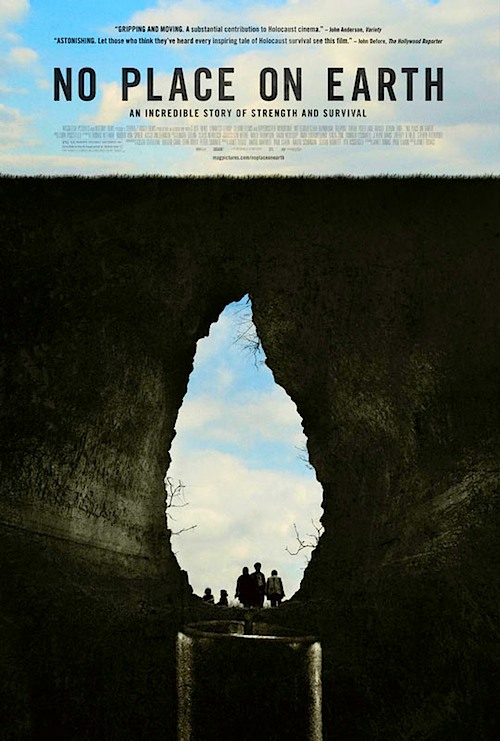
By Joe Bendel. Most think of caving as the stuff of National Geographic, but for thirty-eight Jewish Ukrainians, it was rather more serious. It was a matter of life, not death. For eighteen months they evaded the German National Socialists by hiding deep in two narrow, naturally-formed caverns. Decades later, the survivors tell their story in Janet Tobias’s documentary, No Place on Earth, which opens this Friday in New York.

As it often happens, it was a New Yorker who brought this story to light. British-born Bronx resident Chris Nicola is an experienced caver who originally traveled to the post-Soviet Ukrainian in search of his roots. While exploring a cave, he discovered a series of artifacts clearly suggesting families had once lived there. Not surprisingly, the locals were not forthcoming with information. Nonetheless, after years of sleuthing, he finally tracked down the Stermers and the Dodyks. They all credit their initial survival to the iron-will of matriarch Esther Stermer as well as the resourceful foraging of the elder Stermer brothers, Nissel and Saul.

When Tobias read about Nicola’s expeditions and investigation (in Nat Geo, of course), she recognized the makings of a good documentary. Fortunately, the production fell into place in time to record the elderly Stermer and Dodyk survivors returning to the caves that once sheltered them, bringing along their children and grandchildren, with Nicola to serve as their guide.

Tobias blends dramatic re-enactments, talking head interviews, and her on-the-scene footage of the families’ underground homecoming (not completely seamlessly, but functionally enough). At times, it has the feel of a cable special (perhaps with good reason, considering it is a co-production of History Films), but there is no denying the power of their story. At one point during their subterranean reunion they cut the lights to fully recreate the experience of living there. Coincidentally, at this point the video went out at the screening I attended, yet it took a roomful of jaded film critics several minutes to realize it was supposed to be dark, but not that dark. One could certainly say we were caught up in the moment. (Eventually the problem was fixed and the film rewound to the point in question).

The Stermer and Dodyk family members are still very sharp interview subjects and Nicola is a particularly charismatic screen presence. As a result, Tobias captures a vivid sense of her subjects’ personalities and their lives in the caves, the quality of which was quite high they repeatedly emphasize, because it was free.

Indeed, this is not the usual survival story often depicted on-film, chronicling the efforts of a good Christian protector. The Stermers and Dodyk’s relied almost entirely on themselves. There is a lot to learn from their inspiring stories. Respectfully recommended for family and student viewing, No Place on Earth opens this Friday (4/5) in New York, at the Angelika Film Center downtown and the Elinor Bunin Munroe Film Center uptown.

LFM GRADE: B

Posted on April 1st, 2013 at 11:14am.

Mythic Scandinavian Blondes: LFM Reviews Thale

By Joe Bendel. Huldra are not your typical mythological woodland creatures. These tailed women from Scandinavian myth are very blonde and can be a lot of trouble. Two forensic cleaners might have one on their hands in Aleksander Nordaas’s Thale, which opens this Friday in New York.

Elvis is not really cut out for his friend’s Leo’s industrial strength cleaning service. Their primary gigs are grisly crime scenes. The work doesn’t seem to bother Leo much, but it keeps Elvis close to a bucket. Their latest assignment has them scouring about for the pieces of an elderly recluse, killed under mysterious circumstances. As they proceed, they stumble upon a secret cellar with a naked woman hidden in a bath tub.

It seems the old geezer had kept her prisoner down there since she was a young girl. While the deceased evidently performed various experiments on her, the cassettes he left behind seem to suggest he was also protecting her from outside parties. As if on cue, we start to see strange, shadowy figures darting through the woods. The feral Thale, as the old man called her, also bears watching. Good luck, dudes.

Although billed as a horror film, Thale is long on set-up and short on gore. This is not necessarily a bad thing. There is a bit of character development in their disparate reactions to splattered blood and entrails that pays off later in the film. Nonetheless, there is not so much to satisfy hardcore genre fans. Instead, Thale plays like a dark Nordic version of Splash.

Nordaas deliberately emphasizes Thale’s animal-like vulnerability. Silje Reinåmo taps into that raw primal innocence. It is a rather brave performance, especially considering she is naked for nearly the entire film. It is hardly erotic, but Seth MacFarlane will clearly be able to see her breasts. Erlend Nervold and Jon Sigve Skard are also relatively engaging as the everyman carnage cleaners. They have bits that stay with viewers well after the initial screening, which says something for the genre. Unfortunately, the third act’s perfunctory lack of ambition is disappointing.

Considering the dearth of huldra movies previously available, Thale undeniably fills a void. In terms of tone and subject matter, it certainly has the virtue of being something different. Despite the simplicity of its narrative, cult film enthusiasts should consider it when it opens this Friday (4/5) in New York at the Cinema Village.

LFM GRADE: B-

Posted on April 1st, 2013 at 11:13am.

Schenectady Blues: LFM Reviews The Place Beyond the Pines

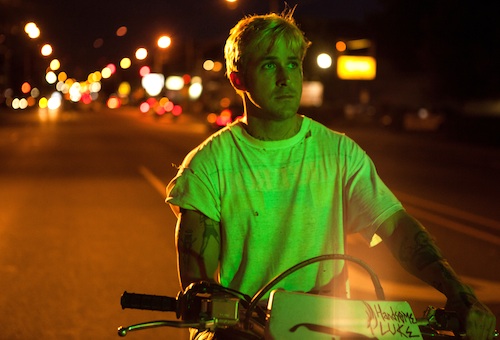
By Joe Bendel. If you shoot a movie in Schenectady, you surely qualify for those New York State tax credits. However, if you just move there looking for regular work, you are likely to get frustrated, especially if your primary skill is motorcycle stunt riding. As a result, drifter Luke Glanton turns to crime, setting in motion a wave of bad karma that will outlive him in Derek Cianfrance’s lumbering family saga, The Place Beyond the Pines, which opens today in New York.

Once a year, Glanton blows through town with the carny, performing his steel cage act. Ryan Gosling obvious spent hours in the gym and having a barrelful of temporary tattoos applied so we will buy him as a steely bad cat. Of course, it fails, putting the film in a credibility hole right from the start. Still, we can believe he is rather thick-headed. That is important, because Glanton will make some very bad decisions.

Romina, his hook-up from the previous year, turns up after his show – but she is acting weird, giving him the Heisman. Dropping by her place to take another shot, Glanton learns she had his baby, but is now engaged to a responsible adult. Much to her surprise, he quits the carnival, intending to settle down and be a father in Schenectady. The only straight gig he finds is low paying mechanic work with the grizzled Robin Van Der Zee. His drinking buddy-boss has other ideas, though.

The idea to start holding up banks involves Glanton’s skill as a driver and Van Der Zee’s cargo truck waiting to whisk him away. Frankly, Beyond’s heist scenes are surprisingly well staged. Regrettably, from this point on, Cianfrance vividly illustrates the principle of diminishing returns with the subsequent story arcs. In the second act, we follow law school grad-police officer Avery Cross, whose path fatefully crossed that of Glanton.

Ryan Gosling in "The Place Beyond the Pines."

Guilt-ridden and gun-shy, Cross finds his career at a standstill, despite his questionable hero status. He is also uncomfortable with the Schenectady force’s systemic corruption. This is fairly standard stuff, somewhat enlivened by Ray Liotta’s dependable crooked copper turn. However, Bradley Cooper never feels right as Cross, looking too old and reserved for a rookie patrolman and too young and bland for a seasoned Attorney General candidate in the third act.

Indeed, the final segment is largely a disaster, aside from the intriguing reappearance of Ben Mendelsohn’s Van Der Zee. Cianfrance drives his “sins of the father” theme into ground when Cross and Glanton’s sons become high school frienemies. Dane DeHaan is cringingly sensitive and damaged as the son Glanton never knew, while Emory Cohen’s inarticulate AJ Cross would be more convincing as the spawn of Cro-Magnons rather than a reasonably educated couple like the Crosses. Forget boarding school, he ought to be kept chained in the attic.

Hardly a subtle stylist, Cianfrance beats on the paternal issue like a rented mule. A talented editor could probably rescue a respectable short from the Glanton section, but with its taxing one hundred and forty minute running time, Beyond is simply far too long and overly melodramatic. Not recommended (unless viewers are intrigued to see the Schenectady experience on the big screen), The Place Beyond the Pines opens today (3/29) in New York at the Landmark Sunshine and Loews Lincoln Square.

LFM GRADE: D

Posted on March 29th, 2013 at 9:01am.

There Will Be Mud: LFM Reviews Detour

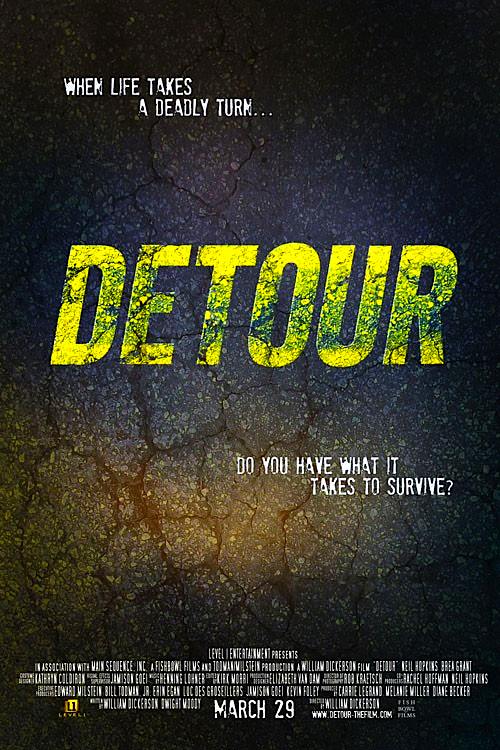
By Joe Bendel. As if the taxes and wildfires were not bad enough, here is yet another reason to avoid California. Trapped in his SUV, an ambitious advertising exec asks how the Golden State can have mudslides when there isn’t any water. It is a fair question, but it is obviously rhetorical in William Dickerson’s claustrophobic survival drama, Detour, which opens today in New York.

Jackson was on his way to a pitch meeting (sort of like that three hour cruise) when the picturesque stretch of coastal highway suddenly turned to mud. Buried underneath who knows how much gunk, he has no cell service and a limited supply of food and water. For temporary distractions (and exposition purposes) he can play videos on his smart phone, allowing viewers to meet his wife. Evidently she is pregnant, but he did not receive the news with spectacular good cheer.

As the mud presses in on his vehicle’s structural integrity, Jackson improvises reinforcements. He is actually pretty handy for an ad man. In fact, Dickerson and co-writer Dwight Moody are quite faithful observing the constraints they impose on their hapless protagonist. However, their flashbacks and delusional interludes are nakedly manipulative.

Despite its apparent simplicity, the one-man-against-the-elements genre (in the tradition of 127 Hours) is hard to pull off. Staginess is obviously an inherent pitfall. Still, Neil Hopkins soldiers through reasonably well. While he is forced to mutter to himself quite a bit, he largely sells the messages he leaves on his iPhone, perhaps for posterity. Unfortunately, the sequences outside the mud-trap are flat and awkward. Odder still, it is difficult to tell whether the final scene is meant to be inspiring, ironic, or ambiguous, which is clearly an execution problem.

Detour is far from classic, but it is certainly presentable by b-movie standards. Nonetheless, it is tough to justify at full Manhattan ticket prices, particularly with Aftershock, the Eli Roth-penned Chilean disaster smack-down, waiting in the wings. At least worth falling into eventually on cable, Detour opens today (3/29) in New York at the Cinema Village (and is now available on VOD platforms).

LFM GRADE: C

Posted on March 29th, 2013 at 8:59am.

Dead Ringers: LFM Reviews Orphan Black on BBC America; Series Premieres Sat. 3/30

By Joe Bendel. Technically, she is the doppelganger taking over someone else’s life. When Sarah sees her exact double commit suicide, she lifts the woman’s purse and wallet. The very recently deceased is much better dressed, after all. However, when she temporarily assumes the dead woman’s identity, she gets considerably more than she bargained for in the opening episode of BBC America’s Orphan Black, which premieres this coming Saturday evening.

Angry and irresponsible, Sarah carries the baggage of a childhood spent entirely in the foster-care system. She wants to begin a new life with Felix, her foster-brother, and her daughter Kira, whom she has not had custody of in some time (and for good reason). Her dubious idea of a fresh start involves stealing some inferior grade cocaine from her pseudo-psycho-boyfriend for Felix to sell. Then she sees Beth throw herself in front of a train.

Making her way to Beth’s pad, Sarah finds out where her accounts are. She only intends to stay long enough to clean them out. Naturally, things do not go according to plan. It turns out Beth was a cop facing a disciplinary hearing for a questionable shooting. Of course, Sarah has no inkling of what really went down.  he is also somewhat at a loss for words when Beth’s romantic interest returns early from a business trip. It seems rather obvious, but Felix has to remind her she and Beth are probably connected in some way that could give her clues to her own past. Gee, you don’t suppose any more apparent twins might show up?

Essentially, Orphan is like a combination of Cinemax’s Banshee and Fox’s late but not terribly lamented John Doe. If the latter doesn’t mean anything to you, don’t worry about it. At least, Orphan starts with a jolt. It is not exactly Sion Sono’s Suicide Club, but the tightly staged and edited train station sequence is undeniably grabby. The first episode also has a promising grittiness. Viewers can readily accept Tatiana Maslany’s Sarah and Jordan Gavaris’s Felix are damaged people long accustomed to operating on the fringes of polite society.

Unfortunately, by the time the first episode’s mystery guest shows up, a familiar pattern begins to emerge. It is all too easy to foresee a covert government laboratory and a parade of sketchy informers in Orphan’s future. Frankly, we have been down that road many times in the past and it almost invariably leads nowhere.

It is impossible to render a final critical judgment on the basis of only one episode, but viewers do just that all the time. Orphan assembles a reasonably strong cast, but in service of a so-so premise. It might be a passable distraction, but it is nowhere near as entertaining as Banshee, with which it apparently shares some superficial cop-impersonating plot elements. Perhaps it will grow on genre fans when it takes its place in BBC America’s “Supernatural Saturday” (3/30) this weekend.

LFM GRADE: C+

Posted on March 27th, 2013 at 10:47am.