LFM Reviews Emperor Visits the Hell @ MoMA’s New Directors/New Films 2013

By Joe Bendel. Before the legendary journey there was a sojourn through Hell. Emperor Li Shimin would eventually sponsor the Buddhist monk Xuanzang’s western pilgrimage in search of sacred texts. However, he must first return from an unplanned detour through the underworld. Luo Li gives the early chapters of Journey to the West an arthouse modernization with Emperor Visits the Hell, which screens during this year’s New Directors/New Films, co-presented by MoMA and the Film Society of Lincoln Center.

Li Shimin is a municipal boss, who murdered his father and brothers to ascend to his “throne.” When Dragon King, a local gangster, shortsightedly refuses to comply with an order from Heaven, he asks the “Emperor” to protect him from Heaven’s Executioner, who just happens to be Li Shimin’s counselor, Wei Zheng. The imperial mayor does his best to occupy his advisor, but he bores the man to sleep. Much to his surprise, the oblivious Wei decapitates Dragon King in his dream, which pretty much does the trick in real life too.

Somewhat disappointed by the quality of Li Shimin’s protection, Dragon King haunts the ruler as an angry ghost. Eventually, he drives the man to his death. All is not lost though. The faithful Wei has some high placed contacts in the kingdom below.

From "Emperor Visits the Hell."

Li Shimin’s tale is one of many discrete chunks of the great Ming era novel that have been adapted for film and television. However, it is a downright bizarre choice to reboot in a contemporary setting. This is not a bloody combat-driven tragedy like Coriolanus. Rather, the mythic elements, such as Dragon King’s decision to forestall the rains at their appointed time, are at complete odds with Luo’s grubby modern day conception. Yet, he keeps doubling down, essentially emphasizing the contrast between the modern trappings and the fantastical story. It is just a weird vibe to take in.

Frankly, Hell looks a lot like Union City through cinematographer Jie Ren’s lens. There is no fire and brimstone, just drab offices and dilapidated slums. Li Wen’s Li Shimin is also a rather cold fish, at least until he gets hammered at the concluding Return of the Jedi-style feast (doubling as the actual wrap party) and proceeds to go off the contemporary state of things.

Although drained of color and deliberately artificial looking, Luo still presents some intriguing images. While decidedly post-modern in its approach, the film is much more about subverting narrative tradition than authority. It lends itself to all kinds of critical literary analysis, which is great if you are covering ND/NF, but it is impossible to recommend it to anyone looking for a movie to get emotionally caught up in. A coldly cerebral film intended for the like minded, Emperor Visits the Hell screens Thursday (3/21) at MoMA and Saturday (3/23) at the Walter Reade as a selection of the 2013 New Directors/New Films.

LFM GRADE: C-

Posted on March 18th, 2013 at 2:34pm.

LFM Reviews From Up On Poppy Hill @ The 2013 New York International Children’s Festival

By Joe Bendel. Hosting the 1964 Tokyo Olympics completed Japan’s post-war rebirth. It would announce the arrival of a new democratic capitalist country on the world stage. However, as Japan prepares for the games in 1963, two high school students will come to terms with their past in Gorō Miyazaki’s From Up On Poppy Hill, the latest animated feature from Studio Ghibli (co-adapted from a manga favorite by the director’s legendary animator father Hayao), which screened as part of the 2013 New York International Children’s Festival, in advance of its Friday opening at the IFC Center.

Umi Matsuzaki is the perfect daughter, who studies diligently when she is not cooking and doing chores for her family’s boarding house guests. Unfortunately, her parents are not present to witness her hard work. Her mother is studying in an American graduate program and her father was lost at sea—or at least so she was told. Nevertheless, every morning she raises signal flags in hopes of guiding her sailor father home again. Her grandmother, siblings, and boarders appreciate all her hard work, but there is still a void in her life.

Suddenly, boys come into her life. Through an odd chain of events, the bemused Matsuzaki falls in with the rabble-rousing leaders of the Latin Quarter, a dilapidated fraternity house for her school’s male-dominated academic clubs. As the editor of the Latin Quarter’s newspaper, Shun Kazama has published his poems inspired by Matsuzaki’s flag-raising. Although the administration has decided to demolish their old building, the practical Matsuzaki becomes instrumental in their campaign to save the Latin Quarter. In the process, she and Kazama fall deeply in manga-anime style love. Unfortunately, Kazama discovers a secret link from their family histories that apparently changes everything.

From "From Up On Poppy Hill."

At least the first third of Poppy is solely devoted to establishing Matsuzaki’s small corner of Yokohama and her various relationships with family, boarders, and fellow students. One could say not much happens, yet it is quite pleasant, in large measure due to the great likability of the virtuous but down-to-earth heroine. When Matsuzaki begins her sweetly awkward relationship with Kazama, while counseling his arrogant but well meaning friends, Poppy takes on the vibe of an upscale anime Archie comic. However, the past will continue to intrude on their reluctant melodrama.

Visually, Poppy is quite attractive, but its backgrounds and cityscapes are not nearly as lush as Ghibli’s two previous American releases, The Secret World of Arrietty and Tales from Earthsea. Still, it presents an appealing protagonist for younger girls, especially those who might feel self conscious about being studious or sensitive. Indeed, the fillm’s tone and characters are all quite endearing, propelled along quite nicely by Satoshi Takebe’s lightly swinging themes.

Reportedly, production on Poppy was interrupted but not derailed by the 2011 earthquake and tsunami, which adds a layer of significance to its story of perseverance and preservation. Comparatively small in scope and firmly rooted in reality, Poppy is like the Ghibli version of an Ozu film. Recommended for pre-teens and up who appreciate character driven animation, From Up On Poppy Hill opens this Friday (3/15) in New York, downtown at the IFC Center and uptown at the Elinor Bunin Munroe Film Center (with the Friday and Sunday screenings to be held in the Walter Reade instead).

LFM GRADE: B

Posted on March 14th, 2013 at 12:30pm.

The Original Media Mogul: LFM Reviews Citizen Hearst

By Joe Bendel. His name has become synonymous with yellow journalism, conspicuous consumption, and raw power. The son of a self-made mining tycoon, William Randolph Hearst always fancied himself a champion of the working people and to his credit, he usually had a good sense of what they wanted to read. Director-editor-co-writer-co-producer Leslie Iwerks profiles the man and the media empire he launched in Citizen Hearst, which begins a run of special nationwide screenings this Thursday to celebrate the one hundred twenty-fifth anniversary of the Hearst empire.

As Indiewire’s Leonard Maltin observes in Citizen, Charles Foster Kane was not exactly Hearst, but it was not that far off. On the other hand, Citizen Kane’s treatment of his actress-lover Marian Davies was pretty harsh. Dropping out of the Ivy League, Hearst started his empire with the San Francisco Examiner, which his father had won as part of a gambling debt. Hearst built what had always been the shabby second fiddle to the Chronicle into the model of his brand of yellow journalism. It was a formula he expanded nationwide, eventually expanding into newsreels and early television stations. Of course, there was also San Simeon, the compulsive collecting, his mostly unsuccessful political campaigns, and his scandalous relationship with Davies.

Citizen emphasizes the up-and-down nature of Hearst’s fortunes within his lifetime. While never destitute, he was humbled at times. That is certainly good dramatic fodder, but only about a third of Iwerks’ film is dedicated to Hearst proper (and completely ignores his principled anti-Communism). The rest of the story follows the company after the death of its larger than life founder. The most fascinating post-Hearst development by far was the fate of the Examiner, a consistent voice of Hearst’s brand of populism, brought to a standstill by a violent union strike. With Examiner advertisers openly intimidated and employees attacked, the 1968 conflict led to one death. Ultimately, the Examiner would be absorbed by its old non-union rival, which in turn was absorbed back into Hearst.

At this point, Citizen Hearst essentially becomes a promotional film for the Hearst of today, celebrating its profitable business decisions, such as changing the A&E network from an arts showcase into a reality programming freak show. Sure, it made money, but what would an art collector like old man Hearst think? Still, there are some interesting conversations with Norman Foster, the architect of their new, innovatively green New York headquarters – but he has his own documentary available, How Much Does Your Building Weigh, Mr. Foster for those intrigued by his geodesic style.

Beyond Maltin, Citizen Hearst talks with many of the Hearsts still involved in the family business. Dan Rather also appears, presumably representing contemporary disgraced/facts-optional yellow journalists. Iwerks even gets celebrity assists from frequent Hearst cover model Heidi Klum and Oprah Winfrey, a television host who once had an afternoon show that was very popular but has since largely disappeared from view. Indeed, the final third of the documentary has the tone of an E! network special.

Hearst, the self-styled progressive, would likely approve of most of the media conglomerate bearing his name today. However, the further Citizen Hearst strays from the enigmatic title figure, the less interesting it will be to non-Hearst employees. Though there is good stuff in the first hour, it is probably best saved for subsequent home viewing. For those soon interviewing with a Hearst division, it screens this Thursday (3/14) in New York at the Clearview Chelsea and 1st & 62nd Street Theatres.

LFM GRADE: C+

Posted on March 12th, 2013 at 10:09am.

LFM Reviews Don’t Stop Believin’: Everyman’s Journey

By Joe Bendel. What is the ratio of jobs lost to positions gained from tweets or any other internet postings? It must be astronomically negative. Arnel Pineda is the exception. Based on performance clips uploaded to YouTube, he would find himself trying out for the biggest prospective gig of his career: filling Steve Perry’s shoes as the lead singer of Journey. Ramona S. Diaz documents a true rock & roll Horatio Alger story in Don’t Stop Believin’: Everyman’s Journey, which opens this Friday in New York.

Pineda was a Filipino bar singer, barely eking out a subsistence living. He had one super-fan posting videos to YouTube. Scouring the internet for a new vocalist, Journey lead guitarist Neal Schon stumbled across Pineda’s covers and fell out of his chair. The other band members could hear what he was talking about, but were a little skeptical of going so far out of the box. Nonetheless, they arranged to bring a flabbergasted Pineda over for an audition.

Presumably, a documentary about how a scuffling singer from the streets of Manila failed his audition for the big time would not get much distribution or festival play, so it is safe to assume Pineda overcomes his initial jitters and earns his shot in the band. Diaz follows the newly reconstructed Journey as they spend their first year on the road together. She had “rockstar” access right from the start, capturing the entire audition process, Pineda’s debut concert, and the wear and tear of a punishing tour schedule.

While Believin’ is all about Pineda’s rags-to-riches story, it is a pretty effective infomercial for Journey, as well. Evidently they started out as an early jam-band, but became more radio friendly to placate their label. It worked. Viewers who are not diehard fans of the stadium-rockers will be surprised by how many recognizable songs are heard throughout their sets. It is more than just the title song, which Diaz shrewdly holds in reserve for the big climatic payoff.

Naturally, the focus is on Pineda and his family, but founding-member Schon also gets his due and considerable camera time as Pineda’s biggest booster and a rock & roll survivor in his own right. And audiences can tell they have real chemistry on-stage.If their band-mates do not get as much attention in the doc, they are still reaping the rewards of a rejuvenated Journey, at least according to Billboard’s figures, ranking them at #12 on the 2012 moneymaking chart, right ahead of Elton John and Katy Perry. The way they have also embraced their legions of new Filipino fans is also a cool subplot.

It is impossible to resist Pineda’s feel-good story, especially when you see the impoverished neighborhoods where he once lived. It might be predictable, but is immensely satisfying. A rare happy look “Behind the Music,” recommended both for the band’s Baby-Boomer fan base and the Facebook generation that will more likely identify with Pineda, Don’t Stop Believin’ opens this Friday (3/8) in New York at the Quad Cinema.

LFM GRADE: B

Posted on March 5th, 2013 at 12:13pm.

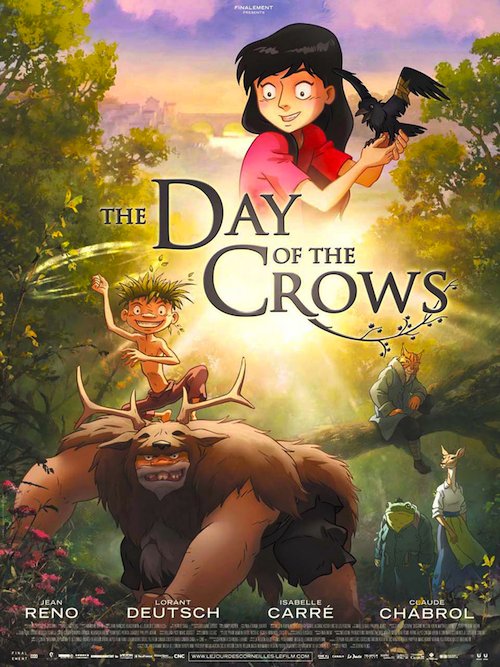
LFM Reviews Day of the Crows @ The 2013 New York International Children’s Film Festival

By Joe Bendel. He is a real wild child. His mother is an animal spirit and his father is a mountain man, bordering on a Neanderthal. His socialization has been lacking, but his world is about to expand in Jean-Christophe Dessaint’s animated feature Day of the Crows, which screens during the 2013 New York International Children’s Film Festival.

“Son” is the only name the Gollum-ish looking boy has ever known, but his gruff father does not use it particularly lovingly. At least his dearly departed mother often consoles him, appearing as a mute deer incarnate. When disaster strikes, the other woodland spirits encourage the boy to drag his comatose father into the forbidden village for medical assistance.

It seems many in town remember his father, surname Pumpkin (first name Rupert, perhaps?), and none too fondly. Fortunately, the kindly doctor will not let gossips stand in his way of treating a patient. His young daughter Manon also makes quite the impression on Pumpkin, fils. Naturally, when old man Pumpkin finally wakes up, he is not happy to be back in civilization. As soon as he is back on his feet, he drags the boy back to the forest. Things are back as they were, except Pumpkin, père is even worse than before.

Crows holds the distinction of being the final screen credit of the great Hitchcockian director Claude Chabrol, who gives voice to the good doctor’s warmth and humanity. Refreshingly old school, the film has an endearing hand-drawn look and a beautiful orchestral score composed by Simon Leclerc. Is it also wildly sentimental and slightly New Agey? But, of course. Still, Amandine Taffin’s screenplay (adapted from the novel by Jean-François Beauchemin) clearly suggests the forest might be all very pleasant to visit, but probably is not the best environment to raise an impressionable child. In fact, Crows portrays nature as both a force of beauty and danger in equal measure.

With its striking backdrops and the charming work of Chabrol (astute ears will also recognize Jean Reno grunting and bellowing as old Pumpkin), Crows has enough to satisfy most animation fans. Its themes of forgiveness and compassion are rather touching, as well. At times it appears poised to lambaste the local military garrison (who certainly look French, even if Crows avoids national specifics), but to its credit, the film veers off before getting too didactic.

There really are crows too, but in case viewers start to wonder, they really do not arrive in force until the third act. Recommended for viewers young enough to identify with the junior Pumpkin, but old enough to handle intense scenes of natural ferociousness and problematic parenting, Day of the Crows screens this Sunday (3/10) at the Alliance Française as part of this year’s NYICFF.

LFM GRADE: B+

Posted on March 5th, 2013 at 12:11pm.

LFM Reviews Muay Thai Warrior, Now on Blu-ray/DVD

By Joe Bendel. For displaced ronin, Ayothaya-era Thailand was not such a bad place to relocate. There was a considerable Japanese colony, steady work as mercenaries, and good diplomatic ties with the homeland. Unfortunately, a secret cabal is out to overturn the existing order, but they will have to contend with the legendary hero Yamada Nagamasa in Nopporn Watin’s Muay Thai Warrior (a.k.a. Yamada: the Samurai of Ayothaya), which releases today on DVD and Blu-ray from Well Go USA.

Attached to the Japanese Volunteer Army, Yamada and his comrades are tasked with apprehending roving gangs of Hongsawadee raiders, Ayothaya’s sworn enemies defeated but not vanquished by King Naresuan in the recent Elephant War. However, when Yamada and his men get their hands on a few (dead, of course) they are disturbed to find that they are Japanese. This is dangerous information that nearly costs Yamada his life. Fortunately, Kham and his fellow imperial bodyguards interrupt the ambush just in the nick of time.

Badly beaten, Yamada is taken to Kham’s village to recuperate. It is the first time Yamada finds himself at peace, aside for the occasional assassin sent to rub him out. Kham’s sister Champa certainly makes an impression on him, but he also forges a deep friendship with the fierce Muay Thai fighter. With the help of the Buddhist monk and trusted advisor royal advisor Phra Khru, Yamada learns Muay Thai in hopes of joining the King’s elite bodyguards. He also has some unfinished business with his renegade countrymen.

As an exercise in comparing and contrasting various forms of martial arts, Muay Thai definitely has the advantage in MTW. Whereas it utilizes knees and elbows to devastating effect, the styles of their rivals largely seem to involve impaling one’s self on your opponent’s sword. At least that is how it looks during the massive Hongsawadee beatdown. It is certainly cinematic though, as are the torch-lit showdowns between Yamada and the evil Japanese mastermind.

Seigi Ozeki is an engaging action figure, even if he does not quite have the skills of the real life mustachioed Muay Thai boxers cast around him. Likewise, Kanokkorn Jaicheun is a charismatic presence as Yamada’s chaste love interest. Most notably for Thai film patrons, Sorapong Chatree brings stately gravitas as Phra Khru, more or less reprising his role in HSH Prince Chatrichalerm Yukol’s epic Kingdom of War.

Lushly lensed by cinematographer Chuchart Nantittanyathada, MTW features stunning locales and rich period settings. Oddly enough, it is the fight choreography that is rather inconsistent. Still, it is a rather stirring depiction of honor and loyalty by choice rather than accident of birth. Conceived to mark 124 years of Thai-Japanese diplomatic relations (and just how did you observe the anniversary?), Muay Thai Warrior will certainly entertain fans of historicals loaded with action and intrigue. It is now available for home viewing from Well Go USA.

LFM GRADE: B-

Posted on March 5th, 2013 at 11:34am.