Coming of Age During the Cultural Revolution: LFM Reviews 11 Flowers

By Joe Bendel. Wang Han should not be growing up in the countryside. Whether they like it or not, his parents were forced to relocate to Guizhou province as part of the Cultural Revolution’s Third Front campaign. For an active eleven year old boy, it is not such a bad environment. However, he has an unusual vantage point to observe the struggles of another “intellectual” family in Wang Xiaoshuai’s 11 Flowers, which opens today in New York.

Frankly, Wang Han’s father is fortunate to have a job with an out-of-town opera company, but it requires spending extensive time away from home. Each time he commutes to work, he accompanies Wang Han part of the way to school. It is an important ritual that cements their bond. Wang Han does not share a similar bond with his stern factory worker mother. When chosen to be the leader of his school’s morning calisthenics (part of their daily Maoist regimen), Wang Han’s principal rather insensitively tells the boy to ask for a new shirt for the occasion. Of course, this would be a considerable investment in money and cloth ration vouchers for the family. Nonetheless, his mother eventually relents.
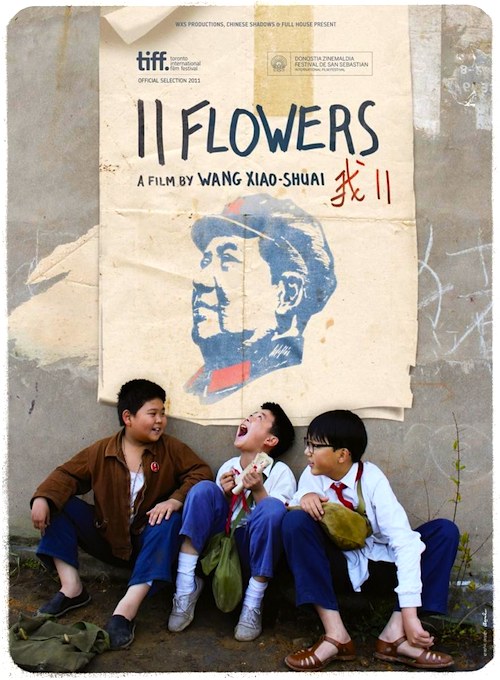
For a brief period, life is good for Wang Han, but the discovery of a dead body is an ill omen, as is the conspicuous distress experienced by Jue Hong, his frequently absent crush. While his family has largely avoided trouble, her “intellectual” father, Xie Fulai, has not. Nor has she. Evidently, the dead man raped the young girl, as her brother the killer explains to Wang Han, when circumstances bring them together in the forest. It is a frightening meeting for the eleven year old, made considerably worse when the fugitive forcibly takes his new shirt.

It might be overstating matters to describe the semi-autobiographical 11 Flowers as the late Cultural Revolution era version of To Kill a Mockingbird, but it gives a general sense of what to expect from the coming of age story. Wang focuses on the personal, but the political periodically intrudes in rudely menacing ways. Through Wang Han’s eyes, the Cultural Revolution is not so much an exercise in ideological excess, but the periodic explosion of street thuggery, as when his father is caught in a Red Guard rampage.

Liu Wenqing is a remarkably expressive young actor, who perfectly anchors the film. He makes Wang Han’s slow evolution from innocence to awakened conscience quite riveting and moving. Likewise, the young supporting cast-members are spot-on as his classmates. Yet, the subtle power of Wang Jingchun’s work as his father really sneaks up on audiences. When he encourages Wang Han’s painting as a means of artistic freedom, it feels light and natural at the time, but it is hugely significant in retrospect.

11 Flowers is unusually sensitive and accomplished. It is probably the best film to focus on a youthful cast since Tom Shu-yu Lin’s Starry Starry Night, which was probably the best since who knows what? Beautifully lensed by Dong Jinsong, it is quality cinema on every level. Highly recommended, 11 Flowers opens today (2/22) in New York at the Quad Cinema downtown and the Elinor Bunin Munroe Film Center uptown.

LFM GRADE: A

Posted on February 22nd, 2013 at 2:52pm.
LFM Reviews Call Girl @ Film Comment Selects 2013

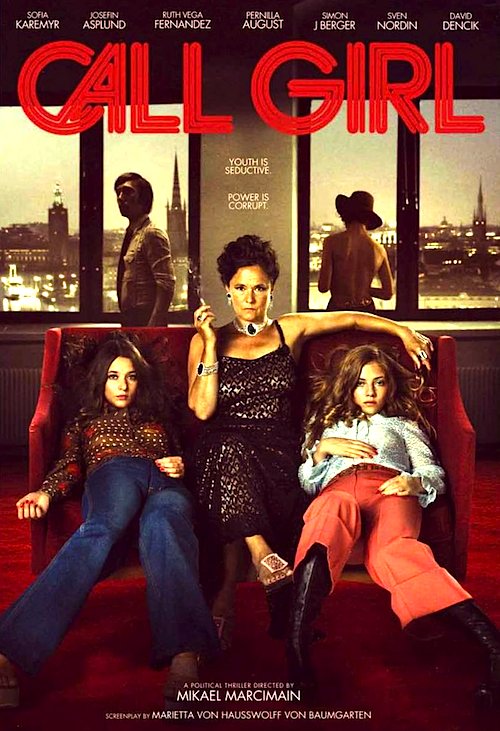
By Joe Bendel. The 1970’s really were swinging for Sweden, especially for the government. At the time, Olof Palme’s Minister of Justice, Lennart Geijer, was pushing a measure to largely emasculate laws against pedophilia, until he was caught up in the prostitution scandal that would subsequently carry his name. As it happens, under-aged girls were involved. It was a sordid but bipartisan national scandal that makes great fodder for Mikael Marcimain’s real life political thriller Call Girl, which screens as a selection of Film Comment Selects 2013.

Mere days before what is expected to be a close election, an American actress suspiciously resembling Jane Fonda sings the praises of the progressive PM never specifically identified as Palme on television. Meanwhile, crusading vice cop John Sandberg types his report with a purpose. At every step, the state security service has interfered with his investigation, as viewers soon learn via flashback.

Iris Dahl is too much for her mother to handle, assuming she ever tried. Fortunately, in liberal Sweden she can simply deposit her problem child in a juvenile home that looks more like a hippy commune. Sneaking out is a snap, especially when her cousin Sonja Hansson arrives to mutually reinforce their delinquency. Unfortunately, in the course of their partying, they encounter Dagmar Glans. A madam with a powerful clientele, Glans recruits the fourteen year-old girls for her stable.

At first, the cousins are seduced by the easy money and flashy lifestyle Glans provides. Inevitably though, the work takes a toll on them, physically and emotionally. Any ideas they might have about quitting are quickly dispelled by the procurer and her enforcer, Glenn. After all, the girls could recognize some rather powerful politicians. Initially, Sandberg is oblivious to Glans’ young working girls and the notoriety of her clients. He is simply trying to bust a vice queen with apparent connections. However, when his wiretaps come in with conspicuous gaps, Sandberg and his hours-from-retirement partner start to suspect the scope of the conspiracy afoot.

Call Girl resembles a 1970’s film in more ways than just soundtrack and décor. In an icily detached manner, it presents a deeply cynical view of the Swedish government, definitely including St. Olof’s administration. Nor does it take leering pleasure from Glans’ dirty business. Marcimain leaves little doubt Dahl and Hansson are grossly exploited by just about everyone – and the state social welfare establishment simply looked the other way, for fear of “stigmatizing” them. We even witness a strategy session for Geijer’s proposal to effectively normalize sexual relations with minors.

With credits including television miniseries and second unit work on Tinker Tailor Soldier Spy, Marcimain was well prepared to tell an intricately plotted, richly detailed, multi-character tale of intrigue. Despite the very specifically Swedish circumstances, it is always easy to follow. Somehow he also clearly conveys the unsavory acts the cousins are forced to participate in, without reveling in the luridness.

Frighteningly seductive in a weird, matronly way, Pernilla August’s Glans vividly shows how the devious exploit others and insinuate themselves with the powerful. It is a big, bravura portrayal of a user. As the used, Sofia Karemyr is shockingly powerful portraying Dahl’s wilted innocence. Risking type-casting (having appeared as Machiavellian game-players in A Royal Affair and Tinker Tailor), Danish-Swedish actor David Dencik again turns up as government fixer, Aspen Thorin.

Call Girl is a great period production that never romanticizes its era. Smart, tense, and unexpectedly pointed in its critique of the Swedish justice system, Call Girl is highly recommended for fans of complex political drama. It screens this today (2/20) and tomorrow (2/21) at the Howard Gilman Theater as part of Film Comment Selects 2013.

LFM GRADE: A-

Posted on February 20th, 2013 at 1:17pm.

Syrian Hospitality: LFM Reviews Inescapable

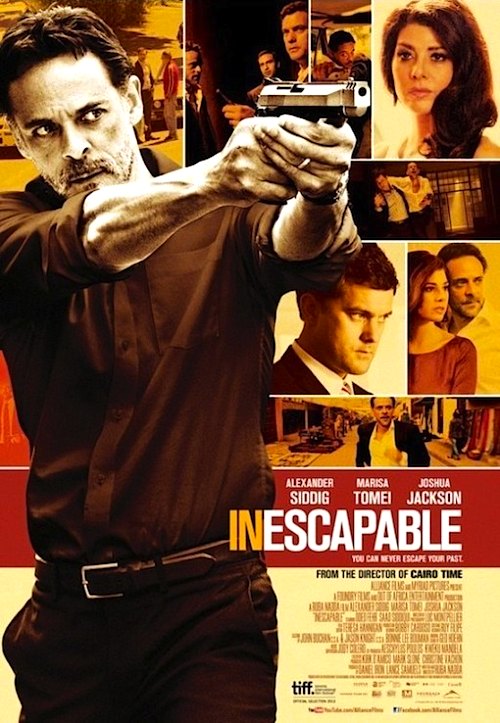
By Joe Bendel. Assad’s Syria is not exactly a family friendly tourist spot. Unfortunately, a former secret policeman’s reticence only intrigued his grown daughter. When she disappears in Damascus under mysterious circumstances, he must temporarily return to his former homeland and life of deception in Ruba Nadda’s Inescapable, which opens this Friday in New York at the IFC Center.

While the Assads are never mentioned by name, their portraits are everywhere in Inescapable’s Damascus. The current civil war never intrudes into the narrative, but the oppressive atmosphere is unmistakable. Once a promising young operative, Adib Abdel Kareem had to leave Syria in a hurry, for reasons he and his ex-comrade Sayid Abd Al-Aziz understand only too well. That is why the senior intelligence officer is slightly surprised when Kareem shows up in his office, demanding he help the convicted traitor find his daughter.

Kareem already has the reluctant help of Fatima, the former teammate and lover Kareem was forced to abandon, for whom Al-Aziz has long carried a torch. While the desperate father checks in with the Canadian embassy simply so his presence in Syria will be officially recorded, he soon discovers that the smarmy consular officer Paul Ridge is actually well acquainted with his daughter. It will become a rather tricky affair, involving a high ranking pedophile in the Syrian government and Kareem’s old Soviet spymaster colleague.

Born in Canada, the half-Syrian Nadda obviously has an affinity for the country’s culture and people, but no affection for the current government. As in the unusually elegant Cairo Time, she sets the mood well. Unfortunately, she is not a master of grabby thriller pacing. As much as viewers will want to embrace Inescapable as an art-house Taken, there is simply too much back-tracking and narrative down time. Frankly, Nadda’s screenplay probably would have benefited from some input from a genre hack. The power struggles going on in the upper echelons of power are potentially juicy stuff, but the film tends to lose momentum in rather workaday sequences.

Alexander Siddig is a charismatic screen presence, who does a credible slow burn as Kareem. In contrast, Marisa Tomei’s Fatima just does not have the right edginess for a femme fatale or the purposefulness of woman conspiring against a despotic regime. In truth, it is not really clear what she is there for, besides picking up Kareem at the border. However, Israeli Oded Fehr (a veteran of the Israeli Navy, El-Al security, and The Mummy franchise) brings some roguish style points to the film as Al-Aziz.

Largely shot in South Africa instead of Syria and its neighbors, for obvious reasons, Nadda and cinematographer Luc Montpellier still make it feels like it was filmed in the bazaars and back alleys of Damascus. Indeed, the look and vibe of the picture are right on target, but the tension is sometimes lacking. Still, Inescapable is certainly topical, earning Nadda credit for essentially scooping Hollywood. For those hungry for Middle East intrigue, Inescapable opens this Friday (2/22) in New York at the IFC Center.

LFM GRADE: C+

Posted on February 20th, 2013 at 1:15pm.

LFM Reviews China Concerto @ MoMA’s 2013 Documentary Fortnight

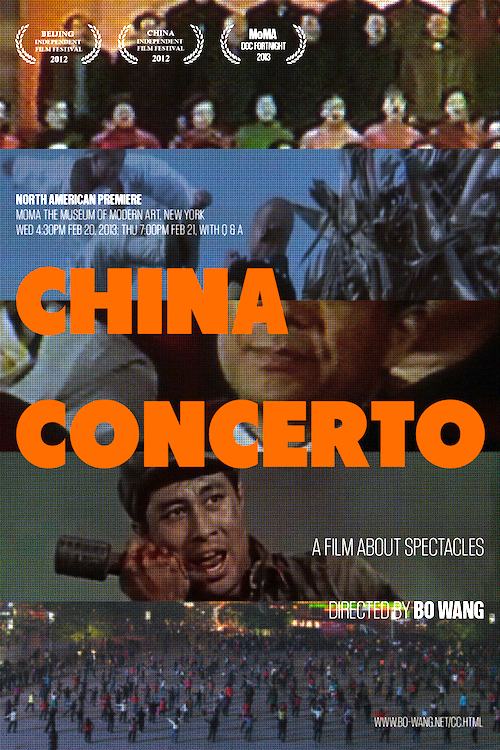
By Joe Bendel. Something as profoundly traumatic as the Cultural Revolution cannot simply be papered over. It hangs over the national psyche, like a malevolent ghost. As much as present day China embraces globalism and crony capitalism, the excesses of the Mao years still have a bearing on it. Indeed, it is part of the internal contradictions Bo Wang analyzes in his documentary-essay China Concerto, which screens as part of MoMA’s 2013 Documentary Fortnight.

A film of observation and rumination, Concerto has a pseudo-epistolary structure, featuring a woman’s disembodied voice reading a man’s dispatches from China. The writer is not a passive viewer, having trained himself to dissect imagery and look for the telling details nobody is supposed to notice. He is in the right place for it. Aside from the movie clips and newscast excerpts incorporated for illustrative purposes, Concerto was almost entirely shot in Chongqing, the China’s version of Chicago. While Bo Wang was shooting, Bo Xilai’s neo-Maoist “Red Culture” campaign was in full swing, but the Chongqing party secretary would soon be removed after the Wang Lijun scandal brought international media attention to rumors of extensive corruption.

He certainly captured images that are both striking and ironic. Perhaps his richest vein of material is the park where viewers witness couples dancing under a model of Mount Rushmore and an elderly man reclining near a Statue of Liberty. Yet, tucked away, there is also a cemetery dedicated exclusively to Red Guards that remains padlocked and shunned. According to the woman’s tantalizingly vague narration, it seems many of those interned were involved in an incident of cannibalism, which has since been consigned to the memory hole. One suspects this park could easily be the subject of an entire documentary feature.

It is absolutely fascinating to watch Concerto apply the techniques of deconstruction to official state propaganda. The stand-in for the filmmaker’s stand-in explicitly argues that China’s obsession with spectacle is intended to mask and empower it Communist rulers. It also offers trenchant analysis of the capitalism promoted by the state, a mutation described as “collective capitalism,” in contrast to the western individualistic variety. The implications for the individual in Chinese society are obvious. That is one reason the correspondent always focuses on a single individual when watching sprawling propaganda pageants.

Indeed, Concerto’s concern for the overwhelmed individual is rather noble, in a genuinely subversive way. As if its indie bona fides needed more burnishing, China Concerto holds the distinction of being a selection of the 2012 Beijing Independent Film Festival, which was shutdown not once, but three times by the government. This is a film that simply encourages audiences to think, but some might find that threatening. Highly recommended for sophisticated viewers, China Concerto screens during MoMA’s Documentary Fortnight this Wednesday (2/20) and Thursday (2/21), with the director present for Q&A both nights. For Georgians, it also screens March 27th at Kennesaw State and March 28th at Emory, as part of the well curated Independent Chinese Film Series.

LFM GRADE: A

Posted on February 18th, 2013 at 2:48pm.

LFM Reviews Tzvetanka @ MoMA’s 2013 Documentary Fortnight

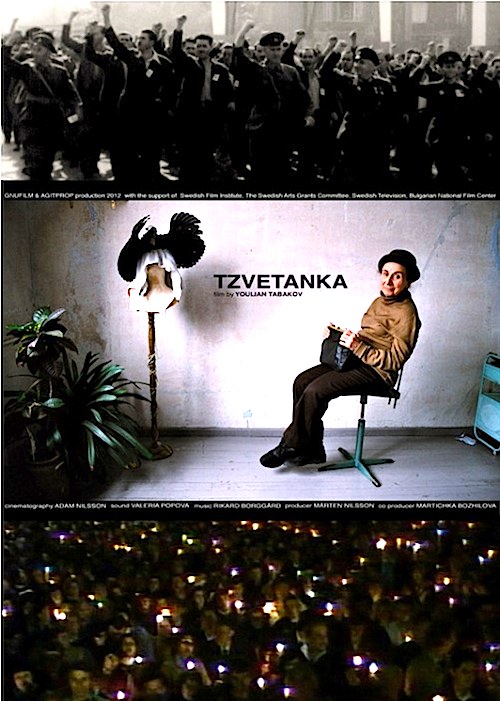
By Joe Bendel. Tzvetanka Gosheva was an oncology specialist forbidden to tell her patients they had cancer. This is how medicine was practiced in Bulgaria during the Soviet era. It wasn’t pretty. Gosheva endured the horrors of war and subsequent absurdities of Communist oppression, living to tell the tale to her filmmaker grandson Youlian Tabakov in Tzvetanka, which screens again today as a selection of MoMA’s 2013 Documentary Fortnight.

Born in 1926 to a prosperous shop-owner, Gosheva’s family would carry the “Bourgeoisie” label like an albatross during the Communist years. While she recalls vivid memories of the bombings, her real experiences with terror began post-war when her father was picked up for a “brief interrogation.” Despite eventually having both parents branded class enemies and sentenced to labor camps, Gosheva somehow was admitted to university. She wanted medical studies but was initially accepted as an English student, which seems doubly ironic given her suspect background, but that was how the Socialist system worked.

Gosheva passed away in the late 2000’s, but she obviously left behind an extensive oral history and some surprisingly playful footage (sometime bordering on the surreal). Tabakov does not take a traditional talking head approach. Instead, he creates impressionistic imagery to accompany his grandmother’s recollections. Sometimes they are rather whimsical, but probably the most striking visual is the blood droplets turning into a crimson rain (not unlike the original Shining trailer) that perfectly fit her discussion of the post-war purges and show trials her parents were caught up in.

At times, Tabakov really pushes the hipster envelope with his post-modern visual style. However, he always gives Gosheva her full say, which ultimately keeps the film grounded in reality. Viewers quickly learn to appreciate her resiliency and keen powers of observation. She makes no secret of her contempt for the so-called “former Communists,” whom she calls out for deliberately undermining Bulgarian democracy. Bulgaria will miss her, even if most of her countrymen do not realize it.

At least Tabakov has preserved her memory and her spirit. His Tzvetanka might be a bit eccentric as eulogies go, but avoiding the maudlin seems perfectly in keeping with its subject. Recommended for students of the Soviet era as well as those fascinated by intensely personal family histories, Tzvetanka screens again this afternoon (2/18) as part of MoMA’s Documentary Fortnight.

LFM GRADE: A-

Posted on February 18th, 2013 at 2:47pm.

The Love Story Behind Zhivago: LFM Reviews Lightning from Heaven

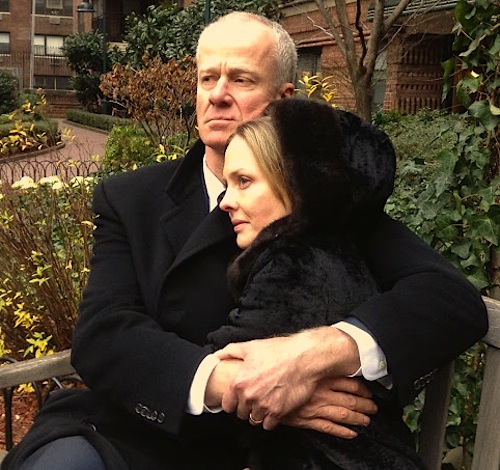
By Joe Bendel. Boris Pasternak’s epic novel Doctor Zhivago was banned, denounced, and was a major factor leading to the Nobel Prize for Literature he was forced to decline. It was also a love story. Unfortunately, the woman who inspired Pasternak faced the full force of the Communist Party’s wrath, to an even greater extent than her more famous lover. Their romance and its legacy also inspired Scott C. Sickles’ play Lightning from Heaven, which officially opened this weekend at the Main Stage Theater in New York.

Set in various cells in the Lubyanka, Lightning is told in flashbacks during Olga Ivinskaya’s many KGB interrogation (torture) sessions. Sadly, she is no stranger to the place. A literary editor by profession, Ivinskaya had more in common with Pasternak than his wife Zinaida. However, as the daughter of a moderately high ranking military officer, Madame Pasternak was able to protect her husband when he publicly spoke out against Stalin.

Of course, the publication of Zhivago was another matter entirely. Zinaida is quite certain she is not Lara. After all, the two fictional lovers never married. Nor is the Party pleased with Pasternak’s portrayal of the Revolution and the subsequent purges, so they target his greatest vulnerability: his mistress-muse Ivinskaya. In order to discredit the late Pasternak and his masterpiece, Vladilen Alexanochkin, the “good cop” KGB agent, engages in a cat-and-mouse game with the sleep-deprived Ivinskaya. Either she will renounce Pasternak and Zhivago, or she will proclaim herself the illicit inspiration for Lara.

From "Lightning from Heaven."

In a way, Lightning is like the historical forebear of the dystopian television show The Prisoner, with the question “are you Lara” replacing “why did you resign,” except it is very definitely based on fact. Sickles alters a detail here and there for dramatic purposes, but he is more faithful to history than David Lean’s great film was to Pasternak’s source novel. It is a smart, deeply literate play, driven by the conflict between individual artistic integrity and the collectivist state. Perhaps most touching are the scenes deliberately echoing Zhivago in which Pasternak and Ivinskaya find beauty in the increasingly drab, dehumanized Soviet world about them.

Jed Dickson resembles the Robert Frost-ish Pasternak that appeared on Time Magazine enough to look credible in the part. More importantly, he really expresses Pasternak’s poetic sensibilities. As a private citizen, Pasternak made some problematic choices, but Dickson makes them understandable, beyond the self-centeredness of the creative class (though there is that as well).

Likewise, Kari Swenson Riely is more than a mere victim of the Communist thought police, although she is certainly convincing enduring the KGB’s physical and emotional torments. She develops a comfortable romantic chemistry with Dickson’s Pasternak that is quite moving in an almost chaste way. Yet, when her character stands on principles, she makes it feel genuine and profound, rather than didactic (like, say, a character from Soviet propaganda). It is also important to note the work of Mick Bleyer as Alexanochkin, who keeps the audience consistently off-balance in satisfyingly ambiguous ways.

Perhaps the only historical figure getting short-changed in Lightning is Giangiacomo Feltrinelli, who ruptured his relationship with the Italian Communist Party by publishing Zhivago. He comes across a bit caricatured here, but that is a trifling complaint. Lightning is big idea production, rendered in intimately personal terms. It also boasts an admirably professional cast that continued on like troopers even when a freak accident in the audience forced an unusually long intermission Friday night. Highly recommended for fans of historical drama or Zhivago in any of its incarnations, the Workshop Theater Company’s production of Lightning from Heaven runs through March 9th at the Main Stage Theater on 36th Street.

Posted on February 18th, 2013 at 2:44pm.