The Man, The Mayor, The Maverick: LFM Reviews Koch

By Joe Bendel. In 1981, the New York Republican Party supported lifelong Democrat Ed Koch’s re-election bid. He has since returned the favor, periodically endorsing Republicans like Pres. George W. Bush, Sen. Al D’Amato, Gov. George Pataki, and Andrew Eristoff. Throughout his public life, Mayor Koch has been something of a maverick and he is always good for a lively quote. Neil Barsky documents the triumphs and controversies of the iconic mayor in the simply but aptly titled Koch, which opens this Friday in New York.

If one thing comes through loud and clear in Koch it is the animosity between him and Mario Cuomo. It all harks back to 1977, when the Cuomo mayoral campaign allegedly gave winking approval to the guerrilla campaign urging New Yorkers: “Vote for Cuomo, Not the Homo.” Shrewdly capturing the center and the right of the electorate, Koch ultimately vanquished Cuomo running as the Liberal Party candidate. However, questions about Koch’s private life would persist. In fact, Barsky’s only real misstep is the inordinate about of time spent on this is-he-or-isn’t-he question.
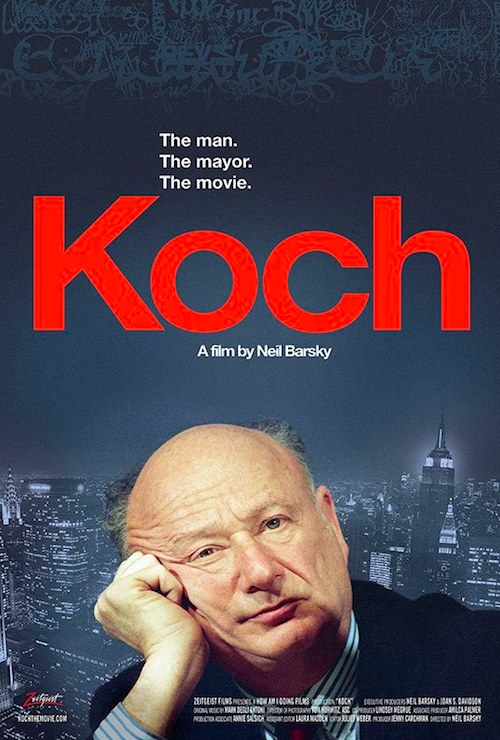
For those New York transplants arriving during the Giuliani or Bloomberg eras, Koch is a briskly entertaining primer on the City’s 1970’s and 1980’s history. Recognizable names like Bess Myerson and Donald Manes, the late Queens Borough President, whose corruption scandal also tarnished the Koch administration, are put into full context. There are also plenty of his “how’m I doing?” greatest hits and the frequent media appearances that established a new template for New York mayors.

Barsky scored top-shelf access to Hizzoner, but the Koch of today comes across a bit sad, clearly uncomfortable with his status as a New York political graybeard-gadfly. Viewers can tell he misses the action.

While Barsky examines his legacy warts-and-all, his documentary will easily convince viewers Koch was the right no-nonsense man for the job, like a pre-Giuliani Giuliani. Koch is funnier, though. Shrewdly, Barsky emphasizes his humor whenever possible. The results, gently prodded along by Mark Degli Antoni’s peppy underscore, are compulsively watchable. One of the most entertaining documentaries of the young year so far, for both political and pop culture junkies, Koch the movie opens this Friday (2/1) in New York at the Lincoln Plaza uptown and the Angelika Film Center downtown.

LFM GRADE: A

Posted on January 31st, 2012 at 12:18pm.
LFM Reviews Stoker @ The 2013 Sundance Film Festival

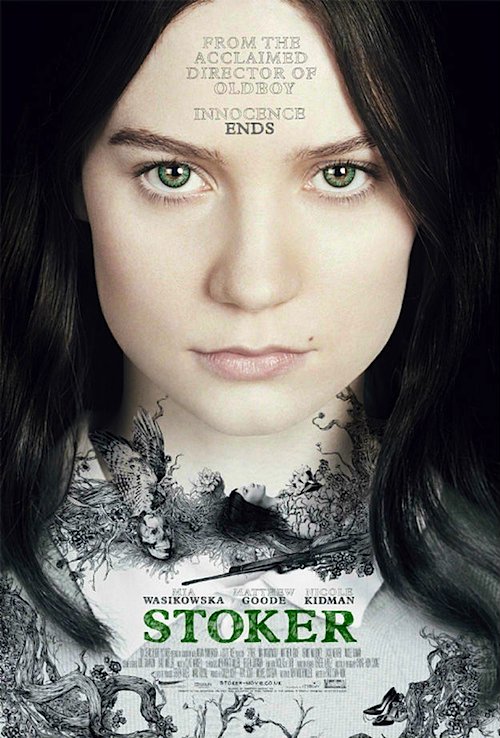
By Joe Bendel. India Stoker is sort of a female Hamlet. After her father died under mysterious circumstances, her mother is all eyes for her uncle. However, Uncle Charlie is more interested in replacing his brother as a pseudo-father-figure for India in Park Chan-wook’s first English language film, Stoker, which screened during the 2013 Sundance Film Festival.

India Stoker and her father were always very close, having bonded during their regular hunting trips. Yes, she is a gothic protagonist who can handle a firearm. Her relationship with her mother is another matter. Evelyn “Evie” Stoker is a woman so chilly and severe, by law she has to be played by Nicole Kidman. When Uncle Charlie shows up after the funeral, the widow turns to him for “comfort.” India is not impressed, rebuffing all her Uncle’s overtures of friendship. Kindly Aunt Gin appears quite alarmed by Charlie Stoker’s presence, but she disappears before she can explain why. People seem to do that around the Stoker family.

Stoker is exactly the sort of film Tim Burton’s Dark Shadows should have been, but totally wasn’t. Park’s mastery of mood is reflected in every scene, particularly in some visually arresting transitions. While the lurid nature of the material often approaches camp, Park emphasizes the repressed, brooding and eerie atmospherics. It also helps that Wentworth Miller’s screenplay tells a fully fledged story that mostly comes together down the stretch (rather than stringing together a series of gags).

It would be spoilery to explain why, but it is safe to say audiences have never seen Mia Wasikowska like this before. Yet in a way, India Stoker is something of a psychologically troubled cousin to Jane Eyre. Matthew Goode holds up his end, bringing all kinds of creepiness as Uncle Charlie. Although Kidman is often relegated to the sidelines, she perfectly delivers some scathing Mommie Dearest lines in the pivotal third act confrontation that audience members were quoting immediately after the screening.

Park’s accomplished hands have transformed a V.C. Andrews-ish yarn into an unusually stylish, dark fable. The Oldboy auteur’s admirers should be well pleased with his English debut and it also ought to earn Wasikowska a whole new level of fanboy appreciation. Elegantly sinister, Stoker is recommended for sophisticated genre patrons. It screened as a Premiere selection of this year’s Sundance Film Festival.

LFM GRADE: B+

Posted on January 30th, 2012 at 11:10am.

LFM Reviews Hank and Asha @ The 2013 Slamdance Film Festival

By Joe Bendel. Is technology stronger than social tradition and family expectations? That question will be put to the test when two aspiring filmmakers fall head-over-heels in “like” via online video messages in James E. Duff’s Hank and Asha, an Audience Award winner at the 2013 Slamdance Film Festival.

Hank had a short film accepted at a Czech film festival. Asha saw it there. She is studying at a Prague film school for a year, before returning to her regular life in India. Something about Hank’s film prompted her to send him a video message. Something about her question convinces Hank to respond in kind—and so on and so on. Soon their long distance flirtation becomes surprisingly serious. However, the inconvenient realities back in India drastically complicate any future they might have together.

The scenes filmed in Prague nicely capture its beauty and vibe, making viewers want to visit the city again. The New York scenes did not seem to have the same effect (but to be fair, I was only in Park City for a week, hardly enough time to get homesick). Regardless, the sense of place and displacement are a big part of what distinguishes H & A.

H & A is sort of like a hipster updating of sentimental favorites like A.R. Gurney’s Love Letters.Dramatically, it works relatively well because of its realistically appealing leads. Andrew Pastides is not afraid to look silly as the somewhat nebbish Hank. He also forcefully depicts the heartsick desperation of a smitten party with no leverage to make their sort of relationship work. Mahira Kakkar has a pixie-like charm as Asha. However, Duff and co-screenwriter Julia Morrison have her doing things that do not really make sense in light of her full situation. Still, both co-leads definitely convince viewers that each has a deep emotional attraction to the other, despite never appearing in the same scene together.

It is easy to see why Slamdance audiences responded to H & A. It offers some unabashed sentiment for the Facebook generation without feeling out of synch with the times. Small but nice, Hank and Asha is recommended for Williamsburg scenesters as a counter-intuitive date movie. Following its success at this year’s Slamdance Film Festival, it should have a long, fruitful festival life ahead of it.

LFM GRADE: B-

Posted on January 30th, 2012 at 11:07am.

LFM Reviews Big Sur @ The 2013 Sundance Film Festival

By Joe Bendel. Big Sur has a long history of inspiring artists, from Henry Miller to Charles Lloyd. Jack Keouac was also one of them, sort of. Adapting Kerouac’s autobiographical novel of his time spent along California’s scenic central coast, Michael Polish conveys an impressionistic sense of Kerouac’s language and the lonesome unspoiled environment in Big Sur, which screens during the 2013 Sundance Film Festival.

To protect the guilty (most definitely including himself), Kerouac changed the names of the Beat elite who appear in Big Sur. Polish changes them back, perhaps to make the film more commercial, but frankly there is no mistaking Kerouac or the Cassadys (or Ferlinghetti for that matter). Only a few years have passed since the publication of On the Road, but Kerouac is not dealing with success well. The literary rock star has come to California with the intention of holing up in Ferlinghetti’s Big Sur cabin to purge his soul. However, a typical Kerouac bender delays his arrival at City Lights.

Eventually, Ferlinghetti ensconces Kerouac in Big Sur, hoping his time spent in isolation will recharge his creative drive. For a few days Kerouac enjoys communing with nature, but he gets antsy quickly. Before long, he is reconnecting with Neal Cassady, launching into a doomed relationship with his friend’s soon-to-be-former mistress, and generally carousing with the usual suspects.

As plot goes, Big Sur leans to the sparse end of the spectrum, making it a real cinematic challenge. However, Polish arguably captures the rhythm and vibe of Kerouac’s language better than any other filmmaker, directly incorporating generous excerpts from Kerouac’s novel, read by Jean-Marc Barr in the persona of the author. Accompanied by images of natural beauty and underscored by a subtle but stylistically diverse score, Big Sur is not unlike a cinematic tone poem at times.

Yet the film is surprisingly peppy. Rather than hold one striking image for an interminable length of time, Polish shows the audience one after another, and yet another, in rapid succession. As result, Big Sur always feels like it is getting somewhere, even when it has little narrative business to show for itself.

A rich visual feast, Big Sur functions as a heck of a show-reel for cinematographer M. David Cullen (whose extensive credits include Jennifer’s Body). Barr also sounds great reciting Kerouac, but dramatically his work is something of a mixed bag. He lacks Kerouac’s considerable physicality and charm, but he certainly expresses the restlessness that defined the author, as well as his aura of danger and dissolute inclinations. Cullen’s lens also loves Kate Bosworth. Nonetheless, she is largely wasted as Kerouac’s increasingly exasperated lover Billie, but Anthony Edwards adds an appealing human dimension to the proceedings as Ferlinghetti.

With the choice to see one Beat Generation-related film from this year’s Sundance, it should be Big Sur rather than the over-hyped Kill Your Darlings. Granted, it might not completely pull it off, but Polish’s film comes far closer to translating Kerouac to the big screen than other recent attempts. There are even surprisingly playful moments that suggest the Pull My Daisy spirit.  Recommended for Beat fans, Big Sur screened as a Premiere selection of this year’s Sundance Film Festival.

LFM GRADE: B

Posted on January 30th, 2012 at 3:37pm.

LFM Reviews Linsanity @ The 2013 Sundance Film Festival

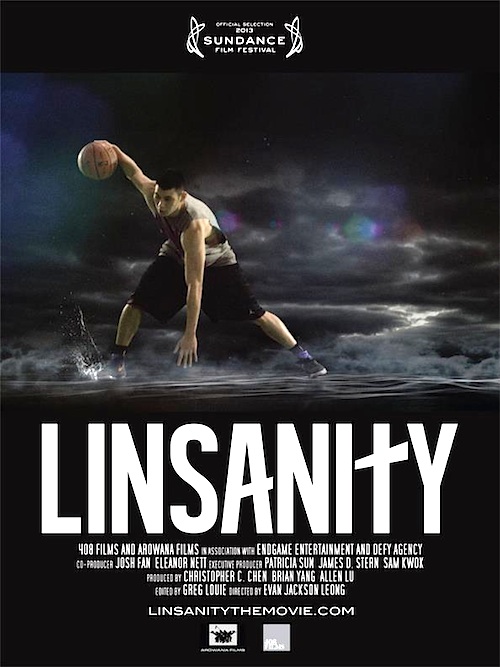
By Joe Bendel. The post-Ewing era has been tough for Knicks fans. Time and again they have watched the organization bring in over-priced under-performing free agents, assembling a mismatched Frankenstein team with no room to maneuver under the salary cap. The only hope was for an unheralded bench player to explode out of nowhere. In February 2012, Jeremy Lin answered Knick fans’ prayers. Evan Jackson Leong follows his long hard road to overnight success in Linsanity, which screened during the 2013 Sundance Film Festival.

There are not a lot of undrafted Harvard alumni playing in the NBA. Lin is one. He is also obviously Asian American—a fact many in the professional basketball establishment have trouble getting a handle on (to put it generously). In fact, Lin faced adversity at every stage of the game. Casual fans might be surprised to learn that Lin’s prep career ended with a Hoosiers like upset state championship, largely powered by his playmaking. Yet, despite his stats, Lin was never recruited by an NCAA program.

Leong probably should win this year’s right-place-at-the-right-time award at Sundance, having begun to document Lin well before he became a Garden sensation in that fateful February. Clearly, he won over the trust of Lin as well as the player’s parents and brothers. As a result, viewers get an intimate look at the central roles Lin’s close relationships with his family and his Christian faith play in his day-to-day life. In a sport filled with show-boaters, Lin emerges as one of the good guys.

However, Leong seems a little too diplomatic in his coverage of the many problematic responses to the sudden outbreak of “Linsanity,” as it was soon dubbed. While the filmmaker lumps it all together, there seemed to be a peculiar resentment from some commentators, reflecting an attitude of racial proprietorship over the game of basketball that allowed for goofy looking Euro players like Dirk Nowitzki but not homegrown Taiwanese-American talent like Lin. Those are indeed torturous waters to navigate, so Leong understandably takes the better part of valor. Still, he forthrightly addresses the overtly racist taunting directed at Lin from supposedly tolerant Ivy Leaguers during his Harvard away games.

Linsanity pulls off the near impossible, getting viewers to root for a Harvard grad. He captures the electric excitement that swept through New York, re-awakening the City’s passion for basketball. It was short, but intense and we still appreciate Lin for it. Even those who do not follow the NBA will understand why after watching Leong’s doc. Recommended for basketball fans and those who enjoy Horatio Alger stories, Linsanity screened as a Documentary Premiere selection at this year’s Sundance.

LFM GRADE: B+

Posted on January 30th, 2012 at 3:36pm.

LFM Reviews Google and the World Brain @ The 2013 Sundance Film Festival

By Joe Bendel. If you were to list corporations arrogant enough to initiate the Terminator franchise’s Skynet apocalypse, Google would have to rank at the top. In fact, they might be the entire extent of the list. Ben Lewis documents enough characteristic weirdness and secrecy surrounding the company’s controversial book-scanning initiative to provoke all sorts of paranoia with Google and the World Brain, which screened as part of the World Documentary Cinema Competition during the 2013 Sundance Film Festival.

It sounded innocent enough during the early stages. Google approached some of the greatest academic libraries, offering to scan their collections. For librarians, it offered the opportunity of digital preservation, without taxing their institutional budgets. However, many were surprised to find Google selling the resulting e-books online, including a considerable number of titles that were out-of-print, but not out of copyright.

To the considerable number of authors affected, this constituted theft of intellectual property. Yet, many tech tea leaf readers were even more concerned about the big G’s ultimate aim. Although not confirmed by the company, the book-scanning project is largely considered to be part of a larger undertaking to create a “World Brain” artificial intelligence.

Lewis employs the words of World Brain proponent H.G. Wells to introduce the concept, but you do not have to wear a tin foil hat to be uneasy with his “paternalistic” rationalizations. Likewise, given the big G’s history of collaborating with the Chinese government (briefly addressed in the doc), one does not have to be a conspiracy theorist to be uneasy with the company potentially keeping tabs on what books people read in the future.

Of course, it is hard to say just what the big G’s intentions are because they are not particular talkative about that. Despite his efforts, Lewis only gets a bit of corporate flackery from an official spokesman and some less than illuminating comments from the rather confused sounding head of Google Books in Spain (who evidently did not get the memo). One thing comes through loud and clear in G & WB:f you want to talk to the big G about a cup of coffee, you will quickly find yourself signing non-disclosure forms.

While not exclusively about the court challenge to the big G’s settlement agreement with the Authors Guild, this is unquestionably Lewis’s strongest material, becoming the dramatic backbone of the film. Plenty of those objecting to the arrangement talk on-camera about the complex court case and their wider reservations. We also hear from the usual futurist suspects, essentially picking up where they left off in Welcome to the Machine.

Further distinguishing it from other tech docs, G & WB sports some surprisingly cool graphics that nicely serve the film’s narrative clarity. In a minor quibble, the film commits a fallacy of composition when it lumps together several ongoing court cases related to e-books that are really more about commercial practices than control of information.

It takes guts to question a company with the resources and self-righteous image of the big G. In doing so, Lewis tells a great David vs. Goliath story and raises some pertinent ethical issues for the information age. Well thought out and lucidly presented, Google and the World Brain is recommended for the Wired set and book publishing dinosaurs as it makes the festival rounds following its world premiere at this year’s Sundance.

LFM GRADE: B+

Posted on January 29th, 2012 at 8:26pm.