LFM Reviews Wrinkles @ Spanish Cinema Now

By Joe Bendel. Emilio is about to rediscover the joys of institutional food. The former banker has a hard time adjusting to life in an old folks home. Unfortunately, his fading faculties will eventually rob him of the relationships he forges in Ignacio Ferreas’s animated feature Wrinkles, which screens as part of the 2012 edition of Spanish Cinema Now.

Emilio has Alzheimer’s, but nobody will tell him that directly. Increasingly difficult to handle, his grown son has packed him off to a nursing home. His new roommate Miguel, an Argentinian scammer, has been down this road before. Still sharp as a tack, Miguel specializes in conning the more addled residents out of their pocket money and flirting hopelessly with the nursing staff. Initially, Emilio is quite appalled by his shameless roommate, but they warm to each other over time—sort of. Miguel insists he is actually doing good deeds by keeping his suckers emotionally engaged on some level. While completely at odds with his middle class morality, Emilio starts to see his point.

Adapted from Paco Roca’s graphic novel, Wrinkles is entirely honest to its characters and their circumstances, making it a bit of a tough sell commercially. Nonetheless, its deeply humanistic spirit is quite refreshing. Avoiding cheap melodrama, it has more quietly telling moments than most slice-of-life live action indies, let alone the typical animated tent-pole.
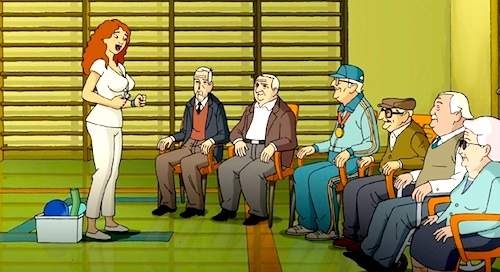
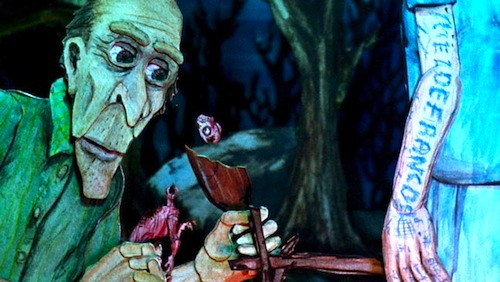
From "Wrinkles."

Ferreras, who served as an animator on Sylvain Chomet’s wonderfully wistful The Illusionist, employs a similarly sensitive 2D animation that feels reassuringly nostalgic. Some of his richly detailed flashback sequences are even quite lovely. While the narrative occasionally resorts to the odd cliché, like the defiant, doomed-to-fail road-trip, most of the notes Wrinkles hits ring true.

While its themes are about as “mature” as they get, there is absolutely nothing objectionable in Wrinkles for young viewers. Still, the vibe of sad resignation is probably best appreciated by somewhat older audiences. Featuring two very real cartoon characters and an elegant visual style, Wrinkles is recommended surprisingly strongly for fans of both animation and Spanish film. It screens this coming Sunday afternoon (12/16) as part of the Film Society of Lincoln Center’s annual Spanish Cinema Now series.

LFM GRADE: A-

Posted on December 13th, 2012 at 10:33am.
Animating Depression: LFM Reviews Consuming Spirits

By Joe Bendel. It seems there are some things all newspapermen have in common: a taste for booze, and an abiding bitterness over the state of their lives. It is true at The Times and it is true at the Daily Suggester, a local broadsheet serving a profoundly depressed burg roughly situated where the Midwest meets Hill country. The scandalous history tying together three Suggester employees will come to light in Chris Sullivan’s years-in-the-making animated feature Consuming Spirits, which is now playing in New York at Film Forum.

As an evening talk radio host and columnist for the Suggester, former ladies man Earl Gray dispenses dark philosophical truths disguised as gardening tips. Victor Blue drudges along in a dreary back-office job at the paper with little hope of reclaiming control of his life from the social workers who have been mismanaging it since he was a child. He is semi-involved with Gentian Violet, the paper’s paste-up employee who lives with her senile mother. She has also just run over a nun, whom she has buried in a fit of panic, even though the sister was not yet dead. Yes, perhaps she was slightly under the influence, but who isn’t? This hit-and-run accident will reveal many secrets in a roundabout way.

Sullivan’s film is absolutely not animation for children. While there are spots of mature content here and there, it is the overwhelmingly fatalistic vibe that would most trouble younger viewers. Yet, that is also its greatest merit. Consuming is more closely akin to David Lynch’s vision of small town America (most notably Twin Peaks and Blue Velvet) than anything produced by the major animation studios. This is really not a genre picture in any sense and its revelations are easy to predict, but there is still something unsettling about it all that lingers with viewers well after the initial screening.

From "Consuming Spirits."

Consuming is also pretty notable for its cynical portrayal of social workers, more or less implying they often compound problems rather than solve them. On the other hand, those poor nuns really take it in the shins. Sullivan will spare them no anti-Catholic stereotype. Still, he nails the rust belt-Appalachian milieu (it smells a lot like Clark County, Ohio, but it could be any number of places).

Visually, Consuming is also quite distinctive, incorporating claymation and deliberately sketchy line animation for flashbacks. However, the bulk of the present day action is rendered 2D cut-out animation that seems to perfectly convey the broken souls inside their flat, crumpled bodies.

There are some wickedly funny moments in Consuming, often coming from the haunted Gray. Indeed, Robert Levy’s richly evocative voice-over performance as the “Gardeners Corners” host is one of the best you will hear in animated films in a month of Sundays. Yet, while Sullivan’s script has its inspired moments, its overall trajectory is disappointingly conventional. Recommended for animation fans who appreciate style, tone, and characterization more than narrative, Consuming Spirits runs through Christmas Day at Film Forum.

LFM GRADE: B-/C+

Posted on December 13th, 2012 at 10:31am.


Anime Gets Medieval: LFM Reviews Berserk the Golden Age Arc I: The Egg of the King on Blu-ray

By Joe Bendel. They were not called dark ages for nothing. Battlefield carnage and an inflexible class system are the realities of the day. Yet, the charismatic leader of a band of mercenaries has unthinkably lofty aspirations in Toshiyuki Kubooka’s Berserk the Golden Age Arc I: The Egg of the King, the feature anime adaptation of Kentara Miura’s popular manga series, recently released on DVD and Blu-ray by Viz Media.

The relatively young looking Guts is a ferocious sword-for-hire if paid well enough, but he is not a joiner. Nonetheless, the mysterious Griffith is determined to recruit him for his “Band of the Hawk” mercenary troupe. While Guts easily overpowers Griffith’s best warriors, including the fiercely loyal Casca, he is no match for their angelically effeminate leader. Bested in a fair fight, Guts swears fealty to Griffith, quickly becoming his favorite.

Thanks to Guts’ reckless courage, the Band of the Hawk earns the gratitude of the Midland Kingdom. Much to the shock and disdain of the nobility, Griffith is rewarded with a title. However, he has even further ambitions, including catching the eye of the Princess. It will probably end badly if you believe the prophecy of Nosferatu Zodd, but you can’t always accept the word of giant demonic mercenaries.

While the Berserk series was produced in Japan (with the original Japanese soundtrack available as a DVD option for purists), it was clearly shaped by the Medieval Europe that served as the foundation of Tolkien’s Middle Earth and most subsequent epic fantasy series. Yet, the anti-heroism of Egg is rather distinctive. Indeed, the opening battle sequences are unusually stylishly by anime standards, yet surprisingly brutal.

Intended for mature audiences, Egg should be considered anime for Game of Thrones fans. Blood will definitely run. There is even some brief fan service provided by Casca. While most of the target audience is probably already familiar with the franchise characters, new arrivals pretty much have to roll with the punches. We can glean there were some difficult childhoods in the past, forging everyone into lethal warriors. Of course, how much characterization do you need in the middle of a full scale siege?

As dark and moody as Egg gets, it never lets the angst interfere with the action.  As a result, the awkwardly titled Berserk the Golden Age Arc I: the Egg of the King delivers all kinds of hack-and-slash, making it a fitting stocking stuffer for a reasonably “grown-up” fantasy fanatic awaiting the new season of Thrones and the final Wheel of Time novel. Recommended pretty enthusiastically for genre and anime fans that prefer blood and guts over magical devices, Berserk … King is now available for home viewing from Viz.

LFM GRADE: B+

Posted on December 12th, 2012 at 8:30am.

LFM Reviews Center Stage

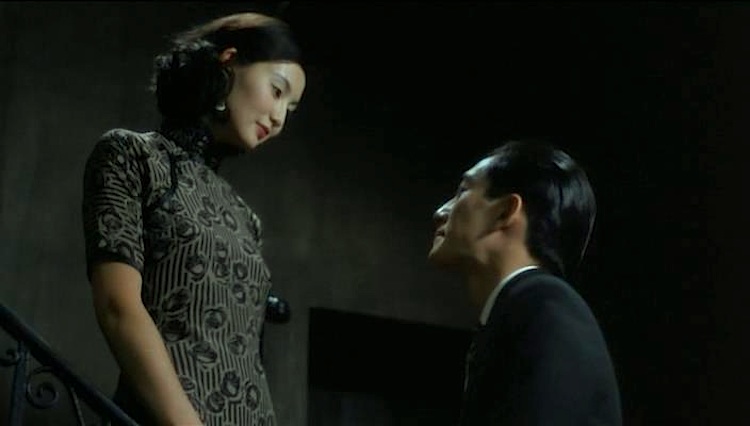
By Joe Bendel. She was one the biggest stars of her generation but the press was out to get her. Eerily, Ruan Lingyu’s short life paralleled the trajectories of her most tragic roles. Her career was marked by scandal, making her story a natural for big screen adaptation. Mixing narrative with documentary snippets, Stanley Kwan sympathetically profiles Ruan in Center Stage, which fittingly concludes the Asia Society’s Goddess film series tomorrow.

There are two divas in Stage, Ruan and Lily Li, played by two divas of a later generation: Maggie Cheung and Carina Lau, respectively. A gifted actress, Ruan is often called the Greta Garbo of Republican China. She gained fame as a romantic heroine, but is now best remembered for her more politically charged films. Unfortunately, she fell for the wrong man at an early age. Arguably, it was a mistake Ruan significantly repeated once, perhaps twice. Ultimately, her ne’er do well ex would serve as the media’s willing tool.

Stage can be quite maddening, because it recreates scenes from many of Ruan’s films that are now considered lost. Many of them look like they were really darn good, but we can only hope they eventually turn up in a mysterious film vault someplace. Naturally, Kwan also gives the audience a behind-the-scenes look at the surviving classics, Goddess and New Women, which kicked off the Asia Society’s retrospective last month.

Cheung is not a bad likeness for Ruan, perfectly expressing her brittle vulnerability. Her Ruan struggles to maintain a placid façade, but she obviously feels the sleights of others on a very deep level. Indeed, screenwriter Peggy Chiao clearly ascribes a great deal of her success as an actress to her remarkable empathy. It is a star turn from Cheung, justly awarded best actress at the 42nd Berlinale.

Kwan’s talking head segments, both archival and original black-and-white interviews with cast and crew, give the film a stop-and-start rhythm that can be distracting. Still, much of this commentary is rather interesting stuff, including the final sit-down granted by Li Lily, Ruan’s friend and fellow diva (represented in the Goddess series with Daybreak). Cheung’s sympathetic take on Ruan adds an intriguing meta-dimension to the film. Her candid segments also serve as a reminder how striking she is, considering how pale and drawn she often looks when appearing in character as Ruan.

At well over two and a half hours, Stage truly brims with ambition. Sort of the HK equivalent of Jessica Lange’s Frances Farmer bio-pic, it is a finely crafted period production that should satisfy Ruan’s fans with its earnest ardor for their star. Viewers will come to feel like they understand the exquisitely morose idol, yet suspect there is something about her that will always remain unknowable. Anchored by a great lead performance, Center Stage is highly recommended for fans of Ruan, Cheung, and Hong Kong cinema in general when it screens tomorrow (12/8), wrapping up the Goddess film series at the Asia Society.

LFM GRADE: A-

Posted on December 7th, 2012 at 11:09am.

Long Island Cheer: LFM Reviews The Fitzgerald Family Christmas

By Joe Bendel. Where are the Griswolds when you need them? It is the season for sentimentality and Edward Burns intends to indulge. He returns to Long Island for a big Irish family get together in The Fitzgerald Family Christmas, which opens today in New York.

Their mother’s birthday is two days before Christmas, but aside from Gerry, her favorite, none of the grown Fitzgerald children want to come home to celebrate. Grown might be too strong a word. Let’s say they are over twenty-one. Gerry is the professional martyr who still lives at home. He has four sisters whose names are impossible to keep straight. It is easier to just number them in accordance with how annoying they are, number four being the most insufferable. He also has two brothers, one of whom would have been forgotten were it not for a handy set of press notes.

There is still a Fitzgerald father out there, but he is dead to Rosie Fitzgerald after he walked out on her when the brood was still quite young. Unfortunately, Jim Fitzgerald will be dead to everyone soon. His final wish is to spend his last Christmas with the family. Gerry tries pleading his case, but his mother and assorted siblings remain steadfastly opposed.

Various other family dramas crop up, including Sister #1’s pregnancy with her abusive husband. Brother Quinn and Sister #4 are pursuing significantly younger and older romantic partners, respectively, while Sister #3 sent her husband packing in favor of their landscaper. Sister #2 actually has a presentable husband and young baby, but she is still absolutely miserable to be around. Meanwhile, completely forgettable Brother Cyril just got out of rehab. Right, good luck with that.

From "The Fitzgerald Family Christmas."

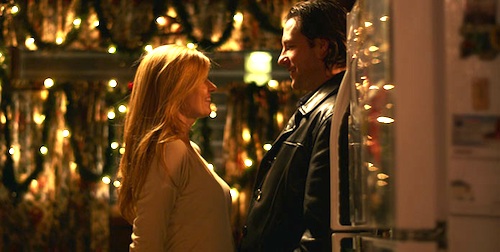
Christmas with the Fitzgeralds will make viewers convert to Buddhism. The only appealing scenes involve Brother Gerry’s awkward courtship of Nora Daugherty, the nurse of a longtime family friend. It is nice to see realistically flawed, everyday looking (slightly worn even) people develop a down-to-earth relationship. Reuniting from The Brothers McMullen, Burns and Connie Britton display real romantic chemistry together. He helms these sequences with a sensitive touch the rest of the middling family chaos lacks.

Granted, it should also be noted Ed Lauter might just give a career performance as the remorseful absentee father. In fact, there are several very nice supporting turns peppered throughout this overstuffed holiday feast of subplots, each of which is neatly resolved, lest they spoil the turkey. While not an outright affront to cinema, The Fitzgerald Family Christmas is unlikely to become anyone’s holiday tradition. More liable to test viewers’ patience, it opens today (12/7) in New York at the Village East.

LFM GRADE: C-

Posted on December 7th, 2012 at 11:08am.

Awkward Moments: LFM Reviews Wagner & Me

By Joe Bendel. Can you separate an artist’s work from their offensive ideology? Hollywood asks Middle America to do exactly that nearly every weekend. Granted, the case of Richard Wagner is of a much higher magnitude. After all, we know whose favorite composer he was. Stephen Fry is also an ardent admirer, who tries to reconcile his beloved music with the man’s problematic legacy in Patrick McGrady’s Wagner & Me, which opens this Friday in New York.

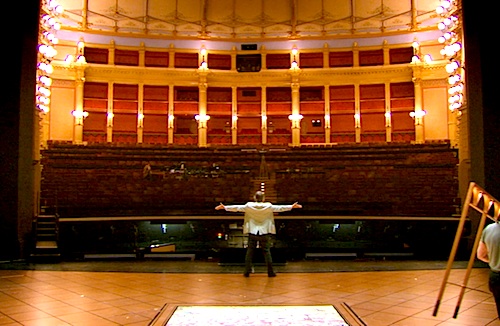
Fry is clearly a civilized man of the arts, who actually lost family members in the Holocaust. He also loves Wagner’s music. Love might be an understatement. Touring the celebrated Bayreuth concert hall built to the composer’s specifications as it prepares for its annual Wagner festival, Fry is absolutely giddy. All his sophistication deserts him. It is a total fanboy geek out.

Frankly, Fry might cringe at some of this footage in years to come, but on the other hand, cynicism is overrated. Fry conveys his passion for the music and God bless him for it. To his credit, though, he does not ignore the dark side of Wagner. While he does not delve too deeply into the composer’s documented anti-Semitic sentiments, he fully explores the way Hitler and the National Socialists used the long deceased Wagner to legitimize their reign of insanity. W&M is particularly eye-opening when addressing the support Wagner’s heirs lent to Hitler at a very early stage in his career. Fry also visits a violinist who survived the concentration camps to get her considered judgment on Wagner, which is indeed quite reasonable and reflective.

From "Wagner and Me."

Wagner will always be a tricky figure to come to terms with. On a basic level, an artist like Wagner or a veteran of film and television like Fry cannot help it if some unsavory characters become fans of their work. Yet, many will fairly argue there were chauvinistically nationalistic themes in Wagner’s operas that were all too compatible with National Socialism. Fry somewhat tries to rehabilitate his idol (while wisely refraining from the “he was a big fan of Mendelssohn and some of his best friends were Jewish” defense the Wagner establishment has floated), but he never closes the deal.

In fact, viewers might walk away from W&M more critical of Wagner the man than when they walked in. That is a testament to Fry’s honesty if not necessarily his persuasiveness. Sometimes interesting but hardly essential, Wagner & Me opens this Friday (12/7) in New York at the Quad Cinema.

LFM GRADE: C+

Posted on December 6th, 2012 at 11:02am.