Hippy Apocalypse: LFM Reviews First Winter

By Joe Bendel. When the end of the world comes, Manhattan will be the first to go. Some people may think that’s a blessing. By contrast, it would be a fate worse than death to be trapped with the yoga hippies communing upstate in Benjamin Dickinson’s slightly apocalyptic First Winter, which opens in Williamsburg (of course it does) this Friday.

There is only one reason Paul’s yoga groupies should not be considered a cult; that would imply a degree of organization they lack. Basically, he leads yoga sessions in between getting stoned and sleeping with the women of his choice, until the world ends. Caught up in their own little universe, the yoga minions sort of miss the big bang when it happens. They just see a bit of smoke and wonder what happened to their friends who never came back from town.

They try to carry on as usual, but sexual issues threaten to spoil the scene. For some reason, Paul dumps the cute (particularly for this group) Jen in favor of Marie, a comparatively drab old flame, who reappeared after the apocalypse. Oh, and their supplies are dwindling. Will the hippies be able to become self-sufficient? They live on a farm, after all. Or will they die a cold, hungry death?

Frankly, it is really hard to care – and why should we? Nobody seems too broken up about the unfathomable human tragedy that presumably happened around them. You might think the prospect of no more Phish tours or Deepak Chopra books would get them down, but everyone is more concerned about who is in Paul’s bed, including the jealous but drug addled Matt.

Why anyone would be attracted to the pasty white, scraggly-haired bargain basement guru remains a mystery throughout the film. It certainly cannot be explained by his self-absorbed personality. Unfortunately, the narrative does not offer much snap to distract viewers. In fact, the big climax comes and goes without viewers even realizing it at the time. Ordinarily, this would be a major dramatic shortcoming, but for First Winter, an abrupt ending is a happy surprise.

In all truth, the most interesting thing about First Winter is the controversy surrounding a deer the production reportedly shot out of season for the big hunting scene, without a proper license. Featuring shallow characters and a listless pace, First Winter is a hard, unpleasant slog. Jennifer Kim and Haruka Hashimoto bring some charisma to their namesakes, but it is arguably out of place amongst the rest of the dull cast of characters.

A failure on multiple levels, First Winter makes the presentable but not classic The Road seem like a masterpiece in retrospect. Both films are vague about the nature of “the end,” but in the case of John Hillcoat’s adaptation of the Cormac McCarthy novel, it works in context. In contrast, the Brooklyn hipster’s lack of curiosity is a conspicuous strain on viewer credibility. Not recommended in any way, shape, or form, First Winter begins a six day run at Videology this Friday (11/16) in the County of Kings.

LFM GRADE: F

Posted on November 14th, 2012 at 11:13am.
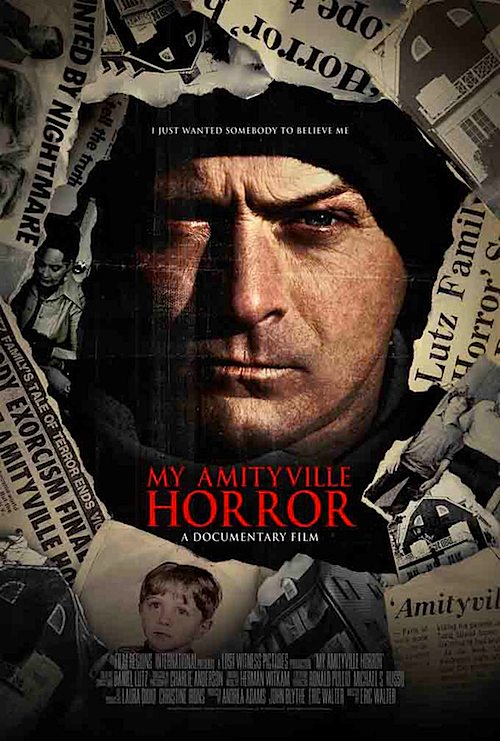
LFM Reviews My Amityville Horror @ DOC NYC

By Joe Bendel. Long Island used to be considered a great place to settle down and raise a family. That was before Buttafuoco and Frankenstorm. However, the thing that really freaked people out was the incident known as “The Amityville Horror” in a raft of books and movies. Now a grown man, the eldest son of the terrified Lutz family, finally breaks his silence on their twenty-eight days spent at the notorious Ocean Avenue address in Eric Walter’s My Amityville Horror, which screened over the weekend at this year’s DOC NYC, closely following word it had been acquired by IFC Midnight.

Daniel Lutz is a heck of an interview subject. Not afraid of a little salty language, he sounds a lot like a typical Long Island knucklehead – until you hear his story. Although there is a fair amount of skepticism expressed by others in the film, no one doubts his sincerity. Clearly, he never enjoyed being known as the kid from The Amityville Horror. Listening to him unburden himself in what appear to be staged counseling sessions, audiences might surmise the subsequent notoriety was as traumatic for him as whatever might have happened in the house itself. The same may well be true for the circumstances surrounding his mother’s marriage to his stepfather, George Lutz, whose name he was forced to adopt.

New Yorkers will be especially interested to learn the extent to which local Channel Five (now Fox 5) owned the Amityville story before Jay Anson’s “true story” novel and the release of the films. Marvin Scott (now with the City’s CW affiliate) even helped introduce the film and appears at length, along with his former colleague, Laura DiDio. Having spent a mostly uneventful night there, Scott remains largely incredulous, whereas DiDio sounds like she gives it all considerably more credence.

Scoring a series of interviews with Lutz was certainly a coup, but it is precisely that tension between belief and skepticism that really distinguishes Walter’s film from a History Channel special or DVD extra. Yet, the documentary still has plenty of creepy moments (particularly with regards to George Lutz and his reported background with the occult), despite Walter’s level headed approach. Many viewers will likely conclude there was definitely something evil in that house, but whether or not it was supernatural is an open question.

Even for us doubting materialists, My Amityville is fascinating stuff, featuring a truly compelling central character in Daniel Lutz. An intriguing nonfictional twist on the horror genre, it would make a strange but fitting double feature with either Rodney Ascher’s Room 237 (as a one-two examination of the cultural impact of well known horror movies) or Joshua Zeman & Barbara Brancaccio’s Cropsey (as the Long Island-Staten Island axis of real life horror stories). Eerie but entertaining and always open-minded, My Amityville Horror is definitely a satisfying doc for genre fans. Recommended accordingly, it should be coming back to the IFC Center relatively soon, courtesy of IFC Midnight.

LFM GRADE: B+

Posted on November 13th, 2012 at 3:47pm.

Klitschko Now Available on DVD

We wanted Libertas readers to know that the superb documentary film Klitschko is now available on DVD. Klitschko tells the story of the famous boxing brothers Vitali and Wladimir Klitschko, covering the brothers’ upbringing in the socialist Ukraine (their father served in the Ukrainian Air Force, and was a first-responder to the Chernobyl nuclear disaster), to their early successes as amateurs, to their move to Germany and subsequent rise as international boxing stars and holders of the championship titles of all five boxing federations. Vitali (the older brother), of course, also recently entered politics and ran for President of the Ukraine – capturing 14% of the vote.

LFM’s Joe Bendel reviewed Klitschko at the 2011 Tribeca Film Festival, and gave it an A grade, calling it “[b]riskly paced and quite informative … highly recommended.”  The movie is available now from Corinth Films here.

Posted on November 13th, 2012 at 3:46pm.

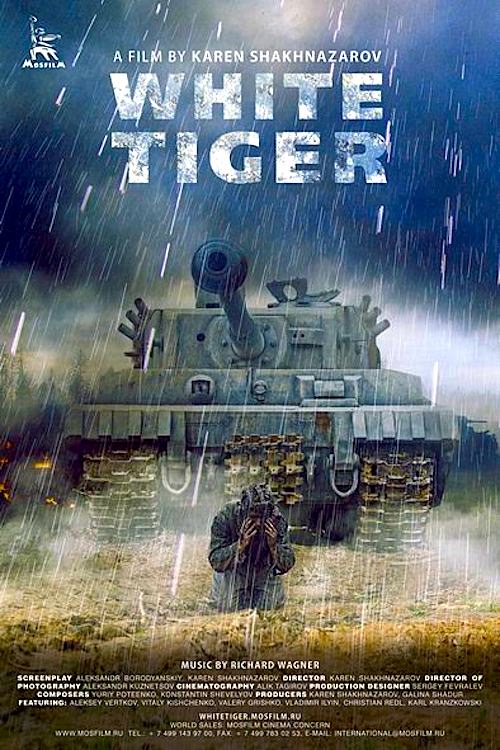
Rolling Russian War Machines: LFM Reviews White Tiger, Submitted By Russia for Oscar Consideration

By Joe Bendel. Ivan Naidyonov could be called the tank whisperer. He seems to have the mystical power to commune with armored vehicles, but his environment is pure blood and guts. War is still war, except more so on the Eastern Front in Karen Shakhnazarov’s White Tiger, which Russia has chosen as their official submission for this year’s foreign language Academy Award.

Hoping to put the debacle of last year’s submission (Friend of Putin Nikita Mikhalkov’s universally panned Burnt By the Sun 2: Citadel) behind them, Russia has opted for another well-connected standard bearer in Mosfilm head Shakhnazarov. However, in this case the quality of the film and the director’s critical reputation represent a considerable step up.

Picking through the remains of a routed Russian tank division, soldiers find a charred driver who is somehow still breathing. Despite suffering severe burns to ninety percent of his body, the tank mechanic makes a full recovery, except for his acute amnesia. Rechristened Ivan Naidoyonov (“found Ivan,” roughly), he is sent back to the tank corps. He is a whiz at fixing and operating tanks, but he is a little spooky. Naidyonov claims tanks speak to him and even starts praying to the “God of tanks” enthroned in the big garage in the sky. Yet he is just the man to track down and destroy the white German super tank that seemingly materializes out of nowhere to wreak destruction on blindsided armored columns.

For Naidyonov it is personal. The spirits of the destroyed tanks have spoken to him about the White Tiger. So perfect are its maneuvers, he is convinced its crew is “dead.” He can sense it before it appears and it seems to be hunting specifically for him.

White Tiger might sound like Life of Pi in a tank, but at every battlefield juncture, Shakhnazarov chooses grit over woo-woo. Everyone thinks Naidyonov is nuts, but they secretly suspect there might be something to him – particularly Major Fedotov, the counter-intelligence officer in charge of the hunt for the White Tiger. The resulting vibe is like The Big Red One as re-written and Russified by Melville.

With his studio’s resources at his disposal, Shakhnazarov stages some fantastic tank battles, vividly conveying their force – and also their limitations. During the first two acts, White Tiger is a completely original, totally engrossing war film. Strangely, though, the final third is largely dominated by completely unrelated scenes of the German surrender and Hitler’s ruminations in the face of defeat. It is like White Tiger won the war, but lost the peace. Still, since it is a war movie, the former is more important.

When Naidyonov and his obsession are center stage, White Tiger is genuinely riveting, with a good measure of credit due to its primary leads. Aleksey Vertkov is perfect as Naidyonov. Refraining from distractingly ticky or showy behavior, he is compellingly “off” in a way that could believably be recycled back into the Soviet war machine. Even though in reality his character would have probably been purged halfway through the film, Vitaliy Kishchenko’s work as the square-jawed Fedotov is similarly smart, understated, and intense.

It is hard to understand why Shakhnazarov would establish such a powerfully focused mood, only to break it up down the stretch. Still, White Tiger boasts two excellent performances and some impressive warfighting sequences, which is more than many of its fellow contenders can offer. Academy voters certainly love them some WWII, so it is probably worth keeping an eye on. Shakhnazarov has also had American distribution for past films like Vanished Empire, so White Tiger should have international legs. Regardless of its odd flaws, it is a film of considerable merit that ought to find an audience.

LFM GRADE: B

Posted on November 9th, 2012 at 2:20pm.

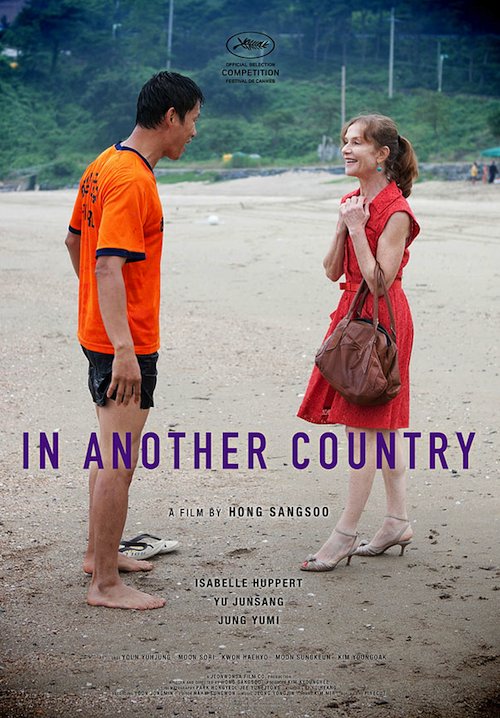
LFM Reviews In Another Country

By Joe Bendel. In the working class seaside village of Mohang, there is not a lot to do except drink. Fortunately, that is what Hong Sang-soo’s characters do best. Intimacy, on the other hand is a problem – especially for a trio of French women stumbling through cultural and linguistic barriers. Isabelle Huppert plays all three of them in Hong’s sort-of English language debut, In Another Country, which opens today in New York.

Dodging debt collectors, film student Wonju and her mother are laying low in a sleepy Mohang inn. To pass the time, she starts writing a screenplay very much in the style of Hong Sang-soo. It is a triptych in which the French expat Anne comes to the very same hotel under different circumstances, yet has similar experiences each time.

The first Anne is an accomplished filmmaker, who tries to discourage the attentions of a drunken colleague with a very pregnant wife. The second Anne is cheating on her wealthy husband with an almost-famous film director. The third Anne bitterly resents her ex-husband leaving her for a Korean woman, but it is not hard to understand why he dumped her. In each case, she flirts with the meathead lifeguard with varying degrees of ambiguity, half communicating through their broken English.

Country is just so Hong Sang-soo, but the tone is a bit lighter than Oki’s Movie or The Day He Arrives. Nor is it as self-consciously post-modern in its approach to narrative. Each of the three Annes’ stories are discrete and completely self-contained (though take 2 includes a dream sequence that could almost count as a fourth strand). In fact, it is a rather sunny film, taking long walks on the beach and chatting amiably with the cute but shy Wonju, who also appears in each arc as the daughter of the hotel proprietor.

Still, it is rather fascinating to watch how Huppert brings successively darker shades to each Anne. Frankly, the third is a bit of a pill, whereas the flawed but self-aware second is the most fully developed. Yu Junsang, the only other constant besides Jung Yumi’s pleasant but rather inconsequential Wonju, is a perfectly believable lunk, but his best dramatic moments come during the first go-round. However, Youn Yuh-jung, the veteran leading lady of Korean television and cinema, is absolutely perfect as Anne #3’s academic friend Park Sook (and appearing as Wonju’s mother in the opening segment as well). Smart, somewhat tart tongued, and likably world-weary, she brings some real verve to the talking and drinking.

Indeed, Country is a chatty film, utilizing English as a second language, so communication is always an issue. The manner in which Hong repeats certain key phrases is often very droll, but there are no great profundities to be found here. That is not necessarily a bad thing. Watching Hong’s latest is like falling in with a group of strangers at a party who are amusing for an evening, but you don’t really want to make a habit of seeing afterward. Again, if they are good for some laughs, that is not so terrible. For Hong and Huppert’s fans, it works quite well. Recommended accordingly, In Another Country opens this Friday (11/9) at the Lincoln Plaza Cinema.

LFM GRADE: B

Posted on November 9th, 2012 at 2:20pm.

LFM Reviews Wonder Women! @ DOC NYC

By Joe Bendel. The last few years have been tough for Wonder Woman. While her Justice League colleagues have gotten big screen treatments, she suffered the embarrassment of a network rejection for her pilot. Considering it was from David E. Kelley, maybe it was just as well. The heroic Amazon will always have her fans, several of whom explain her personal significance and lasting cultural influence in Kristy Guevara-Flanagan’s Wonder Women: the Untold Story of American Superheroines, which screens as a Midnight selection of the 2012 DOC NYC.

Psychologist William Moulton Marston created Wonder Woman to embody feminine virtue – but Wonder Woman also found herself frequently bound-up, like a comic precursor to Bettie Page. Wonder Woman might imply much about her creator’s subconscious, but her self-reliance struck a chord with many readers. Unfortunately, when the Comics Code Authority began nannying the industry, Wonder Woman was amongst the hardest hit, effectively becoming a costumed Ally McBeal.

Lynda Carter as Wonder Woman.
Guevara-Flanagan incorporates many talking head interviews with self-identifying feminists who celebrate the 1940’s era Wonder Woman and bemoan her subsequent watering down. Frankly, she would have gotten much the same response had she interviewed conservative cultural critics, as well. The old school Wonder Woman might have been an Amazon Princess, but she also adopted the American cause – fighting the Axis tooth-and-nail. That’s a role model.

Yet, when addressing Wonder Woman’s cultural influence, the doc is rather hit-or-miss, by any standard. Guevara-Flanagan and her experts draw a straight line from Lynda Carter’s Wonder Woman to Buffy the Vampire Slayer and Xena the Warrior Princess, who serve as the sole representatives of a smallish, contemporary golden age of strong women action figures. Yet they ignore, for example, a huge chunk of Michelle Yeoh’s intervening filmography, in which she made a practice of playing strong butt-kicking women. (She still does.)  Furthermore, Wonder Women largely ignores recent developments for the character, including her comic book reboot in conjunction with the 2011 re-launch of the DC universe, the 2009 animated direct-to-DVD animated feature (featuring the voice of Keri “Felicity” Russell), or the much hyped but ill-fated pilot. That’s too bad, because the film is at its strongest when tracing Wonder Woman’s early evolution.

Too politicized for the natural comic fan audience, Wonder Women is expressly intended for those who fondly remember her appearance on the first issue of Ms. Magazine. For the rest of us, the film is quite uneven, reflecting a rather insular perspective. It screens at the IFC Center this coming Sunday night (11/11) and the following Tuesday (11/13) as part of DOC NYC 2012.

LFM GRADE: C-

Posted on November 8th, 2012 at 11:57am.