LFM Reviews A Girl and a Gun @ DOC NYC

By Joe Bendel. It is a real Rorschach test. When people see a gun in the hands of a woman, they might see it as an equalizer, an instrument of empowerment, or as a fetish object. None of these is mutually exclusive. Indeed, the many perspectives on women gun-ownership often overlap and conflict with one another in Cathryne Czubek’s A Girl and a Gun (see excerpt above), which screens as part of DOC NYC 2012.

Although many of G&G’s talking head experts hail from the general neighborhood of feminist thought, just about everyone acknowledges women’s relative physical vulnerability compared to men – especially liquored up stalkers. This was particularly true for one middle aged tai chi instructor who broke up with her abusive body-builder boyfriend. Realizing that the police operate almost entirely reactively rather than proactively, she came to the somewhat reluctant conclusion that she needed a gun.

She is not the only one to rely on guns for protection of life and limb. One young widow living on an isolated farm with her young baby used her late husband’s shotgun to blow a home-invading predator to Kingdom Come. Part of her remains troubled by the incident, but she will do it again if need be to protect her child. Similarly, sex columnist Violet Blue has seen her fair share of death threats. However, letting would-be stalkers know she keeps a loaded gun handy has had a deterrent effect. She also thinks armed women are hot (and we’re not about to argue with her).
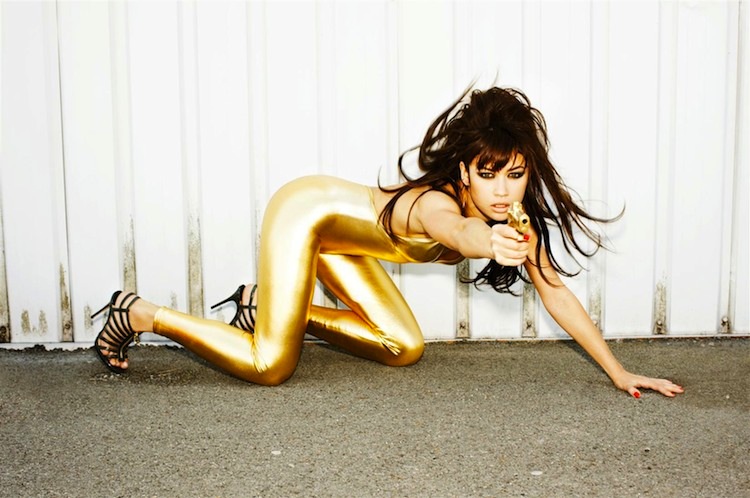
More than meets the eye: former Bond girl Olga Kurylenko, with gun.

Naturally, G&G takes great efforts to show the other side of the coin, such as the prison interview with a woman who fatally shot her ambiguous roommate. Somewhere in the middle, we meet an Upper Westside social worker, who became an accomplished recreational shooter – but refuses to keep a firearm in her apartment.

When supposedly exposing the ways the gun industry has attempted to exploit the women’s market, G&G is rather underwhelming. In truth, it is hard to imagine a better informed group of consumers than women gun-owners. Still, the fact that Czubek’s film will even entertain the notion some women have a legitimate and pressing need to own a gun for reasons of self-defense is rather bold. That she bends over backwards to present cases of accidental and criminal gun deaths is to be expected. Yet, it is impossible to watch the Oklahoma farm widow’s segment and argue she would be safe without her guns.

Given its somewhat balanced approach, G&G is probably in for a rocky reception at DOC NYC. However, it could have earned Blue a whole new fanbase were it not for some gratuitous political material on her site. For New Yorkers and her Bay Area neighbors, A Girl and Gun offers some eye-opening moments. Recommended accordingly for local audiences, it screens this coming Sunday (11/11) and the following Wednesday (11/14) at the IFC Center, during DOC NYC ’12.

LFM GRADE: B-

Posted on November 8th, 2012 at 11:56am.
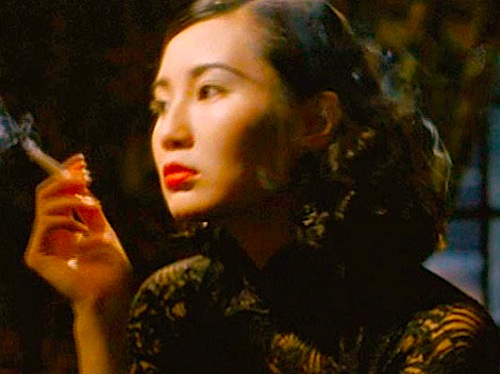
LFM Reviews Dangerous Liaisons, The 1930’s Shanghai Edition

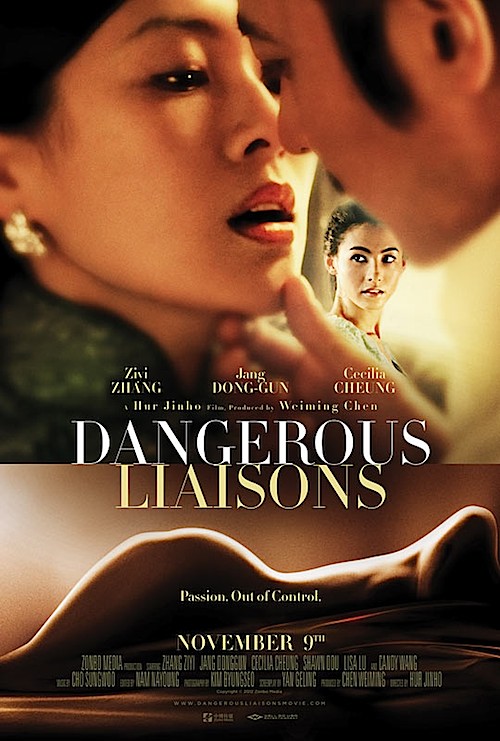
By Joe Bendel. In the 1930’s, Japan was gobbling up Manchuria, but Shanghai’s privileged class refused to let it spoil the party. Violence and foreboding hang in the air, but the cruel emotional games played by a merry widow and her dissolute ex will be more treacherous in the short term. This is indeed Pierre Choderlos de Laclos’ scandalous Eighteenth Century novel adapted to Republican era China. It makes the transition rather well in Hur Jin-ho’s Dangerous Liaisons, which opens this Friday in New York.

This time around, the Marquise de Merteuil is Mo Jieyu, the widowed chairwoman of a major banking concern and all around hedonist. She is slightly out of sorts after reading in the newspaper that her industrialist lover has dropped her in favor of his new sixteen year old fiancée, Beibei (the Cécile de Volanges). Seeking revenge, she turns to her former lover turned torch-carrying friend, playboy Xie Yifan, to corrupt her innocent rival. However, he has become preoccupied with the virtuous widow Du Fenyu (a.k.a. Madame de Tourvel). As most viewers will know, this leads to a fateful bet. If Xie cannot seduce and discard Du in reasonable period of time, he will do Mo’s bidding – whereas if he meets his challenge, she will finally yield to his advances.

Granted, the French tale of scandal has been told and retold many times in the past, but probably never with such an attractive ensemble cast (sure they are good actors, but Malkovich and Close as predatory seducers?). The chemistry between Xie/Valmont and Mo/Merteuil has rarely been as scorching either. Whenever Dong-gun Jang and Cecilia Cheung are on-screen together, it seems like they can barely resist ripping off each others’ clothes. It almost throws off the necessary dramatic dynamic between them, but it is certainly entertaining to watch. In contrast, Zhang Ziyi, somewhat playing against type, plays the indrawn Du/Tourvel with subtle power and genuine sensitivity. Not all the supporters players fare as well, but most eyes will squarely focused on Cheung and Zhang.

In fact, resetting Liaisons in Shanghai works quite well, because it establishes a fittingly dangerous backdrop, thereby raising the stakes. It also gives rise to an enjoyably era-appropriate big band jazz soundtrack, somewhat following in the tradition of Roger Vadim’s 1960 film adaptation, which featured the music of Thelonius Monk and Art Blakey.

There is truly nothing new under the sun. Hur Jin-ho’s Korean and Chinese cast and crew were not the first to produce an Asian Dangerous Liaisons. That distinction probably belongs to Lee Je-yong’s Untold Scandal. The real story of this Liaison is Cheung’s diva turn as the scheming but endlessly complex Mo/Merteuil. She is worth the price of admission in Manhattan by herself. Unapologetically melodramatic, Hur Jin-ho’s Dangerous Liaisons is recommended for fans of tragic Chinese and Korean period cinema when it opens this Friday (11/9) at the AMC Empire in New York and the AMC Metreon in San Francisco.

LFM GRADE: B

Posted on November 6th, 2012 at 9:42am.

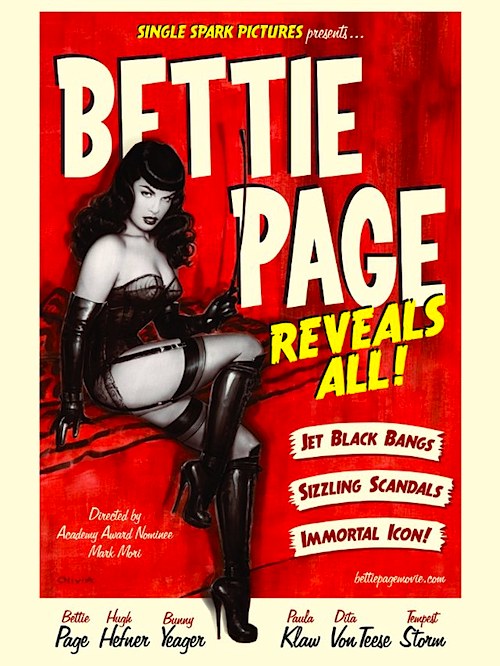
LFM Reviews Bettie Page Reveals All @ DOC NYC

By Joe Bendel. Don’t call her “notorious.” Bettie Mae Page was a good Christian and the ultimate girl next door. She just happened to have had a pin-up and fetish modeling career. Gone but never forgotten, the late cult icon tells her story for posterity, serving as the de-facto narrator of Mark Mori’s Bettie Page Reveals All, which screens as part of the new Midnight section of the 2012 DOC NYC at the IFC Center.

Who doesn’t recognize those trademark bangs? The rest of her was pretty distinctive, too. Mori illustrates the film with plenty of Page’s risqué-for-the-time and still somewhat naughty photos. In fact, as per Ms. Page’s wishes, he almost exclusively shows her as she wished to be remembered. In the opening minutes, Page relates several incidents from her early life that could have permanently scarred her and left her completely incapable of intimacy. Yet, Page was always comfortable with such matters, particularly when it came to a little topless posing.

Through Page’s reminiscences, viewers get a peek into a bygone era, when the salaciousness was more innocent. Page often worked for “camera clubs,” groups of earnest and impeccably behaved photography enthusiasts who would slink off on weekends to shoot live (and usually topless) models. As one might suspect, Page was one of their favorites, but evidently no funny business ever happened on a shoot. Yet, it was Irving Klaw’s specialized mail order photos that made Page’s fame.

Unfortunately, Page’s second and third acts were characterized by a series of divorces and a persistent struggle with mental illness. Having dropped out of the pin-up world soon after Estes Kefauver’s grandstanding Senate hearings on pornography, Page’s fate was the subject of wild speculation amongst her fans. She does indeed deliver, revealing all, but it is often rather sad. Still, Mori deals with it forthrightly, warts and all, to his credit.

Indeed, Mori’s overall approach is right on target, giving viewers a good eyeful of what they want to see. He also puts Page in proper cultural context, tracing her influence on second rate imitators like Madonna and Katy Perry—make that third rate imitators—and explaining her role as graphic novelist Dave “Rocketeer” Stevens’ muse.

Mori makes it clear that Page truly represents Americana at its hottest. It is surprising but fascinating how much seemingly unrelated cultural history finds its way into her story. Lovingly assembled, Bettie Page Reveals All should definitely hold the attention of non-fans nearly as well as that of devotees, which is the real test for documentary profiles. Recommended with affection, it screens late night this Friday (11/9) as a midnight selection of DOC NYC ’12. For obvious reasons, it is hard to see it getting much airtime on PBS, so Page admirers should probably see it now.

LFM GRADE: A-

Posted on November 6th, 2012 at 9:40am.

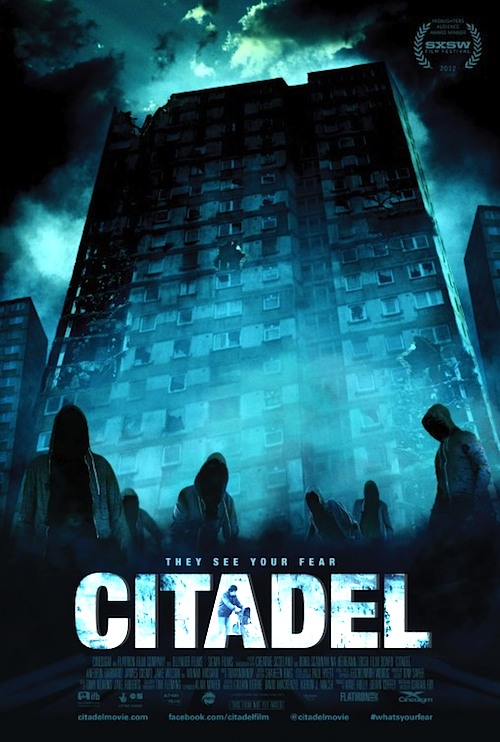
Fear is the Whole Point: LFM Reviews Citadel

By Joe Bendel. They are not merely the misunderstood and marginalized. The hellions inhabiting a shunned Irish housing project thrive on fear. In fact, they can literally see it. Whether they are truly supernatural creatures or not is left rather ambiguous, but their feral savagery is beyond doubt throughout writer-director Ciarán Foy’s Citadel, which opens this Friday in New York.

Tommy Cowley and his pregnant wife were the last decent people to move out of their ominous looking housing project. Unfortunately, they waited too long. While trapped in the typically malfunctioning elevator, Cowley witnesses the fatal assault on his wife. However, their infant daughter Elsa survives. The incident deeply scars Cowley. An agoraphobic basket case, he becomes convinced that the hoodie shrouded thugs are after Elsa. He might be a nervous wreck, but he is not paranoid.

During several harrowing nighttime home invasions, Cowley barricades himself and Elsa in the bathroom as the hooded hooligans rampage through their flat. Cowley finds a sympathetic ear and temporary shelter with Marie, a kindly nurse. She insists that the delinquents living in the title high rise are just disadvantaged youths, who lash out to vent their frustration with the system. Unfortunately, she will be proved dead wrong. However, the misanthropic parish priest understands what they are only too well.

Aneurin Barnard is almost too convincing as Cowley. Every twitch of his body language screams victim. To see him is to want to mug him. He is so put-upon, viewers almost, but don’t quite lose patience with him. Conversely, James Cosmo tears into the scenery and everything not nailed down with rip-roaring relish as the caustic priest.

While Foy eventually drops some pretty clear hints regarding the nature of the Citadel dwellers, it hardly matters. They are simply mindless tormentors. As anyone who has watched Room 237 (the cinematic deconstruction of Kubrick’s The Shining) understands, authorial intent is irrelevant to critical theory. With that in mind, Citadel can clearly be interpreted as an allegory for the War on Terror, regardless of Foy’s conscious intent. Clearly.

So let’s have a little fun with this, shall we? Like al-Qaeda and their ilk, the hooded ones spread terror for its own sake. There is no reasoning with them. The West can lock itself in the bathroom and hope they go away, but that strategy is obviously doomed to failure over time. Marie is attractive and conciliatory, like a classic appeaser, but her course only leads to death. So to protect the future of liberal democracy for Elsa and the rest of our children, we need to follow the advice of the priest – call him the Dick Cheney figure – and hook up the plastic explosives to the car battery.

Right … or possibly not. Who’s to say? The point is that Citadel taps into some profound fears, burrowing under the skin like a bionic tick. It has to be the grittiest, grimiest, grimmest horror film you are likely to see in a good long time. Cinematographer Tim Fleming’s oppressively grey look sets the mood of foreboding right from the start, while Foy steadily builds the tension as he repeatedly cranks Cowley through the wringer. Despite the absence of a strong focal villain, it is a chillingly effective horror film. Highly recommended for genre fans, Citadel opens this Friday (11/9) in New York at the Angelika Film Center.

LFM GRADE: B+

Posted on November 6th, 2012 at 9:39am.

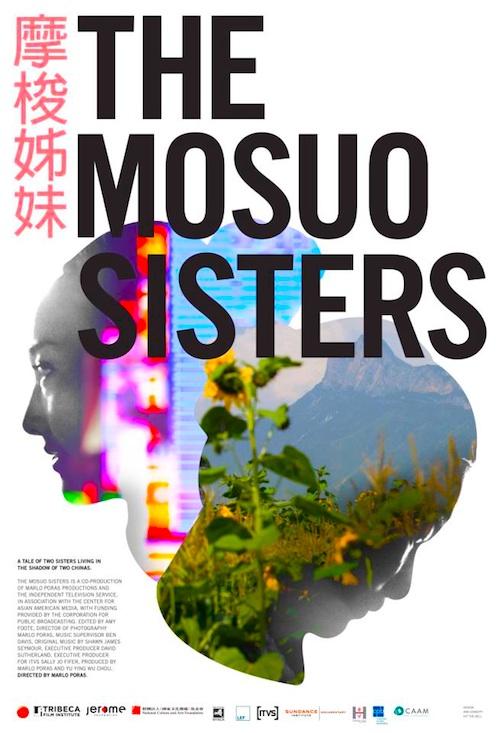
Economic Inequality in China: LFM Reviews The Mosuo Sisters @ DOC NYC

By Joe Bendel. The Mosuo people are considered somewhat exotic in China, but that is a decidedly mixed blessing. Their traditional matriarchal way of life is slipping away, but there are opportunities to perform in Tibetan themed bars and dancehalls – at least for the pretty ones. This again is a dramatically mixed blessing. When the impact of the global financial crisis forces the siblings to return home from Beijing, they start to rethink their long term plans in Marlo Poras’s The Mosuo Sisters, which screens during the proceeding-as-scheduled DOC NYC 2012.

Juma and Latso’s Himalayan Village is close to exactly nowhere. Returning home after their employer shutters her Beijing bar is an arduous, depressing journey. For Latso, the younger sister, it is a particularly bitter pill to swallow. Having enrolled in an accounting class, she had hoped to support her family with a more professional career. Now she is returning, knowing full well it will be difficult to leave again. Indeed, it is Juma, the superior earner who is sent out (this time for Chengdu), while her mother keeps her home to work on their hardscrabble farm.

One hopes the sisters will reap some benefit from Poras’s film, especially if it airs on public television. After production wrapped, their village was shook by an earthquake, which leveled their family’s home. Currently living in tents according to the film’s Facebook page, their family could use some of those Kickstarter funds.

Even before disaster struck, the year and a half Poras spent with the sisters dramatically illustrates Socialist China’s vast economic inequalities. Being an ethnic minority is also a dubious distinction for the sisters; it is considered intriguing, but often for the wrong reasons, to the wrong people. For instance, Juma must often endure misconceptions about Mosuo “Walking Marriages.” Roughly, those are procreative arrangements, in which the wife and husband live in their mothers’ households, but jointly raise their children during evenings spent together. Often deliberately misunderstood as an institution fostering promiscuity, they are anything but.

Of course, the status of China’s ethnic minorities has always been rather tenuous, particularly during the Cultural Revolution. However, Poras keeps the focus exclusively on the sisters’ here and now. Blessed with natural screen presence, viewers will definitely root for them. They might be from the middle of nowhere, but they are not bumpkins. In fact, they are quite intelligent and extremely sensitive. Yet the way they evolve and mature over this period of time is surprising.

While not even covered in the film’s post-script, the current condition of the sisters’ family speaks volumes about the nature of the Chinese government. We witness first-hand how unabashed gangsters thrive in a city like Chengdu, but education is practically a luxury. Poras’s frequent shots of Chairman Mao’s portrait staring down on the proceedings add an unmistakable layer of irony to their difficult struggle for survival.

A number of unvarnished documentaries addressing China’s social ills have been released internationally in recent years, but Mosuo Sisters has a somewhat different angle. It captures a vanishing culture and features two primary POV figures who completely win over audience sympathies. Strongly recommended, particularly for China watchers, Mosuo Sisters screens this Saturday (11/10) at the IFC Center. If you go, also bring some cash in case they pass the hat for the sisters’ family. Consider it a helping hand extended from one disaster area to another.

LFM GRADE: A-

Posted on November 5th, 2012 at 9:35am.

Ruan Lingyu, a True Diva of Chinese Cinema: LFM Reviews The Goddess

By Joe Bendel. Ruan Lingyu was often called the “Chinese Greta Garbo,” but unfortunately Marilyn Monroe might be a more tragically apt comparison. Dogged by scandal, the celebrated actress would take her own life in 1935. Awareness of her fate adds even more poignancy to her work in Wu Yonggang’s The Goddess (which can be seen in its entirety above), a classic of silent Chinese cinema, which inspired the title of the Asia Society’s latest film series, Goddess: Chinese Women on Screen. Fittingly, it launches their retrospective this Friday.

Ruan’s character has no name. Nor does she have a husband – but she has Shuiping, a baby boy for whom she will do anything. With no other resources, the woman is forced to sell herself on Shanghai’s predatory streets. There are no codes or euphemisms, here – she is a prostitute, plain and simple. Operating outside the law, she has no recourse when “the boss” appoints himself her pimp. While she tries to escape his clutches, he threatens to take the only bright spot in her life: Shuiping.

Nevertheless, as Shuiping matures, his mother sets aside money at great risk to pay for his education, at great personal risk. Unfortunately, intolerant parents complain to the progressive headmaster, claiming the presence of a prostitute’s son would threaten their children’s morals.

Released the year before Ruan’s sad demise, Goddess is arguably like an Oprah pick for 1930’s Shanghai. It forthrightly deals with issues of gender victimization and class exploitation, working towards a bittersweet conclusion, with the emphasis on the bitter. Yet Ruan elevates the film well beyond the realm of social issue melodrama.

Classic Chinese cinema star Ruan Lingyu.

While the appeal of some silent stars, is not always compatible with contemporary tastes, Ruan has a timeless beauty and projects a devastating vulnerability as the unnamed woman. She also has heartbreakingly touching chemistry with young Li Keng as the sweet-tempered Shuiping. Li Juunpan, a stage actor who crossed over to silent movies, also brings remarkable presence and dignity to the film as the John Dewey-esque headmaster, while Zhang Zhizhi personifies sweaty odiousness as “the Boss.”

Ruan’s work in Goddess is so honest and powerful, it transcends time and fashion. In fact, there are none of the grossly exaggerated performances that often date silent cinema. A true classic in any era, The Goddess will leave viewers deeply moved, in a fully satisfying way. Highly recommended, it screens this Friday (11/9) at the Asia Society. The touchstone figure for the series, Ruan also stars in New Women screening this Sunday (11/11) and is the subject of Stanley Kwan’s biopic Center Stage, which concludes the series on Saturday, December 8th.

LFM GRADE: A+

Posted on November 5th, 2012 at 9:34am.