LFM Reviews Matraga @ Premiere Brazil

By Joe Bendel. Those who know their Brazilian cinema and literature will know Augusto Esteves, a.k.a. Matraga, is one bad cat. The protagonist of João Guimarães Rosa’s short story, adapted for the screen in 1965 by Roberto Santos, made a triumphant return, sweeping most of the prizes at the 2011 Rio International Film Festival, proving Brazilians appreciate a rugged convert. Once again, he sees the light in Vinícius Coimbra’s Matraga, which screens as part of the 2012 edition of Premiere Brazil!, now underway at MoMA.

Better at drinking and whoring than farming, Esteves has made his share of enemies, most definitely including Major Consilva. Eleven of the local land baron’s gunslingers got the jump on him out in the wild grasslands. It was a decent idea, but they did not bring enough men. They will learn from this mistake. Using the incident as a pretext to banish his wife and child, Esteves continues his reckless hedonism, pressing his luck. Beaten and branded, Esteves is left for dead after pitching head first into a rocky gorge. However, a devout elderly couple nurses his broken body back to health and puts his spirit on the path of righteous.
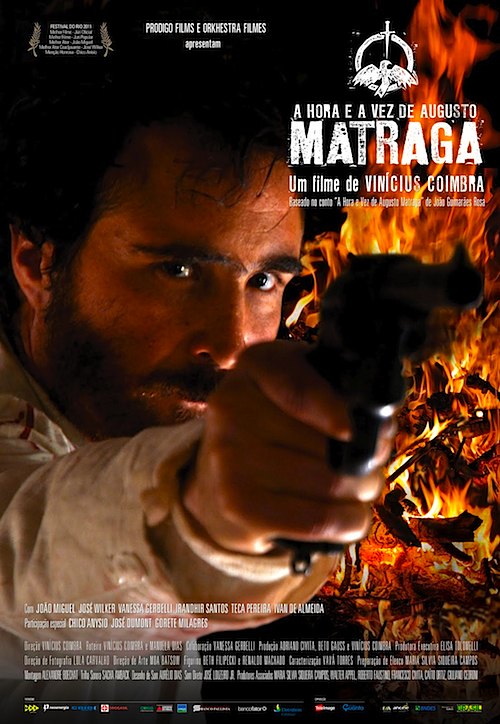
Though sometimes tempted to give into his inner demons, Esteves holds to the Christian faith of his adopted parents, living with them in anonymous isolation. Eventually, the powerful landlord Joaozinho Bem-Bem and his extra-legal posse of enforcers ride into Esteves’ village, like a Brazilian John Tunstall and the Regulators, hoping to skirt a company of legitimate government troops. Much to their surprise, Matraga receives them in the spirit of Christian hospitality, welcoming them into his home. Recognizing a kindred spirit beneath Esteves’ pious exterior, Bem-Bem feels an instant rapport with the reformed killer. Indeed, their fates will be intertwined.

Matraga is often billed as a Brazilian spaghetti western, and that is fair to an extent. Yet Esteves is as much Paul on the Road to Damascus as the Man with No Name. In truth, it is quite a solid film, but it will be tricky finding the right audience for it beyond Brazilian cinema showcases, such as MoMA’s Premiere. This is a brooding film that treats issues of faith with deadly seriousness. Still, when its go time, everyone gets down to business as the bullets fly.

Glowering impressively, João is convincingly fierce and conflicted as Esteves. He handles the fight scenes quite credibly, but most importantly his depiction of the character’s hard won new faith is grittily realistic and in no way caricatured. Nonetheless, José Wilker earns most of the film’s style points as the smoothly lethal Bem-Bem.

Clearly, Coimbra and cinematographer Lula Carvalho were taken with the wide open vistas of the Minais Gerais countryside, giving it the full John Ford treatment. Yet what is most notable is the manner the film stays true to the expectations of the western genre and the integrity of Esteves’ post-conversion character. That is quite a trick. Partly a moody, unhurried art film and partly a violent western shootout, it is recommended fairly strongly for patrons of Brazilian cinema and those drawn to dark morality tales when it screens Tuesday (7/17) and the following Sunday (7/22) as part of the tenth annual Premiere Brazil! at MoMA.

Posted on July 17th, 2012 at 2:36pm.
LFM Reviews Collaborator

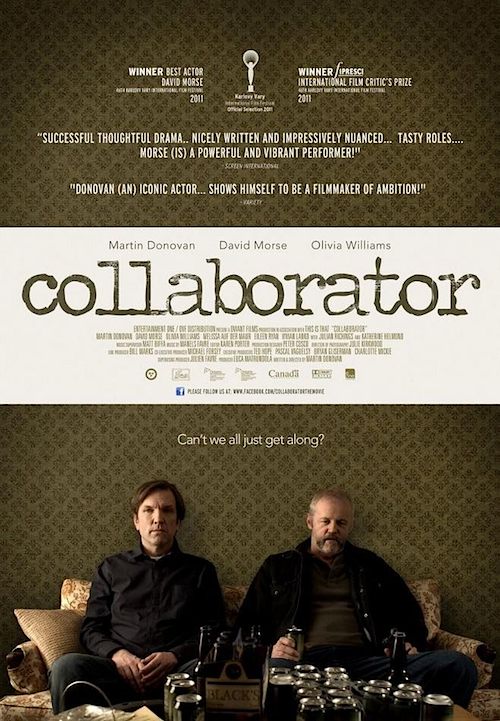
By Joe Bendel. If you are ever taken hostage, start doing acting exercises. Anyone that annoying is sure to be quickly released. It does not quite work that way for snobby leftwing playwright Robert Longfellow, but it is debatable just how much danger his captor really represents in Martin Donovan’s directorial debut and star vehicle, Collaborator, which opens today in New York at the IFC Center.

Smarting from the critical drubbing unleashed on his latest play (the appropriately pretentious sounding American Excursion), Longfellow left New York and his ever patient wife to visit his aging mother. As luck would have it, he is also able to re-connect with his former romantic interest, Hollywood actress Emma Stiles. His childhood acquaintance still living across the street also wants to hang. One of those right-wing ex-cons, Gus Williams has not made good. In trouble with the law again, Williams shows up with a gun and a shopping bag full of beers. Thus begins Longfellow’s hostage ordeal.

Donovan might have been Hal Hartley’s bro-muse in all those great 1990’s indies, but as a director-screenwriter he does not exhibit a natural talent for pacing or characterization. While he deserves credit for his relatively sympathetic treatment of Williams, we never really believe the hostage-taker would pull the trigger, at least with Longfellow on the receiving end. As a result, instead of a taut cat-and-mouse game, the deliberately stagey and static Collaborator feels more like forty-plus minutes of extended endgame, grinding along laboriously.

In lieu of plot progression, Longfellow engages Williams in a series of actors’ improvs designed to show the intellectual superiority of a New York elitist to the bitter red-stater. Yet, the truth is that both characters are just talking in clichés when they debate hot-button issues, such as the Viet Nam War. This is all supposed to reveal the fundamental essences of their psyches, but it really just leaves viewers shrugging, so what then?

Frankly, Donovan’s emotional frozen Longfellow, as well as David Morse’s wounded, anti-social Williams are only too familiar, following predictable development arcs. We have seen similar from both of them before. However, Olivia Williams has some intriguing moments as Stiles. Ironically, in Collaborator, the movie star is the most human character of the lot.

While the premise of Collaborator had potential, the execution never really clicks. There are some well turned moments here and there, especially from Ms. Williams, but it is clearly the product of an insular environment, much to its detriment. Highly skippable, Collaborator opened Friday in New York at the IFC Center.

LFM GRADE: D+

Posted on July 10th, 2012 at 2:02pm.

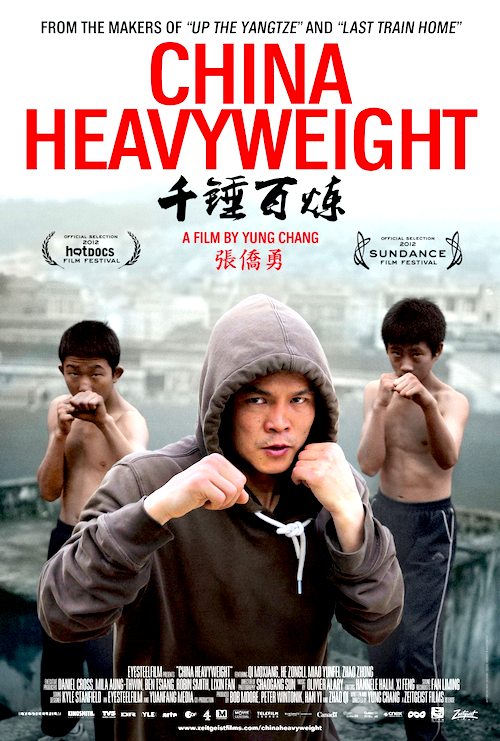
Looking for Rocky in Sichuan: LFM Reviews China Heavyweight

By Joe Bendel. Life in China must be improving. They now have round-card girls. Decades ago, Mao banned Olympic-style boxing on the grounds it was too western and excessively violent. He then launched the Cultural Revolution. Legalized in 1986, the Chinese boxing authorities are now taking a long view, recruiting potential Olympians at the middle school level. Yung Chang follows a contender turned coach and two of his fighters in China Heavyweight, which opens this Friday in New York at the IFC Center.

Boxing is an attractive alternative to working in the tobacco fields for many of the students in the Sichuan countryside. The sport has become a way of life for Coach Qi Moxiang. He recruits young boxers, both boys and girls, and directly oversees their training. He is tough, but popular with his charges.

At first, Chang’s primary POV figures appear to be He Zongli and Miao Yunfei, two boxers about to graduate to the regional level of competition. We see a fair amount of training and the mean condition of life in the province that they hope to escape. However, Heavyweight kicks into narrative gear about halfway through, when Qi decides to return to the ring to face a Japanese belt-holder. Suddenly, there is a traditional underdog boxing story unfolding in Sichuan.

Heavyweight is highly attuned to the economic disparities of contemporary China as well as the conflicts between tradition and the drive to modernize. However, Chang largely overlooks Sichuan’s recent tragic history. Rocked by an earthquake in May of 2008, anger boiled over at the local authorities for allowing the shoddy construction practices that acerbated its deadly toll. Sichuan could use a champion, but that might not be in the interests of the vested establishment.

Still, Chang has a good handle on the conventions of boxing movies, capturing some dramatic ringside action. There is even a scene of Qi’s boxers running up a series of ancient steps that echoes a certain film from 1976. He and cinematographer Sun Shaoguang also convey the harsh and lonely beauty of the surrounding terraced landscape. Viewers get a sense of the milieu, but besides Qi, the boxers’ personalities are not so strongly delineated (He is the shy one, while Miao is the slightly more confident one).

Shifting from an observational doc into old fashioned sports story, Heavyweight becomes more engaging as it goes along. The development of organized boxing post-Maoist insanity is a story worth telling, but as a socio-economic investigation, it is not nearly as telling as a raft of recent depressing Chinese documentaries, such as Zhao Liang’s jaw-dropping expose Petition, or the uncomfortably intimate Last Train Home, helmed by Heavyweight co-executive producer Lixin Fan. Oddly recommended more for the audience of HBO’s Real Sports than for serious China watchers, China Heavyweight opens this Friday (7/6) at the IFC Center.

LFM GRADE: B-

Posted on July 3rd, 2012 at 2:43pm.

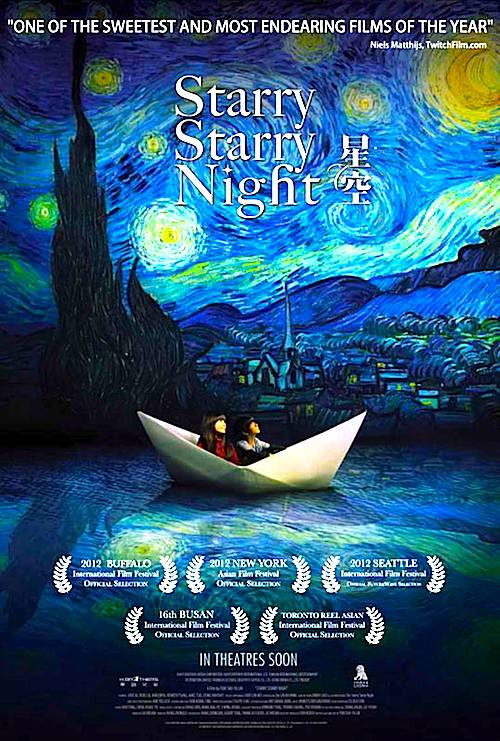
A Coming of Age Story for All Ages: LFM Reviews Starry Starry Night @ The 2012 New York Asian Film Festival

By Joe Bendel. It is tough being the kid with an artistic temperament in school. Having trouble at home is a double whammy for both Mei and Jay. At least they have each other’s support in Tom Shu-yu Lin’s Starry Starry Night, an exquisitely sensitive portrait of young love that opens this Friday in New York following its 2012 New York Asian Film Festival screening this afternoon.

Jay is a shy kid with a remarkable talent for creating art. He has a hard time making friends, because he and his mom must constantly move to new addresses. Mei has many friends, but is not particularly close to any of them. Her mother has taught to appreciate fine art through the jigsaw puzzles they use to put together as a family. Unfortunately, her parents are now too busy fighting to spend quality time with her. She feels her closest connection to her aging grandfather, who lives in a Kinkadean cabin in the woods, until she meets Jay.

At first it is a case of fascination for Mei, but as she and Jay share their mutual interests, an innocent friendship blossoms into innocent love. Grieving her grandfather and upset by the announcement of her parents’ impending divorce, she leads Jay on a journey to the late woodworker’s cottage nestled deep in the mountains.

In a nutshell, Starry could be considered the Taiwanese Moonrise Kingdom, except its young protagonists are far more endearing and their troubles are considerably more real. The closing credits even feature illustrations from Jimmy Liao’s picture book, upon which the film is based. Yet despite the more liberal use of CGI, bringing to life origami animals animated by the duo’s purity of spirit, Starry is much more grounded. Indeed, the emotional stakes involved in growing up and caring for others are quite real throughout Lin’s sympathetic screenplay.

Young Josie Xu carries a disproportionate share of the film’s dramatic load, but she is fantastic as Mei. Charming and vulnerable as circumstance demand, it is a remarkably assured screen performance. While his character is more reticent and reserved, Eric Lin Hui Ming is also quite compelling in Jay’s big revelatory scenes. Starry also boasts a special, too-significant-to-be-a-cameo appearance by Kwai Lun Mei in an epilogue completely one-upping anything Nicholas Sparks ever wrote.

True, Starry is not afraid of a little sentiment, but it earns its pay-off, every step of the way. Firmly but elegantly helmed by Lin, the film treats its young characters and their dilemmas with refreshing respect. Its lush, animated backdrops are truly striking, but the film never really engages in magical realism, per se. It is merely amplifying the feelings of its charismatic leads. Nonetheless, it is quite visually dynamic (with particular credit due to Penny Tsai Pei-ling’s design team), capturing the essence of Liao’s book. Enormously satisfying and hugely commercial, it is precisely the sort of international film that can break into the mainstream. Highly recommended for general audiences, Starry Starry Night opens this Friday (7/6) in New York at the AMC Empire and in Seattle at the AMC Pacific Place, courtesy of China Lion Entertainment.

LFM GRADE: A+

Posted on July 3rd, 2012 at 2:42pm.

Robert Flaherty & The Origins of the Documentary: LFM Reviews A Boatload of Wild Irishmen

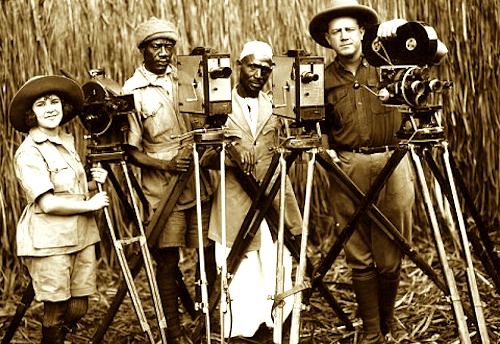
By Joe Bendel. Robert Flaherty is considered the father of documentary filmmaking. With Nanook of the North, he not only launched the modern documentary film genre, he also introduced the ethical questions that continue to dog non-fiction filmmakers. The legacy of Flaherty and the relatively small handful of films he actually completed is explored in Mac Dara Ó Curraidhín’s A Boatload of Wild Irishmen, which screens as part of this week’s Robert Flaherty series at the Anthology Film Archives.

Boatload opens with the dramatic closing scene of Flaherty’s masterwork, Man of Aran (see above). Struggling against a powerful surge, the salt-of-the-earth fishermen fight their way to shore. Flaherty did not just happen to be in the right place at the right time to capture the action, however. He either sent them out into the roiling tide, or they volunteered to go. Accounts differ, but everyone seems to agree the money Flaherty was offering played a role. Even then it would not have been much by Hollywood standards, but to residents of the Ireland’s hardscrabble Aran Island, it was significant.

Indeed, Boatload’s various on-screen commentators make it clear that staging scenes was a major part of Flaherty’s working method. Opinions regarding the Irish-American filmmaker appear to be mixed at best amongst contemporary Aran Islanders and Irish film scholars. However, such criticism of Flaherty’s authenticity is largely based on current standards of documentary filmmaking, which are rather selectively applied.

Groundbreaking documentary filmmaker Robert Flaherty (far right).

Ó Curraidhín paints a picture of Flaherty as more of an adventurer than an auteur. Rather than Jacob Riis, P.T. Barnum would be better considered his forerunner. So what if he did stage a scene, or a dozen? It was for the sake of a good show. In contrast, when recent documentaries like Gasland play veracity games, it is far more serious, because they are advocacy broadsides, arguing for punitive measures targeting specific companies and industries.

Clearly, Flaherty was not a take-only-pictures-leave-only-footprints kind of documentarian, as the interview with his Inuit granddaughter fully attests. Yet the Samoans still regularly screen Flaherty’s Moana, enjoying the sight of their ancestors on-screen, even if the episodes they are recreating were from generations before them. Obviously, the point is that there are many different ways to come to terms with Flaherty’s small oeuvre.

Refraining from passing judgment on Flaherty, Boatload emphasizes his larger than life persona and the lasting audience for his films. Ultimately, the people have spoken. Considerably more film patrons will attend screenings of Flaherty’s films this year than those of silent western superstar Tom Mix by a wide margin, a trend that continues this week at AFA. Informative and evenhanded, A Boatload of Wild Irish is a satisfying survey of Flaherty’s work and controversies. Recommended for those who enjoy films about filmmaking, it screens this Saturday through next Monday (7/7-7/9) in New York at the Anthology Film Archives.

LFM GRADE: B

Posted on July 3rd, 2012 at 2:41pm.

LFM Reviews War of the Arrows @ The 2012 New York Asian Film Festival

By Joe Bendel. Sure China invaded Korea, but it was all for the sake of greater regional stability. The year is 1636 and only an unemployable archer with an attitude problem stands between Joseon and an army of Manchurian invaders in Kim Han-min’s War of the Arrows, which screens tomorrow during the 2012 New York Asian Film Festival.

Choi Nam-yi and his sister Ja-in should not be alive. When their father is wrongfully branded a traitor, they barely escape to the home of his lifelong friend, who raises them in secret. Unable to live a productive public life, the grown Choi becomes a sullen slacker, wasting his life with his Falstaffian cronies. He only excels at one thing: archery.

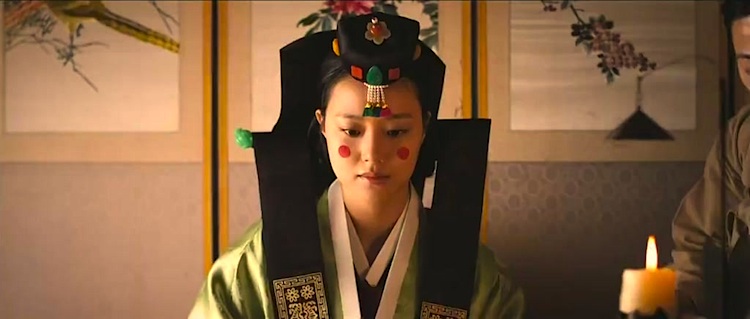
In contrast, his sister has fallen in love with Kim Seo-goon, the son of their protector. Believing they can lead a normal existence together, Kim has convinced his parents to allow their marriage. Unfortunately, the Qing army happens to choose their wedding day for their invasion. They only make one mistake, scooping up Choi’s sister and new brother-in-law along with the rest of their prisoners. Somewhat put out by this, Choi dogs the returning Qing forces, becoming a guerrilla army of one. Of course, the trail of arrow-impaled bodies he leaves in his wake attracts the attention of an elite company of archers led by the seriously hardnosed Jyushinta.

From "War of the Arrows."

A commanding screen presence, Ryoo Syeung-ryong makes quite the villain as the relentless Jyushinta. He seethes with authority and projects a quiet sense of menace perfect for his role as the Qing commando leader. While Park Hae-il’s Choi lacks a similar gravitas, he is a convincing action figure, letting the arrows fly as he careens through the forest.

War is one fierce archery film. Those who considered Hawkeye the biggest take-away from The Avengers are in for a treat. This is warfighting at its most personal level. Though already available on DVD, War of the Arrows is the sort of film that should be a blast to watch with an appreciative NYAFF audience when it finally gets an overdue New York ovation tomorrow. Well worth seeing on a big screen, it would have also made a good 3-D fixer-upper (unlike say, Clash of the Titans), considering how many projectiles come flying out towards the audience. Like the best action historicals, War of the Arrows is both high tragedy and a total blast. Enthusiastically recommended, it screens Friday night (6/29) at the Walter Reade Theater as part of the intrepid 2012 NYAFF.

LFM GRADE: A-

Posted on June 28th, 2012 at 3:21pm.