The Young Inspector Morse: LFM Reviews Endeavour

By Joe Bendel. Consider it a portrait of the curmudgeon as a young man. Inspector Morse would make a name for himself as the prickly but refined Chief Inspector with a taste for opera and poetry. However, in 1965, Endeavour Morse was an Oxford drop-out just hoping to catch on with the Thames Valley force after a stint in the military. His first case will be difficult, bringing him back to his former college in Endeavour, the one-off Inspector Morse prequel, premiering this coming Sunday on PBS’s Masterpiece Mystery.

Mary Tremlett, a local school girl, has been murdered and her former lover, an Oxford student, has committed suicide. It is supposed to look like an open-and-shut affair, but the details do not quite fit. Constable Morse’s inquiry leads him to the faculty member tutoring Tremlett (under questionable circumstances), who happens to be married to Morse’s favorite opera diva.

Though preoccupied on several fronts, Morse doggedly follows the clues leading to sleazy car dealer with half the force in his pocket. To proceed, he will need the career-risking assistance of his prospective mentor, the somewhat Morse-like Detective Inspector Fred Thursday, who drives a Jaguar and has little patience for his colleagues’ corruption.

For a television mystery, Endeavour is fairly successful at misdirecting viewers, despite dropping some fairly obvious clues. It also comes fully approved and vouched for, featuring a cameo appearance from Morse author Colin Dexter, as well as Abigail Thaw, the daughter of the late John Thaw (the star of the original Morse series), appearing briefly as the editor of the Oxford newspaper. Frankly, it seems strange that Endeavour was initially produced as a one-shot, much like the Morse spin-off, Inspector Lewis, but in each case the viewers have clearly spoken. A full four episode season of Endeavour is reportedly already in the works.

Shaun Evans as Endeavour Morse.

In his eponymous first outing, Shaun Evans looks appropriately awkward and earnest as Constable Morse, but it will be interesting to see how the character and his performance evolve over time. Indeed, it is easy to understand how this early case would appreciably contribute to his disillusionment. Fortunately, Roger Allam (who once played a suspect on the flagship Inspector Morse) provides plenty of color as the flamboyant but principled DI Friday. The only real weaknesses on Constable Morse’s maiden voyage are his suspects, who are a rather bland lot, in an English upper crust sort of way.

Sure to please the preexisting base, Endeavour should also appeal to viewers of PBS period dramas. There is definitely a sense of nostalgia here that should help the prequel series establish its own discrete identity. An entertaining feature length murder mystery that has plenty of potential for growth (again, much like Lewis before it), Endeavour is easily recommended for Brit TV fans when it airs this Sunday (7/1) on most PBS stations nationwide.

LFM GRADE: B

Posted on June 28th, 2012 at 3:19pm.
LFM’s Govindini Murty at The Huffington Post: New Film Words of Witness Testifies to Egypt’s Hopes for Democracy

[Editor’s Note: the post below appears today at The Huffington Post.]

By Govindini Murty. Egypt’s government announced on Sunday that an Islamist has won Egypt’s first competitive presidential election. The superb new documentary Words of Witness, screening at the Human Rights Watch Film Festival in New York through June 26th, sheds much needed light on how Egyptians got to this point. Directed by Mai Iskander, the film depicts the complex reality of an Egypt in which long-suffering citizens genuinely desire democracy, but must deal with the less than ideal reality of having to vote either for the Muslim Brotherhood or for remnants of the former Mubarak regime – with the military looming over any choice they might make.

Against this backdrop, Words of Witness makes the smart decision to focus its story on a young Egyptian woman, journalist Heba Afify. The documentary follows the 22 year-old Afify, a reporter for the English-language newspaper Egypt Independent, as she covers Egypt’s transition to democracy – from the heady days of the revolution in early 2011, through Egypt’s chaotic year and a half under military rule, to the recent months of buildup to Egypt’s first free presidential election. Completed in just the last few weeks, Words of Witness has a remarkable timeliness and immediacy in depicting the contending forces that are challenging Egypt’s journey to democracy.

Like her fellow citizens, Heba Afify finds herself torn between tradition and progress. Her traditional Muslim family worries about her career and her safety, while Afify’s chief concern is reporting the truth of the Egyptian revolution so that she may contribute to her nation’s democratic future.

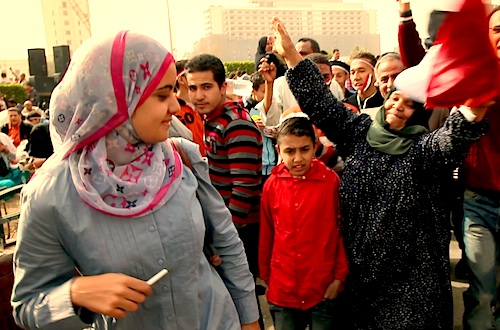
Heba Afify in Tahrir Square.

As Afify poignantly says: “I can’t abide by the rules of being an Egyptian girl if I want to be a good reporter.” And if she can’t be a good reporter, the implication is that she can’t help her country, as a free press and democratic liberty go hand in hand. Afify adds, “It’s hard to live under a dictatorship – if you say the wrong thing, they will knock on your door and take you away forever.”

The film documents the remarkable degree to which Afify and other young Egyptians like her are willing to buck authority in order to bring about freedom and progress. It is her faith in these ideals that leads Afify to volunteer to cover the most dangerous demonstrations, despite the fears of her family. Afify’s conviction and her willingness to put her ideals on the line are what ultimately make her such a compelling protagonist.

In one extraordinary scene, Afify hears that there is a protest taking place outside the State Security headquarters. This is the home of the hated secret police who have been arresting (and reportedly torturing) thousands of pro-democracy activists. Even though it is nighttime, and reports indicate that the situation is dangerous, Afify doesn’t hesitate to join the demonstration. What follows is shocking footage, shot by Afify herself, in which the demure young woman dives right into the crowd of protesters in the dark – joining them as they break into the building. They’re hoping to free political prisoners, but as they turn on the lights in the building, they discover something even more surprising: boxes of surveillance files kept by the secret police on government employees, media, public figures, and countless ordinary Egyptians. A colleague of hers hands Afify boxes of files, saying “This happens only once in history, Heba.” Afify shakes her head at the magnitude of the surveillance, commenting: “The number of files is unbelievable.”

As Afify later examines the files in her office, she finds a transcript of an actress’ phone call; Afify wonders why the state police felt the need to write down every word of this woman’s personal phone conversation. As the film suggests, such an abuse of authority engenders a moral corrosion that is an important reason why authoritarian societies have such trouble adapting to freedom. It can take generations to overcome the cynicism, paranoia, and bad faith created by a system in which the government spends more time repressing its own people than in serving them.

Heba and her mother at home.

Another important point made in the film is the need for religious tolerance. Afify shows concern when the unity between Muslims and Christians – that had largely prevailed in the early days of the revolution – breaks down in the wake of attacks on Christians. When a church is burned down in the village of Atfeeh, leading to riots in Cairo, Afify goes to the village herself to find out what has happened. When she gets to the village, she finds a curious scene – the kind of scene that often doesn’t make it into the Western media. A local Muslim leader addresses a large group of villagers, telling them that they should show support for their Christian brothers and work to have the church rebuilt. However, a large army presence watches the scene, and Afify is prevented from visiting the site of the church. Indeed, no-one is allowed to go near the church site, and the rumor ripples through the crowd that it is the State Security apparatus itself that burned the church down in order to inflame religious tensions in Egypt and justify the old regime hanging on to power.

Continue reading LFM’s Govindini Murty at The Huffington Post: New Film Words of Witness Testifies to Egypt’s Hopes for Democracy

LFM Reviews Nameless Gangster @ The 2012 New York Asian Film Festival

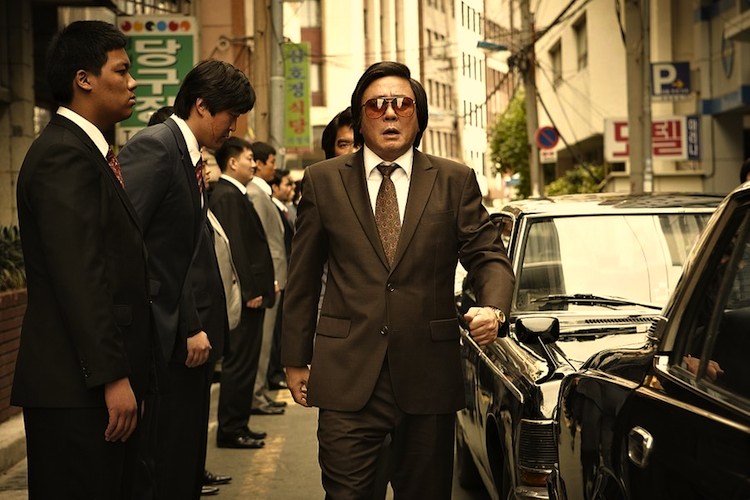
By Joe Bendel. Though still a young democracy, by the early 1990’s the South Korean government had run out of patience with the unchecked lawlessness of organized crime. Choi Ik-hyun became one of their top targets. He did not look like much of a criminal, but he was very organized. It is time to get your gangland beatdowns on as the New York Asian Film Festival comes roaring in with a whole new slate of fresh selections. Yun Jong-bin’s Nameless Gangster: Rules of the Time will deliver plenty of said when it screens at the 2012 festival this Saturday.

Choi is a low level customs inspector, corrupt in the pettiest of ways. His family was once wealthy and respected, but their fortunes have fallen. However, he remains hyper-connected amongst the larger Choi clan hierarchy. Stumbling across a shipment of heroin, Choi parlays it and his surname into a business relationship with the Busan mob’s top gun, Choi Hyung-bae.

This Choi looks the part of a gangster. Though initially skeptical of the doughier Choi, the steely cool gangster comes to appreciate the value of the older man’s connections and his skill at exploiting them. For a while, they become a very profitable team. However, Choi Ik-hyun’s greed and vanity will lead him to flirt with his “god-son’s” chief rival, Kim Pan-ho, destabilizing their alliance. Gangsters always do that kind of thing.

From "Nameless Gangster."

Nameless is far broader in scope than a mere series of gangland rumbles. Nonetheless, when the Choi and Kim factions start bashing each other fifty shades of black and blue, it is quite impressively cinematic. Still, Yun is more concerned with the zeitgeist of the time, the ROK’s years of transitional democracy, while depicting the base cunning of a wanna-be consigliere.

Indeed, special festival guest Choi Min-sik is quite compelling as his slovenly namesake. It might sound like a role quite removed from the ferocious serial killer he played in I Saw the Devil. Yet both characters are small men who react desperately when their method of empowerment is threatened. However, it is Ha Jung-woo who really makes a lasting impression. Icily fatalistic, but not without the capacity for explosive rage, his Choi Hyung-bae is exactly the sort of performance that makes great gangster films tick. Likewise, Kim Seong-gyoon has a nice flair for ruthless and reckless villainy as the younger’s Choi’s lead enforcer.

It’s been a while since there was a mob movie with the sweep and ambition of Nameless. It certainly is good to have another one. Despite the wider historical context, Yun keeps the action gritty and violent. It is a big picture, but it has a tight focus. Enthusiastically recommended, it screens this Saturday (6/30) and next Tuesday (7/3) as part of the 2012 New York Asian Film Festival.

LFM GRADE: A

Posted on June 25th, 2012 at 11:40pm.

LFM Reviews Unforgivable

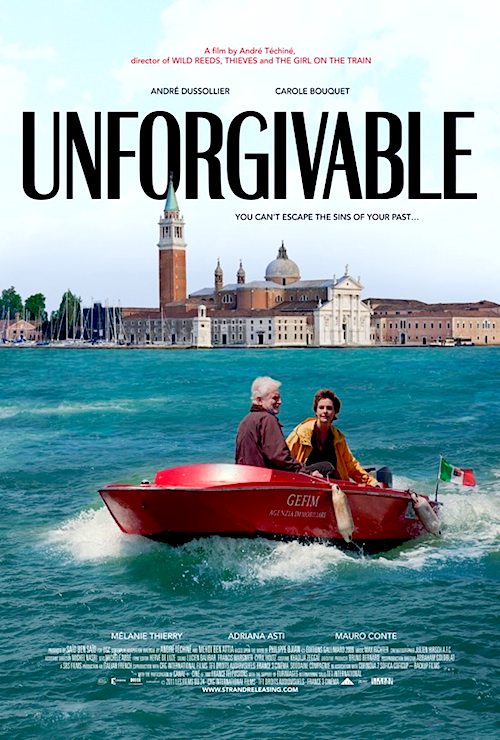
By Joe Bendel. Evidently Venice is a lot like New York. You will find a lot of writers and realtors there. One fateful day, a French mystery novelist walks into a former fashion model’s real estate agency. It will be the start of a very complicated relationship for the lead characters in André Téchiné’s latest pseudo-thriller, Unforgivable, which opens this Friday in New York.

There seems to be an inverse relationship between Francis’s creative productivity and his domestic happiness. He came to Venice to write in seclusion, but took up with Judith instead. At least she had the perfect rental for him: a secluded old villa on the island of Sant’Erasmo. Happy with his new home and lover, Francis has not written a word in months. Fortunately or unfortunately, that will all change when his ostensibly grown daughter Alice comes to visit.

Either to get back at Francis or her vastly more responsible ex, Alice disappears without warning, apparently taking up with a penniless aristocratic drug dealer. Not inclined to let things be, Francis hires the half-retired private detective Anna Maria, Judith’s former lover turned awkward platonic friend, to shadow his daughter across the continent. As Francis’s escalating emotional neediness turns to jealousy, he hires Anna Maria’s delinquent son to shadow Judith in turn.

Based on Philippe Djian’s novel, Unforgivable is a perfect example of Téchiné’s knack for skirting the boundaries of the thriller genre without fully crossing over. He toys with plenty of noir conventions, such as a mysterious disappearance, a smarmy underworld figure, and a whole lot of skulking about the streets of Venice. Yet Téchiné is more concerned with his characters’ extreme emotions—the passion, jealousy, and contempt driving their actions.

Perfectly cast as Francis, André Dussollier projects the appropriate sophistication, arrogance, and insecurity, while still connecting with something fundamentally human and sympathetic about the character. However, the real pleasure of Unforgivable is seeing Carole Bouquet (the most under-appreciated “Bond Girl” ever, from the pinnacle film of the Roger Moore era, For Your Eyes Only) as Judith, the mature femme fatale. Indeed, it is a smart, delicately calibrated performance.

Capitalizing on the mysterious Venetian backdrop, Unforgivable is like a film noir for those who avoid on-screen violence and cynicism. It is literate and worldly, yet compassionately forgiving of its characters’ self-defeating foibles (title notwithstanding). Highly recommended for French film connoisseurs, it opens this Friday (6/29) in New York at the IFC Center downtown and the Beekman Theatre uptown.

LFM GRADE: A-

Posted on June 25th, 2012 at 11:39pm.

LFM Reviews Return to Burma @ The 2012 Los Angeles Film Festival

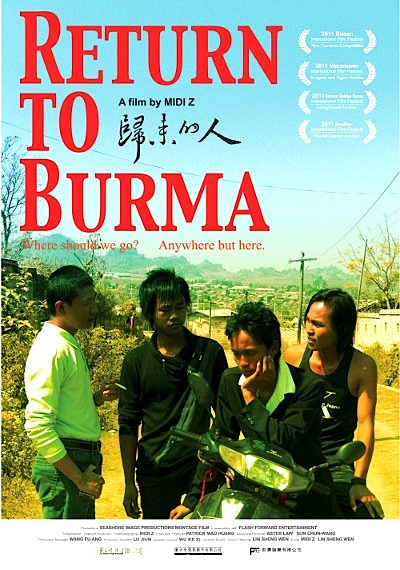
By Joe Bendel. Coca-Cola may have just announced its imminent return to Burma, but China maintains a chokehold on its client state’s closed economy. Such is the situation an expatriate construction worker finds on his homecoming. Regardless of potential political liberalizations, economic opportunities remain few and far between in Midi Z’s Return to Burma, which screens during the 2012 Los Angeles Film Festival.

After years of working and saving in Taipei, Wang Xing-hong is returning home. He had planned to travel with his co-worker Rong, but instead he will carry his countryman’s ashes. Transferring from bus to bus he hears the saccharine radio jingles proclaiming the promise of progress through new elections. Yet he arrives home to the same depressed provincial town, except now maybe even more so.

Traveling between Taiwan and Burma is an expensive and complicated proposition. Clearly, Wang would prefer to stay and put down roots. Simultaneously, his sporadically employed younger brother is about to leave for Malaysia in search of work. The fact the neighboring country offers greater opportunity than the more richly resource-endowed Burma is a testament to decades of government mismanagement and plunder. Yet, that is the state of things.

The pseudo-characters of Return are a lot like New Yorkers compulsively discussing comparative rents and maintenance fees at a dinner party. Viewers will leave knowing the market wage for just about every form of manual labor in the country as well as the start-up cost for numerous small service proprietorships. The lesson is clear—do not relocate to Burma. By the way, Midi Z and his colleagues obviously call it Burma and not Myanmar, unlike the military junta and the legacy media.

Shot surreptitiously on the streets of Yangon and Mandalay, with non-professional actors kind of-sort of playing themselves, Return is the first domestically produced Burmese feature (evidently ever). It was also more or less illegal. Perhaps not surprisingly, it is closely akin stylistically to the Digital Generation school of independent Chinese filmmakers. Deliberate and observational rather than action-driven or chatty, the film is really all about conveying the experience of Burma’s underclass—and that includes everyone except the top military and government officials.

It is probably a small miracle the Burma-born Taiwan-based Midi Z and his crew-members were not imprisoned during the Return shoot. They earn considerable kudos for vividly capturing the atmosphere of Burma. There are times when you can practically smell the humid night air. Still, the languid pace and hardscrabble living conditions have a rather claustrophobic effect. It is a worthy but wearying look inside the isolated society. Recommended for dedicated Burma watchers (but not necessarily casual connoisseurs of Asian cinema), Return to Burma screens this Friday (6/22) and Saturday (6/23) as an International Showcase selection of the 2012 LA Film Fest.

LFM GRADE: B-

Posted on June 19th, 2012 at 8:45pm.