LFM Reviews Reportero @ The Human Rights Watch Film Festival/The L.A. Film Festival

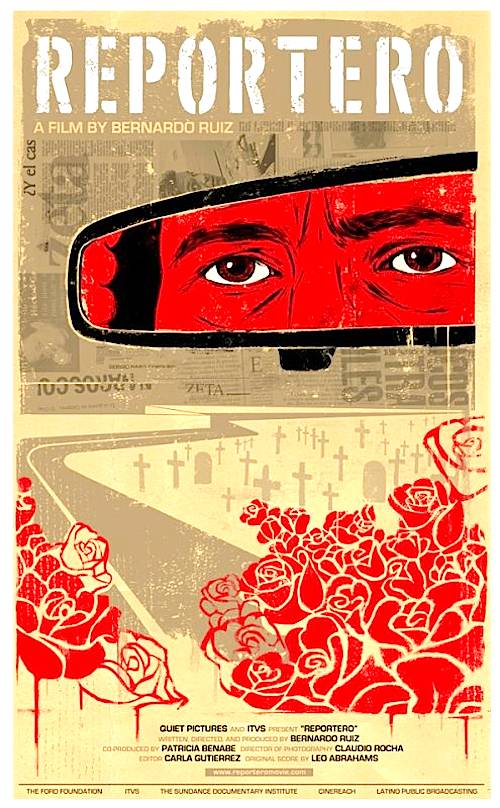
By Joe Bendel. For years, Mexico’s best journalism has been done in Tijuana. Frankly, with the rise of the drug cartels’ power, Tijuana might be the only place in the country where real journalism is practiced with conviction. However, the staff of the resolutely independent news weekly Zeta has paid a heavy price for their journalistic integrity. Bernardo Ruiz documents their dangerous mission covering the drug lords and the crooked politicians abetting them in Reportero (trailer here), which screens as part of the 2012 Human Rights Film Festival in New York and also at The Los Angeles Film Festival.

Based on the experience of Zeta staffers, one could justifiably ask if Mexico ever had a free press, as such. Founded to investigate the widespread corruption of the long ruling socialist PRI party, Jesús Blancornelas made a crucial decision to print the newspaper on the American side of the border. This would be more expensive, but far more secure. While the PRI is now temporarily on the outs, the drug traffickers have become even more proactive buying-off or outright intimidating journalists. Indeed, Zeta has suffered its share of assassinations, including very nearly their founder, Blancornelas.

Ruiz adopts old school investigative journalist Sergio Haro as his primary POV figure. No stranger to death threats, Haro has fearlessly raked the muck of Baja California. Though a family man, he comes across as an existential champion of the underclass, who nonetheless needles the leftist PRI every chance he gets. While not the most animated screen presence, Haro clearly walks the walk. His stories should be considered blockbusters, but the guilty continue on, with evident impunity.

Ruiz’s dry observational style tries its best to drain all the sensationalism out of the film, but Zeta’s four-alarm headlines speak for themselves. Indeed, the crusading publication’s war stories are exactly that. Their scoop concluding the film is quite a jaw-dropper, but it is the memorial to one of two fallen comrades that really says it all.

It is nearly impossible to consider Mexico a functional state after viewing Ruiz’s profile of Zeta. Fascinating but deeply scary stuff, Reportero is a bracing tribute to the new weekly’s principled journalists (and the staff of a short lived daily paper Haro founded in between his Zeta stints). While it is an ITVS production destined for PBS broadcasts, it is well worth seeing the longer festival cut, because these details are devilishly important. Recommended for anyone concerned about press freedoms or the social-political health of our southern neighbor, Reportero screens at The Human Rights Film Festival next Thursday (6/21), Friday (6/22), and Saturday (6/23) at the Walter Reade Theater and tonight (6/18) at The Los Angeles Film Festival.

LFM GRADE: B

Posted on June 18th, 2012 at 4:54pm.
The Legacy of The Khmer Rouge: LFM Reviews Brother Number One @ The 2012 Human Rights Watch Film Festival

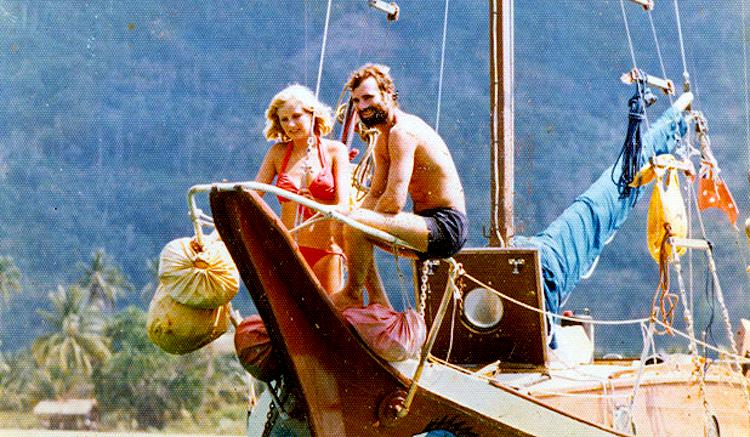
By Joe Bendel. For one New Zealander, a Canadian, and a British subject sailing through Asia, straying off course became a capital crime. It was their profound misfortune to anchor within the territorial waters of Cambodia while the country was held in the inhuman grip of the Communist Party of Kampuchea, or the Khmer Rouge as they would subsequently be known. In 2007, Rob Hamill had the opportunity to testify on behalf of his late brother in the first trial of a Khmer Rouge official for crimes against humanity. Annie Goldson followed Hamill’s quest for justice, or at least a measure of closure, in Brother Number One, one of a handful of must see films at this year’s typically uneven 2012 Human Rights Watch Film Festival in New York.

The film’s title carries a rather odd double meaning. Pol Pot, the Robespierre of the nationwide genocide, was dubbed “Brother Number One” in Communist propaganda, whereas Kerry Hamill was the first of three brothers. Charismatic and athletic, the elder Hamill brother left New Zealand in search of seafaring adventure. The 1970’s still felt like the 1960’s for him and his mates, who were largely oblivious to the horrors underway in Cambodia.

Canadian Stuart Glass was killed during the attack on their small yacht, which was probably a small mercy. Hamill and the British John Dewhirst were captured and transferred to the notorious Tuol Sleng prison, commanded by Kaing Guek Eav, a.k.a. “Comrade Duch.” In his own words, Duch’s prisoners were to be “smashed.” This entailed torture, the extraction of a false confession, and an agonizingly slow execution.

As he prepares his “Civil Party” statement, Hamill visits the Tuol Sleng Genocide Museum and talks to the handful of survivors, getting a painful sense of his brother’s final months. He also interviews several former Khmer Rouge officials, who are not exactly forthcoming. More satisfying are his meetings with Dewhirst’s sister and his brother’s girlfriend, bonding through their shared grief.

Kerry Hamill (right) and his girlfriend.

Though it is an intensely personal story, Brother vividly establishes the scale and ferocity of the Khmer Rouge’s reign of terror. The walls of victim photographs at Tuol Sleng speak for themselves. We do learn a bit about Duch, the subject of The Bookkeeper of Death (recently seen on PBS World), but Rob Hamill is appropriately granted the floor throughout the documentary. Frankly, it is quite amazing how well he keeps it together as he confronts the ghosts haunting his family.

An Olympic rower at the Atlanta games, Rob Hamill is indeed a compelling POV figure. He certainly puts a human face on the nearly inconceivable tragedy of so-called “Democratic Kampuchea.” Yet, the documentary never feels manipulative or exploitative. Goldson wisely stays out of the picture, resisting the temptation of putting any sort of explicitly personal stamp on the film. Nor are there moments of quiet observational slack. Brother has a compelling narrative, which Goldson and her co-director-dp Peter Gilbert and co-editor James Brown hew to quite tightly.

Brother Number One clearly illustrates how vicious ideology can be. It also reminds viewers how one murder can devastate an entire family. As for resolution, that is another matter entirely. That is indeed why Brother Number One is a timely and important film. One of three highly recommended films at this year’s New York edition of HRWFF, along with Salaam Dunk and Ai Weiwei: Never Sorry, it screens this coming Tuesday, Wednesday, and Thursday (6/19-6/21) at the Walter Reade Theater, with Goldson and Hamill in attendance all three nights.

LFM GRADE: A

Posted on June 18th, 2012 at 4:51pm.

LFM Reviews The Sword with No Name

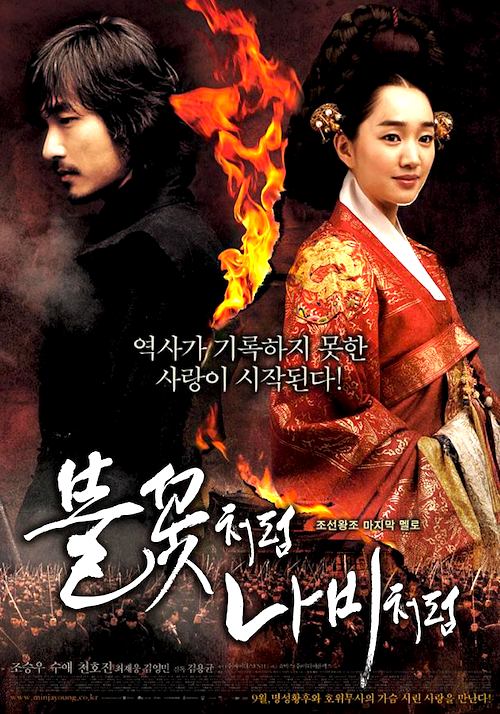
By Joe Bendel. She was a queen who advocated modernization and greater contact with the west. Niall Ferguson would approve, but many at court did not, particularly those aligned with the Imperial Japanese. Empress Myeongseong could only count on the support of one man, and it was not the king. At least that is the speculation of Kim Yong-gyun’s fictionalized epic The Sword with No Name, which screens this Tuesday as the latest selection for the Korean Cultural Service’s Korean Movie Night in New York.

Mu-myeung knew the queen when her name was Min Ja-yeong. Their chance meeting made quite the impression on the freelance ruffian. Recognizing that he is no match for a noble-born woman, he enlists (the hard way) with the palace guards to serve as her protector. She will need it. While the king trifles with his concubines, the queen forges a potentially game-changing alliance with Russia. Japan is not amused. Neither is the king’s father Daewongun, the former regent, who still very much considers himself the power behind the throne. Various factions will orchestrate uprisings and assassination attempts targeting Queen Min (as she was also known), but they will have to go through the devoted Mu-myeung first.

In recent years, Korean cinema has not been all that flattering in its characterizations of former kings. Sword is no exception, depicting King Gojong as a dissolute tyrant, much like his brethren in King and the Clown, Frozen Flower and Shadows in the Palace. There is also plenty of precedence for the brooding swordsman Mu-myeung, but Cho Seung-woo plays him with enough grit and angst to make him fresh, nonetheless.

However, the queen is something else entirely. Not just an early feminist role model, she can be seen as a progressive visionary, understanding the value of close diplomatic relations with the west and a less insular approach to statecraft in general. Had her policies been adopted, the next fifty years of Korean history might have been more pleasant. A smart and luminous screen presence, Soo Ae’s performance as Queen Min is a model of restraint and sensitivity.

There is something for just about everyone in Sword, but occasionally some of the Matrix-style action sequences escalate a bit over the top. In truth, it is the love story that really packs the wallop here. There is something quite beautiful about the queen and her protector’s star-crossed love, sustained over years by the merest incidental contact. It is impossible to find the same depth of feeling in western film. Instead, we would see two ill-fated lovers rolling their eyes in disbelief at the social circumstances blocking their union.

Like a late Joseon era Bodyguard without the annoying theme song, The Sword with No Name delivers all the intrigue and tragic romance fans of historical sagas could ask for. Though a bit slow out of the blocks, it locks in soon enough, hitting its stride with some heavy yearning and cool swordplay. Highly recommended, Sword screens for free this Tuesday (6/19) at the Tribeca Cinemas, courtesy of the Korean Cultural Service.

LFM GRADE: B+

Posted on June 18th, 2012 at 4:50pm.

Dramaville Goes Noir: LFM Reviews Inside Men

By Joe Bendel. Incentives matter. A cash-processing depot manager is put through the wringer by his superiors for the occasional irregularity in his accounts, but if an armed robber sticks a gun in his face, they will grant him time-off and provide counseling. If he is ever going to steal from the apparently impenetrable Larson House, he ought to do it in a big way. That is pretty much his plan in the four-part Inside Men, which premieres this Wednesday on BBC America’s Dramaville showcase.

The unassuming John Coniston is like a Bob Cratchit, promoted to management. He is keenly aware that neither his boss nor his subordinates respect him. When viewers first meet Coniston, he is having a bad day. Masked gunmen are forcing him to open the vault, while an accomplice holds his wife and newly adopted daughter hostage. However, there is more to this story, as the series title ought to indicate.

Yes, Coniston is in on it, but there are complications he never anticipated. Having caught his chief security guard Chris Lebden and loading dock worker Marcus Riley skimming mere tens of thousands off the top, he recruits them for a far more ambitious take: the lot of it.

Constantly flashing forward and backwards between the September heist and the planning stages six months earlier, Inside Men requires fairly close viewer attention. While there is plenty of skullduggery afoot, it is really more of a dark character study. Writer Tony Basgallop and director James Kent show us step by step how it all goes down, twisting viewer assumptions here and there along the way.

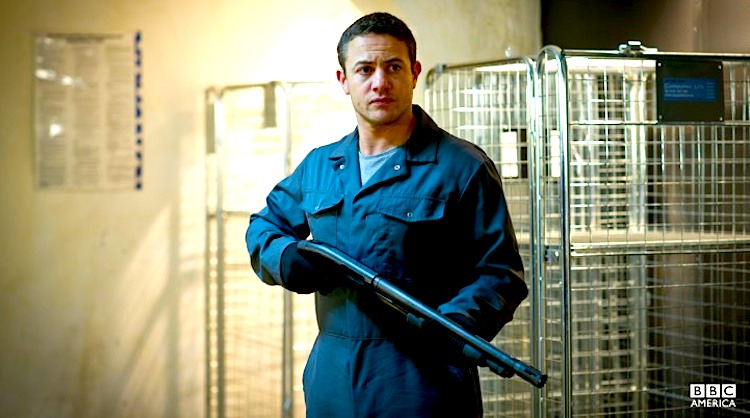
Warren Brown as Marcus Riley in "Inside Men."

The deceptively bland Coniston is clearly the key piece to the conspiracy. Steven Mackintosh convincingly sells his burgeoning empowerment as a criminal mastermind. Indeed, some of his best scenes involve the grudgingly respectful relationship he forges with Kalpesh, the purveyor of criminal support services reluctantly brought into the scheme. Though his character arc is quite intriguing, it is still hard to believe Coniston would put his family through such trauma, despite the safeguards he puts in place.

As Riley, fellow Luther alumnus Warren Brown makes a credible enough good-time knucklehead, while emerging UK TV star Ashley Walters is appropriately intense as the conflicted Lebden. However, the most invigorating supporting turn might come from Irfan Hussein, playing Kalpesh with icy flair.

Inside Men could well be too cold-blooded and intricately pieced together for fans of cozier British mystery television. Unabashedly naturalistic in its depiction of human nature, it definitely follows in the tradition of more fatalistic film noir. Even though it ends on a bit of a flat note, it is smart television, keeping a fair amount of surprises in store for engaged audiences. Recommended for those who enjoy a dark criminal yarn, Inside Men begins this Wednesday (6/20) and concludes July 18th (skipping Independence Day), on BBC America.

Posted on June 18th, 2012 at 4:49pm.

Women’s Basketball, Women’s Freedom in Iraq: LFM Reviews Salaam Dunk @ The 2012 Human Rights Watch Film Festival

By Joe Bendel. There was no Title IX in Iraq under Saddam. In fact, the general idea of gender equity that motivated the landmark legislation remains scarce throughout the region. Yet, two years after its founding, the American University of Iraq, Sulaimani (AUIS) fielded a pioneering women’s basketball team. They never won a game during their first season. David Fine documents their second in the truly inspiring Salaam Dunk, which screens as part of the 2012 Human Rights Watch Film Festival in New York.

Their students are the future leaders of Iraq. Offering a rigorous academic program in the relatively sheltered environment of Sulaimani, AUIS makes a point of recruiting a cross section of Iraq’s population. As a result, the nascent women’s basketball team boasts a roster of Arabs, Kurds, Shiites, Sunnis, and Christians. They are led by Coach Ryan, a visiting American English lecturer. Tough but supportive, he is a refreshing antidote to all the wrong sorts of coaches who have made the news recently. However, everyone is keenly aware that his fellowship ends with the current academic year.

For students from Baghdad, Sulaimani is an island of stability, yet many still worry about their families. Nearly all team members have lost friends or family to violence. As Coach Ryan observes, his team has faced more in their still young lives than most of those watching their documentary will ever have to contend with. Not merely an extracurricular activity, basketball becomes something uniquely “theirs.” It bonds the young women together and gives them a sense of identity. They also want to win.

Probably no genre traffics in shopworn clichés like the sports documentary, but Salaam is something else entirely. When the coach consoles his team after a hard loss that their gutty performance is more important than a “W” or an “L,” it is not hollow. It is a profoundly heavy moment. Notions of sportsmanship and the “healing power of sport” take on very real meaning here.

Director-editor-co-cinematographer Fine gives viewers a full sense of players’ personalities, as well as that of their coach and student-manager. They are all bright and immensely likable. Indeed, the experience of AUIS in general and the women’s basketball team in particular appears to be a successful social catalyst, bringing the diverse team together, despite their religious and ethnic differences. This does not mean Salaam is uneventful. The AUIS team just saves their drama for the court (or the classroom or the debating society).

This is a great documentary. The term “crowd-pleaser” just does not cover it. While the circumstances of the Iraq War unavoidably hang over the young Iraqis, Salaam scrupulously avoids politics, as such. It is one of the best sports docs in years, but it is not really about games and stats. It is about a group of young scholars becoming athletes and leaders, who will inspire audience confidence in Iraq’s future. While the HRW festival is always a radically mixed bag, Salaam Dunk and the opening night selection, Alison Klayman’s Ai Weiwei: Never Sorry, the Sundance alumnus profiling the Chinese dissident artist, are two films that should absolutely not be missed. Highly recommended, Salaam Dunk screens this Saturday (6/16), Sunday (6/17), and Monday (6/18) at the Walter Reade Theater.

LFM GRADE: A

Posted on June 14th, 2012 at 11:29am.

LFM Reviews The Woman in the Fifth

By Joe Bendel. Tom Ricks is a writer, so he must be a little off. With only one obscure novel to his name, the American cuts an underwhelming literary figure, but he has enough issues to earn a restraining order from his French wife. Following her and their daughter to Paris does little for his overwrought state of mind in Pawel Pawlikowski’s The Woman in the Fifth, which opens this Friday in New York.

Less than thrilled to see him, Nathalie Ricks promptly calls in the gendarmerie. Beating a hasty retreat, Ricks finds himself penniless at the flop-house motel run by gangster Sezer. To pay for his room and board, the novelist accepts a job working as a sketchy subterranean watchman for one of Sezer’s criminal endeavors. He figures it will give him time to work, but his writing is definitely not of the healthy variety. The only bright spot are his semi-regular assignations with Margit Kadar, an elegant and alluring widow of a Hungarian novelist perhaps even more obscure than Ricks, living in Paris’s 5th arrondissement.

While his ex shuns his reconciliation attempts, Ricks attracts the romantic attention of Ania, the Polish immigrant waitress at Sezer’s tavern, who also happens to be the mobster’s lover. This profoundly destabilizes the novelist’s situation. It also starts a chain of events leading Ricks to suspect a hitherto unknown force is meddling in his affairs.

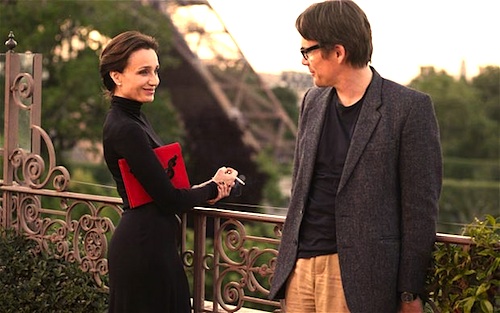
Kristin Scott Thomas and Ethan Hawke in "The Woman in the Fifth."

Based on the novel by Douglas Kennedy, Fifth blends elements of genre cinema in ways that would be spoilery to discuss in detail. However, Pawlikowski is more interested in presenting an extreme psychological study with a distinctly Continental art film sensibility than aiming for mere thrills or chills. Never rushing the revelations, Pawlikowski still deftly creates sense that all is not right with his protagonist and his world.

Leading a multinational ensemble, Ethan Hawke and his terrible French accent are effectively moody and withdrawn as the socially problematic Ricks. Polish actress Joanna Kulig, recently seen (and very much exposed) in Malgoska Szumowska’s Elles, is also quite credible as the glammed-down Ania. Yet, Kristin Scott Thomas is the crucial piece of the film’s puzzle. Always an intelligent presence, she is absolutely perfectly cast as the sophisticated Kadar. The audience instantly shares Ricks’ interest in her—and of course her accent is always flawless, in both French and English.

Fifth’s slow build and emotionally detached approach to Ricks’ existential drama might be difficult for some viewers to whole-heartedly embrace. However, it is a smart, stylish film. Indeed, cinematographer Ryszard Lenczewski’s chilly gray color palette nicely suits the on-screen mystery and alienation. It is the sort of film viewers will kick around in their heads for days after screening it, which is an increasing rarity. Highly recommended for fans of European cinema with a dark twist, Woman in the Fifth opens this Friday (6/15) in New York at the Village East.

LFM GRADE: B+

Posted on June 13th, 2012 at 10:39am.