Aside from Battleship and classic naval war movies, we want to encourage LFM readers to spend Memorial Day watching a touching new documentary about real-life naval heroics from LFM contributor Steve Greaves, called Tin Can Sailors Will Not Be Forgotten. The film premieres this Memorial Day, Monday, May 28th on The Documentary Channel at 9:30pm EST/PST. You can watch Steve and other folks involved with the film talk about it above.
Tin Can Sailors tells the extraordinary World War II story of the USS Morris, a Sims Class destroyer that saw action from the North Atlantic all the way to the island-hopping campaigns against Imperial Japan. The Morris participated in a seemingly endless number of decisive battles during the war, including in the Battle of Coral Sea, the Guadalcanal campaign, the fighting around Leyte Gulf – and was nearly sunk by a kamikaze at Okinawa. For her efforts, the Morris received 15 battle stars for her action in World War II, placing her among the highest decorated American ships of the Second World War.
Tin Can Sailors tells the dramatic story of the Morris, and also documents how her remaining crew members to this day reunite to celebrate their service, and to honor their fallen shipmates who never made it back. Our own Steve Greaves co-directed the film, and also composed the film’s musical score. Tin Can Sailors is a moving tribute to the brave men and women of the Greatest Generation who fought the good fight and preserved our freedom, and we encourage LFM readers to take time out on Memorial Day to watch it on The Documentary Channel. You can also purchase the film here.
By Jason Apuzzo. Star Wars was released 35 years ago today. It’s hard to believe it’s been so long! All these years later, the original Star Wars and Errol Flynn’s The Adventures of Robin Hood are still my favorite films of all time. Unlike with Robin Hood, however – which I first saw on TV – I had the good fortune of seeing Star Wars when it first came out in theaters back in 1977. My six year-old imagination was completely overwhelmed, and I was hooked on the movies for good.
If memory serves, the trailer above represents all that many of us knew about the film prior to its release – and it was pretty exciting stuff. And although a lot has changed about the Star Wars universe since that time, it’s worth remembering how fresh, original and imaginative the film seemed back in 1977. I know that watching Star Wars in 70mm Dolby stereo with excited crowds at the then-Plitt Century Theater in Century City (Los Angeles) still represents the most fun I’ve ever had at the movies. And really, the film hasn’t changed that much for me after all these years – the many special editions and digital revisions aside. I still love the film, and I don’t think it’s ever been topped.
Writer-director George Lucas did a marvelous job with this film, breaking a lot of new ground and opening up a whole new imaginative universe to audiences and filmmakers. I’d say even more about the film, but I have to go over to the Toshi station right now to pick up some power converters. 😉 Congratulations on Star Wars‘ 35th.
By Govindini Murty. In the midst of a movie season dominated by special-effects blockbusters, it’s nice to see smaller-scale indie films that celebrate the human within technology. Lee Kirk’s The Giant Mechanical Man, a selection of the 2012 Tribeca Film Festival currently available on VOD (video on demand), depicts two sensitive souls looking for meaning within the machinery of the modern city. Set in Detroit, the title also evokes the industrial heritage of the city, with elegant montages that resemble sequences from such classic ‘20s documentaries as Paul Strand and Charles Sheeler’s Manhatta or Walter Ruttman’s Berlin: Symphony of a City.
The Giant Mechanical Man stars Jenna Fischer as Janice, a shy and insecure thirty-something struggling to find purpose in her life. She works as a temp but her lack of focus gets her fired – forcing her to move in with her picture-perfect, blonde, ambitious sister Jill (Malin Akerman) and her dentist husband. Tim (Chris Messina) is also a thirty-something loner adrift in the big city. He spends his days as a performance artist on the streets of Detroit playing a robot-like figure on stilts known as the Giant Mechanical Man.
The opening of the film features a striking, almost avant-garde sequence. Tim dons silver face paint, a silver suit, and stilts, puts on a silver bowler hat and – grabbing a silver umbrella – heads down the streets with a purposeful stride that is an ironic commentary on the businessmen around him going to work. Tim’s Giant Mechanical Man is an exaggerated, postmodern version of The Man in the Gray Flannel Suit, the subject of the best-selling 1955 novel by Sloan Wilson about a businessman who struggles to find meaning in his career.
When a local news show asks Tim why he does his act, he explains:
“I thought that it might brighten people’s lives up. … I guess I feel like modern life can be alienating … you’re mindlessly walking through it like a robot and you can feel lost. … Maybe if you see a giant mechanical man wandering down the street towards you, it would help to put it into perspective, you know?”
Jenna Fischer and Chris Messina in "The Giant Mechanical Man."
Janice sees Tim performing on the street and feels a connection with him, recognizing in his mechanical motions her own sense of being just a cog in the machine of the city. Through serendipity, Janice and Tim then both get jobs at the Fillmore Zoo. The zoo serves as yet another metaphor for the entrapment of humans in modern city life, with Tim at one point even comically pretending to be one of the exhibits. Janice and Tim strike up a friendship that turns into romance, but Tim is unable to tell Janice that he is the mechanical man. All this is further complicated by her sister Jill’s efforts to set Janice up with a self-absorbed author of motivational books, played with gusto by Topher Grace.
Woven into the story is Janice and Tim’s love of silent movies. As in Martin Scorsese’s Hugo, a love of silent movies in Mechanical Man is used to indicate an affinity for the poetic and the romantic. Janice watches Charlie Chaplin’s The Kid and Buster Keaton’s The General – perhaps drawn to both films because they feature wistful, sensitive characters who resemble herself.
The Giant Mechanical Man is a sweet, feel-good alternative to this summer’s action-heavy movie fare. Jenna Fischer and Chris Messina are both charming in their roles, and the quirky cast of supporting characters deftly play their parts. I especially appreciate the fact that Chris Messina’s Tim is a gentleman, standing up at one point to some misogynistic yuppie characters at a business party. I would have liked to have seen more stylistic experimentation in the film to highlight the theme of mechanization, but director Lee Kirk nonetheless shows in his debut feature a nice touch for genuine emotion and humanistic values.
The movie’s air of romance carried over into real life, as well, with star Jenna Fischer and director Lee Kirk falling in love during the shoot and getting married – a sweet, real world ending to a charming movie tale. The Giant Mechanical Man is currently available from Tribeca Films on video on demand through June 19th.
By Joe Bendel. Two twelve year-old runaways would like to remake the generic sounding Mile 3.25 Tidal Inlet into a New England version of the Blue Lagoon, but they aim to maintain the cultural trappings of 1965 middle class America, as they relate to it, in the process. Unfortunately, the adult world keeps intruding on their private moments in Wes Anderson’s Moonrise Kingdom, the opening night film of this year’s Cannes Film Festival, which bows theatrically in New York tomorrow (Friday, 5/25).
Sam Shakusky is a terrible Khaki Scout. Actually, his skills are not that bad, but he does not fit in socially with Scout Master Ward’s troupe. Unbeknownst to Ward, Shakusky is an orphan, about to get the heave-ho from his foster family. However, the sensitive scout has successfully wooed Suzy Bishop, the eldest child of two self-absorbed yet profoundly unhappy attorneys.
When Shakusky fails to appear at revile one fateful morning, it sets off a manhunt throughout New Penzance Island, taxing the meager resources of Captain Sharp, Mrs. Bishop’s recently dumped lover. Chastely dedicated to each other, the two fugitives would like to permanently retreat from reality at the prosaically named inlet they duly redub “Moonrise Kingdom.” Instead, they will repeat a cycle of chase, apprehension, and escape, as a historic storm approaches New Penzance, as it always happens in an island-bound story.
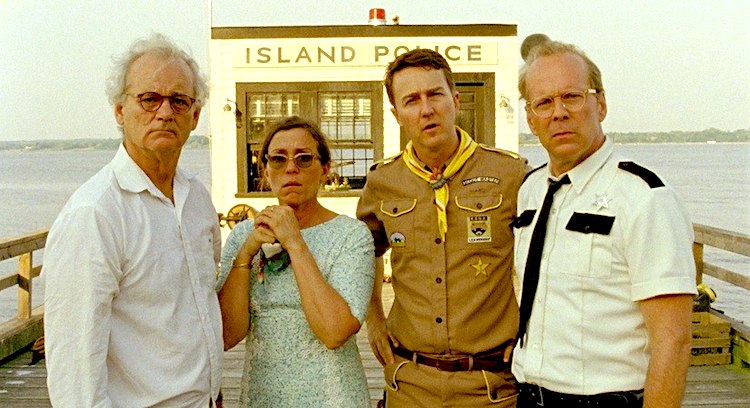
Bill Murray, Frances McDormand, Ed Norton and Bruce Willis in "Moonrise Kingdom."
It takes about ten seconds for Moonrise Kingdom to announce itself as a Wes Anderson film, through his constantly panning camera and the richly detailed vintage sets. Indeed, the attention to detail extends down to the covers of the chapter-books Bishop reads aloud to Shakusky. Yet, rather than detracting from his fable-like story, Anderson’s signature style is perfectly suited to the innocence of young love. Focusing on young POV characters is actually quite a shrewd strategy on his part, giving him the license to incorporate all kinds of nostalgic eccentricity (nod to Norman Rockwell? Check.) while staying faithful to their precocious worldview. Frankly, this is the sort of film a visual stylist like Tim Burton ought to be making, instead of aimless tent-poles like Dark Shadows.
As Mr. Bishop, Anderson mainstay Bill Murray once again plays a middle-aged depressive with deep-seated relationship woes. Fellow alumnus Jason Schwartzman is also back for more, getting some of Moonrise’s best comedy scenes as Cousin Ben, a slick operating senior Khaki Scout. Indeed, the film boasts several notably colorful supporting turns, including by Bruce Willis, acting his age and playing against his action hero persona as the put-upon Captain Sharp. Tilda Swinton also absolutely plays to the hilt the personification of bureaucracy known simply as “Social Services,” while the mere sight of Bob Balban’s “Narrator” in his bright crimson wardrobe generates laughter. Still, the dramatic load largely falls on the young newcomers, Jared Gilman and Kara Hayward, who are quite emotionally engaging leads, playing their scenes together scrupulously straight.
Essentially, Moonrise is a children’s movie for adults. Robert Yeoman’s cinematography gives it all a sensitive period sheen, while the soundtrack (dominated by the unlikely combination of Benjamin Britten and Hank Williams recordings, more than Alexandre Desplat’s original themes) effectively underscores the wistful vibe. Altogether, it is very Wes Anderson – but its gentle, humane spirit is quite winning. Recommended surprisingly highly (well beyond Anderson’s established circle of admirers), Moonrise opens tomorrow (5/25) in New York at the AMC Lincoln Square and Regal Union Square.
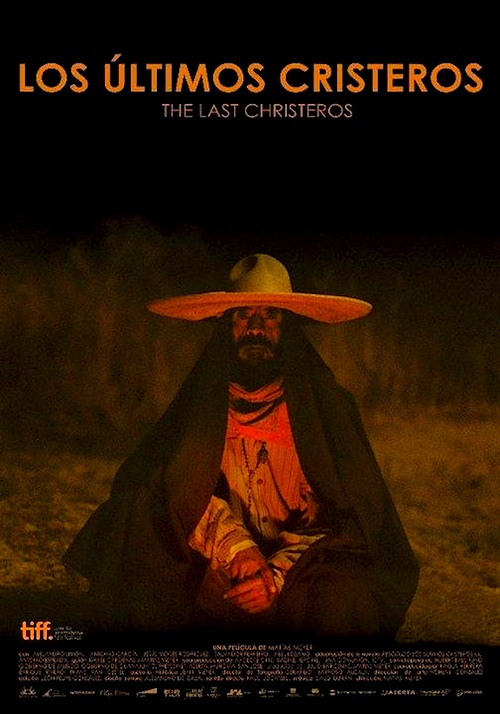
By Joe Bendel. One of the twentieth century’s bloodiest assaults on religious freedom happened in the western hemisphere. It was perpetrated by “revolutionary” Mexican socialist president Plutarco Calles, whose iron-fisted anti-clerical policies inspired a real grassroots revolution. By the 1930’s an uneasy and imperfect peace had been brokered, but scattered bands of Cristero resistance fighters held out as best they could. One of the final squads grapples with their destiny in Matías Meyer’s The Last Christeros, which screens during the 2012 Seattle International Film Festival.
Mexico is still a land of wide vistas John Ford could love, but it is steadily closing in on the Cristero remnants. Pursued by a company of Federales, Col. Florencio Estrada’s troops are running low on everything, including bullets. Word reaches them of an amnesty, which some of the men are willing to consider. However, Estrada has been down that road before. Calles had violated the terms of truces before, and the period of his unelected “Maximato” was still underway. Though he misses his wife and daughters, Estrada has long since realized he will meet his end through this war, one way or another.
To establish the stakes of the Cristero revolution, Meyer opens the film with the 1969 oral history recording of Francisco Campos, who very well may have been the last Cristero. However, that is about as deeply as the film delves into the political, historical, and religious significance of the civil war. Instead, Last Christeros (for some reason, the international title carries the Anglicized “h,” while most references to the Cristeros maintain the original spelling) is an impressionistic depiction of the trying conditions endured by the weary freedom fighters. Theirs is not an existential life, though. Rather, they live for a purpose.
Though the ensemble consists largely of neophyte actors, they all look convincingly gaunt and weathered. Alejandro Limon is particularly haunting as the dedicated (and/or resigned to his fate) Estrada. Yet the picture’s defining work is that of cinematographer Gerardo Barroso, who creates painterly-like tableau of the rugged terrain and hardscrabble villages the Cristeros silently trudge through. Galo Duran’s evocative soundtrack also helps set an appropriately wistful mood.
For those thinking the Cristero revolt would also readily lend itself to a more traditional historical drama take heart—Andy Garcia rides into theaters with For Greater Glory on June 8th. This mini-boomlet of interest in the Cristeros is actually quite timely. In an election year, it reminds us of the price many have paid for liberty. If not exactly a work of advocacy cinema, Meyer certainly respects the Cristeros’ sacrifices. Recommended for open minded cineastes, The Last Christeros screens again next Wednesday following (5/30) as part of this year’s Seattle International Film Festival.
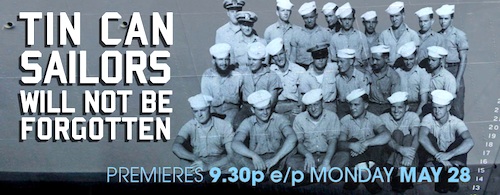 Tin Can Sailors tells the extraordinary World War II story of the USS Morris, a Sims Class destroyer that saw action from the North Atlantic all the way to the island-hopping campaigns against Imperial Japan. The Morris participated in a seemingly endless number of decisive battles during the war, including in the Battle of Coral Sea, the Guadalcanal campaign, the fighting around Leyte Gulf – and was nearly sunk by a kamikaze at Okinawa. For her efforts, the Morris received 15 battle stars for her action in World War II, placing her among the highest decorated American ships of the Second World War.