A promising new teaser trailer is out for In Time director Andrew Niccol’s adaption of Stephenie Meyer’s alien invasion novel The Host, so check that out. Apparently alien-possessed people all have blue eyes. Who knew?
Plus, in seemingly related news, Obama-Hope poster artist Shepard Fairey apparently wants to produce a new adaptation of George Orwell’s 1984 with Brian Grazer and Ron Howard’s Imagine Entertainment. The irony of Fairey’s participation in such a project is apparently lost on Grazer and Howard … or is it?
Posted on March 23rd, 2012 at 12:13pm.
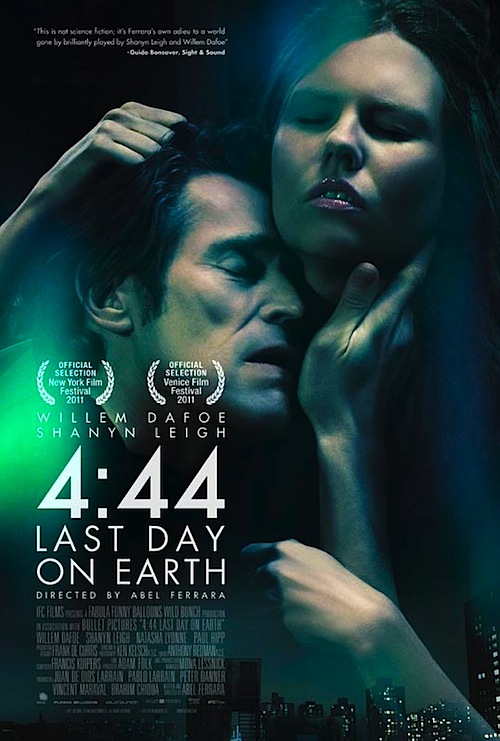
By Joe Bendel. Abel Ferrara is determined to vindicate Al Gore. He will have to destroy the world to do it, but surely that is a small price to pay. Armageddon indeed comes to the Lower East Side in Ferrara’s 4:44 Last Day on Earth, which opens today in New York at the IFC Center.
The details are vague (for obvious reasons), but we are told Gore was more right than even he knew. Global warming has become so severe, all life will end at 4:44am in some sort of great microwaving, but of course women and children will be hit the hardest (?). At least it’s not daylight savings, because it would be a real bummer to lose an hour tonight. Cisco and his girlfriend Skye will spend their final hours together, as New York prepare for the end.
Frankly, Ferrara’s set up is surprisingly effective. During the first half hour or so, New Yorkers will be reminded of the empathic solidarity that swept over the City on 9-11 and to a lesser extent during the blackout. He really creates a convincing sense of what it would be like to knowingly experience the apocalypse in New York.
As the day progresses, Cisco and Skye frequently make love in between her creative bursts of painting, which is perfectly appropriate given the dramatic context. However, viewers will start to wonder where Ferrara is taking it all. Frankly, nowhere.
Essentially, 4:44 shows us scene after scene of Cisco puttering about his apartment, wrestling with the mother of all existential crises. Late in the day, Ferrara makes a half-hearted attempt to gin up some phony drama, but it quickly subsides. We also get one cheesy montage before its Hasta time.
During the long stretches of Wilem Dafoe gamely channeling his inner Ferrara as Cisco, we hear intrusive excerpts from an old Gore appearance on Charlie Rose and several streaming lessons from the Dalai Lama and other Buddhist teachers. It is as if the secular faith of environmentalism is battling Buddhism for the soul of the apartment. Considering how clumsily Ferrara tilts the playing field in favor of the former, most viewers will want to throw their lot in with His Holiness.
Strangely, despite the Dalai Lama’s archival appearance, 4:44 is largely unconcerned with the religious ramifications of the end of the world. Indeed, it never speculates on the implications for the cycle of reincarnation so important to the Buddhism, but viewers might as their attentions start to wander. In another piece of good local color, 4:44 also shows the final broadcasts of NY1 anchor Pat Kiernan. He might not be particularly well known outside New York City, but that’s okay, considering ninety-nine percent of the film’s audience will come from a handful of Brooklyn and lower Manhattan neighborhoods.
As you would expect from such a quintessentially New York filmmaker, Ferrara nails the City vibe, but that’s about all 4:44 has. Quite skippable in theaters, it might be worth sampling the first twenty minutes on cable eventually, but don’t make any special effort. For Ferrara’s die-hard fans, it opens today (3/23) at the IFC Center.
Northern California film enthusiasts take note: you’ve got a great weekend ahead of you. Starting this Friday at the magnificent Art Deco Paramount Theatre in Oakland, Abel Gance’s legendary silent masterpiece Napoleon will be screening in its newly restored form. The film’s four performances (March 24th, 25th, 31st and April 1st) will mark the American premieres of both the complete 5 1/2 hour Photoplay-BFI restoration by Academy Award-winner Kevin Brownlow and the film’s new, monumental orchestral score by Carl Davis – who will conduct the 46-piece Oakland East Bay Symphony live.
One of the most innovative and epic films of all time, Napoleon will be presented with its original 3-screen ‘Polyvision’ climax, with the screen dramatically expanding to three times its width (for the film’s finale, two custom-built screens will flank the Paramount’s normal screen).
This screening represents the first performance in 30 years of Napoleon with orchestra and Polyvision. No screenings are being planned for any other city and there are currently no plans for DVD, BluRay, streaming, or television. (Why? One is tempted to ask …) In any case, tickets for the live performances can be purchased here. To read more about the film’s restoration and the screening, see The New York Times.
In other Bay Area cinema news, starting tonight (3/22) and running through Sunday (3/25) the Disposable Film Festival will be taking place in San Francisco. One of the most refreshing and unpretentious film festivals around, the Disposable Film Festival was founded in 2007 by Eric Slatkin and Carlton Evans to celebrate the creative potential of ‘disposable’ video: i.e., short films made on everyday equipment like cell phones, pocket cameras, and other inexpensive video capture devices.
The Disposable Film Festival, which represents a real breakthrough in the democratization of both filmmaking and film festivals, kicks off in San Francisco this weekend before traveling to cities around the world. Make sure to check it out, and tickets for the festival are available here. You can also check out what The Wall Street Journal says about the fest, and read founder Carlton Evans’ recent, fascinating post about disposable filmmaking at The Huffington Post.
A new trailer is out for the film For Greater Glory, about the Cristero War (or ‘Cristiada’) of 1926 to 1929, which was an uprising against Mexico’s then-Marxist government. For Greater Glory opens June 1st, with a cast featuring Andy Garcia, Eva Longoria, Peter O’Toole, Oscar Isaac, Ruben Blades and Bruce Greenwood.
By Joe Bendel. It is a time in Algiers when Jews and Muslims lived together harmoniously. It is also an animated fantasy with a talking cat. Nonetheless, there is a distinctive mix of gentle nostalgia and broad comedy in Joann Sfar & Antoine Delesvaux’s The Rabbi’s Cat, which screens as part of the 2012 New Directors/New Films.
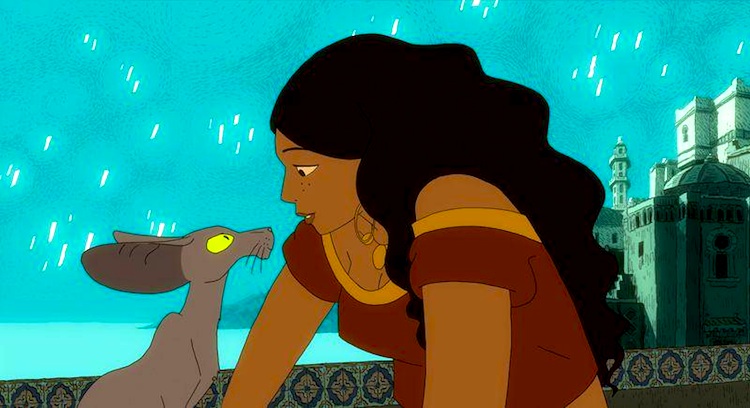
The time is the early 1920’s, after the Russian Revolution, but before World War II. We know this because Rabbi Sfar regularly gets shipments of Russian Rabbinical texts sent to him for safekeeping from the Bolsheviks. He has a cat with no name, known only as “le chat du rabbin.” While his identity comes from the Rabbi, it is the Rabbi’s voluptuous daughter Zlabya whom the cat loves best. However, the Rabbi temporarily forbids the cat to see his mistress when the cat mysteriously begins talking one day.
Actually, the talking thing comes and goes, to the Rabbi’s befuddlement. He will have even more to puzzle out when through a turn of magical realism, a Russian refugee is found alive and well in his latest cargo from the Soviet Union. Of course, nobody can understand his Russian, except the cat, who inconveniently is currently amid one of his speechless stretches.
From "The Rabbi's Cat."
There are enough Jewish identity jokes in Cat to fill Billy Crystal’s next Catskills set. Yet, there is also something seductively exotic about this cat’s eye view of Algiers. Sfar and Delesvaux earnestly want to present a picture of interfaith tranquility, perfectly represented by the Rabbi and his Sufi cousin, Sheik Mohammad Sfar, two branches of the same but diverse family. They even skewer the unrehabilitated and pre-Spielbergized Tintin in one rather random scene. Yet, they do not completely burry their heads in the Kumbaya sand, depicting the touchy intolerance of an Islamist Bedouin clan, whose hospitality quickly becomes somewhat precarious for the inclusively motley Sfar expedition.
Considering Cat adapts non-sequential volumes of Sfar’s popular graphic novel series, it is hardly surprising the narrative jumps around quite a bit. In an odd way, though, that hop-scotching gives the film its energy. Those looking for something to offend them will probably find it here, but Cat is mostly just harmless fun. Though a bit spicy at times, it is probably okay for older kids, but parents should probably decide on a case by case basis.
Evocatively rendered, Cat’s animation captures the spirit of the original comic art, while conveying the allure of the Middle Eastern locales. It also represents a bit of festival history, holding the distinction of being ND/NF’s first 3D selection and their first screening deliberately intended for family viewing. Recommended for animation fans, particularly admirers of Sfar’s work, and kids who can handle subtitles and more advanced thematic material (but still enjoy talking animals), The Rabbi’s Cat screens this Sunday (3/25) at MoMA and the following Tuesday (3/27) as ND/NF continues at both venues.