Sundance 2012: LFM Reviews The Conquerors

By Joe Bendel. They are sort of like the Swiss Family Robinson, except more archetypal. They also must learn to share their bizarre new world with fantastical insectoid creatures in Tibor Banoczki & Sarolta Szabo’s unusually ambitious, genre-defying animated short film The Conquerors, which screens during this year’s Sundance Film Festival in Park City.

Amidst a roiling sea, a man and a woman become castaways on a forbidding island. Since she is pregnant, their situation is particularly dire. Yet, after some initial days of hunger, the man learns how to tame the smaller beetle-like creatures and hunt the larger ones. The woman safely delivers her baby and several more follow. Eventually, their family becomes a small community. For the most part, they live in harmony with their macabre environment, but danger is ever present. Then outsiders arrive and everything changes.

Rendered in a distinctive photorealistic style of animation, Conquerors has a striking look truly unique unto itself. Its evocative black-and-white images suggest the influence of both German expressionism and 1930’s adventure serials in equal measure, while the strange world owes more to the surrealists. Yet, in terms of tone, its closest comparison might be René Laloux’s Fantastic Planet, for its bold use of Biblical motifs and brutally naturalistic representation of the rule of the jungle.

Conquerors screens as part of the short program in Sundance’s New Frontiers track, which is sort of a catch-all for work that is experimental or tech-driven. While its animation might be cutting edge, it is still perfectly accessible from a narrative standpoint. In fact, Banoczki and Szabo tell quite an epic tale in an economic twelve minutes.

So richly detailed and loaded with allegorical significance, Conquerors is definitely the sort of film that rewards multiple viewings. Visually, it is absolutely absorbing, even when depicting unsettling events. A co-production of the National Film Board of Canada, it would be a highlight of most any short film program. Highly recommended, it screens during the 2012 Sundance Film Festival’s New Frontiers shorts block this coming Monday (1/23), Wednesday (1/25), and next Saturday (1/28) in Park City and this coming Tuesday (1/24) in Salt Lake.

Posted on January 21st, 2012 at 10:04am.
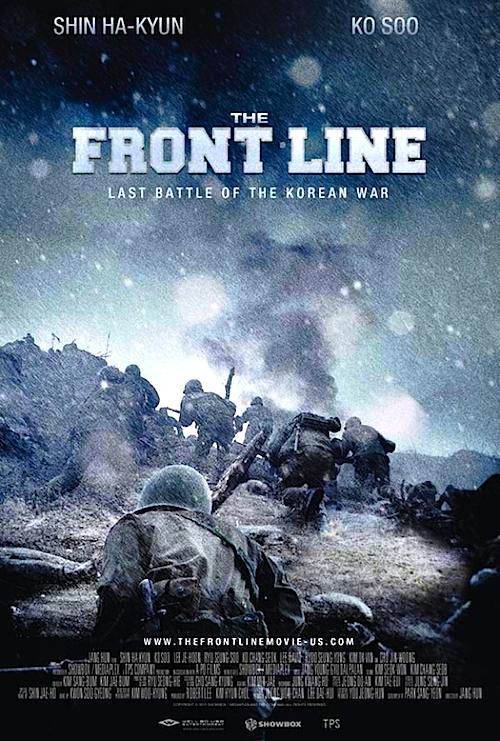
Submitted to the Oscars by South Korea: LFM Reviews The Front Line

By Joe Bendel. When a South Korean officer is killed with one of his troops’ weapons, someone has to investigate. It is also a convenient way to move a trouble-making lieutenant out of the way. Indeed, war is brutal, messy, and soul-deadening in Jang Hun’s The Front Line, Korea’s official best foreign language Oscar submission, which opens this Friday in New York.

A vocal critic of the drawn-out peace negotiating process, Kang Eun-pyo is assigned to investigate irregularities reported within the “Alligator Company” dug-in around the pedestrian looking but strategically prized Aero.K hill. In addition to the suspicious death of a despised commander, several letters from North Korean soldiers have been posted to family members in the south by someone in the company. A mole is suspected.

However, when Kang arrives, he discovers the situation is murkier than that. There has been a form of communication flowing between the two sides, but it is born of survivors’ fellowship rather than espionage. Still, he maintains suspicions regarding Kim Su-hyeok, a comrade from the early days of the war long presumed to be a POW, but evidently serving as the Company’s lieutenant.

Over the course of the film, Alligator Company will take, lose, and regain the fateful hill over and over again. It would get somewhat repetitive if not for the intense warfighting scenes, rendered by Jang in a take-no-prisoners style. Line’s sense of place is so strong, audiences will feel they know every inch of that crummy nub of a hill.

Do not get too attached to any characters in Line. Jang will call up their numbers at the most arbitrary of times, as befits the nature of war. Nonetheless, there are many strongly delineated characters. In fact, the self-medicating Captain Shin Il-yeong and the darkly brooding Lt. Kim, memorably played by Lee Je-hoon and Ko Soo respectively, clearly bear the spiritual scars of war. As the film’s only substantial female character, Kim Ok-bin also hints at a host of inner conflicts as the soon-to-be not so mysterious woman often seen foraging near the battlefield.

Like Jang’s previous film Secret Reunion (which screens February 15th in New York as part of the Korean Cultural Service’s regular cinema showcase), Line not very subtly advocates for reunification, arguing that divisions are merely an arbitrary matter of hills and parallels. Of course, it ignores the grim reality of the DPRK, in which famine is commonplace and the gulags are so extensive that they are the only features of the country that can be seen from space. While the soldiers could easily lose sight of it in the carnage surrounding Aero.K, there were indeed real stakes and consequences to the war. Whether it was also prosecuted competently, is an entirely fair and separate question.

Regardless, Jang masterly stages some of the most realistic, decidedly unheroic battle scenes viewers will see at the theater this year. It is a powerful, draining statement, recommended for connoisseurs of war movies, including the anti-war variety. Line opens this Friday (1/20) in New York at the AMC Empire and in the Bay Area at the AMC Cupertino.

Posted on January 19th, 2012 at 9:04am.

New York Jewish Film Festival 2012: Remembrance

By Joe Bendel. The unfettered flow of information is a powerful thing. During the final days of WWII, Tomasz Limanowski smuggled shocking photographic evidence out of a Nazi concentration camp in Poland. Thirty-some years later, his former lover is shocked to discover he is still alive, thanks to a BBC interview. Based on historical events, their incredible story of love and survival is told in Anna Justice’s Remembrance, which screens at the upcoming 2012 New York Jewish Film Festival.

Limanowski is not Jewish, but the resistance fighter is quite resourceful, which makes him a natural scrounger in the camp. He is thought to stand the best chance of breaking out and rendezvousing with the Polish Homeland Army with his comrades’ negatives. However, his decision to bring Hannah Silberstein with him complicates their plans. She is Jewish, speaks German, and is very sick. In fact, unbeknownst to Limanowski, she is pregnant.

Somehow, Limanowski and Silberstein manage to escape (in a markedly well shot and edited sequence), but with her health failing, they are forced to take refuge at his former estate. Of course, it has been confiscated by the National Socialists, but his mother Stefania now lives in a servant’s cottage and Limanowski’s resistance colleague Janusz still tends to the stables. Unfortunately, his mother’s anti-Semitism comes as a rude surprise to her son. It will also be the cause of much future grief when the couple must separate.

Decades later, both lovers assume the other is dead. Silberstein is now Hannah Levine, married to a perfectly nice research doctor in Brooklyn. When she happens to see Limanowski’s British interview on her dry cleaner’s television, it all comes flooding back, inconveniently during an important dinner party.

Alice Dwyer as Hanna Silberstein.

In a way, Remembrance shares a kinship with Sophie’s Choice, but it is a more forgiving, life affirming film. Levine née Silberstein suffers acute survivor’s guilt that viewers can well understand and easily pardon. Indeed, her complicated but loving relationship with her husband is just as important to the film’s dramatic structure.

The inherent decency of its three principles (this obviously does not include mother Limanowski) is what makes Remembrance such a touching film. It vividly portrays the personal consequences of two successive totalitarian ideologies that conspire to keep the star-crossed lovers apart. In addition to the horrors of the concentration camp, Justice also forthrightly depicts the terror of the post-war Communist regime. Years later, its attempts to excise the Homeland Army from the history books fittingly dovetails with the film’s themes of memory and documentation.

As young Limanowski, Mateusz Damiecki is viscerally intense and totally credibly as the scholarly-looking action hero. Alice Dwyer is also quite compelling depicting the young Silberstein’s drive to survive. Yet, there is something unusually honest and real about Dagmar Manzel and David Rasche’s scenes together as Hannah and Daniel Levine. (Though the Sledgehammer! star still apparently works round the clock in television, Rasche has also appeared in a handful of interesting international films recently – Remembrance being the most notable.)

Pam Katz’s literate screenplay (co-written with the perfectly named Justice) features one of the most moving letters ever heard on film via disembodied narration. Never ginning up phony drama, the sensitively rendered Remembrance consistently rings true. It is one of the best Holocaust-themed features in recent years, considerably superior to Sarah’s Key, Protektor, and Berlin ’36. Highly recommended, it screens this coming Monday (1/16) and Tuesday (1/17) at the Walter Reade Theater as part of the 2012 New York Jewish Film Festival.

Posted on January 10th, 2011 7:55pm.

YouTube Jukebox: Flamenco

By David Ross. The dynamics of rock and its offshoots are very strange. Young men make a ruckus and recede into burnt-out abeyance or empty iconicity. Why should this be? The law of diminishing returns does not especially apply to painting, poetry, or fiction. Milton began Paradise Lost at age fifty. Yeats did not begin to write his greatest poetry until roughly the same age. Yeats’ late poem “An Acre of Grass” indicates his geriatric ferocity:

Grant me an old man’s frenzy,
Myself must I remake
Till I am Timon and Lear….

Why do bluesmen deepen and roughen and come to perfection, while rockers become parodies of themselves? Drugs take their toll, I’m sure. It may also be that rockers’ aesthetic aspirations merely euphemize the deeper lust for fame and fortune, upon achievement of which the creative apparatus begins to shut down.

Flamenco’s great guitarists shame the oligarchs of rock. These liver-spotted old men play with immense pride and passion, confirming what Hemingway says in Death in the Afternoon, his treatise on Spanish bullfighting: “In Spain honor is a very real thing. Called pundonor, it means honor, probity, courage, self-respect and pride in one word. . . . Honor to a Spaniard, no matter how dishonest, is as real a thing as water, wine, or olive oil.” The Spanish flamenco guitarists of the previous generations were full of honor in this sense. Like the great toreador Maera, they “gave emotion always” as a matter of their own arrogant mastery. Can we say the same of any member of the Rock and Roll Hall of Fame?

Sabicas (b. 1912) is my ideal; so too Carlos Montoya (b. 1903), despite occasional errant notes (for Sabicas, see above; for Montoya, here and here). They represent precisely the “old man’s frenzy” that Yeats has in mind. Coincidentally or not, both were of Romani origin.

The great Flamenco guitarists of the younger generation – Paco Pena (b. 1942), Pepe Romero (b. 1944), Paco De Lucia (b. 1947) – are astonishingly virtuosic, but cooler and more clinical, less evocative of old Spain as I imagine it. Fair or not, I see conservatory practice rooms instead of sun-baked streets, dusty markets, girls parading in the evening. What’s lacking is swagger, sensuality, the manly disregard that purifies Maera in Hemingway’s telling:

He was driving and the bull was driving and the sword buckled nearly double and then shot up into the air. As it buckled it dislocated his wrist. He picked the sword up in his left hand and carried it over to the barrera and with his left hand pulled out a new sword from the leather sheath his sword handler offered him.
“And the wrist?” the sword handler asked.
“F*k the wrist,” Maera said.

Posted on January 10th, 2012 at 7:54pm.

The Man in the Hood: LFM Reviews El Sicario, Room 164

By Joe Bendel. Don’t ask who that masked man is. You don’t want to know. In 2009, a ‘sicario’ (a professional killer working for the Mexican drug cartels) gave an in-depth interview to Charles Bowden for a revealing Harper’s article. Despite the cartel’s $250,000 bounty, he subsequently consented to a lengthy on-camera interview with Bowden’s filmmaker colleague Gianfranco Rosi, who shaped his pseudo-confession into the documentary El Sicario, Room 164 (trailer below), now playing in New York at Film Forum.

Rosi and Bowden are deliberately sketchy about the details, but the film was shot in a border town hotel room (number 164), where the masked sicario once held and tortured someone who owed money to his cartel. Eventually, he turned the battered man over to another team of sicarios. While he does not know his victim’s ultimate fate, he knowledgeably assumes a grisly end. Though this disturbing information seems to lend considerable significance to the location, it quickly becomes apparent the sicario has done such crimes innumerable times before in similar motels and so-called “safe houses” on either side of the border.

The sicario might very well be embellishing a host of individual details, but the broad strokes he sketches out ring chillingly true. Like a talented young baseball player, the sicario was recruited by his cartel at a young age. After serving a drug-running apprenticeship, the cartel greased his way into the police academy. Yes, the killer is also a copper. He estimates about a quarter of the graduates of all Mexico’s law enforcement academies are cartel plants. Not surprisingly, the free access to squad cars greatly simplifies the kidnapping process.

164 is all kinds of scary. Frankly, it makes it pretty clear narco-terrorist warlords have taken over the country. This is not happening in remote Afghanistan, but along our southern border. It is also evident the current administration is not capable of thinking sufficiently strategically over the long term to combat them in any meaningful way. Sending them a bunch of free guns as part of Operation Fast & Furious just is not going to do it. Continue reading The Man in the Hood: LFM Reviews El Sicario, Room 164

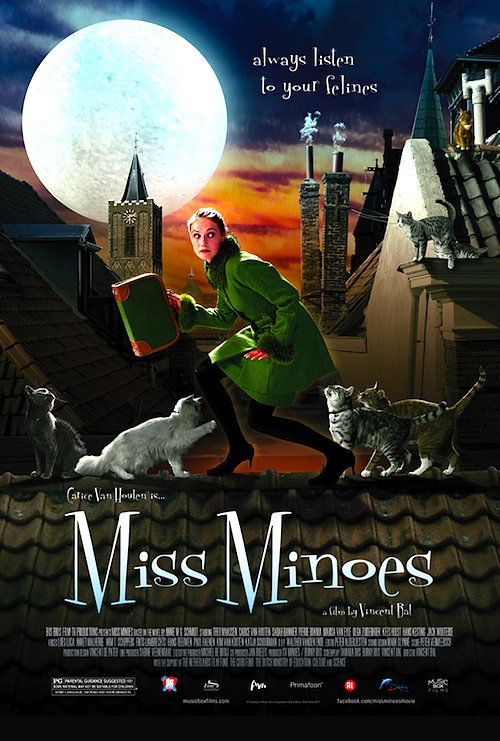
The Dutch Cat Woman: LFM Reviews Miss Minoes

By Joe Bendel. Do not call Miss Minoes catty. The proper term is feline. She should know what passes for political correctness amongst the cat population. She used to be one. Indeed, she has a difficult time acclimating to the human world in Vincent Bal’s Miss Minoes (trailer above), which opened Friday in New York.

After an unfortunate accident involving a mysterious barrel of chemicals from the local deodorant factory, Miss Minoes suddenly transforms into a human. However, she retains many of her feline characteristics, including a taste for fish, the fear of dogs, and an ability to caterwaul. Though some of her former friends now shun her, she can still communicate with the cats of Killendoorn, whom she uses as a network of informers for Tibbe, the incompetent journalist temporarily sheltering her. Naturally, newsmakers do not think twice about talking in front of cats. They are commonplace in this quaint little town and frankly rather disposable.

For a while, Tibbe becomes top dog at the paper. Unfortunately, when Miss Minoes and her feline associates goad him into writing an unsourced attack on the deodorant factory owner (a secret animal hater) he becomes the Mikael Blomkvist of Killendoorn. Still, a philanthropic industrialist will surely be no match for a woman with the mentality of a house cat and the eight year old girl living below Tibbe.

Without question, Carice van Houten’s work as Miss Minoes is quite a pleasant surprise. Her twitchy, cat-like mannerisms and wide-eyed naivety are rather disarmingly winning. Though an international star, she is clearly not afraid to look silly, which is cool. On the other hand, Theo Maassen’s Tibbe is just a big lunkhead. He might be somewhat “likable,” but it is hard to invest in a character that is dumber than the animals around him.

Yet the biggest problem with the film is the standard issue villain, Mr. Ellemeet of the DEO factory (broadly but flatly played by Pierre Bokma). Frankly, the nefarious businessman-slash-hypocritical fussbudget is such a cliché even the cats in the film seem bored with him. It really is a shame, because his subplots are so rote and uninspired, they weigh the film down like an albatross around its neck.

Indeed, there are some nice elements to be found in Miss Minoes, including an appealingly eccentric lead turn from van Houten. Cinematographer Walther Vanden Ende’s warm lighting and autumnal color palette are also quite inviting. They just get no help whatsoever from the inert, paint-by-numbers screenplay, based on Annie M.G. Schmidt’s Dutch children’s book. For cat loving little girls, it is probably still quite engaging, but parents should be warned, there is some mild, dubbed cursing. Cineastes should also beware, the dubbing is considerably below current anime standards. Mostly harmless and occasionally charming, despite trafficking in the worst class-based stereotypes, Miss Minoes opened Friday in New York at the Cinema Village and the Elinor Bunim Munroe Film Center.

Posted on December 27th, 2011 at 7:43pm.