Tibetan Buddhism in a Business Suit: LFM Reviews Crazy Wisdom

By Joe Bendel. Chogyam Trungpa, Rinpoche was a Tibetan Buddhist teacher who embraced the 1960’s counterculture, but could not abide rock & roll. He drank significantly more than he should have, openly and often, but he had no use for drugs. A former monk, Trungpa renounced his robes, developing ways to teach Tibetan Buddhism in the western vernacular. A study in paradoxes, Trungpa’s all too brief life avoided cliché, making him a rich documentary subject in Johanna Demetrakas’ Crazy Wisdom: the Life and Times of Chogyam Trungpa, Rinpoche, which opens this Friday in New York at the Rubin Museum of Art.
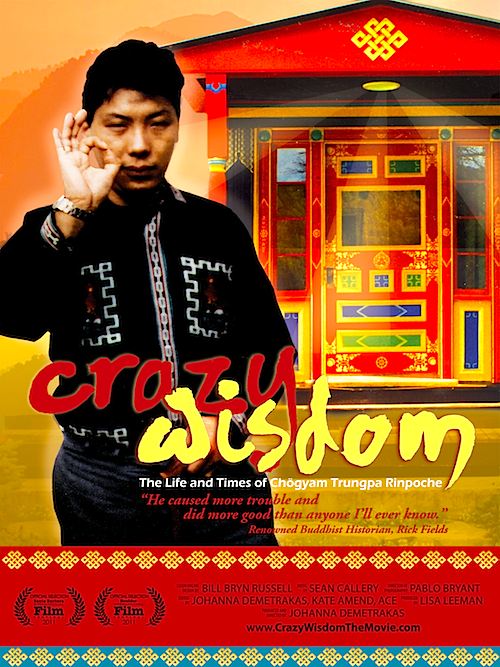
A recognized reincarnation, Trungpa was the last of his generation to be entirely educated in Tibet. After the Chinese Communists invaded in 1959, he took a leading role securing the teachings and documents of his faith, personally guiding a group of his fellow monks to safety in India. Living in exile, Trungpa chose to embrace the west, trading his robes for a business suit. It was the start of a transformation that was decidedly controversial with his elders.

Living in Scotland, Trungpa married a young British woman and began teaching Tibetan Buddhism to hippies. For obvious reasons, they were attracted to his “crazy wisdom,” a recognized approach to enlightenment celebrating the eccentric and unconventional, sort of the rough Tibetan Buddhist analog to drunken master martial arts. However, Trungpa liked to keep people guessing.

As one of his students recalls, at the height of the anti-war movement, Trungpa was once asked to comment about aggression in America, to which he replied: “I want to talk about the aggression in this room.” Ouch. He was also evidently a stickler for the Queen’s English, perhaps giving scores of hippies their first elocution lessons. However, the greatest irony must have been the Dorje Kasung, the military drill team he established at Naropa University, the American Buddhist school Trungpa founded in Boulder, Colorado. Continue reading Tibetan Buddhism in a Business Suit: LFM Reviews Crazy Wisdom

YouTube Jukebox: The Legacy of Bert Jansch

By David Ross. Bert Jansch, storied fingerpicker and warble-voiced bard of the British folk movement, died last month at age 67. He achieved quiet glory as a guitar stylist and as guiding light of the folk group Pentangle, in which he was paired with equally legendary guitarist John Renbourn.

Above, Jansch performs “Moonshine,” a lovely tune of his own composition, circa 1975. Here Pentangle performs in the lush first flush of its jazzy, bluesy thirteenth-century folk rock. Jansch is seated to the right, the bearded Renbourn to the left. Jacqui McShee could not sound or look more the part of the British folk chanteuse. Her pale, somber, chinless face is a lovely study in the art of the church altarpiece, lacking only a halo and a swaddled Christ.

Jansch’s influence on Jimmy Page’s acoustic style is unquestionable. Page’s “Black Mountain Side” from Led Zeppelin I is a note-for-note nicking of Jansch’s “Blackwaterside” (here), which appeared on his 1966 album Jack Orion. Jansch was miffed enough to consider suing Page, but he could not afford a legal crusade on a folk guitarist’s salary and let the matter drop. One can easily construe Tolkienian epics like “Stairway to Heaven” and “The Battle of Evermore” (featuring Jansch’s old protégé Sandy Denny) as grand bastardizations of Jansch’s antiquarian interests. Admittedly, Page is the more gifted musician. In this clip, he transforms “Black Mountain Side” into a frenzied druidic raga, achieving an intensity that was well beyond Jansch and Renbourn.
Jansch’s complex, open-tuned stylings equally influenced Nick Drake, the Keats of British folk, in whom the movement’s decade of research and experiment became something new and consummate. As far as I know, there is no extant footage of Drake performing live, but a tune like “Cello Song” (here) gives the feel of his exquisite little nocturnes.

To have schooled both Jimmy Page and Nick Drake is to have helped midwife the music of the twentieth century. I hope that Jansch, his work done, rests where he belongs, in some old churchyard, amid the moss and weathered stone.

Posted on November 23rd, 2011 at 11:31am.

LFM Review: Garbo the Spy

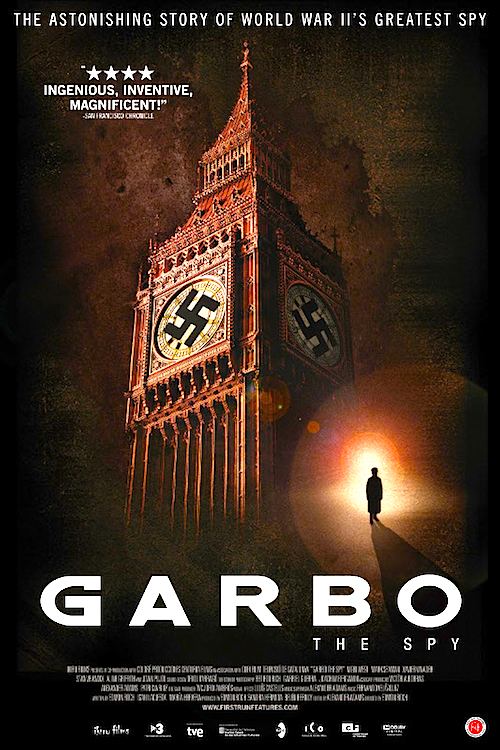
By Joe Bendel. Juan Pujol was the all-time greatest writer of spy fiction, but he wrote for a very select audience: German intelligence. Supposedly based in England, the Spanish double agent wrote incredibly verbose reports to his unsuspecting German handlers, riddled with disinformation and imaginary sub-agents, but it all boiled down to one word: Calais. Misdirecting the National Socialist war machine was the intrigue of a lifetime in Pujol’s life of intrigue, idiosyncratically documented in Edmon Roch’s Garbo the Spy (trailer above), which opens this Friday in New York.

The Germans knew him as Alaric, but the British code-named him Garbo. A deserter during the Spanish Civil War, Pujol’s story is so unlikely it would be difficult to believe without documentation. In fact, MI-5 did not believe him when the unprepossessing man came cold-calling. Rebuffed but undeterred, Pujol next approached the Germans, who immediately recruited him as an agent.

Pujol fed the Germans a steady diet of information largely culled from old newspapers that nonetheless built up his controllers’ trust. Eventually, after several further overtures, the British realized Pujol was legit and began directing his work. While he passed along a great deal of misleading intel, his most important assignment was Operation Fortitude, a concerted campaign to convince the Germans the D-Day invasion would land at Calais rather than Normandy.

Eventually, the war ends satisfactorily for Pujol. A bit of time passes, he disappears, and at some point is reported dead. Obviously though, there will be more to the master of the deception’s story. Military historian Nigel West (and former conservative MP under his given name, Rupert Allason) would tell the full tale when he literally wrote the book on Pujol, finally giving the remarkable spy his proper due.

Roch’s film is incredibly cinematic, employing extensive archival footage and clips from vintage war and espionage films as illustrative devices. In fact, the video sampling strategy often threatens to overwhelm the deadly serious subject matter, giving Garbo a vibe somewhat akin to a Jay Rosenblatt short film collage. Frankly, it occasionally borders on the inappropriately ironic. Still, the substance of Pujol’s story consistently rises above any stylistic excesses.

Garbo the film also boasts a relatively small but highly specialized cast of interview subjects, including West (as he is billed) and Aline Griffith, Countess of Romanones, a contemporary of Pujol’s working clandestinely for the OSS. Everything they have to say is quite noteworthy. It also interviews members from both of Pujol’s families, neither of whom knew of the other until West discovered his fate.

There is no question Pujol saved many Allied lives. Perhaps hundreds of thousands of servicemen survived the European theater because the Germans were dug in at Calais. The strange details and anecdotes surrounding Operation Fortitude by themselves are well worth the price of admission. Totally fascinating history, briskly if somewhat distractingly rendered on-screen by Roch, Garbo is definitely worth seeing, particularly for history buffs and espionage junkies, when it opens today (11/18) in New York at the Quad Cinema.

Posted on November 18th, 2011 at 3:52pm.

Friday Special: LFM Guest Review of “#Occupy Cinema Untitled 1”

By Jason Apuzzo. It appears that we may have a new film movement afoot, inspired by the Occupy Wall Street protests: “Occupy Cinema.” For the moment this movement seems to be situated around just a few sites: Cine Foundation International, Occupy Cinema and Cinemas In Solidarity. However, I sense a trend growing – a filmic uprising that may change the cinema as we know it.

Or not.

A movement in the making?

I recently watched two of the film offerings at Cine Foundation International, and decided to embed their latest – a short film titled “#Occupy Cinema Untitled 1” – above, for LFM readers’ consideration. Frankly, I wasn’t quite sure what to make of the film, so I decided to email my old colleague, Professor Jacques de Molay, Professor of Cinema & Neurosemiotics at the University of Northern California. I was very eager to seek out Jacques’ opinion about the film – as he’s always had a better feel for radical, transgressive cinema than I do.

As regular Libertas readers know, Jacques is a widely recognized Marxist intellectual, and last appeared on our site here to provide a guest review of Piranha 3D, which he liked very much – interpreting the film as a subversive parable on ‘consumerism.’ As Jacques put it at the time, reviewing Piranha: “after the Wall Street collapse, commerce in today’s capitalist society can only end in bloody apocalypse – a farrago of bikini tops, chewed limbs … and shattered ideals.”

With this in mind, I asked Jacques what he thought of the film above. He emailed me this reply, from his vacation home in St. Bart’s: Continue reading Friday Special: LFM Guest Review of “#Occupy Cinema Untitled 1”

YouTube Jukebox: The Who

By David Ross.The Beatles were uncanny craftsmen, but their music interests me almost not at all these days. I listen to a Beatles album once every few years. I invariably feel awed, bored, and irritated. The irritating part is the self-importance of the whole shtick (this self-importance later became fully obnoxious in John Lennon’s insufferable “Imagine”). Nobody can deny that the Beatles were peerless in their ability to craft albums, but the music itself, for all its endless melodic invention and vast tonal spectrum, so often seems hollow. The long suite that ends Abbey Road is at once the most amazing feat in the history of rock and the most abstract and elaborately empty.  In the end, the Beatles’ preeminence is a Baby Boomer phenomenon. I don’t believe it will entirely survive the transition to a post-Boomer culture.

On the other hand, I never tire of the Who. I love to feel the whiplash of their sonic overdrive: the skittering cannonade of the drums, the waves of guitar thunder, the endless frisky invention of Entwistle’s bass. In terms of instrumental prowess and cohesion, the Who far exceed the Beatles, the Rolling Stones, and even Led Zeppelin. The band’s defining idiosyncrasy – in many ways the secret of its success – was the unique reversal of the guitar and bass parts. So often Townsend establishes the rhythm or adds tonal effects while Entwistle carries the melodic burden. Watching the Who play live, one realizes that what sound like guitar parts – power chords, dashing melodic runs – are actually bass parts. The primacy of the bass gives the Who’s music such underlying movement and momentum. The most dynamic aspect of the music is buried deep in the tonal structure and speaks to some primal lobe of the brain, the part that remembers the pulse of the womb. Jimi Hendrix was the greatest rock instrumentalist of all time, but Entwistle may be in his quiet way the second greatest.

Above, the Who perform a kaleidoscopic mini-suite as part of the Rolling Stones’ Rock and Roll Circus, a 1968 made-for-TV extravaganza that also featured John Lennon, Eric Clapton, and Jethro Tull. The Stones sat on the footage until 1996, allegedly because the Who so utterly upstaged them. We now know how long it takes the wounded rock star ego to convalesce: 28 years.

Equally magnitudinous is the Who’s performance at Woodstock (see here), which somehow manages to dwarf the audience of 500,000. The Woodstock version of the “See Me, Feel Me” sequence from Tommy is a career highlight. Rarely has a band been at once so powerful and so soulful. Like no British band before them, they here enter Otis Redding territory.

Posted on November 18th, 2011 at 1:46pm.