By Jason Apuzzo. While we’re on the subject of major figures of the Cold War era (see the J. Edgar review below), a new trailer has just arrived for The Iron Lady, about Margaret Thatcher.
So will this be the hit job many people are fearing, or something more complex and true-to-life? Judge for yourself.
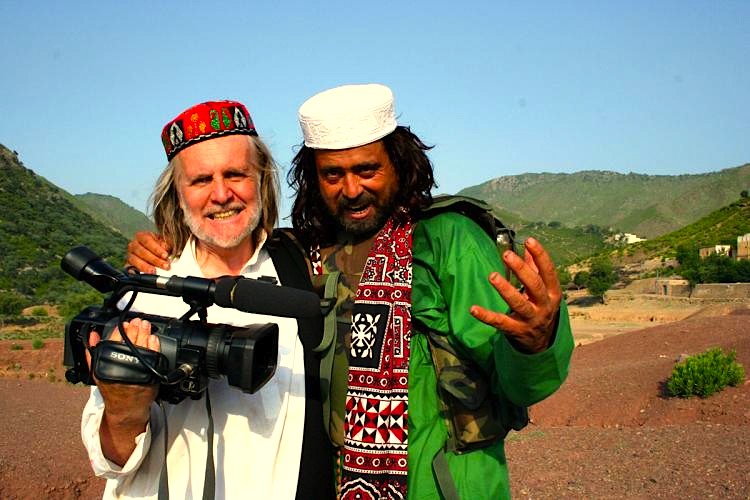
By Joe Bendel. If the Taliban mullahs want to call you something heavy, they will probably label you a “miscreant” (a villainous heretic). Unfortunately, for entertainment-starved Pakistanis, just about everyone involved in artistic endeavors is automatically considered a “miscreant,” most definitely including actors and filmmakers. Ironically though, the cottage Pashto film industry was largely based in the Taliban stronghold of Peshawar, which is where Australian filmmaker-artist George Gittoes took his camera for an up-close and personal look at militant intolerance in The Miscreants of Taliwood (see a 6-minute preview above), which screens during Anthology Film Archives’s upcoming retrospective of Gittoes gonzo-ish filmmaking.
If truth be told, Gittoes was probably fortunate to live through the first thirty seconds of Miscreants. Fortunately, he was only roughed up a bit while filming Islamists building a bonfire of CDs and DVDs in Islamabad, a city that Gittoes reminds viewers contains nuclear weapons. However, as Gittoes pursues his story, he becomes increasingly a part of his own film, at considerably further risk to his own well being.
While it is ordinarily annoying to see filmmakers inject themselves into their own documentaries, Gittoes was hardly motivated by self-aggrandizement. To gain access to the world of Pashto filmmaking, he became an actor himself, forming a fast friendship with his co-star Javed Musazai. When the Taliban terrorized Taliwood into submission, Gittoes financed two films on his own in order to keep the documentary going. Though hardly well-heeled, Gittoes is able to scrape together seven grand, sufficient funds for two Pashto films.
George Gittoes & Javed Musazai in "The Miscreants of Taliwood."
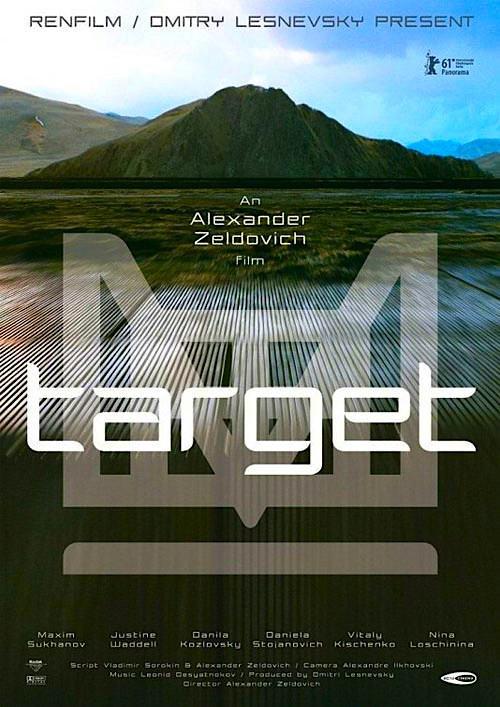
By Joe Bendel. In near future Russia, red signifies good and blue designates evil. Ahem. Russia’s powerful natural resources minister is preoccupied with a device that reveals the good-to-evil ratio of everyone and everything viewed through it. He would like to put this information into practice and he ought to have the time to do so, considering he will more or less live forever. Of course, nothing is quite so simple in Alexander Zeldovich’s science fiction fable The Target (trailer above), which screens during the eleventh annual Russian Film Week in New York.
Somewhere in Nowherestan, there is a colossal abandoned Soviet astrophysics research facility. Built into the ground, it looks like a giant target from the surrounding mountains. The bull’s eye collects not just radiation, but also chi force. Those who spend the night in the focal point will apparently live forever. For a man of privilege like Minister Viktor Chelshchev and his increasingly discontented wife Zoya, it is a trip worth the expense and inconvenience.
With Zoya’s brother Dmitri and his friend Nikolai, a thrill-seeking border enforcement officer, they make the long journey east. They also share their passage with another postmodern pilgrim, who turns out to be the woman of Dmitri’s dreams. Together they spend a fateful night in the Target, which turns out to be everything it was promised to be and then some.
Initially, everyone feels energized, buzzed even. However, it quickly becomes clear the target acts as a karmic steroid shot. Their emotions become rawer and their passions more intense, overriding their empathic affinities. As Zoya and Nikolai launch into an affair, taking the film on a futuristic Anna Karenina detour, Chelshchev boldly announces his intention to screen mines and worksites to avoid evil deposits (for real). How do you think that goes over?
A strange but not implausibly exotic environment, Target initially brings to mind the austere, almost antiseptic near future vibe of classic 1960’s-70’s science fiction films like 2001, World on a Wire, and, dare we say it, Solaris. However, things get rather messy in a hurry. Indeed, Target is a tricky film to get a handle on, because it veers into some trippy territory that has very real narrative consequences. Yet, despite the nature of its themes and motifs, there is nothing New Agey about the film. It is never proscriptive. Rather, it returns to one of the central cautionary principles of speculative fiction: those who would become like gods . . .
As Zoya/Anna, South African born English actress Justine Waddell (who had a smaller supporting role in Bernard Rose’s Anna Karenina) is a brittle, haunting presence, bringing to mind Anouk Aimée and Anna Karina in the films of Fellini and Godard. Likewise, Maxim Sukhanov finds unexpected depths of humanity in Chelshchev, somewhat resembling a Russian Mastroianni. Indeed, Target is better thought of in Nouvelle Vague and surrealist traditions than as genre cinema per se.
From the Russian sci-fi epic "The Target."
Ambitious in scope, cinematographer Alexandre Ilkhovski’s wide vistas of the Target and surrounding mountains are visually arresting. This is definitely big picture filmmaking. Still, in several respects Target is an alarmingly current film, positing a Russia ever more dominated by a resource hungry China. It also depicts the violent cruelty of mobs in no uncertain terms. Even if they are poor, they can still be evil.
In just about every way, Target is an uncompromising film for the ‘top one percent’ rather than a simpleminded rabble. For those who enjoy science fiction at its most challenging, Target is strongly recommended. It screens again tomorrow night (11/1) during Russian Film Week in New York.
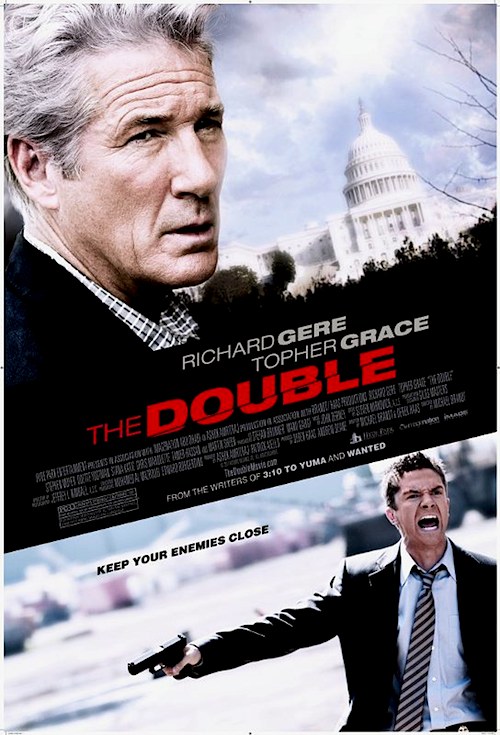
By Joe Bendel. The Cold War is over, technically speaking, but a lot of unfinished business remains. A notorious Soviet assassin is one of those loose ends. Never captured but presumed dead for years, the American intelligence services are slightly concerned when the body of a murdered senator bears the signature techniques of the killer code-named Cassius. Unfortunately, the game is afoot once again for his temporarily retired CIA nemesis in Michael Brandt’s The Double, which opens this Friday in New York.
Paul Shepherdson thought it had all ended with a bang. Cassius’s body was never recovered, but since the killings stopped, closure appeared to be achieved. Years later, the Senate’s leading critic of neo-Soviet Russian aggression is brutally murdered. Pointing to a few variations here and there, Shepherdson insists it is the work of a copycat. However, FBI analyst Ben Geary is certain it is Cassius’s work. He is also something of an expert on the old Soviet bogeyman, having written his master’s thesis on Shepherdson’s investigation. Reluctantly, the CIA veteran agrees to an inter-agency odd-couple pairing with Geary, trying to pour cold water on his enthusiasm every step of the way.
Refreshingly, the Russians and the Soviets before them are the villains in The Double, while the Americans simply scramble to counter their infiltration campaign. (It is a bit of a stretch making the murdered hawkish senator a Democrat and his Russian puppet counterpart a Republican, but if that is the concession that had to be made, so be it.) On the macro political level at least, Double is quite sound and realistic.
Double takes great delight in springing two big twists on the audience, yet inexplicably gives away the first one in the trailer (above). Several more follow, which naturally alter our perceptions of characters a second time. While viewers will be primed for the second switcheroo, Double has some very smart investigative detail that makes the dot-connecting process considerably more engaging than usual.
As Shepherdson, Richard Gere has the right steely, grizzled presence, maintaining a consistent world weary character throughout his character’s revelations. Frankly, Double is his best work in years (maybe since Chicago). Conversely, Topher Grace’s Geary looks like a mere boy among men. Granted, he is a rookie, but he does not even look convincing wearing a suit. His presence is a major albatross weighing down the film. Still, the film has Martin Sheen, suitably commanding as CIA director Tom Highland and True Blood’s Stephen Moyer nicely projects feral cunning as Brutus, the only captured member of Cassius’s team.
In his directorial debut, 3:10 to Yuma co-writer Brandt maintains a decent if not exactly breakneck pace. He has a nice handle on the details, but never delivers a centerpiece action sequence. Still, it is a solid Cold War-reloaded thriller genre fans and Russophobes should enjoy when it opens Friday (10/28) in New York at the AMC Empire and Village 7.
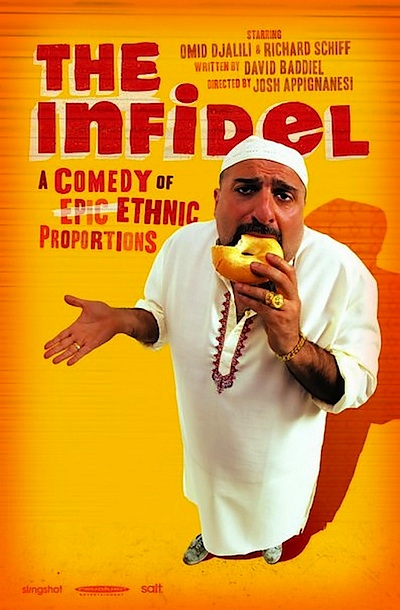
By Govindini Murty. One of the reasons we champion independent film here at Libertas is because of the crucial role it plays in incubating talent. One of the first indie films we talked about when we launched Libertas Film Magazine was The Infidel, a quirky little British comedy that screened at the Tribeca Film Festival in the spring of 2010. The Infidel tells the hilarious story of a middle-aged Muslim man, Mahmud, who finds out that he was actually born Jewish – at the very same time that he also discovers that his son is about to marry into the family of a radical Islamic cleric.
One of the reasons we liked the film so much was because of the lead performance of Omid Djalili, the Iranian-British comic who plays the hapless Mahmud. You can read Jason’s review of The Infidelhere, and you can see a number of Djalili’s hilariously un-PC comedy skits on YouTube. One of my favorite Djalili skits is “Arabs at the airport” (Djalili describes getting freaked out when he sees Arabs at the airport), and I also like his satires of immigrant Iranian life – they remind me of the earthy and very funny ethnic humor of Nia Vardalos’ My Big Fat Greek Wedding. Check out Djalili’s “Iranian in UK,” a satire of Sting’s “Englishman in New York.”
Now Deadline Hollywood reports that NBC is developing a TV series to be based on The Infidel. The series would star Djalili, who would also produce the show with his wife. This seems like a timely idea to me. A comic of Iranian descent succeeding in mainstream American TV while satirizing radical Islamist mores would send a great message to the rest of the world – one that advocates for moderation over extremism in the Muslim community. It would also be a rebuke to the repressive Iranian regime, which, as we’ve documented numerous times here, jails and abuses it own leading filmmakers and film artists in one of the most anti-art dictatorships on earth.
Finally, a TV series based on The Infidel is a good idea because it would also just be funny. I don’t find a lot of today’s comics very amusing, but Djalili is one of the few who seems to have a natural ability to make people laugh based on character and timing – not just gross-out jokes. This is a great thing, whether or not it leads to world peace and understanding. I hope the NBC series stays true to the courageous, un-PC spirit of the original film. I find the Brits are a lot braver in their satire than Americans, and I truly hope that NBC doesn’t water down the comedy of the original Infidel or reverse its message. Check out the trailer for The Infidel above and I think you’ll see why we welcome this becoming a TV series.
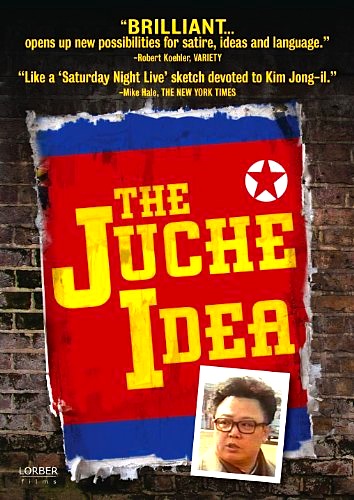
By Joe Bendel. Before Kim Il-sung, mass-murdering megalomania had never been so kitschy. The Kim dynasty’s tyrannous misrule has been marked by imposingly ugly architecture, stilted cinema, and truly bizarre mass “arirang” stadium performances, all of which promoted the so-called Juche Idea, his crypto-Confucian brand of self-isolating socialism. An expatriate leftist South Korean filmmaker takes on the challenge of making Juche propaganda art films for an international audience, when not weeding the vegetable patch of a North Korean arts collective in The Juche Idea (trailer above), Jim Finn’s experimental mockumentary mash-up, now available on DVD.
Before he bravely led the proletariat into the future, the crown prince Kim Jong-il wrote North Korea’s definitive book on film studies. Not surprisingly, he concluded any honest, class conscious film should scrupulously adhere to his father’s Juche Idea concepts. DPRK films tended to be a wee bit formulaic as a result, typically culminating with a tearful self-criticism session and a vow to rededicate one’s self to Communist Party, as Finn illustrates with several clips crying out for the Crow and Tom Servo treatment.
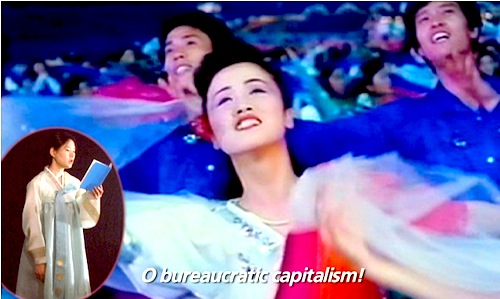
As Yoon Yung Lee, the filmmaker-in-residence, splices together her strange Chuck Workman-like Juche films, the insular nature of the North’s ideology-driven culture becomes inescapably obvious. As soon as any distance is applied to the cheesy visuals and overblown synchronized dance numbers, irony rushes in like air into a vacuum. There is also an unexpected abundance of accordion music to heighten the surreal vibe of it all.
Finn never directly addresses the brutal reality of DPRK concentration camps, intrusive secret police, and widespread famine. As a result, Juche Idea really ought to be seen in conjunction with other North Korean documentaries, like Mads Brügger’s fearlessly subversive Red Chapel, which Lorber Films has also just released on DVD. Unlike the play-it-safe “Yes Men,” Brügger and his colleagues punk a target that wields absolute, unchecked power, on its own turf. You have yet to truly live until you have witnessed a pair of Danish-Korean comedians perform a slapstick rendition of “Wonderwall” for an audience of stone-faced DPRK apparatchik-minders in this mad expose-performance art hybrid.
In contrast, Juche Idea is all about the outrageous over-the-top propaganda serving the Great and Dear Leaders’ personality cults, without any reality-based context. Though it seems hard to miss the joke when a Russian tourist’s loose bowels lead to a lecture on the merits of North Korea’s socialized medicine, some of those protesting downtown might just swallow it whole.
Clearly, Finn is not exactly an underground conservative filmmaker, having also produced the short film Dick Cheney in a Cold, Dark Cell, which should have certainly maintained his standing in the experimental film community. Still, after watching Juche it is clear North Korea is a profoundly scary place, at least by any rational aesthetic standard.
Viewers who missed Brügger’s Chapel in theaters should definitely catch up with it first and then supplement it with Juche’s head-spinning images and sly satire. Though only sixty-two minutes, there are some nice supplements on the DVD, including some deleted scenes, such as a whacked-out Juche comic book given the motion-comic treatment, as well as Finn’s short film Great Man and Cinema, which essentially boils down the essence of Juche Idea to three minutes and forty-nine seconds. Recommended for the ironically-inclined and the propaganda-savvy, Juche Idea and Chapel are easily two of last week’s most notable DVD releases.