Punk Rock Behind The Iron Curtain: LFM Reviews All That I Love

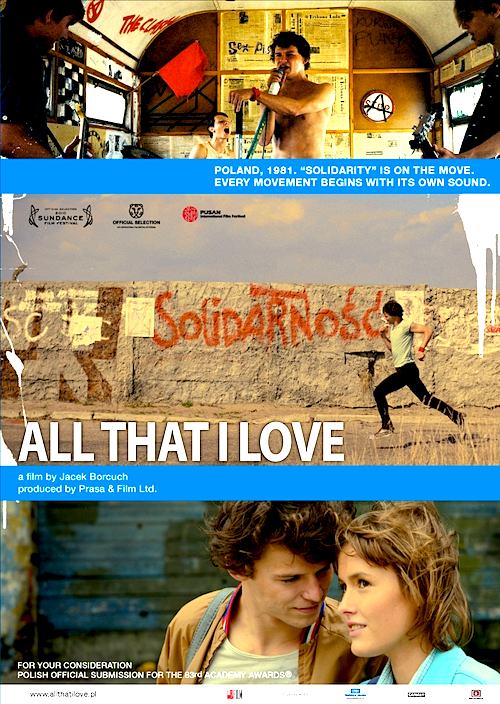
By Joe Bendel. Punk rock is supposed to be subversive. For Communist Poland poised on the brink of Martial Law, it was downright revolutionary, in spades. Yet, young Janek and his friends were not trying to be political, and this is exactly why their music is so threatening in Jacek Borcuch’s All That I Love (trailer above), Poland’s most recent submission for official foreign language Academy Award consideration, which screens this Saturday as part of the Film Society of Lincoln Center’s new retrospective, Transitions: Recent Polish Cinema.

Janek’s brother also plays in his hardcore punk band, All That I Love, affectionately known as ATIL for short. His mother is a nurse, which is all fine and good, but his father is a mid-level officer in the Polish Navy. Ordinarily this is a good thing, leading to a few modest perks for the family. However, when courting Basia Martyniak, the very cute daughter of Solidarity organizers, it is not so hot. The rebellious nature of his music does not cut much ice with the Martyniaks either, but Basia is impressed.
Though not necessarily impressed himself, Janek’s father is still supportive enough to arrange rehearsal space on the local base. Clearly the naval captain is not the typical Communist apparatchik, a fact not lost on Sokołowski, the neighborhood Party snitch. Resenting the boys’ ill-concealed interest in his cougarish wife, Sokołowski targets them where it will hurt the most—their music.

Throughout the film, Borcuch juggles a number of disparate elements quite sure-handedly, including a rather tender coming-of-age romance and some paint-peeling punk, based on the music of the era-appropriate Polish band WC. It is also a story of human tragedy, directly resulting from an inherently oppressive political ideology. Yet part of the irony of ATIL is that Janek’s family will probably be far better off in the new Poland that rises from the ashes of Communism for having gone through their tribulations in the film. Unfortunately, viewers can surmise the short term will be rather long and difficult for them in the December of 1981.

There is no denying the charismatic appeal of Borcuch’s teen-aged leads. Mateusz Kościukiewicz’s Janek could have walked out of Tom Hanks’ That Thing You Do into Jaruzelski’s police state, while as Basia, Olga Frycz resembles a considerably younger and warmer Nicole Kidman. Yet, arguably Andrzej Chrya serves as the lynchpin of the film, investing Janek’s father with humanity and integrity that will first challenge and then reconfirm all our assumptions of Poland’s Communist military.

With convincing period detail, Elwira Pluta’s design team faithfully recreates the bleak look of Martial Law era Poland, when Brutalist-style Soviet housing projects were considered desirable. Nevertheless, despite the apparent downer ending mandated by history, ATIL is a surprisingly uplifting film, deriving optimism from the spirit of its characters.  An excellent kick-off for the FSLC’s Transitions series, ATIL screens this Saturday (9/10) and next Thursday (9/15) at the Walter Reade Theater.

Posted on September 7th, 2011 at 10:15am.
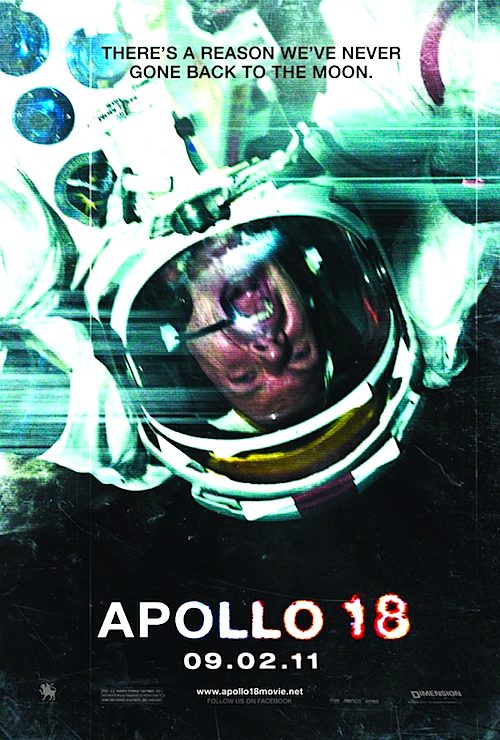
Failure to Launch: LFM Mini-Review of Apollo 18

By Jason Apuzzo. THE PITCH: Timur Bekmambetov produces a $5 million found-footage sci-fi thriller about an ‘officially’ scrubbed Apollo 18 mission that we learn was secretly launched by the Defense Department in December 1974 in search of … a mysterious presence on the Moon.

THE SKINNY: The Weinstein-distributed Apollo 18 wastes a great premise and an effective re-creation of America’s pioneering Moon landings on a listless storyline, thin characters, lame thrills, and a gratuitous cheap shot at the U.S. military that confounds the film’s own plot. NASA was wise to steer clear of this film, and so should you.

WHAT WORKS: • If you ever wanted to experience what a Moon landing might feel like from the first-person perspective of the astronauts, Apollo 18 captures that in 1970s period detail – although the film spends too much time in the claustrophobic confines of the lunar lander, and never fully stretches its legs on the Moon.

• The found-footage motif is worked nicely into the storyline, introducing (courtesy of Apple’s Final Cut Pro) a mixture of handheld Super-8mm footage and distressed analog video that gives the film visual interest and an authentic, period feel.

WHAT DOESN’T WORK: • Actors Lloyd Owen and Warren Christie aren’t able to capture the stoic, tight-lipped heroism of actual astronauts. Their acting performances here are much too histrionic to be believable given the circumstances of the mission and the time period.

• ***SPOILER ALERT*** The plot hinges on the idea that the Defense Department would send U.S. astronauts to the Moon without briefing them on the basic nature of their mission, and would even leave them to die – even when rescue is possible. The film’s cynicism is ugly, and undermines the storyline’s basic believability. ***END OF SPOILERS***

• The film’s amateur attempt at ‘suspense,’ such as it is, never really achieves much of a payoff. The ‘threat’ the astronauts eventually uncover on the Moon would barely pass muster in a Roger Corman movie.

• The film lacks humor or laughs, giving it no place to go once the shock-moments wear off. As a result the movie is dull – like listening to Muzak for 90 minutes inside a 1970s photo booth.

THE BOTTOM LINE: Trying to quickly cash-in on the alien invasion and found-footage genres, Apollo 18 has the extreme misfortune of being out at the same time that a newly remastered, 3D IMAX version of Michael Bay’s Transformers: Dark of the Moon just arrived in theaters this past week. Since Apollo 18 is so utterly forgettable, and even contemptible in its cynicism toward the American military, my strong advice is to spend your money this weekend watching the first 10 minutes of Dark of the Moon, instead. Even if you only stay for those first few minutes, you’ll enjoy a much better experience than Apollo 18 can muster.

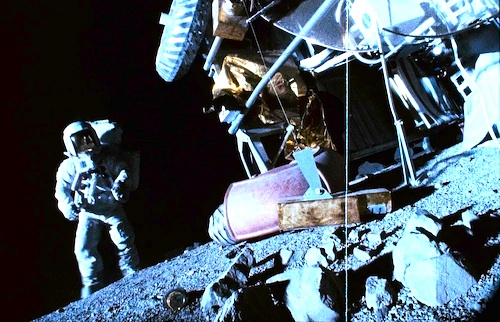
Misfire: from "Apollo 18."

If you haven’t seen it yet this summer, Dark of the Moon (see my review here) opens with a heroic sequence that re-creates the 1969 Apollo 11 Moon landing, as astronauts Neil Armstrong and Buzz Aldrin step onto the surface of the Moon and – unbeknownst to the world – secretly explore a gigantic, mysterious (and seemingly moribund) alien spacecraft. This breathtaking opening flourish, presented in 3D IMAX, is truly one of the inspired moments in the entire Transformers trilogy, and at its conclusion when I saw the film again earlier this week actually touched off a round of applause in the audience – and I will confess to having had some watery eyes, myself.

Like other such moments in Michael Bay’s films – particularly Armageddon and Pearl Harbor – the sequence summons elegiac emotions of pride in America’s bold, pioneering spirit, our legacy of achievement in pushing the boundaries of outer space, of opening new horizons through courage and innovation. That’s what America’s efforts in outer space mean, not the junk the Weinsteins are currently peddling with Apollo 18, a film destined for the bargain bin at your local gas station – tucked somewhere between other Weinstein classics like Mimic 3 and Children of the Corn 5.

If we ever get back to the Moon, or push ahead further to Mars, it certainly won’t be because films like this are inspiring us with a sense of wonder about getting there.

Posted on September 2nd, 2011 at 6:11pm.

Surviving the Aftermath of 9-11: LFM Reviews Rebirth

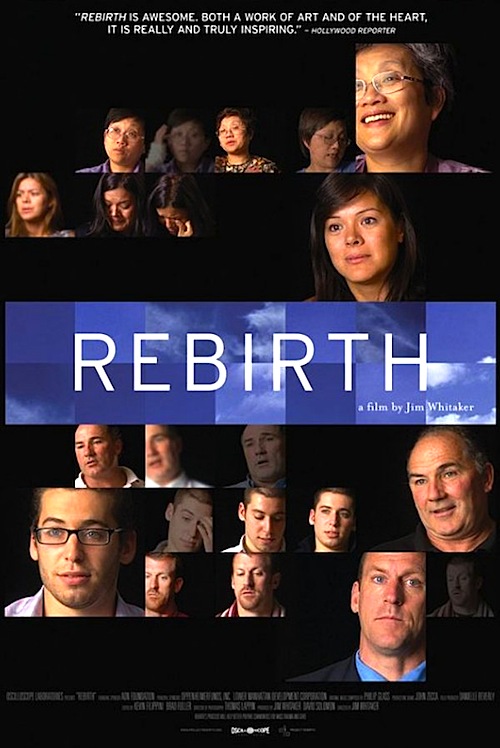
By Joe Bendel. New Yorkers are tough. Since the horrific events of September 11th, the City has weathered blackouts, blizzards, tornadoes, earthquakes, and hurricanes. Still, the lingering trauma of 9-11 dwarfs all subsequent travails. Capturing the physical rebuilding of Ground Zero and the emotional healing of five New Yorkers profoundly affected by the tragedy, director and conceiving producer Jim Whittaker shot almost a thousand hours of footage, resulting in perhaps the first documentary with its own non-profit governance structure: Rebirth, which opens this today in New York at the IFC Center.

Affectionately called “Captain Manhattan,” FDNY Cap. Terry Hatton was already widely regarded as a fireman’s fireman, even before his heroic death during the collapse of Tower 1. For his best friend and colleague Tim Brown, both grief and survivor’s guilt would debilitate his psyche. Yet, despite his depression, we watch as Brown tries to take affirmative steps to prevent such acts of terror in the future, accepting an appointment to the then newly created Department of Homeland Security and serving as an advisor to Mayor Rudy Giuliani’s ill-fated presidential campaign.

Like Brown, Tanya Villanueva Tepper grieves a New York firefighter, her fiancé, but her new life seems to fall so well into place, she starts to feel guilt over her happiness. In contrast, construction worker Brian Lyons has a more difficult recovery process. He also mourns for a FDNY brother, his younger brother, Mike. In addition, his tireless work in the rescue and recovery efforts has left him with persistent health issues and a case of PTSD. Nick Chirls also lost someone close to him: his mother. Unfortunately, a difficult bereavement would lead to an estrangement between Chirls and his father.

Yet, of the five interview subjects, Ling Young is arguably the most compelling. A dutiful state employee at work on the 78th floor at the time of the attack, Young suffered burns so serious, they caused considerable physiological complications. Though her physical healing process remains unresolved, she emerges as the film’s most inspiring figure.

It is hard not to be moved by pain and honesty expressed by Whittaker’s POV figures. However, the time lapse footage of the Ground Zero rebuilding project might ironically prove counterproductive. While it is impressive to see the construction of the transit hub and smaller buildings in fast forward, it is conspicuously obvious that the Freedom Tower has yet to rise triumphantly from the rubble.

To his credit, Whittaker treats his subjects with sensitivity and respect. Still, it seems clear he chose to play it safe at each juncture, glossing past Brown’s reasons for signing on with the Giuliani campaign and including only a brief vent from Chirls directed at moral relativist apologists for the terrorists. Perhaps it is just as well, focusing Rebirth squarely on the personal makes it more immediate and universally relatable, but the gaps still show. After all, what happened in Lower Manhattan was not a random happenstance, but a deliberate act of mass murder motivated by a hateful ideology. Rebirth completely ignores that reality, concentrating solely on the consequences.

In truth, it is a defensible decision, but it requires far more context than that found in Rebirth to fully understand September 11th. Technically, it is also a well-crafted production, with important aesthetic contributions coming from composer Philip Glass and cinematographer Tom Lappin, who gives the oral history portions a warm glossy look. (As an aside, viewers should look for Jon Fein & Brian Danitz’s thematically related documentary Objects and Memory, also boasting a Glass score, when it airs on PBS as part of their ten year anniversary programming). Well intentioned and executed, but clearly determined to avoid controversy, Rebirth opens today (8/31) in New York at the IFC Center.

Posted on August 31st, 2011 at 5:41pm.

YouTube Jukebox: David Foster Wallace’s Kenyon Commencement Speech

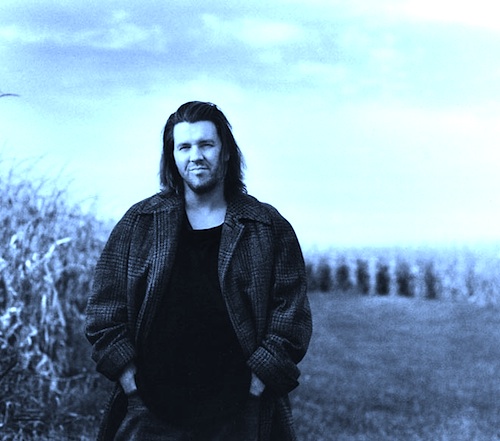
Author David Foster Wallace.

By David Ross. Every so often I dip into contemporary literature to confirm my sense that I’m not missing very much. I recall forays into the work of Paul Auster, Angela Carter, Douglas Coupland, Dave Eggers, Bret Easton Ellis, Jonathan Franzen, Michel Houellebecq, Jay MacInerney, Cormac McCarthy, Rick Moody, Chuck Palahniuk, Salman Rushdie, Jeanette Winterston, and other passing fancies of Time and Newsweek. Zadie Smith waits her turn on my shelf. All this sifting of silt has produced only a few glinting nuggets. I discovered in Houellebecq a fierce and welcome fellow despiser of modernity (see my comments here), and something even more in David Foster Wallace: a vast nineteenth-century mind struggling to find itself.

The “covering cherub,” in Blake’s parlance, was the postmodernism that DFW formally embraced against the grain of his personality. He was profoundly sincere, empathetic, and humane, a believer in “the sub-surface unity of things,” as he puts it in his famous Kenyon graduation address of May 2005, and yet devoted his career to self-conscious intricacies of irony and gamesmanship. He made great art in this mode – only Nabokov and Borges are his postmodern betters – but it was not, I can’t help feeling, the art he was born to make.

I have additional misgivings about his prose, though he is the only prose writer of his generation even worth noting. While meticulously attentive to his art, he was ambivalent about the formality of his art, the ideal of the well-wrought urn. His language is often splendid, but always splendid despite a certain scruffiness and loose-limbed sprawl. My eye is always instinctively performing the function of an editor, pruning, reshaping. He was too invested in his own unpretentiousness, too much infected with the modern American ideal of jeans and sandals, which ultimately expresses a yearning to be liked, to be no better or different than the rest of the crowd. I suppose this is the symbolic meaning of DFW’s hallmark bandana, an accouterment of kitchen and field workers, housewives and athletes. Great writers don’t care about being liked. They scorn our right to judge. They discover themselves amid the execrations of the crowd.

Even with his foibles and arguable failings totted up, DFW was the redeemer of his literary generation. He saved it from the humiliation of being the first generation in American history to lay nothing – not the least nosegay – on the graves of Emerson, Thoreau, and Whitman. He saved it from the gaping wound of a great naught.


DFW’s rightly famous Kenyon Commencement Speech (here and here) has become a pop-cultural touchstone. Perhaps enthusiasm for it has already become a bit of a cliché. Yet I defy anybody to listen attentively without succumbing to its moral seriousness and sinking into an inner hush just as the initially boisterous Kenyon audience stills into an outer hush. In the guise and moment of his speech, DFW defies the default setting of the culture. He sheds his celebrity – the unpeelable skin of the Oprah era – and becomes the conduit and servant of a message more urgent than himself. Thus Emerson spoke from the podium of the Concord lyceum.

Alex Niven, a friend of a friend, comments intelligently on the speech and on much else concerning DFW.

Posted on August 24th, 2011 at 2:04pm.

The BBC Plays Itself: LFM Reviews The Hour

By Joe Bendel. It is a provocative, ‘what if’ question. Had the United States forcefully backed the British government during the Suez Crisis, how would history be different? Indeed, the Soviet backed Nasser’s media victory is often considered a precipitating factor contributing to the overthrow of the pro-western Hashemite monarchy in Iraq, but everything turned out okay there in the long run, right? Instead America undercut her closest ally to curry favor with the UN and the independent Arab States. How well did that work, again? A watershed moment for the collective British psyche, the Suez Crisis supplies the backdrop for the newsroom drama The Hour, which premieres on BBC America this Wednesday as the inaugural selection of the network’s Dramaville showcase of British dramatic limited series, hosted by Luther’s Idris Elba.

Romola Garai in "The Hour."

Bel Rowley and longtime platonic friend Freddie Lyon consider themselves the future of British journalism, wasted in the BBC’s newsreel department. Unfortunately, Lyon is a bit too tightly wound for his own good. When the call comes to work on the network’s new weekly newsmagazine, The Hour, Rowley gets the producer job he covets. Nearly chucking away his career out of resentment, Lyon reluctantly accepts an unglamorous position as the home affairs correspondent. He might be brilliant, but his personal cold war with Hector Madden, the show’s presenter, complicates Rowley’s position. Much like William Hurt in Broadcast News, he is not gifted at thinking on his feet during an interview segment. However, the married Madden’s ambitions are considerable and they include Rowley.

Initially, the show-within-the-show flounders, but when the Suez ignites, they hit their stride. Suddenly questions of censorship are raised when the Eden government starts invoking the gag rule for issues under debate in parliament. To that end, Angus McCain, an Eden advisor with a rather vague portfolio, starts haunting the BBC offices, creeping out the staff with his oiliness. Shocking as it might sound, it turns out many of the journalists have their own agendas as well.

For most of the first three episodes, The Hour hints at a conspiracy within the Eden government, possibly involving the murder of Ruth Elms, Lyon’s childhood friend of aristocratic lineage. However, two events occur in episode four that cloud the show’s ideological implications, making it richer and more complex: the Soviets invade Hungary and we learn they also have a mole operating within the BBC. Just what sort of Cold War morality play The Hour will ultimately become is not at all certain at the shows mid-point, but that ambiguity is not necessarily a bad thing.

Many critics might be tempted to dub the show Mad Men meets Smiley’s People. Indeed, the show has a well crafted 1950’s period look and there is certainly a good deal of alcohol being consumed. The moody jazz-influence score also nicely heightens the noir atmosphere. Continue reading The BBC Plays Itself: LFM Reviews The Hour

LFM Review: Russia Invades Georgia in 5 Days of War, Starring Andy Garcia

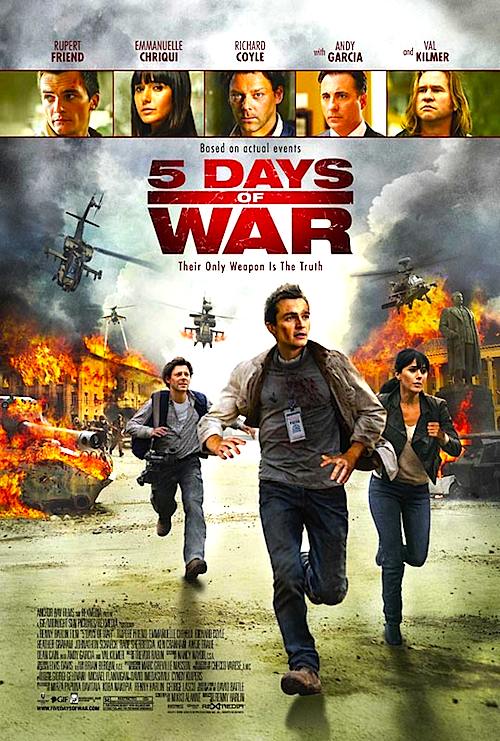
By Joe Bendel. In early August, 2008, the Russian military invaded the free and democratic country of Georgia, leaving death and destruction in its wake. They are still there, occupying the so-called breakaway republics of South Ossetia and Abkhazia, a fact the media has yet to notice. Indeed, the journalistic establishment did its best to look the other way, except for a hardy band of foreign correspondents who risked life and limb to cover the Russian atrocities. Finnish filmmaker Renny Harlin (yes, that Renny Harlin) dramatizes Georgia’s struggle to preserve its sovereign integrity through their lenses in 5 Days of War, which opens this Friday in New York.

Georgian president Mikheil Saakashvili was elected President as a Western-oriented reformer, the exact opposite of Russian PM Vladimir Putin. So committed to strengthening relations with America and NATO, Georgia contributed military forces to Operation Iraqi Freedom. For war reporter Thomas Anders, it is a good thing they did. As 5 Days opens, Capt. Rezo Avaliani’s unit arrives just in the nick of time to save him from a terrorist ambush, creating a bond of friendship between the two men. As Russia starts massing troops on the border, the psychologically wounded Anders heads back into the field, where he will encounter the good Captain again.

President Saakashvili and his American advisor scramble to rally world support, but the media is not interested. When CNN bothers to cover the story (yes, the network is mentioned by name), they only present the Russian government’s spin. Even more frustrating, legitimate journalists on the ground, like Anders and his hard drinking colleague Laurens “Dutchman” Roemer, are not able to place their dramatic stories of Russian war crimes (unflinchingly illustrated throughout the film), because their outlets simply do not care. Unfortunately, the Olympics will soon start, crowding beleaguered Georgia out of the media spotlight.

It will come as a shock to many that Renny Harlin had such a serious and timely film in him. Yet, it is important to remember the Cliffhanger director’s Finnish roots. Indeed, Saakashvili explicitly references Finland’s resistance to Soviet invaders in his climatic address to the nation. The director clearly has a passion for the story, but his action movie roots also serve the material quite well.

Frankly, it is a bit of a misnomer to call 5 Days a war film, because it was never a fair fight. However, Harlin and cinematographer Checco Varese (a former news cameraman who saw action in Bosnia and Chechnya) convey a vivid sense of what it is like to have the Russian war machine bearing down on you. It is a scarily convincing sensation, never really captured on film so effectively before.

A surprisingly good physical match for Saakashvili, Andy Garcia invests the film with real dignity and gravitas. In fact, his delivery of the President’s stirring national address might just get you a little choked up. Indeed, the Georgian characters are all quite credible and compelling, particularly Johnathon Schaech as the resourceful Capt. Avaliani.

Andy Garcia as Mikheil Saakashvili in "Five Days of War."

Shrewdly, Val Kilmer plays to his new degenerate out-of-shape image as the cynical Dutchman. Rade Sherbedgia, Kilmer’s former co-star from The Saint, notches another memorable heavy role, playing Col. Demidov with more nuance than the Russians deserve. If there is a weak spot in the cast it is Rupert Friend, who only digs into his character just so far, in between dodging bullets and getting the stuffing kicked out of him. Still, he is serviceable enough to keep the film on track and firing on all cylinders.

Tightly helmed by Harlin, 5 Days is absolutely riveting as cinema when considered only according to strict formalist criteria, but of course there is much more to take into account. One suspects it was originally conceived with an even darker slap-in-the-face ending. Regardless, the final film is blisteringly angry and honest. Yet it is also inspiring, depicting a small, scrappy Eastern European nation standing up against a vastly more powerful aggressor, championing the values we advocate. Conversely, for nearly everyone working for a major media outlet, the film is a long cold glass of shame. One of the year’s best, 5 Days opens this Friday (8/19) in New York at the Angelika Film Center.

Posted on August 15th, 2011 at 11:02am.