By Jason Apuzzo. Take a look at a new trailer above that aired during the NBA Finals for Transformers: Dark of the Moon, and tell me if you’re not left with the impression that this film will feature the UN collaborating with an alien invasion of planet Earth. If that’s the case … thank you, Michael Bay! You get better with each film.
In other news, Relativity Media has apparently just picked up distribution rights to Act of Valor, described as a “very patriotic” action thriller about the Navy SEALs, starring a cast of unknowns … along with actual, active-duty SEALs. The film was written by 300 screenwriter Kurt Johnstad, and may also be getting an IMAX release. You can read more about the project here, and there are already some production photos available.
This is good news. I’m liking this new SEAL-movie trend because it indicates that Hollywood is finally becoming responsive to actual, present-day events. If only this had been the case ten years ago …
By David Ross. My daughter and I heard the Tokens’ “Wimoweh” somewhere or other; this led to Ladysmith Black Mambazo; this in turn led to Miriam Makeba, and ever since we’ve been listening to Makeba day in and out, with no weariness – indeed with ever deepening respect – on the adult side. My daughter wanted to be an ‘African singer’ last Halloween, but we talked her down from this ledge of potential racist scandal, and she wound up going as a ‘Chinese princess.’
Let me offer a simple conviction: during the 1960s Miriam Makeba was one of the very greatest vernacular artists in the world, in a category with the likes of James Brown, Ray Charles, John Coltrane, Miles Davis, Jimi Hendrix, Charles Mingus, and Thelonius Monk. She might be reasonably compared to Aretha Franklin or Sarah Vaughan, but on the whole she was their superior, combining the former’s soaring voice with the latter’s genius for phrasing, and endowing everything she did with a palpable personal charm. As a politically resonant Third World artist combining native and American idioms, the obvious – and fair – comparison is to Bob Marley.
Here (see above) is a tremendous clip associated with Makeba’s appearance in Stockholm in 1966. The concert is available as a DVD import titled Miriam Makeba Live at Bern’s Salonger (I purchased mine from Amazon.co.uk), but the film does not include this sequence. I gather that Makeba appeared on TV in support of the concert proper. The clip features two tremendous songs and some comments on the arch-nastiness of the racial politics of South Africa, with Makeba herself utterly fetching in her duality of girlishness and loftiness. This second clip, a bossa nova delight from the live appearance at Bern’s Salonger, highlights Makeba’s remarkable versatility. This third clip drives home her capacity for massive, earth-shaking grooves.
Enjoy this material while you can. YouTube has lately been stripped of Makeba material.
The core of Makeba’s sixties output is available on three CD sets that repackage seven of her albums. These sets are a must for anyone with a serious interest in twentieth-century music, as indispensible as Live at the Apollo and Kind of Blue.
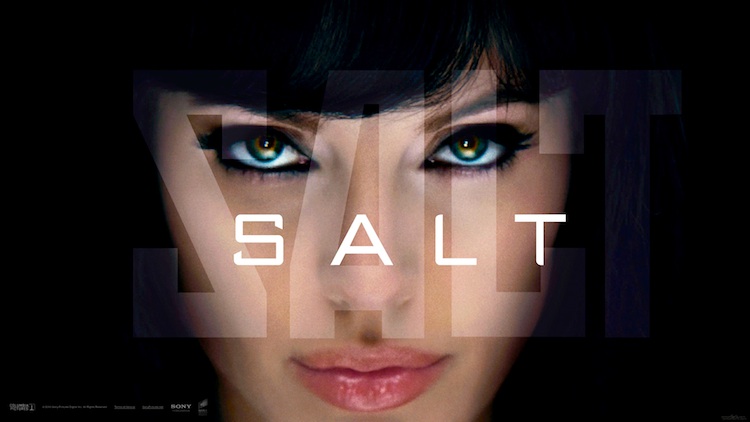
By Jason Apuzzo. • So the fantastic news from yesterday is that the Angelina Jolie anti-communist thriller Salt, which we loved here at LFM, is likely to get a sequel. Deadline broke the story yesterday that Sony is moving forward on the project, with Jolie returning to star and Kurt Wimmer returing to write the screenplay. It’s not clear at the moment whether Phillip Noyce will be returning to direct, which is a key issue in my opinion – as Noyce is an old pro who really guides such projects masterfully. But nonetheless this is fabulous news, as Hollywood currently now has its own full-fledged communist-hunting franchise up and running. What could be better?
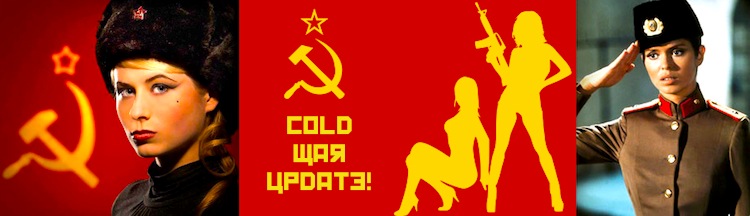
As LFM readers will recall, we were very enthusiastic over this film last year, not because the film was a masterpiece, but because it represented a return to the classic, Cold War anti-communist ethos that has been missing not only from mainstream Hollywood cinema – but also from the broader culture. Salt as much as any film was the reason we began doing Cold War Updates! – although other projects like MGM’s new Red Dawn (which we’d privately seen, way in advance) or Mao’s Last Dancer contributed to this Cold War Update! series being created, as well.
As we know, the communist threat has very much shifted from West to East, with China and North Korea emerging as potent threats to America – but Salt dwells on what has always been a great subject for spy cinema, which is the threat of communist infiltration here at home. (Specifically, Salt deals with Russian communist sleeper agents here in America left over from the Cold War, who are ultimately intent on returning Russia to its Soviet past.) Nowadays one might well ask whether communists need to even bother hiding themselves, anymore … incidentally, have I ever mentioned to Libertas readers that Van Jones is an old acquaintance of mine, and of Libertas contributor David Ross? … but perhaps that’s a story for another day.
What’s even more remarkable about the Salt ‘franchise’ – if we can call it that now – is that it’s emerging without the help of Fox News, talk radio, or the conservative blogosphere, all of whom appear curiously unaware of this film – even though Jolie is easily the biggest female star in the world, besides being daughter to Jon Voight. What gives? I often hear conservatives complain about ‘films that Hollywood won’t talk about’ or films that Hollywood is somehow trying to ‘suppress’ – such as Atlas Shrugged or American Carol, or a seemingly endless parade of conserva-documentaries – but box office hits like Salt (nearly $300 million worldwide) or even superb indie dramas like Mao’s Last Dancer ($22 million worldwide) or Peter Weir’s The Way Back ($20 million worldwide) seem to now be the films conservatives themselves won’t talk about.
Why is that? Is it because they’re not made by the ‘right’ people?
Just for fun, by the way, I’d like to float an idea out there: that with Michael Bay concluding his work on the Transformers series, that the Brocollis consider giving him the Bond franchise … and Michael Fassbender the role of 007. Wouldn’t this be great? Feel free to comment below on the idea. You never know, after all, who might be reading this site.
• A boffo new trailer for the Call of Duty 3: Modern Warfare game is out, a game that will continue the Call of Duty storyline of a Russian invasion of America … this time involving Russian sponsorship of worldwide terror-attacks. The trailer is really something – absolutely epic in the scope of the villains’ all-out assault on the Western world – so be sure to check it out above.
By David Ross.In a new feature, Libertas will excavate the YouTube cave of treasures, drawing attention to certain heroes of film, music, art, and literature – and preferring as always the vintage, the homemade, and the un-co-opted. YouTube Jukebox will be an ongoing demonstration of genuine creativity – a recurrent potshot, if you will, aimed at the ventilation shaft of the Hollywood Death Star.
The D.C.-area chanteuse Eva Cassidy (1963-1996) died young of cancer, so we can enjoy her work only elegiacally and with the kind of autumnal wistfulness with which we listen to Sandy Denny (see here), a similar and even greater singer-songwriter who departed all too soon. I stumbled upon Cassidy’s epochal version of “Autumn Leaves” only because my daughter happened to be learning the song on the piano. I was stunned. Nearly seventy years after the song was written, Cassidy reinvents it and claims it utterly, much as Coltrane claims “My Favorite Things” and Hendrix claims Bob Dylan’s “All Along the Watchtower.” Her talent is not remotely theirs, but her desire to speak through the song is enormous and urgent. She recorded the song at Blues Alley in Washington on Jan. 2, 1996. Did she know she was dying? Perhaps she did, in which case the image of ‘autumn leaves’ is pregnant indeed.
Yves Montand debuted “Autumn Leaves” – originally called “Les Feuilles Mortes” (“The Dead Leaves”) – in Marcel Carne’s 1946 film Les Portes de La Nuit. Here Montand reprises his signature tune in the 1951 film Paris Is Always Paris. In 1947, Johnny Mercer rewrote the song in English and it has been a jazz standard ever since.
I hazard to say that nobody has ever taken the song as seriously as Eva or so fully grasped its expressive possibilities. “Autumn Leaves” was supposed to be a smoke-ring of 40s-era café sentimentality; it was never meant to have the emotional weight she gives it. Compare Eva’s life-and-death version to Montand’s unctuous crooning or to Stanley Jordan’s gymnastics on two guitars. She sings closed-eyed with the effort of permanent statement.
Thankfully, the Blues Alley concert is available on CD, though the album does not include, perhaps for copyright reasons, Eva’s fine version of Cyndi Lauper’s “Time After Time,” a gorgeous melody that Eva rescues from its original synth-heavy context.
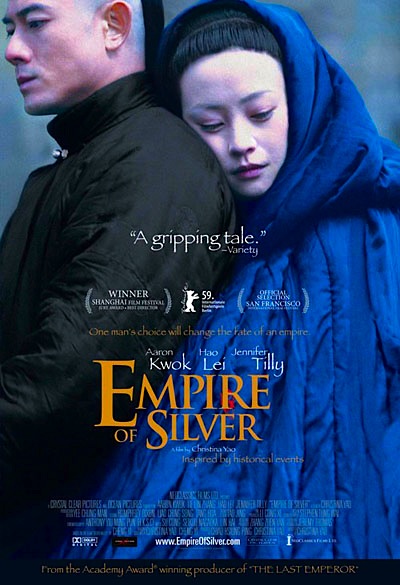
By Joe Bendel. Initially, the late Qing Dynasty’s new paper money is an economic boon, especially helpful facilitating transactions for the lower classes. Unfortunately, when the people come to suspect it is not fully backed by silver, it leads to bank runs. This is an ominous development for Lord Kang’s financial dynasty. Yet he will face even greater tribulations within his own family in Christina Yao’s Empire of Silver, which opens tomorrow in New York.
In 1899, the “piaohao” bankers of Shanxi were like Tom Wolfe’s “Masters of the Universe.” Lord Kang, or “Old Master” as he is often called, assumed four sons would be sufficient to ensure a safe line of succession for his venerable banking company. Of course, as a pious Buddhist deaf-mute, “First Master” never really counted. Unfortunately, when the Second and Fourth Masters are undone by calamity partly of his own making, old Kang is left with the dissolute playboy Third Master. Still, he is probably the most talented of the lot, but he has heretofore squandered his life out of resentment for his father’s Machiavellian management of family affairs. This is Third’s time to chart his ascendance, but it remains unclear whether he wishes to assume the mantle of leadership.
Needless to say, Old and Third Masters have very different management philosophies. However, his relationship to his young stepmother is even more strained. Quickly we come to understand Third and his former teacher had quite a bit of history before she became Madame Kang, which obviously explains much.
Silver is a big historical melodrama, but there is only a spot of actual fighting here and there. Still, the costumes, sets, and sweeping vistas are worthy of epics like Hero and Red Cliff. Jeremy Thomas, the producer of ambitious films like The Last Emperor, Little Buddha, and Merry Christmas Mr. Lawrence, served as executive producer, lending Silver further prestige.
While Silver is indeed a finely crafted period production, Aaron Kwok is surprisingly flat as Third Master. Yes, his character is emotionally damaged, but at some point we should see some signs of life percolating. Still, Hao Lei largely compensates as Madame Kang with her exquisite expressiveness. Frankly it is just nice to see her working, considering she appeared in Lou Ye’s bold Tiananmen Square drama Summer Palace, which was duly banned by the Communist authorities. Silver also boasts a number of rich supporting performances, particularly Ding Zhi Cheng and Lei Zhen Yu as two rival branch managers – one talented but dangerously independent, while the other is deemed controllable by virtue of his mediocrity.
Yao revels in the classical tragedy of her story, but she periodically offers up shrewd nuggets of insight as well. It is intriguing to look at a proud family and their celebrated house of finance – increasingly destabilized by China’s mounting anarchy – but it might well be too restrained and respectable for fanboys. An engaging feature directorial debut for Yao (if not a perfect star vehicle for Kwok), Silver opens today (6/3) in New York at the AMC Empire and AMC Village 7.
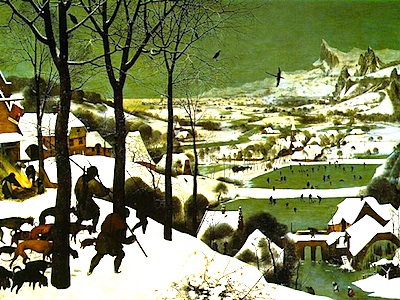
By David Ross. I first heard Bach’s choral prelude Ich ruf zu dir, Herr Jesu Christ (“I call to you, Lord Jesus Christ”) in Tarkovsky’s Solaris (1972). It seems to me one of the world’s most beautiful compositions, and Tarkovsky’s scene, in which the piece harmonizes with the camera as it plays over Brueghel’s Hunters in the Snow (1565), seems to me one of the most solemnly lovely scenes in cinema. The camera scrutinizes the details of Brueghel’s painting, at first coldly (as Kris must see it), but then with a certain wistful sorrow, as if in recognition of our hopeless estrangement from the natural life of the old village. The mournful precision of the piece by Bach (see here for Vladimir Horowitz’ transcendently lovely interpretation) underscores that there is only the beautiful sadness of our estrangement and longing. Kris stirs with new humility and humanity, and he and Hari begin to float, ostensibly in a state of zero gravitation, but actually in a state of grace.
Pieter Bruegel the Elder's "The Hunters in the Snow" (1565).
People often speak of Falconetti’s ecstatic expression in Dreyer’s La passion de Jeanne d’Arc (1928)as film’s most inspired synecdoche of the religious experience, but Tarkovsky, in my opinion, exceeds Dreyer artistically and spiritually. Tarkovsky seems engaged not in a pastiche of an archaic faith, but in the genuine struggle of modern faith, and his dense, intricately coded scene seems to compress everything integral to Western culture in its modern self-bewilderment and tentative hope.
In a 1986 interview, Laurence Cossé asked Tarkovsky whether he considered his films “acts of love towards the Creator.” Tarkovsky responded “I would like to think so. I’m working in it, in any case. The ideal for would be to make this constant gift, this gift that Bach alone, truly, was able to offer God.”