By Jason Apuzzo. I wanted to put up a movie clip today that would capture my feelings about what happened yesterday in Pakistan. The selection of the clip turned out to be an easy one.
Well done, Mr. President, and bravo to the many American heroes who made this historic victory possible.
By Joe Bendel. There are more Polish citizens recognized by the State of Israel as Righteous among the Nations than any other nationality. Irena Sendler was not just one of the Polish rescuers. She was an underground ringleader. Yet it was not until long after the fall of Communism that the Catholic Sendler was widely hailed for her heroism. Featuring Sendler’s final interview of appreciable length, Mary Skinner’s documentary profile records her words and deeds for posterity in Irena Sendler: In the Name of Their Mothers, which airs on PBS stations across the country on Holocaust Remembrance Day, this Sunday. Continue reading Holocaust Remembrance Day on PBS: Irena Sendler & Prisoner of her Past
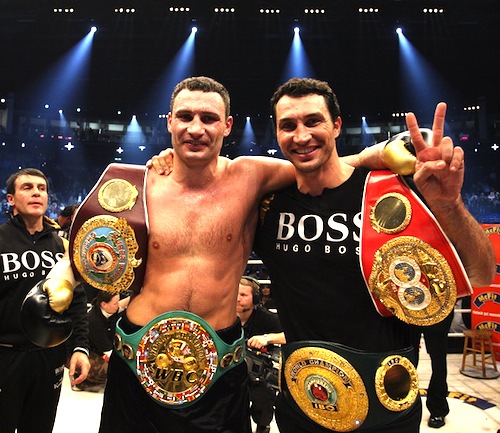
By Joe Bendel. Mother Klitschko is no fun. She expressly prohibited her boxer sons Vitali and Wladimir from fighting each other. Of course, that is exactly what the boxing world wants to see. Sebastian Dehnhardt profiles the two well-educated Ukrainian brothers who rose to the top of the boxing ranks, got knocked down, and clawed their way back in the simply but aptly titled documentary Klitschko, which screens at the 2011 Tribeca Film Festival.
The Klitschko brothers.
Growing up military brats, the Klitschko brothers’ father was an ardent Communist. However, he would pay for his blind faith, when his unit responded to the Chernobyl crisis without adequate protective gear. Fortunately when his cancer inevitably surfaced, the Klitschkos already had sufficient means to provide their father with the best of western medicine. Coincidentally, the now cancer-free Col. Klitschko has had a complete ideological change of heart, at least according to his sons.
Though not technically twins, the Klitschko boys were always big and nearly impossible to tell apart. The older Vitali actually started out as a kick-boxer while so-called “Western martial arts” were prohibited in the Orwellian Soviet Union. Eventually the Klitschkos switched to boxing, where fighters could make serious money. Due to inopportune injuries, they lost several high profile bouts they should have won. The elder Klitschko was especially dogged by the quitter epithet. Yet, both brothers would have their Rocky moments in the ring.
Klitschko the film is definitely produced with boxing fans in mind. However, those who follow post-Soviet politics will also find Dehnhardt’s documentary engaging. A reformer, the elder Klitschko was even elected to the Kiev City Council for two stormy terms. The film is also unexpectedly (and unfortunately) topical, given the increased interest in the Chernobyl disaster following the near-repeat in Fukushima. Continue reading LFM Review: Klitschko @ Tribeca 2011
By Joe Bendel. The wave of protests sweeping the Middle East started in Iran, but it was the Islamist government that supplied all the rage. Their crackdown was swift and violent. The almost-revolution was not televised, but it was on YouTube, where a young Iranian expat breathlessly follows the tumultuous events rocking her country from the safety of France in David Dusa’s Flowers of Evil, which screens at the 2011 Tribeca Film Festival.
Rachid Youcef in "Flowers of Evil."
When the French-Algerian Rachid (a.k.a. Gekko) first meets Anahita, he does not make a strong impression. He is the one carrying her bags when she checks into her upscale hotel. It is not snobbery. The attractive Iranian is understandably preoccupied with the government’s brutal response to the “Green” pro-democracy demonstrations. It is not just political. She has a number of friends and relatives ominously missing. Yet Rachid’s joie de vivre appeals to her, particularly as she faces the reality of Iranian oppression.
Anahita and Rachid initially connect through Facebook, and social media is deeply ingrained in their daily lives. Though both are Muslim, their socio-political backgrounds are radically different. Naturally she is the moderate, though he wisely refrains from judging her occasional glass of wine (much). Initially they appear to be a good match, with Anahita drawing off his energy, while he learns from her to appreciate the French culture he had always taken for granted. She even introduces him to the poetry of Baudelaire (hence the title). Unfortunately, her survivor’s guilt often manifests itself in bouts of depression, which the immature Rachid has little patience for. Continue reading LFM Review: Flowers of Evil @ Tribeca 2011
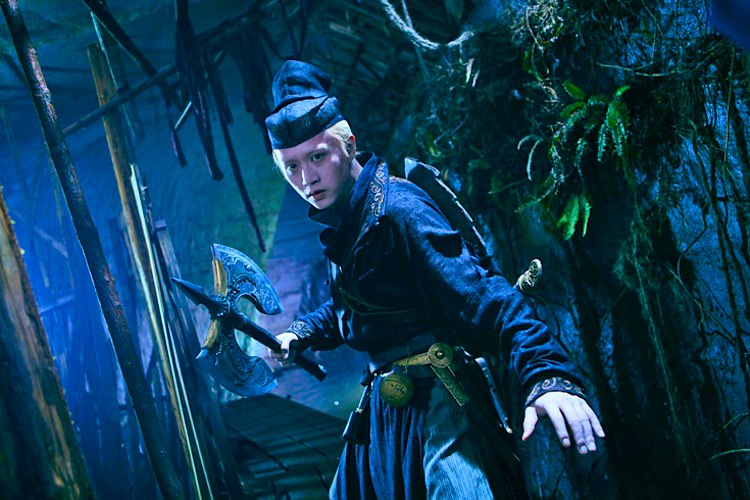
By Joe Bendel. He was a legendarily honest and perceptive administrator during the turbulent reign of Wu Zeitan, the first and only woman to rule China in her own right. However, most westerners know him as Judge Dee, the protagonist of Dutch Asian scholar Robert van Gulik’s detective novels. Dee, or more properly Di Renjie’s powers of deduction, are such Wu Zeitan plucks him from prison to ferret out the truth behind a series of grisly deaths threatening to derail her coronation in Tsui Lark’s Detective Dee and the Mystery of the Phantom Flame, which screens during the 2011 Tribeca Film Festival.
One look at the giant Buddha statue under construction outside the Imperial palace (complete with internal staircase and observation deck) should tell viewers something spectacularly disastrous is in the offing. Currently, a former associate of Die Renjie is scrambling to finish construction in time for Wu’s official ascension. Suspiciously, the court architect and lead investigator spontaneously combusted there (presumably after seeing something sinister), setting work slightly behind schedule.
Through his animal avatar, the mysterious Imperial Chaplain tells Wu Zeitan who she’s gonna call: Die Renjie. Dispatched to fetch the imprisoned Die Renjie, the trusted Jing’er finds him fending off a horde of assassins with the help of his blind prison mentor. There will be plenty more for her blade over the course of their investigation, as well as a considerable helping of sexual tension with the tentatively rehabilitated Die Renjie.
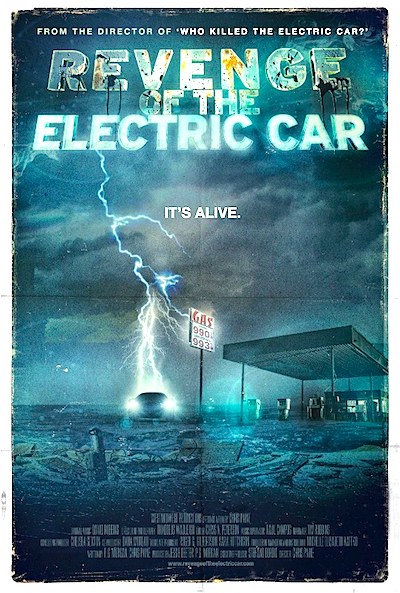
By Joe Bendel. In Terminator 2, the villain of the previous film comes back as the hero of the sequel. Such is also the case with Chris Paine’s latest film, except it is a documentary. The freshly reformed protagonist? General Motors. The times just might be changing after all in Paines’ Revenge of the Electric Car, which premiered recently at the 2011 Tribeca Film Festival.
According to Paine’s Who Killed the Electric Car, despite enthusiastic driver feedback, GM recalled their experimental EV-1, while twisting its mustache and laughing maniacally. Instead, they ramped up production on Hummers. The end, or is it? Fast-forward a few years and meet Bob Lutz, the Vice Chairman of the automotive giant. The car executive’s car executive, Lutz is no tree-hugger. Yet, like Saul on the road to Damascus, Lutz fundamentally changed his mind about the feasibility and desirability of electric cars. Only Lutz has the prestige to put GM back in the electric business and the guts to allow their old nemesis to document it.
Revenge has other protagonists, like Elon Musk, the tech-centric entrepreneur, who made his fortune with Pay Pal before starting Tesla Motors. Sleek and striking, these sports cars are probably too elite to change the world, but they ought to make electric cool. Unfortunately, Musk has trouble filling customer orders (including Paine’s). As more mass market competition, Nissan chairman Carlos Ghosn has “bet the future” of his company on electric, but that shoe has yet to drop.
It is important to note, none of these ventures are the result of government mandates. Indeed, they are highly speculative ventures that might just short circuit careers and fortunes. To his credit, Paine himself gives due credit to the captains of industry and entrepreneurs of Revenge. Though he retracts nothing from his previous film, it is clear he and pre-government takeover GM made a lasting peace.
Of course, Bob Lutz is a major reason why. Although Paine probably has a naturally affinity for the Silicon Valley-based Musk, Lutz’s curmudgeonly charm dominates the film. The camera loves the cigar chomping old school executive far more than the icy Ghosn or the cerebral Musk. (While Revenge eventually addresses the government bail-out, most of the GM segments deal with Lutz’s early championing of the hitherto underwhelming Volt.) Continue reading LFM Review: Revenge of the Electric Car @ Tribeca 2011