By Joe Bendel. Nearly any art the Soviets would suppress, Igor Savitsky collected—using their money. In a remote corner of Central Asia, Savitsky built the Nukus Museum to house an extraordinary collection of Soviet modernist and Uzbekistani folk art. This unlikely institution and its visionary founder are introduced to the world at-large in Amanda Pope and Tchavdar Georgiev’s fascinating documentary, The Desert of Forbidden Art, which opens today in New York and next week in Los Angeles. Continue reading Suppressed Soviet Art: LFM Reviews The Desert of Forbidden Art, Narrated by Ben Kingsley
Category: Watch Movies!
LFM Review: Time of Eve @ The New York International Children’s Film Festival
By Joe Bendel. As usual, Isaac Asimov got it right. In the future, robots follow his three laws. However, there are still a lot of grey areas for androids, including the very nature of their existence. Two high school students grapple with the notion of human-android relations in Yasuhiro Yoshiura’s Time of Eve, a surprisingly smart science fiction anime feature adapted from his webseries, which screens during the 2011 New York International Children’s Film Festival. Continue reading LFM Review: Time of Eve @ The New York International Children’s Film Festival
What a Revolution Should Look Like: The Power of the Powerless
By Joe Bendel. Initially, the student-driven revolution against Czechoslovakia’s hardline Communist government seemed hopelessly naïve. In a mere eleven days, the humbled regime relinquished their dubious claim to power, clearing the way for democratic elections. Unlike the current Middle Eastern “Days of Rage,” it all transpired without demonstrators committing any sexually, ethnically, or religiously motivated acts of violence. In fact, whether Havel and the Velvet Revolution were too forgiving of their former oppressors is one of the questions raised in Cory Taylor’s documentary, The Power of the Powerless, which opens this Friday in the Los Angeles area. Continue reading What a Revolution Should Look Like: The Power of the Powerless
Jafar Panahi (Not) at The Asia Society: The Circle
By Joe Bendel. It is good to be a man in Iran, provided you do not care about religious, political, or economic liberty. However, women must endure a profoundly misogynistic and frequently brutal society that regards them as little more than the chattel of men. Jafar Panahi confronted the unjustness of Iran’s treatment of women directly in The Circle, the winner of the 2000 Venice Film Festival’s Golden Lion prize – and a film which was promptly banned in Iran. Not content to stop there, the Iranian government has recently barred Panahi from further filmmaking for the next twenty years and sentenced him to six years in prison. Indeed, Panahi’s circumstances only heighten the poignancy of The Circle, which screens this Friday as the concluding film of the Asia Society’s retrospective-tribute to the persecuted filmmaker.
Solmaz Gholami (remember that name) has just given birth to a healthy baby girl. This should be happy news, but her mother is distraught. The in-laws were expecting a boy and will surely abandon their daughter-in-law and grand-daughter. The obvious high school science fact that it was the husband who failed to supply the Y chromosome is lost on such medieval fundamentalists. As Gholami’s mother seeks help from her family, Circle peels off, focusing on its next set of characters.
Three women have just been released from prison on unspecified “morals” charges. However, the Iranian system sets them up in a perverse Catch-22, kicking them loose without the necessary identification papers should they be stopped once again by the police (who are definitely out hunting for women in their situation). Lacking a male chaperone, sweet-tempered Nargess cannot take the bus trip back to her provincial home. Despondent, she seeks another friend, Pari, an escapee with even greater problems. She is four months pregnant with the child of her executed lover. From Pari, the chain continues, introducing a desperate mother and a woman arrested as a prostitute (perhaps not without some justification in her case), who ultimately brings the story to its symmetrical conclusion.
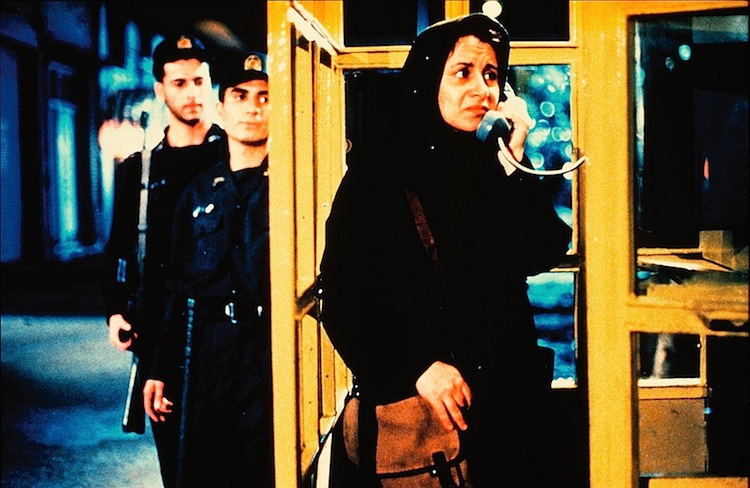
Sexism is a wholly insufficient term for the abuses Circle dramatizes. A stinging indictment – but also an honest, frequently moving human drama – it is not hard to see how it ran afoul of the state censors. Yet the film is not just a testament to Panahi’s artistic integrity. The cast deserves tremendous credit, especially those playing fallen women while living under a literal-minded fundamentalist theocracy. Though Circle is the only credit listed on IMDB for many of the actresses, their work has a powerful immediacy. They are frighteningly believable. Perhaps most haunting is Nargess Mamizadeh as her namesake. Young and innocent, to paraphrase the tagline of one of Circle’s international posters, she could only be guilty of being a woman.
To be banned by the mullahs might be a greater accolade than the raft of awards Circle won on the international festival circuit. Of course, the repercussions for Panahi have been severe. A truly bold film, Circle has only appreciated in importance and relevance with the regime’s campaign against the filmmaker. Highly recommended, it screens this Friday (3/11) at the Asia Society—and once again, tickets are free.
Posted on March 7th, 2011 at 10:01am.
LFM Review: Cannes Palme D’Or Winner Uncle Boonmee Who Can Recall His Past Lives
By Joe Bendel. An old commie hunter, Uncle Boonmee is haunted by spirits. However, his ghosts are largely benevolent, seeking to comfort Boonmee during his final days. Rife with magical realism but deliberately toying with narrative structure, Apichatpong Weerasethakul’s Cannes Palme D’Or winning Uncle Boonmee Who Can Recall His Past Lives is now playing in New York at Film Forum and elsewhere around the country in a limited art house release.
Boonmee is slowly dying from a humiliating kidney dysfunction. He is faithfully attended by his Laotian servant Jai and the ghost of his deceased wife Huay, among others. Even his long lost son Boonsong pays his final respects, despite having transformed into a red glowing-eyed monkey spirit, lurking the dark heart of the jungle with his beastly cohorts.
It has been an eventful life, but it is nothing compared to Boonmee’s visions of his previous incarnations, particularly an episode in which a mystical catfish ravishes a self-esteem-challenged princess. Consistently obscure throughout Recall, Weerasethakul never explicitly spells out Boonmee’s role in this Leda-like tale, but since the lagoon is described as the place where Boonmee’s lives began, it seems safe to assume there is some fishy DNA in his karma.
Though Boonmee ruefully suggests his current bad karma stems from his past anti-Communist military activities, perhaps he should ask the Cambodians about what he helped spare his countrymen (“you did it for your country,” his sister-in-law Jen reminds him). Regardless, Weerasethakul’s somewhat veiled commentary is so deeply buried under multiple layers of symbolic meanings and narrative gamesmanship, it is doubtful Recall will inspire many viewers to spontaneously erupt in a rendition of “The Internationale.” Instead, those so inclined will probably break the film down into the parts they can deal with, whether that might be the animatronic catfish or Buddhist reincarnation themes.
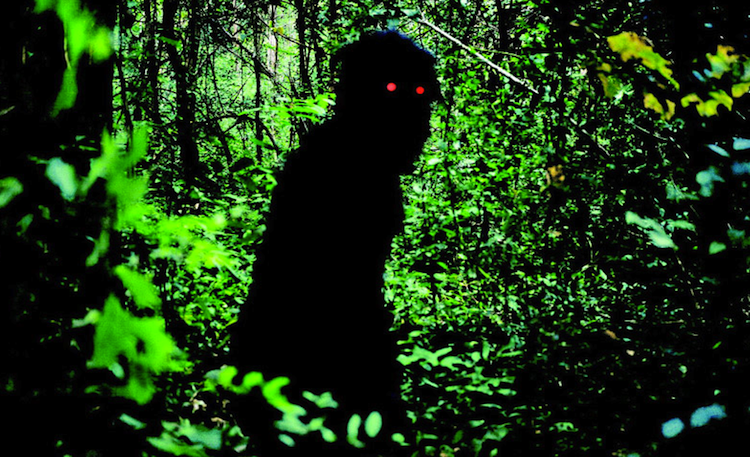
Of course, there is something problematic about a film’s whole, if it is less than its constituent parts. Between its double-secret allegories, nonlinear forms, and deliberate stylistic shifts, Recall is so busy displaying a self-conscious artiness, the rain forest gets lost for the trees. In fact, Recall along with the experimental companion short Letter to Uncle Boonmee were conceived as part of Weerasethakul’s multi-media, multi-platform project Primitive. Indeed, there are times when the static nature of Recall and particularly the narrative-free Letter seem more closely akin to installation videos than stand-alone films.
Though the late reappearance of characters from Weerasethakul’s past films might be enriching for those in the know, bringing things full circle, it further limits the film’s ability to connect with average well-meaning audiences. Still, Thanapat Saisaymar manages to express something fundamentally and universally human as the dying Boonmee, while Jenjira Pongpas also adds a bit of grace to the proceedings as Jen.
Obviously, Recall is a film for hardcore art-house and festival audiences. It boasts some reasonably nice performances, but it thoroughly confuses the distinction between avant-garde provocation and portentous pretention. A film that does not live up to its festival acclaim, Recall is now playing in New York at Film Forum and elsewhere in limited release.
Posted on March 4th, 2011 at 1:42pm.
The Sartorialist: Feeding the Visual Sense
By Govindini Murty. In honor of Fashion Month, I thought it would be fun to introduce Libertas readers to one of my favorite fashion/street-photography sites, The Sartorialist. Founded in 2005 by Scott Schuman, The Sartorialist is one of the most visually-inspiring sites out there. Schuman has been doing an exceptional job recently covering the New York, London, Milan, and Paris fashion shows. I’ve included a favorite look he captured from the Gucci show here, and other striking shows he’s covered include the Marc Jacobs show and the Altuzarra show in New York. Back in January Schuman also covered the men’s collections in Florence (where Luca Rubinacci epitomized the Italian style) and Milan, where the most elegant presentation was the Bottega Veneta show.
Of course, Schuman covers a lot more than runway shows – his main talent is as a street-style photographer – but we’ll get to that in a moment.

Jason and I often speak about the importance of feeding the visual sense. As filmmakers and creative people, it’s extremely important to think about the image as much as about words, dialogue, and ideological meaning. That is why we here at Libertas make the effort to provide you with a site that is as appealing to look at as it is thought-provoking to read.
I found out about The Sartorialist about a year and a half ago from an article in British Vogue. Scott Schuman started the site in 2005 by posting photos he had taken of the quirky and chic people he encountered on the streets of Manhattan. The Sartorialist attracted more and more admirers, including many fashion industry professionals who turned to the site to see what was happening on the street-level in fashion. Within just a few years Schuman has become a fashion force to be reckoned with. The Sartorialist now receives more than two million unique visitors a month and Schuman’s photos are on the inspiration boards of major fashion houses around the world. Schuman has also been named one of Time Magazine’s Top 100 Design Influencers and he has been profiled in numerous fashion magazines and newspapers (read an LA Times profile here and an article in The London Times). In 2009 Schuman also published a terrific book of his street-style photography. Continue reading The Sartorialist: Feeding the Visual Sense