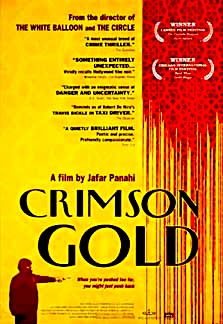
By Joe Bendel. The Iranian government’s record on human rights is certainly lacking, but anything less than a completely equitable distribution of the country’s vast oil revenues must represent the highest form of hypocrisy. Indeed, the Islamic Republic stands so charged in Jafar Panahi’s Crimson Gold, the winner of the Un Certain Regard Jury Prize at the 2003 Cannes Film Festival. Unfortunately, social criticism is a dangerous proposition in Iran. It earned Panahi a six year prison sentence and a twenty-year filmmaking ban. Needless to say, Panahi will not be in attendance when Crimson screens this Friday as part of the Asia Society’s retrospective-tribute to the persecuted filmmaker, but its depiction of a contemporary Iran illiberal in nearly every way speaks volumes.
There is something profoundly unsettling about Hussein. Though he walks through life in a haze, a little like James Franco at the Oscars, there is a great deal of anger and resentment roiling below the surface. We know right from the start, it is not going to work out for him. Through the circular narrative of celebrated Iranian director Abbas Kiarostami’s screenplay, the audience witnesses the events that drove Hussein to his tragic hold-up attempt.
Hussein and Ali, the brother of his fiancé, work as pizza deliverymen and dabble in a bit of purse-snatching. One otherwise unremarkable purse holds a receipt for an extravagantly expensive necklace. Intrigued, they proceed to the high-end jewelry store out of curiosity, only to be turned away as the low class riffraff they so obviously are. Hussein’s resulting umbrage will be his undoing, eventually leading us back to where the film started, but the getting there will be both oppressively naturalistic and at times surreal.
Hussein is one of the Islamic Republic’s disposable people, a psychologically traumatized Iran-Iraq War veteran living in abject squalor. However, the mobility of his job allows him to observe both the glaring disparity between the have’s and the have-not’s, as well as the morals police at work. Crimson truly captures the absurdity of contemporary Iran when Hussein tries to deliver his pies to a scandalous party featuring verboten dancing between the sexes, only to be waylaid by the cops waiting outside to arrest each sinner as they leave. One of Crimson’s inconvenient ironies is the rigid fundamentalism of Hussein himself and his desperately poor neighbors.
Iranian filmmaker Jafar Panahi.
Reportedly, Hussein Emadeddin was a nonprofessional actor living with paranoid schizophrenia when Panahi cast him as Crimson’s protagonist. Unlike the typical Hollywood-indie portrayal of mental illness, Emadeddin is never showy in the role. All his energy seems to be directed inward rather than outward. Beyond convincing, he is frankly eerie to watch lumbering through the margins of Iranian society—a ticking time-bomb waiting to explode.
In America, it is a compliment to call Crimson a challenging film. In the mullahs’ Iran, it constitutes a prison sentence. A pointed attack on hypocrisy and a somewhat more circumspect critique of Iranian social controls, Crimson is also compelling tragedy, deftly executed by Panahi. Worth seeing as a film in its own right, Crimson is only too timely given the circumstances of its director. Highly recommended, it screens this Friday (3/4) at the Asia Society and once again, tickets are free. In addition, the Society will host a panel discussion on Panahi and free expression in Iran (or the lack thereof) that will also be simultaneously webcasted here at AsiaSociety.org/Live.
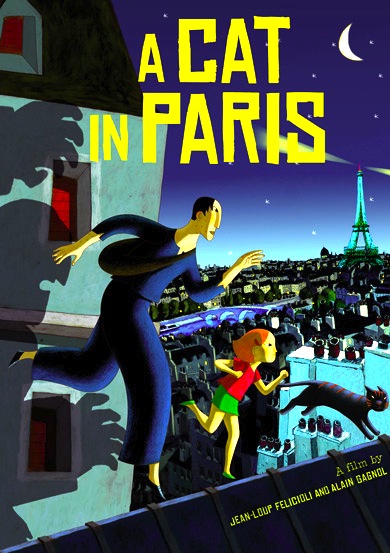
By Joe Bendel. Paris is a playground for an adventurous cat like Dino. By day, he is the loyal tabby of the police superintendent’s daughter. By night, he joins the nocturnal adventures of an actual cat burglar, climbing the city’s ornate masonry and gothic gargoyles. The City of Lights rarely looked as beautiful on the big screen as it does in Alain Gagnol and Jean-Loup Feliciolli’s animated feature A Cat in Paris (trailer here), which has its American premiere at The 2011 New York International Children’s Film Festival.
Young Zoe has not spoken a word since her father was murdered by gangster Victor Costa. Her copper mother is too busy working the case to help her adequately work through her grief. She spends most her time with Dino, who enjoys bringing her little presents, like small dead animals and the occasional diamond bracelet. One night Zoe follows on Dino as he slinks off to join the Rafflesesque Nico, only to stumble across the Costa gang. The chase is on, across the stylishly rendered Parisian cityscape.
The hand-drawn Cat is a wonderful antidote for the mass-produced computer animation constantly dumped into multiplexes. These figures have an idiosyncratic look that deliberately evokes a sophisticated Parisian sensibility. If Toulouse Lautrec was resurrected to craft an animated film, he would probably look up Gagnol and Feliciolli.
Indeed, the city is an integral part of film, right down to its fitting conclusion at Notre Dame. Though clearly produced with young viewers in mind, the romantic urban backdrops, the hat-tips to film noir, and the jazz-influenced soundtrack (including a vintage Billie Holiday rendition of “I Wished on the Moon”) will keep parents and other ostensive adults quite engaged. A well constructed feature, Gagnol and Feliciolli maintain a brisk pace, while showing the action from dramatic angles that further heightens the noir appeal.
Cat is a thoroughly charming film with genuine heart and just enough attitude to avoid cloyingness. Though admittedly brief at sixty-five minutes, it packs a lot into that time, including some very cool closing credits. NYICFF and gKids have a good eye for animated features, having previously selected intelligent and artfully crafted features like Sita Sings the Bluesand In the Atticfor previous festivals. The tradition continues this year with Cat and some first-rate anime imports. Highly recommended, Cat screens at NYICFF on March 5th, 6th, 12th, 13th, and 19th, but it appears tickets are only still available for Saturday the 12th, so act fast.
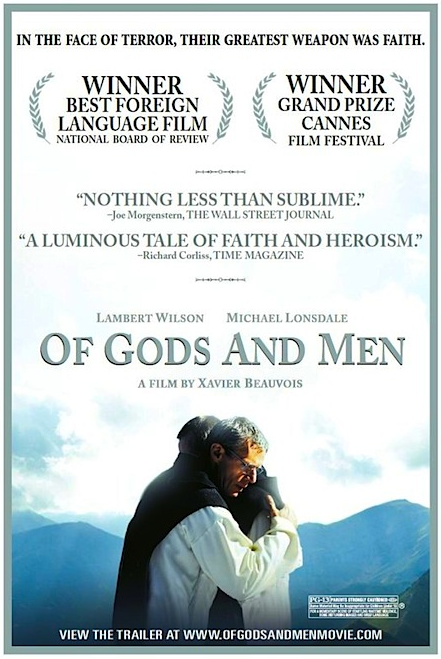
By Joe Bendel. They lived in perfect harmony with their Muslim neighbors. Their mission was one of charity, conducted with tolerance, yet seven of their ranks were executed in 1996, either by Islamist guerillas (who claimed responsibility) or the Algerian army in an attempt to cover up a botched rescue attempt—opinions vary. Though a small group of French Trappist monks knew they were in harm’s way, they went about their final days just as they always had. Xavier Beauvois captures their faith and fellowship with genuine sensitivity while trying to finesse the worldly hatreds that ensnared them in his thinly fictionalized Of Gods and Men, the 2010 Cannes Grand Prix winner, which opens in New York and Los Angeles today.
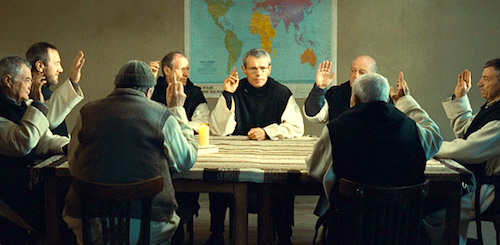
They do not reside in seclusion, but are actively engaged in their adopted community. The eight Trappists of Tibhirine do many good works, yet their daily existence is still comparatively quiet and meditative, filled with prayer and liturgical singing. Brother Luc runs the free clinic and distributes clothes to the needy. Brother Christian is a learned scholar of Islamic theology. Brother Christophe struggles with his faith, yet their provincial corner of Algeria is the only place he feels a sense of belonging.
Unfortunately, the world around them is far from peaceful. As French Christians, they are prime targets for the Armed Islamic Group of Algeria. Fearing their presence will attract trouble, the Algerian government wants them to evacuate. However, many of their neighbors want them to stay, believing only the monks’ presence has protected them from the atrocities reported throughout the countryside. The dilemma for the monks is obvious: what course of action is most consistent with their mission and the tenets of their faith?
Working closely with monastic advisor Henry Quinson and choirmaster François Polgar, Beauvois renders their not-so cloistered life with respect and scrupulous attention to accuracy. The issues of faith the monks grapple with are serious, not just because of their obvious life-and-death implications. Indeed, Beauvois and co-screenwriter Etienne Comar offer the most insightful and compelling depiction of Christian monasticism seen on-screen since Into Great Silence, a film Men somewhat resembles in tone – despite the former being a documentary about Carthusians.
As befitting men of God, the monks forgive their captors (and likely executioners). It is their final act of Christian charity, explicitly elucidated in the concluding narration of Brother Christian’s journal. However, Beauvois’ constant pleas to distinguish Islam from Islamists run the risk of protesting too much. Frankly, he somewhat undercuts the feelings of humanist empathy and solidarity inspired by his graceful portrayal of the Trappists by fetishizing their murder as an act of martyrdom on behalf of their Muslim murderers. As not just men of the cloth, but as those trespassed against, it is their place and perhaps their highest calling to forgive. That right is not ours to exercise.
From "Of Gods and Men."
Despite the agenda ultimately appended to Men, it is a finely crafted film. Caroline Champetier’s warm lens finds the weathered beauty in the Algerian land and its people. Beauvois’ use of both silence and Polgar’s arresting chorale music is equally adept. Yet, it is the dignity and intelligence the cast invests in the monks that are redemptive above and beyond any pat message tacked onto their tragic story. Truly, the eight principles give career performances, but veteran French character actor Michael Lonsdale is a genuine standout as Brother Luc – while Lambert Wilson effectively centers the film as wise Brother Christian.
These are men, albeit of God, but men none-the-less, rather than symbols. The greatest aspect of Men is its success in delineating the monks as characters and conveying the distinct ways Christian faith manifests itself through their callings. Though it requires time to contemplate and digest, in the final analysis Men is a quietly moving film of considerable substance. It opens today (2/25) in New York at the Landmark Sunshine and next week in Los Angeles at Laemmle’s Playhouse 7.
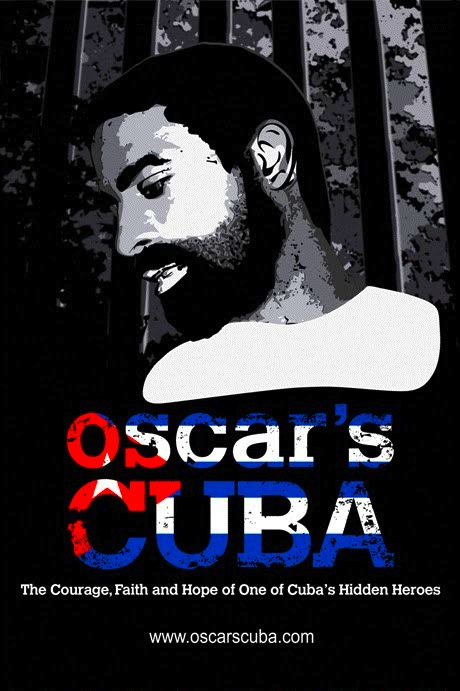
By Joe Bendel. It is not hard to see why the Castro brothers fear Dr. Oscar Elías Biscet. A medical doctor with commanding leading man looks, Dr. Biscet has been a selfless and tireless champion of human rights in Cuba. In short, he is everything they are not, which would make him a formidable political rival if Cuba were a free democracy.
Of course, this is not the case. Imprisoned for years, usually in solitary confinement, Dr. Biscet has become a unifying symbol of hope and non-violent resistance throughout the island gulag, as filmmaker Jordan Allott documents in Oscar’s Cuba, a selection of the 2011 John Paul II Film Festival, which has a special screening this coming Wednesday in Las Vegas at the Clark County Library Theatre.
When allowed her brief bi-monthly visit, Dr. Biscet’s wife Elsa Morejon always brings him toilet paper, because his Communist captors refuse to supply such everyday staples necessary for basic human dignity. This ritual encapsulates the essence of the Cuban police state. However, it has not broken Dr. Biscet’s spirit according to those who have met him in prison. No stranger to Castro’s dungeons, thirty-six days after serving a three year prison sentence, Biscet was swept up again in the notorious 2003 Black Spring round-up of seventy-five Cuban dissidents. To this day, he remains in a dark, confined, unsanitary cell.
Born shortly after the unsuccessful Bay of Pigs invasion, Biscet has lived his entire life under Castro’s regime. Yet, the dissident doctor has always maintained a profound Christian faith. In fact, much of the pro-life Biscet’s activism began in protest of the Communist government’s policies of forced abortions – and even infanticide – of premature newborns to bolster their internationally vaunted infant mortality statistics. He would become Cuba’s leading advocate of democratic reform and a proponent of non-violence, often referencing the works of Martin Luther King, Jr. and Henry David Thoreau.
Though not able to talk to the man himself (for obvious reasons), Allott interviews many of Biscet’s former prison-mates and fellow human rights activists, without the sanction or supervision of the Cuban regime. We also hear from former Cuban political prisoner and U.S. Ambassador (to the UN Commission on Human Rights) Armando Valladares, a figure well worthy of his own documentary.
Dr. Biscet & his wife.
While clearly produced to spur grassroots activism, Allott still earns props for his on-the-spot undercover reporting, capturing first-hand the unsavory realities of Cuban life, like Castro’s thuggish flash-mobs sent to intimidate dissidents and their families. Jazz and Afro-Cuban music lovers will also appreciate the original score composed by bandleader-defector Arturo Sandoval, Dizzy Gillespie’s close collaborator and heir as the king of the trumpet’s uppermost registers.
Far too much of Oscar’s Cuba will come as a revelation to general audiences who rely on the absentee media for international news. Highly informative, but also an inspiring portrait of one man’s faith, courage, and dignity in the face of oppression, Oscar’s Cuba was a truly fitting selection for the JP2FF. Recommended along with a prayer for Dr. Biscet and his colleagues, Oscar’s Cuba screens this coming Wednesday (3/2) in Vegas.
By Jason Apuzzo. • The biggest news since our last Cold War Update! was the debut of the trailer (see above) for Apollo 18, produced by Timur Bekmambetov. I can’t say that I was all that impressed with it; the movie looks more or less like Paranormal Activity on the Moon, and otherwise far inferior even to what Michael Bay seems to be doing, re: Apollo missions in Transformers 3. The trailer looks cramped and claustrophobic, and plot-wise a bit too obvious in terms of where it’s going. None of the characters jumped out at me as being interesting – merely as victims in a standard-issue horror scenario.
Also: I don’t mind the ‘found-footage’ motif, but what bothers me here is that the filmmakers don’t seem to have actually nailed what Super 8 film looked like back in the day. Super 8 was generally grainier, but also (as I recall) had slightly deeper-than-usual color saturation. In any case, I’m a bit underwhelmed by what I’m seeing thus far with this film. Perhaps they need to find some piranhas on the Moon …
• Christopher Nolan has announced that after Batman 3, he essentially wants to do a hit-job biopic of Howard Hughes. That, at least, is the strong implication from this piece over at New York Magazine, which states that Nolan’s Hughes-pic “would focus on the freakier decades of Hughes remarkably secretive and OCD-addled life.”
This captures, in essence, what I dislike so much about Nolan. Howard Hughes was an extremely innovative, daring and ultimately tragic individual – and easily one of the most compelling American figures of the twentieth century. (He was also, incidentally, an ardent anti-communist and Cold Warrior.) Martin Scorsese’s biopic of Hughes, starring Leonardo DiCaprio, only lightly scratched the surface of Hughes’ accomplishments and refined allure – but I’m glad Scorsese at least got a crack at the material, because what Nolan is sure to give us is another of one his epics of adolescent derangement (The Dark Night, Inception, Memento, etc.) for which he’s becoming so famous.
Olga Kurylenko as a Russian Spy.
What disgusts me here is that Hughes’ mental and emotional troubles later in life – which were likely genetic in nature, and beyond his control – were also ones that he went to great lengths to conceal, precisely in order to avoid this kind of exploitation. Like a graverobber, though, Nolan apparently can’t resist the temptation to plunder them – his new film project, incidentally, will be based at least partially on handwritten memoranda actually burglarized from Hughes’ office – and so now Nolan will drag us through the garbage pile of Hughes’ later life in order to make whatever trite points he has in mind. It’s ghoulish – but typical for Nolan.
• Olga Kurylenko has a spread in the current issue of the Russian Glamour. It’s pretty good, but I like this picture to the right better.
• According to Kiefer Sutherland, the 24 movie is still very much on – and Tony Scott is still apparently interested in doing it. They’re still waiting on a script, though. Scott, incidentally, has also been attached to the Top Gun sequel.
And speaking of Top Gun, writer Mark Harris in GQ is currently blaming Top Gun for ruining contemporary Hollywood cinema. Harris recycles the oldest cliche in the book: that the nefarious forces of Lucas, Spielberg and Bruckheimer have ruined Hollywood forever, when the industry should rightfully have been left to the likes of Hal Ashby and Mike Nichols. Harris – who reads like a kind of poor man’s Peter Biskind – also doles out more trendy, fanboy love to Christopher Nolan.
Memo to Mr. Harris: had the industry been left to the likes of Hal Ashby and Mike Nichols – admittedly fine filmmakers – Hollywood would’ve gone bankrupt, and we would still be shooting movies in Super 8. Sorry, but that’s how it is. Incidentally, if a genuinely innovative filmmaker like Hal Ashby came up nowadays, people like Harris would probably be the first to attack him.
• The makers of John Milius’ anti-North Korean Homefront video game recently talked to The Wall Street Journal. Here are some choice quotes from the WSJ piece:
Homefront is less about vilifying North Korea than about placing the player within an occupied America. The 1984 film “Red Dawn,” which Milius directed and co-wrote, was a key influence. In “Red Dawn,” a group of high schoolers form a guerrilla resistance against an invading Soviet Union and its allies. The uncanny image in the film of paratroopers landing in a school field, says Votypka, sums up the feeling Kaos has attempted to capture in Homefront—that of a gross violation of boundaries. Invasions are not supposed to happen on American soil, and as such must inspire a certain gut reaction in the player.
This is certainly true of Homefront’s opening minutes. The game begins with a dizzying pastiche of real and simulated news footage about foreign conflicts and the failing economy, blurring the line between fact and fiction. Secretary of State Hillary Clinton, speaking in a televised broadcast about last year’s North Korean torpedo that sank a South Korean ship, is the very first image. The rest of the video sequence concerns the game’s near-future setting and backstory but is hard to parse. What it does convey is a sense of urgency and imminent danger. When the player is subsequently given control as Robert Jacobs, standing in his home in occupied America, it isn’t long before Korean soldiers drag him out and onto a bus headed presumably for a prison camp.
Like a long establishing shot in a film, the bus ride sets the scene, but lets the player move the camera. Looking out the windows, one can see Korean guards battering young men in front of a playground, spot a large “Store Closing” sign, and watch Koreans gun down a young boy’s parents as he begins to sob. The reaction, of course, is anger on top of helplessness. “When you play most military shooters, you get the sense that there’s a war overseas somewhere, and the military commander has told you to go take these objectives,” says Votypka. “[This game is] less about trying to associate with some military character that you have very little in common with. Homefront is much more personal, because it’s about how you would react in this situation.”
Cool. Not to pick a bone with the WSJ writer, but actually the game rather obviously does seem to be about “vilifying” the North Korean regime – which is fine by me. The game certainly sounds intense, not to mention hard core in its depiction of our current antagonisms with Pyongyang. Homefront debuts March 15th.
Russian model Irina Shayk.
• In other Cold War News & Notes: some footage has leaked of Leonardo DiCaprio filming Clint Eastwood’s Hoover biopic; January Jones is talking more about X-Men: First Class (see here and here); more images have leaked of Meryl Streep playing Margaret Thatcher; word comes that Kevin Spacey was almost set to play the villain in the new Bond film (nooo!); THR has a review up of the new documentary just premiered in Berlin about the Mikhail Khodorkovsky trial; THR also talks to the German director of the new Red Army Faction movie; the creators of Atlas Shrugged have released a clip from the film that looks like something out of Dallas; and Tyrese Gibson is saying that Transformers: Dark of the Moon is going to be the best movie of the series. I certainly hope so. Special Note: As I’ve previously reported in our Invasion Alerts!, producer James Cameron and director Shawn Levy are apparently going to be remaking Fantastic Voyage in 3D. I’ll be reporting on this periodically here in our Cold War Updates!, since the original Fantastic Voyage was, in fact, a Cold War thriller about America and the Soviet Union racing to create technologies that could miniaturize their militaries for transportation purposes (an odd idea, when you think about it). What Cameron will be doing with this premise, God only knows.
 There is something profoundly unsettling about Hussein. Though he walks through life in a haze, a little like James Franco at the Oscars, there is a great deal of anger and resentment roiling below the surface. We know right from the start, it is not going to work out for him. Through the circular narrative of celebrated Iranian director Abbas Kiarostami’s screenplay, the audience witnesses the events that drove Hussein to his tragic hold-up attempt.