Tura Satana & American Cool

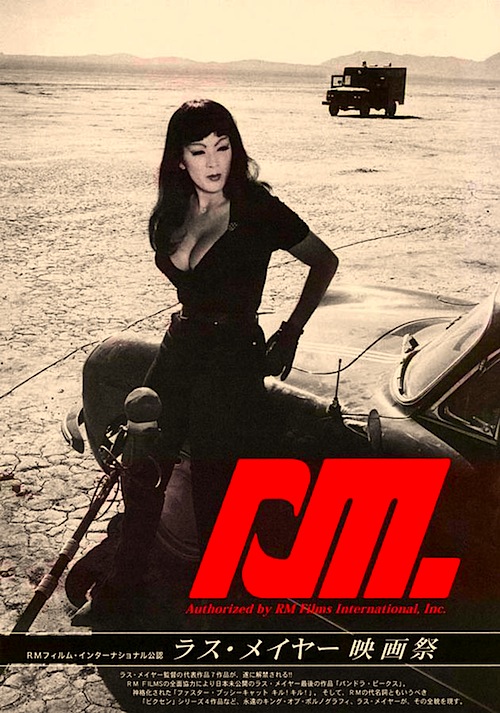
A behind-the-scenes photo of Tura in "FPKK."

By Jason Apuzzo. The great Tura Satana passed away this past Friday. Our condolences to her family, many friends and fans. She will be greatly missed. (Read the NY Times obit here, and classic film blogger Kimberly Lindbergs’ fine 2007 piece “Tura Satana: An American Icon”).

Govindini and I met Tura about two years ago at an event. I’m a great fan of Russ Meyer’s films, and of Faster, Pussycat! Kill! Kill! in particular, so I approached Tura to express my enthusiasm for her work. What I expected to be a brief exchange turned into an hour-long conversation, and I soon found myself snapping pictures of Tura with Govindini (they got on like a house on fire) and with the other Pussycat girls Haji and Lori Williams, and having a fantastic time. I talked with Tura about her incredible life – her hard upbringing, her Japanese family’s stint in the Manzanar internment camp, her romance with Elvis. In particular I remember her telling me how some of Elvis’ signature dance moves were actually lifted from her burlesque act.

She also talked a lot about her love of America, and the opportunities it had given her. Tura was intensely patriotic, and was not shy about expressing it. It was amazing to see that coming from someone who’d had such a difficult upbringing – a young life filled with violence, betrayal and a lot of pain. (More horror stories, more abuse and hard luck than I care to recount here.) Nonetheless, the impression I had of Tura that day was of a survivor with a very tough exterior – who had nonetheless preserved a tender heart, and a robust love of life.

For those of you who may not be familiar with her, Tura delivered what is in my opinion – and in the opinion of many others – the iconic performance of cult cinema, playing Varla in Russ Meyer’s Faster, Pussycat! Kill! Kill!. And for some bizarre reason, it’s the only really large role that Tura was ever given. This is a bit like not wanting the young Wilt Chamberlain on your basketball team. I’ve heard many explanations for her disappearance from the film scene after Faster, Pussycat – but none of them has ever made any sense to me. She seems so impossible to ignore.
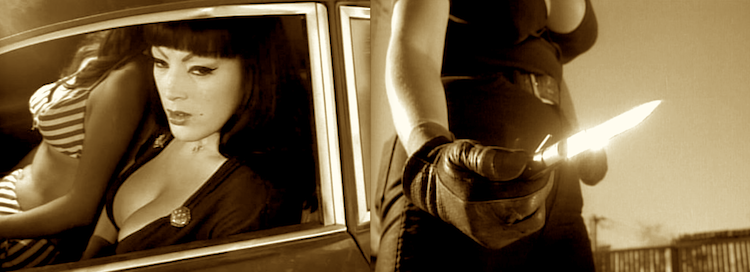
Images of Tura Satana from "Faster, Pussycat! Kill! Kill!"

The biggest tragedy of Tura’s career, one which Russ Meyer himself acknowledged, was that he and Tura didn’t continue to make films together. The mind reels to think of what those two could have accomplished, had they kept that partnership going.

In the very least, however, we have Faster, Pussycat! Kill! Kill!.

And on that subject, 1965’s Faster, Pussycat is easily the greatest cult film ever made – and the competition is not even close. Certainly one of the major reasons for the film’s success is Tura’s performance as Varla – and how does one describe her in that film? She’s like a force of nature – a category 5 hurricane – something primal, unstoppable, a torrent of violence, lust, desire, and mocking humor rolled into one. Imagine a Japanese Venus of Willendorf with bangs, dressed like Marlon Brando in The Wild One, puffing on a cheroot, bellowing quips into the desert air that seem like something out of a long-forgotten Bogart film. And then come the karate chops, the kicks and knives! Not exactly Bruce Lee stuff, but deadly nonetheless.
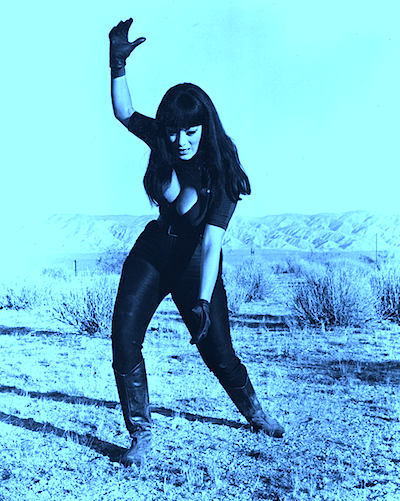
Publicity still for "Faster, Pussycat! Kill! Kill!"

The image of Tura Satana (has there ever been a name like that?) – dressed in black, leaning against her car in the high Mojave desert – has become one of those iconic images that end up on the dorm room walls of young guys in college … and increasingly young girls, as well. It’s a great American image, one of cool independence, not unlike the image that Steve McQueen or Clint Eastwood projected during that same period. It’s an image of what we all want to be, or should want to be – tough, self-reliant, skeptical, at home in the wild.

We don’t do ‘cool’ here in America very well, any more. I’m told by experts that we have a President who’s ‘cool,’ for example, but I don’t quite believe it. Cool people don’t get everything in life handed to them, and nobody handed anything to Tura Satana – except maybe Russ Meyer, who gave her that one role of a lifetime.

Since we still have that film, Tura will still be with us, reminding us of how cool all of us can be.

Somewhere in the afterlife, God and the Devil are probably fighting over credit for creating Tura Satana. God will win that one.

Footnote: Tura was a fan of Libertas Contributor Steve Greaves‘ music. Plus: I’ve embedded below the first 6 minutes of  Russ Meyer’s Faster, Pussycat! Kill! Kill! There’s never been anything quite like it.

Posted on February 9th, 2011 at 11:49am.
Delivering the Goods: LFM Reviews American Grindhouse

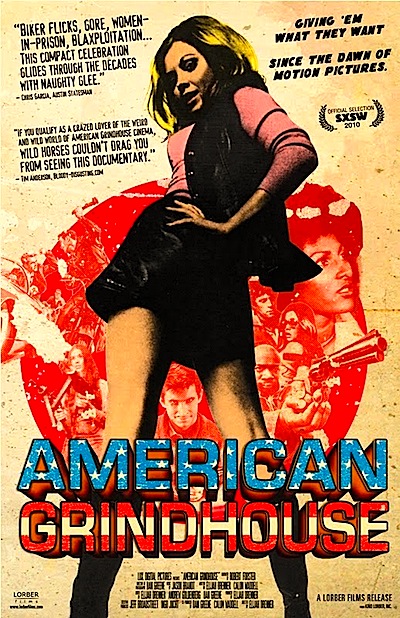
By Joe Bendel. It seems like every hipster filmmaker wants to make a retro-grindhouse movie these days, but the results are usually pretty lame. The truth is, real-deal grindhouse auteurs did not have time for posing. They had to get their shots before the cops shut them down. The subversive attitude of their oeuvre flowed organically from their dodgy working environment, thoroughly infusing the zero-budget cult films Elijah Drenner lovingly surveys in American Grindhouse, which opened last Friday in New York.

“Exploitation” films were independently produced movies with some grabby element to “exploit” which audiences could not otherwise find from mainstream studio fare. Though not necessarily limited to sex and violence, those were certainly the biggies. Drugs and circus freaks were also reliable hooks. Such films were typically booked into seedy, pre-Giuliani-era Times Square-style theaters, often playing continuously without formal start times (hence the grind in grindhouse).

Drenner and his battery of film scholars start with the silent era, when Universal hit pay dirt with Traffic in Souls, a rather sensationalistic story of white slavery – carrying the fig leaf of a progressive reform message. It established the template many exploitation filmmakers would profitably follow for decades, including the so-called “Forty Thieves” emerging in 1930’s.

Grindhouse surveys a number of rather self-explanatory sub-genres, like “birth of a baby” movies, beach party movies, faux nudist documentaries, “nudie cuties,” “roughies,” women-in-prison films, Nazi-exploitation (exemplified with class and distinction by Ilsa: She-Wolf of the SS), and the ageless blaxploitation picture. Amongst his many talking heads, Drenner notably scored sit-down interview time with Fred Williamson, of Black Caesar and Hell Up in Harlem fame, who looks and sounds as cool as ever.

While Grindhouse focuses squarely on the filmmakers, it is not a cheap tease. Indeed, many of the voluminous clips from the seminal classics under discussion are real eye-poppers. Still, Drenner maintains the right balance of (half-) serious cultural history and crowd pleasing naughty bits.

Well-stocked with wild stories and vintage scenes of pure lunacy, Grindhouse is a whole lot of fun, sort of like an old-school Hollywood Boulevard version of That’s Entertainment. Like the “birth of a baby” films it documents, Grindhouse is in fact educational, but its subject matter is definitely mature. Ultimately, it is a winning tribute to genuinely independent filmmakers, marginalized and even demonized though they might have been. Heartily recommended to those who already have a good idea what they will be getting into, Grindhouse opened this past Friday in New York at the Cinema Village.

Posted on Feburary 9th, 2011 at 11:41am.

Voices on the Street in Cairo

By Jason Apuzzo. Here is more interesting footage from the streets of Cairo, in this case from a documentarian named Oliver Wilkins.

There are reporters and documentarians who have been doing some excellent work in Egypt as this protest unfolds, professionals trying to capture the tenor of these demonstrations and the complex undercurrents driving them. You will see many different opinions expressed by the protestors in this video – not all of which I’m happy about, incidentally. In any case, it makes for interesting viewing.

Posted on February 8th, 2011 at 11:35am.

From Sundance to HBO: LFM Reviews Eugene Jarecki’s Reagan

By Joe Bendel. In an ironic way, President Ronald Reagan might have approved of the approach taken by his documentary profiler, Eugene Jarecki – at least in principle. While readily conceding Reagan’s personal virtues, Jarecki gives no quarter in the political arena. Such a strategy earned Jarecki Pavlovian praise for his ‘evenhandedness’ at the 2011 Sundance Film Festival, but it contributes little to the public discourse. Instead, Jarecki essentially offers viewers the same old canned talking points in Reagan, which debuts on HBO tonight.

Reagan in Hollywood in the 40s.

Frankly, Jarecki’s polemical Reagan is best when covering the early Reagan years. A better actor than generally acknowledged, Reagan was eager to serve his country during WWII. Unfortunately, he was nearly as blind as a film critic, which to his genuine regret kept him out of combat duty. So the metaphor Jarecki ultimately latches onto is Reagan the lifeguard, the vision-impaired teenager who pulled seventy-seven floundering swimmers to safety.

By contrast, when addressing political issues, Jarecki is far from an honest broker. He only cursorily discusses Reagan’s time as the Screen Actor’s Guild President, largely to speculate on whether the future president named names. Had he delved deeper, he would have examined Reagan’s alarm at the extent to which Communist and fellow-traveling factions had co-opted Hollywood’s unions and progressive organizations. Of course, this would have challenged long held articles of faith regarding Hollywood and the HUAC committee, which Jarecki obviously was not about to do. Better to play it safe.

As a result, this omission leaves Reagan’s evolution from Roosevelt Democrat to Reagan Republican (if you will) largely unexplained. Context is not a priority here, though. All viewers are really told about his predecessor Jimmy Carter, for example, is that Carter had the ‘courage’ to make his ‘malaise’ speech. The word “stagflation,” however, is scrupulously ignored. The Iranian hostages are discussed, but apparently only to illustrate Reagan’s providential good fortune with their fortuitous release.

Jarecki interviews some Reagan insiders, but his editorial hand is always obvious. Peter Robinson has a chance to discuss Reagan’s frequently-lauded talents as a communicator, but policy analysis is reserved solely for the President’s partisan critics. So what do you suppose they say happened to ‘the rich,’ for example, during Reagan’s tenure?

Reagan on the campaign trail in the 60s.

One can also see this formal balance but practical bias in the appearances of Reagan’s family. Michael Reagan is only seen playing a cheerleader role while conducting a Reagan-themed tour (just long enough for the audience to suspect he might be trading on his father’s name). Conversely, Ron Reagan is allowed long, thoughtful camera time to whittle away at his father’s political legacy. It is worth noting, though, that Jarecki’s film directly contradicts the junior Reagan’s claim that his father exhibited symptoms of Alzheimer’s while in office.

Despite the near constant criticism of Reagan, Jarecki never comes close to suggesting that the iconic president ever acted out of self interest or cynical calculation. Even during the Iran-Contra affair, the ‘lifeguard’ metaphor is too hard for him to shake. Indeed, this is Reagan’s ultimate saving grace – or failure, depending on one’s perspective. Further diminishing the film’s seriousness, the constant use of vintage 1980’s pop tunes, like “99 Luftballoons” to underscore Reagan’s nuclear policy, is rather shallow and clichéd. (Sadly, it seems Jarecki was not able to clear the Buggles’ “Video Killed the Radio Star” for a “Great Communicator” segment.)

Disappointing but not surprising, Jarecki’s Reagan does a disservice to its subject and to its audience. It airs tonight (2/7) on HBO, following its recent Sundance premiere.

Posted on February 7th, 2011 at 11:28am.


Watch Iranium Here FREE on Tuesday, February 8th

By Jason Apuzzo. We want to alert Libertas readers that Iranium, the controversial new documentary on the Iranian nuclear program – and a film about which we reported here several weeks ago – will be available for free viewing right here at Libertas (in the embedded player below) on Tuesday, February 8th. IMPORTANT: You must be one of the first 50,000 people to sign up in order to watch the film for free on Tuesday, February 8th, so make sure to sign up today!

As Libertas’s Govindini Murty reported here a few weeks ago, a screening of Iranium by the Free Thinking Film Society in Ottawa was recently canceled by the Library and Archives Canada after the Library received an official complaint from the Iranian government. (The screening was subsequently re-scheduled and took place yesterday.) A media firestorm blew up in Canada over the cancellation of the film’s screening – with the Prime Minister’s office, the Minister of Heritage Canada, and the Immigration Minister all getting involved and eventually backing the film’s screening. We’re pleased that Canada refused to be intimidated by official Iranian complaints.

Iranium is a 60 minute documentary featuring interviews with leading politicians, Iranian dissidents, and experts covering: Iran’s threat to peace in the Middle East, terrorism, and nuclear proliferation. The film documents the development of Iran’s nuclear capabilities, beginning with the Islamic Revolution of 1979 and the ideological leadership of Ayatollah Khomeini. The film then tracks Iran’s use of terror as a policy weapon, beginning with the U.S. Embassy hostage crisis, through Iran’s support of insurgent terrorists in Iraq and Afghanistan.

Iranium also deals with the Iranian regime’s brutal treatment of its own citizens, and the Iranian people’s desire to rejoin the international community. The film concludes by outlining troubling scenarios the greater Middle East and the Western world may face should Iran cross the nuclear threshold.

You can read more about the film here at its website.

Posted on February 7th, 2011 at 10:32am.

BREAKING: Lionsgate Acquires Uday Hussein Film The Devil’s Double for Distribution

Dominic Cooper and Ludivine Sagnier in "The Devil's Double."

By Jason Apuzzo. Deadline Hollywood reports today that Lionsgate has acquired North American distribution rights to the Sundance hit The Devil’s Double, director Lee Tamahori’s new gangster epic about Uday Hussein and his body double. Libertas’ own Joe Bendel saw The Devil’s Double at Sundance and loved it (see his glowing review).

The film stars Dominic Cooper as Uday, and Ludivine Sangier as his mistress Sarrab. [Side note: expect to see lots of pictures of Ludivine Sangier here at Libertas in days ahead.] For those of you not familiar with the film, here’s the official description:

The year is 1987 and Baghdad is the playground for the rich and infamous- where anything can be bought, for a price. When army lieutenant, Latif Yahia (Dominic Cooper), is summoned from the frontline to Saddam’s palace, he is faced with an impossible request – to be Iraq’s notorious Black Prince Uday Hussein’s ‘fiday ,’ his body double. With his family’s lives as well as his own on the line, his fate is decided. Latif begins his journey as Uday Hussein, a man as widely hated as he is powerful. As he learns to walk, talk and act like Uday, he experiences the extravagance of a world filled with fast cars, endless money, easy women, and deeply depraved violence. Knowing who to trust becomes a matter of life or death, as he battles to escape from his forced existence alongside Sarrab (Ludivine Sangier), Uday’s notorious concubine. In a dynamic and chilling portrayal of Latif Yahia’s autobiographical novel, THE DEVIL’S DOUBLE charts one man’s struggle in a world of bloodlust, power and seduction.

Congratulations to the filmmakers, and we look forward to the film’s release. Here’s an interesting interview below with director Lee Tamahori (Once Were Warriors, Die Another Day) about the film.

Posted on Feburary 3rd, 2011 at 2:14pm.