The Russian Ark Screenplay

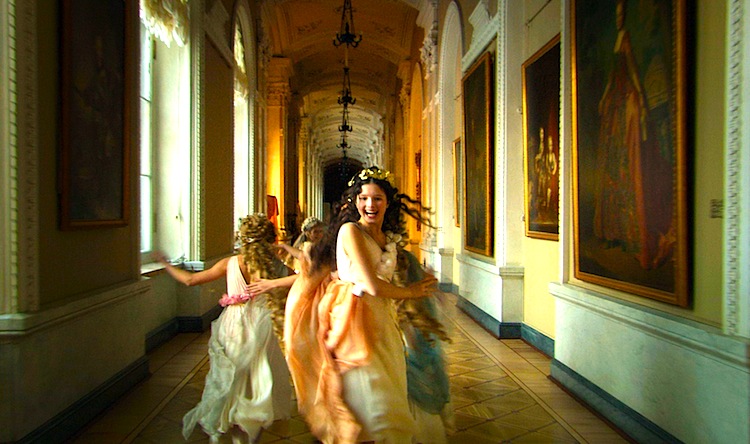
By David Ross. Aleksandr Sokurov’s Russian Ark (2002) is a marvel: a ninety-six-minute movie consisting of a single unbroken tracking shot. With a sensual fluidity unmatched except perhaps by Ophuls’ La Ronde, the camera follows two ghosts – one Russian, the other European, one earnest, the other ironic – as they stroll through the Hermitage Museum in St. Petersburg.

The centuries swirl gracefully about them, the twentieth century suddenly giving way to the nineteenth, the eighteenth suddenly giving way to the twenty-first, as if time itself were a gently shifting breeze. The film is pregnant with a wonderful faith that time is not an erosion, but an accretion, that some great memory catches the falling drop of the individual moment, that all is somehow gathered to the breast. As they make their tour, the ghosts maintain a patter of wry commentary and affectionate observation, humanists mingling in the parade of humanity. They have no urgent message to deliver and nothing to teach, thankfully; their pleasure is the film’s essential communication, though there is also a clouding of elegy. Meanwhile the camera makes a tour of its own, lingering on the splendid details of the palace: molding, gilding, ironwork, marble-work, drapery, china, crystal. The camera provides an implicit object lesson in the tradition of disciplined form that has made the beauty of the West, and this aspect of the film can only seem a terrible if inadvertent reproach. In comparison to the door handle or to the lace of a tablecloth, calmly wrought for the eye of God, whose discernment is infinite, our contemporary masterpieces – a Jackson Pollack, say, or the Guggenheim Museum in Bilbao – flail hysterically, as if the soul itself were abandoned and drowning.

To promote and honor the film – one of the greatest ever in my opinion – I have fully transcribed the dialogue and annotated some of the artistic and architectural detail. This task required perhaps fifteen hours of truly tedious labor. I drew upon and sometimes cribbed directly from Paintings in the Hermitage by Colin Eisler and The Hermitage Collections (2 vols.) by Oleg Yakovlevich Neverov, Dmitry Pavlovich Alexinsky, Dr. Mikhail Piotrovsky (who possibly figures in the film; see here and here).

It is sometimes difficult to identify who speaks what words, and I can’t vouch for the accuracy of my transcription in every instance. I look forward to receiving corrections and additional annotations from our conscientious and knowledgeable readers. Please consider the script below a first attempt to map the fluid, elusive drama of the film. Hopefully somebody will find it useful in its present, rough form.
Continue reading The Russian Ark Screenplay

Frantisek Vlacil at The Lincoln Center: The White Dove

By Joe Bendel. Like many contemporary Iranian filmmakers, the late great Franstišek Vláčil often focused on ostensibly apolitical subjects, like children and animals. Yet, as a filmmaker in the vanguard of the Czech New Wave, his work was still considered suspect by the Communist power structure. Though his career would be put on hold for six years following the 1968 Soviet invasion, the international acclaim greeting his 1960 feature film debut The White Dove promised great things at the time for the filmmaker, making it the perfect selection to launch Film Society of Lincoln Center’s Fantastic World of Franstišek Vláčil retrospective.

A group of doves is released in Belgium. On a small Baltic island, their handlers eagerly anticipate their return. However, young Susan’s bird has a late start due to a twinge of the wing. While detouring through Prague, the wheelchair-bound Miša’s pellet gun nearly proves fatal. Shamed by Martin, the artist in the next door apartment, he nurses the bird back to health, while Susan faithfully keeps watching the skies.

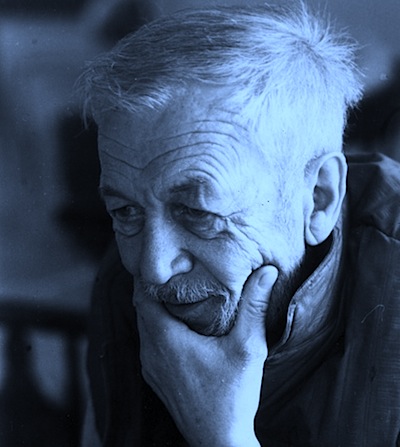
Franstišek Vláčil.

Dove is a deceptively simple story, involving several themes Vláčil would return to in later films, such as the bond between children and animals. Reportedly reluctant to overwhelm his youthful cast with extensive lines to memorize, Vláčil makes his points visually rather than verbally. Stark but sensitive, nearly every artful black-and-white frame lensed by cinematographer Jan Čuřík is suitable for framing. Indeed, it is an arresting film to behold, effectively contrasting the claustrophobic, urbanized Prague with the idyllic sun and sea of Susan’s Baltic isle. Adding further texture, composer Zdenek Liska’s spritely jazz interludes and more suggestive chamber music nicely underscore and reinforce the power of the film’s speechless moments.

Vláčil elicits some natural yet restrained performances from Karel Smyczek and Katerina Irmanovová, as the dove’s two youthful caretakers. He also captures the artistic impulse better in Dove than nearly any other film, raptly observing as Martin creates a series of works inspired by Miša and the injured dove (which are credited to Czech artists Theodor Pištěk and Jan Kablasa).

At times, Dove seems to suggest deeper allegorical significance, but Vláčil judiciously keeps it all rather obscure—though perhaps not obscure enough, in retrospect. (Whenever you have a cat named Satan hunting a peaceful white dove, it could be rather awkward explaining what each represents to the occupying commissar .)

Many have likened Vláčil’s films to poetry. Indeed, like a good poem (at least by Poe’s standards) Dove is relatively short at seventy-five minutes. Though it memorably evokes a child’s perspective, it is unquestionably high art cinema, better suited to the discerning connoisseur. A major work from a filmmaker under-exposed on the American film scene during his own lifetime, Dove kicked-off the FSLC’s welcome reappraisal of Vláčil’s films yesterday at the Walter Reade Theater.

Posted on February 3rd, 2011 at 12:17pm.

The Kennedys Lands at The ReelzChannel, Show Debuts April 3rd

By Jason Apuzzo. According to The Hollywood Reporter, Joel Surnow’s The Kennedys miniseries has finally found a home – at the ReelzChannel, where the show will premiere April 3rd.

This is good news, I suppose, but quite a come-down from what the initial ambitions for this series were. In the status-conscious world of Hollywood, this amounts to a body-slamming of everyone involved in the project – sort of like the LA Dodgers moving back to Brooklyn.

In any case, I suppose I will now have to actually find the ReelzChannel.

Posted on February 2nd, 2011 at 10:22am.

Unfairly Snubbed by Oscar: A Muslim Wife Breaking Away in When We Leave

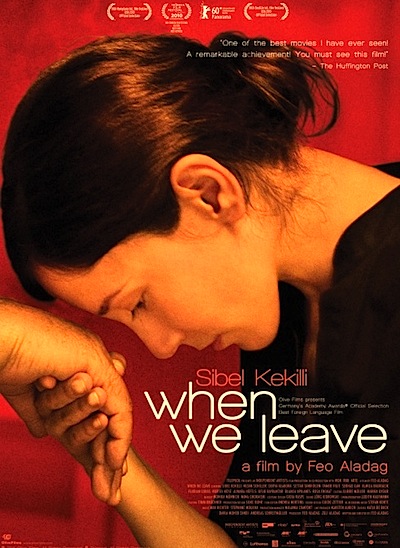
By Joe Bendel. Like many Turkish immigrants, Umay came to Germany in search of a better life for herself and her young son Cem. In their case, that meant getting away from her abusive husband Kemal. Unfortunately, she finds the traditional baggage from her home country is hard to shake in Feo Aladag’s When We Leave (trailer above), Germany’s unfairly overlooked official submission for best foreign language Oscar consideration, which opened Friday in New York and elsewhere.

Due to Leave’s framing device, we start the film under the assumption that things will not work out for Umay. Actually, we have no idea. A strikingly beautiful woman, Umay’s husband uses her as a domestic slave.  However, when he begins terrorizing their son as well, Umay decides to flee. At first, her family in Germany is delighted to see her, but they keep asking about Kemal. When her father Kader and older brother Mehmet learn the truth, they have only one word for Umay: “whore.”

Despite Umay’s protests, Kader makes it unequivocally clear Umay must return to her rightful owner, or consider herself banished from the family. While Umay must protect herself and her son, she cannot turn her back on the only family she has ever loved. Unfortunately, the warning of her friend proves tragically correct—her family will always choose their community over a mere daughter.

Leave is a truly intense film that frankly depicts all manner of crimes committed in the name of so-called ‘honor.’ We witness spousal abuse, abduction attempts, stalking, and worse. Yet, for Umay, the emotional isolation for her family is the hardest to bear.

The strikingly beautiful Sibel Kekilli deservedly won best actress honors at last year’s Tribeca Film Festival for her heartrending portrayal of Umay. An active supporter of Terre de Femmes, a German-based non-profit dedicated to Muslim women targeted with physical violence, Kekilli clearly drew from real life in her riveting performance. It is hard to watch at times as her Umay is spat upon (literally and figuratively) by her formerly loving family.

The unblinking intimacy of Aladag’s approach viscerally captures a wealth of unspoken nuances passing between characters. She also elicits some quite accomplished work from her supporting cast. As Umay’s German boyfriend Stipe, Florian Lukas adds a bit of depth to a part that could easily be dismissed as the schmucky nice guy. Yet perhaps the most surprising turn comes from Settar Tanriögen as Umay’s pained father, evoking a sense of high tragedy through Kader’s cowardice and conformity.

Frankly, it is something of a scandal Leave did not even make the nine film shortlist for the best foreign language Oscar. It is a powerful film, featuring a truly brave lead performance from Kekilli. Far superior to the five nominees announced last Tuesday, the remarkable Leave opened Friday (1/28) in New York at the Angelika Film Center.

Posted on February 2nd, 2011 at 9:51am.

LFM Sundance Review: Oscar-Nominated Incendies & Violence in the Middle East

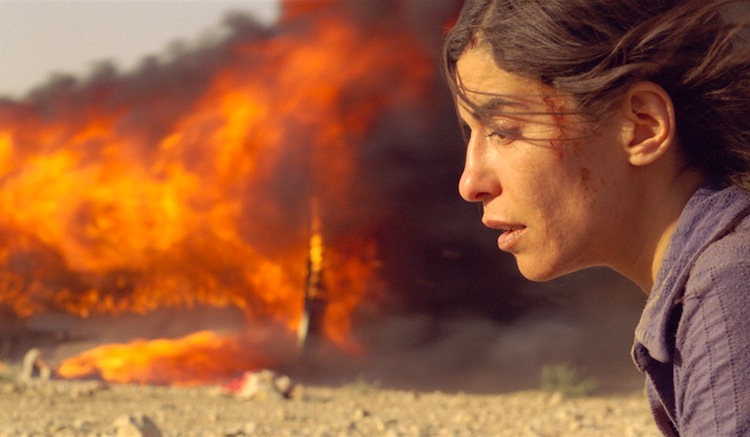
By Joe Bendel. Religious extremism is a handy prism through which to view Mid East conflicts. However, it ignores one critical contributing cause of ever-escalating violence, at least according to the recent screen adaptation of Lebanese-Canadian Wajdi Mouawad’s stage play. While religious resentments are often a primary motivation, nothing trumps human nature and the downright Biblical desire for revenge. It’s that eye-for-an-eye cycle a Middle Eastern immigrant hopes to break with her last will and testament in Denis Villeneuve’s Academy Award nominated Incendies, which screened during the recently wrapped 2011 Sundance Film Festival.

Nawal Marwan, beloved employee of attorney and notary-public Jean Lebel, had secrets her grown son and daughter never suspected. An immigrant from an unnamed Middle Eastern country bearing a strong resemblance to Lebanon (particularly given its open warfare between Christian and Muslim militias), Jeanne and Simon assumed their father died during the civil war. Much to their surprise, at the reading of Marwan’s will, Lebel produces two letters handwritten by their late mother. One they are to deliver to their father, the other to their heretofore unknown brother.

At first, Simon refuses to play his mother’s game, leaving Jeanne to wrestle with their family intrigue alone. However, as she learns the extent of her mother’s past, including involvement with a shadowy Muslim warlord and a long stint in a notorious Christian militia prison, Simon reluctantly joins her, with the faithful Lebel in tow.

From Denis Villeneuve’s "Incendies."

Perhaps the most fascinating aspect of Incendies is the slipperiness of various characters’ loyalties. Though raised a Christian, Nawal Marwan throws her lot in with the Muslim militia after witnessing a Christian atrocity. Likewise, a critical mystery man changes sides at least twice, seemingly just to facilitate various plot turns.

Indeed, Incendies has a monster of a twist that viewers probably will not recognize until Villeneuve commences the film’s big reveal. It depends on a very tight timeline though, which just barely holds up to post-screening scrutiny. Frankly, given the importance of dates, Mélissa Désormeaux Poulin and Maxim Gaudette, though otherwise convincing in the roles, look at five or ten years too old as the grown Marwan children. Yet Villeneuve pulls it off through sheer cinematic power.

While Incendies might sound like typically didactic Mid East agitprop, it really is more about the personal than the political. In fact, neither Israel nor America are ever mentioned at all. Instead, it is about the grubby, up-close-and-personal hatreds and resentments that define such skirmishes. At one point, the Marwans are advised to seek out a former militia leader for information, because warlords have long memories. Point taken.

If not exactly subtle filmmaking, Incendies delivers visceral drama. Oddly, it also serves as a tribute to the noble calling of notaries through Rémy Girard’s richly realized supporting turn as Lebel. A suitably sweeping package, cinematographer André Turpin adeptly captures the rough beauty of the landscape, while the euro-pop influenced sound track sounds somewhat out-of-place, but is evocative nonetheless. A bold, messy, and totally engrossing film, Canada’s Incendies is one of the better nominees for the best foreign language Oscar and a worthy selection of this year’s Sundance Film Festival.

Posted on February 2nd, 2011 at 9:48am.

LFM Sundance Review: Elite Squad 2

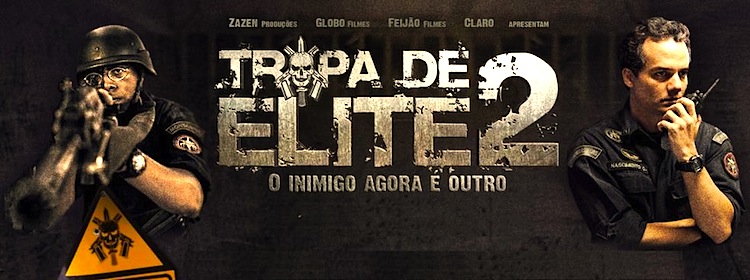
By Joe Bendel. Watch out for those left wing academics. They will steal your wife and poison your son against you. At least that’s what happened to Colonel Nascimento, the leader of Rio’s SWAT team equivalent: the Special Police Operation Battalion, or BOPE in the Portuguese acronym. However, Nascimento still finds himself working with his nemesis to bring down a crypto-fascist criminal empire run by crooked cops and politicians in José Padilha’s Elite Squad 2: The Enemy Within (trailer above), which screened during the 2011 Sundance Film Festival.

Diogo Fraga is the Brazilian Al Sharpton. Whenever the inmates riot (which is often), they send for him to act as a “mediator.” However, when the latest standoff gets tense, Fraga starts to look like a legit hostage. When Nascimento’s protgege Matias sees his shot, he takes his shot, as per his training. Unfortunately, the resulting blood-splatter all over Fraga’s peace t-shirt is too rich not to exploit in the media, even if was meant to save his behind. As the officer in charge, Nascimento bears the brunt of Fraga’s protests, but the fearful public is completely behind him. Left with only one recourse, the politicians kick him upstairs to some sort of homeland security position.

Suddenly, Nascimento is setting criminal justice policy on a state level. He gives BOPE the resources they always needed and turns them loose on the cartels. Actually, it works too well, leaving a vacuum to be filled by “The System,” a ruthless syndicate run by crooked cops and hypocritical “law & order” politicians.

Evidently, Padilha was stung by the criticism of Elite 1 as an endorsement shoot-first-and-ask-questions-later vigilantism, considering how far he swings the pendulum over in Elite 2. Now the credo is depose-first-and-ask-follow-up-questions-later-in-committee-hearings.

At least Wagner Moura is still the ever-popular Nascimento, who looks like a non-descript everyman, but is seriously hard-nosed. His no-nonsense presence helps redeem Elite 2 from its constant attempts at redemption through sociopolitical relevancy. In a standout supporting turn, André Ramiro brings a scary intensity to the tightly wound Matias. Brazilian music lovers should also keep an eye out for superstar vocalist Seu Jorge, appearing early in the film as powerful drug kingpin.

There are some tightly executed action sequences in Elite 2, but the film is ultimately undone by its didactic political subplots. After all, one doubts many favela residents would identify over-zealous policing as the greatest problem they face. While not without its moments, Elite 2 strays too far from its roots – which ironically, probably makes it more attractive to American distributors, following its high profile screenings in the Spotlight section of this year’s Sundance Film Festival.

Posted on February 1st, 2011 at 9:43am.