Invasion Alert!: The New Purpose of Alien Invasion is … Iraq War-Payback? + Brooklyn Decker & Rosie Huntington-Whiteley!


By Jason Apuzzo. • Given the sudden shift in theme and meanings in ABC’s V, it’s obvious that we’ve got to keep a careful eye on sci-fi these days – as each new project further proliferates and complicates the political messages being conveyed by the genre. Aside from V – which within one week went from satirizing global warming hysteria, to associating the Israeli Mossad and the Catholic Church with suicide bombing (!) – two other interesting cases in point are the forthcoming Battle: Los Angeles, and Steven Spielberg’s new Falling Skies TV series. Let’s do a little speculative ‘deep reading,’ shall we?

The latest Battle: LA trailer (see above), which just hit the internet this week, revealed something interesting: namely, the aliens’ motivations in the film for attacking Earth. Apparently Battle: LA‘s wave of alien invaders – among many similar alien hordes arriving on our planet during the 2011 and 2012 movie calendars – will be arriving specifically in order to seize our natural resources.

Now, this is a fairly typical theme in the alien invasion genre going all the way back to the 1950s, and it has been re-appearing as recently as in V (and James Cameron reversed the scenario in Avatar, with humans doing the invading) … and yet I can’t help but wonder if in a post-Iraq War world whether the subtext of this film, much as in Spielberg’s War of the Worlds (at least, according to War of the World‘s screenwriter, David Koepp), is to let Americans now feel ‘what it’s like to be invaded/exploited’ ourselves? (Even when we’re not actually exploiting anyone, but liberating people living under tyranny.)

I only ask this because of this somewhat peculiar, on-the-nose line that appears conspicuously early in the trailer:

“When you invade a place for its resources, you wipe out the indigenous population. Right now, we are being colonized.”

Which real-world invasion/’colonialist’ scenario is that referring to? I’d love to know. Somehow I think I already do.

Were it to be a reverse commentary on the Iraq War, Battle: LA would certainly resemble Spielberg’s War of the Worlds – and, on that note, the other big alien invasion trailer to hit recently was for Spielberg’s Falling Skies TV series (see above).

Aside from recycling every cliché of the genre imaginable, the trailer was noteworthy for this similarly on-the-nose line:

“History is full of inferior forces creating so much trouble that the invading army leaves.”

Hmm. I wonder what ‘history’ this line is referring to here. I keep scratching my head, but I can’t come up with anything – maybe some of Libertas’ clever readers could help? In any case, one gets the sense from both the Battle: LA and Falling Skies trailers – and even from last week’s episode of V (alas) – that the thematic ‘purpose’ of some of these alien invasion thrillers may actually be Iraq War-payback.

Should that be the case – and I’m not yet assuming it is – I’m allowed to find such a message troubling; it has an angry, vengeful, self-loathing quality at a time when the mandarins of our culture are currently lecturing everyone about how we’re supposed to be ‘toning down our rhetoric.’ Hollywood, look in the mirror.

• We’re apparently going to be getting a Total Recall remake with Colin Farrell, a remake which will not be taking audiences to Mars this time , however – nor will the film be shot in 3D. This might actually be the only case in recent memory of aliens actually being removed from a project, rather than added to them (i.e., Universal’s Battleship).

• And speaking of Universal’s Battleship, James Cameron is back in the news – after a whole 2 weeks – for publicly blasting, so to speak, Universal’s alien-invasion themed Battleship. Here’s Cameron:

We have a story crisis. Now they want to make the Battleship game into a film. This is pure desperation. Everyone in Hollywood knows how important it is that a film is a brand before it hit theaters. If a brand has been around, Harry Potter for example, or Spider-Man, you are light years ahead. And there lies the problem. Because unfortunately these franchises are become more and more ridiculous. Battleship. This degrades the cinema.

Unfortunately I agree with him here. We just had Missile Command go into development this week, and in a few months we’ll be getting a third Transformers movie, with McG’s Ouija board game movie not far behind. What’s next, a Voltron movie? Oh, wait, somebody’s already doing that … In other Cameron news, incidentally, here is an update on the Cameron-Guillermo del Toro adaptation of Lovecraft’s ‘alien invasion’ novel At the Mountains of Madness.

Actress-model Brooklyn Decker of "Battleship."

• Incidentally, Universal’s $200 million alien-invasion ‘epic’/board-game adaption Battleship is currently in the midst of reshoots – based on the fact that multiple endings of the film were apparently shot (which probably doesn’t help the budget) – but nonetheless Battleship star Brooklyn Decker is out praising her ’embattled’ director, Peter Berg.

But her standing up for her director isn’t really what’s got you excited, though, is it? You want to see the recent pictures of her shooting the film on the beach in Hawaii – so here you go. You deserve that, after making it through the Falling Skies trailer.

Anne Francis, from "Forbidden Planet."

• It seems impossible, yet even more alien invasion projects were announced this week: Fox just announced that it’s put a movie adaptation of Atari’s classic video game Missile Command into development – a game which has no plot, incidentally; and, just today, something called Alien Sleeper Cell went into development, as well, with District 9 producer Bill Block attached. The title Alien Sleeper Cell alone should tell you everything you need to know about whether the current wave of alien invasion films carry political/ideological connotations.

• The lovely and talented Anne Francis of 1956’s Forbidden Planet has died – just a few months after her Forbidden Planet co-star Leslie Nielsen also passed away. Our condolences to her family. Ms. Francis was a marvelous star, and did a wonderful (if short-lived) series in 1965 called Honey West in which she played a stylish, 60s go-go girl detective. She had a sweet, pixie-like charm about her – and she will certainly be missed.

• Did you know that the alien invasion genre has even hit this year’s Sundance? Of course, Sundance being Sundance … they’ll be premiering Codependent Lesbian Space Alien Seeks Same (no, that’s not a Roger Corman movie) at this year’s festival, along with Another Earth (check out an interview with director Mike Cahill here) and Troll Hunters – the latter being, I suppose, more of a ‘creature invasion’ film.

Rosie Huntington-Whitely of "Transformers 3."

• And on the Creature Invasion Front, Piranha 3D just hit Blu-ray (including 3D Blu-ray; see our review here); David Fincher will apparently be shooting the massive squids of 20,000 Leagues Under the Sea in 3D; Gareth Edwards, director of the indie alien invasion thriller Monsters (see our review here) has improbably been given the Godzilla reboot – which can only mean Legendary Pictures hasn’t actually seen Edwards’ film; and, of course, Troll Hunters will be getting its world premiere at Sundance. I love Troll Hunters’ trailer, by the way – is that because I’ve met so many trolls in LA? The movie does seem authentic in depicting trolls, although in real-life they’re usually much shorter.

• In other Alien Invasion/Sci-Fi News & Notes: we may be getting a Tron sequel after all; there will apparently be a Cowboys & Aliens Super Bowl commercial (you can catch actor Sam Rockwell discussing Cowboys & Aliens here); here are DVD/Blu-ray details for Skyline (see our review here); J.J. Abrams’ Super 8 and also Transformers 3 will be getting the IMAX treatment; we may also be getting a Super 8 trailer in March; there are some new production stills out for Steven Spielberg’s Terra Nova TV series; Charlize Theron may be in contention for the Alien prequels (I doubt she’ll make it; it will probably be Noomi Rapace); there’s a new TV spot out for I am Number Four; the new alien invader-comedy Paul has a new trailer (it’s terrible); the faux-documentary alien invasion thriller Apollo 18 will now be released on April 22nd; Jodie Foster has signed on for Neill Blomkamp’s Elysium; check out this new trailer for the Star Wars Blu-rays; and there’s a great new trailer out for the new Star Wars: The Old Republic video game.

• AND IN TODAY’S MOST IMPORTANT NEWS … Transformers 3′s Rosie Huntington-Whiteley has an artsy, sexy new photoshoot out, perhaps designed to make people forget that Megan Fox was once the belle of that alien invasion franchise. Click here to see more of the shoot .. which is quite an eye-full.

And that’s what’s happening today on the Alien Invasion Front!

Posted on January 13th, 2011 at 4:26pm.


Injustice in China: LFM Reviews Petition

By Joe Bendel. They are the dregs of society. Scorned and maligned, they live a dangerous existence in crude shantytowns as they pursue their quixotic quest.  They seek redress from the Chinese government and for filmmaker Zhao Liang, these “petitioners” are his country’s greatest heroes. The product of over ten years spent with these marginalized justice seekers, Zhao’s Petition stands as arguably the most damning documentary record of contemporary China to reach American theaters since the initial rise of the Digital Generation of independent filmmakers. A special selection of the 2009 Cannes Film Festival, Petition finally opens in New York this Friday at the Anthology Film Archives.

Throughout Petition it is crystal clear that the Chinese government has institutionalized corruption and hopelessly stacked the deck against the petitioners. Those victimized by unfair rulings have limited options locally for appeal (from the same corrupt bodies), so their only recourse is through the Kafkaesque “Petition Offices” in Beijing. Never in the film do we see the bureaucrats there actually give a petitioner satisfaction. They do keep records though. In fact, the local authorities have a vested interest in maintaining low petition numbers.  Hence, the presence of “retrievers,” hired thugs who physically assault petitioners as they approach the petition office.

Petition is definitely produced in the fly-on-the-wall, naturalistic style of Jia Zhangke and his “d-generate” followers, but there is no shortage of visceral drama here. Each petitioner we meet has an even greater story of injustice to tell. Perversely, it seems it is those who do not take bribes who usually find themselves prosecuted in China. Petitioners are arrested, beaten, and even die under mysterious circumstances. Yet, it is through Zhao’s central figures, Qi and her daughter Juan, that we experience the emotional drain of the petitioning process with uncomfortable immediacy. Frankly, even if you have seen a number of Chinese documentaries, this film will still profoundly disturb you.

Zhao deserves credit for both his significant investment of time and his fearlessness. Not surprisingly, filming is strictly prohibited in the Petition Offices, but that did not stop him from trying, often getting more than a slight jostle for his trouble. Indeed, Petition represents truly independent filmmaking.

Petition is the cinematic equivalent of a smoking gun. It is impossible to maintain any Pollyannaish illusions of about the rule of law in China after watching the film. Yet, like Zhao, viewers will be struck by the petitioners’ indomitable drive for justice. May God protect them, because their government certainly won’t. A legitimately bold and honest film that needs to be seen, Petition opens this Friday (1/14) in New York at the Anthology Film Archives.

Posted on January 13th, 2011 at 10:18am.

UPDATED: ABC’s V Back Tonight + New Morena Baccarin Interview with Details About the Show’s Future

Morena Baccarin as the alien queen, Anna.

By Jason Apuzzo. I just wanted to remind those of you who are enjoying ABC’s V that the show is back tonight, in what promises to be an interesting episode. Previews for the show (albeit not the one below) have shown a suicide bombing taking place during this episode; plus, the colorful Jane Badler – who played the alien leader in the old series – returns in this episode, something teased in the season premiere.

Also today there’s a new interview out with actress Morena Baccarin, who plays the Visitor queen, Anna. SPOILER WARNING: Baccarin reveals some tantalizing details about how the show’s storyline will be developing – including what cast members from the original series will be returning, and in what capacity; and, furthermore, it’s revealed that the producers have planned-out the storyline of the series through a hypothetical third season, a season which may or may not happen depending on ratings.

Click on over to Collider for more details. I’ve also embedded a preview for tonight’s show below.

[UPDATE: Having now seen the episode, I was not happy with it at all – and my earlier fears about the ‘suicide bomber’ subplot were validated, alas. Although there were aspects of the show I liked – particularly the speculative elements about the human soul, and Jane Badler’s juicy performance as the alien queen’s mother – I was very disappointed by the overall arc and purpose of the suicide bomber subplot. Its purpose seems to be to show that ‘desperate people in desperate circumstances’ will turn to terrorism, even – as we learn – an ex-Israeli Mossad agent. Memo to ABC: the Mossad fights terrorism, and doesn’t practice it. Had the leader of this rogue, suicide-bombing branch of the show’s ‘Fifth Column’ been a Chechen or a Russian, I think it would’ve been much more believable. As it stands, however, having its leader be ex-Mossad feels like a cheap shot toward the Israelis. Also: having the actual suicide bomber himself be a Catholic parishioner who is ‘inspired’ by Father Jack’s words was in extremely poor taste. What a disappointment. Two shows in, and my enthusiasm has already cooled.]

Posted on January 11th, 2011 at 2:26pm.

LFM Double Review: “Country Strong” and “Golden Girl of the West” Live at the Met in HD

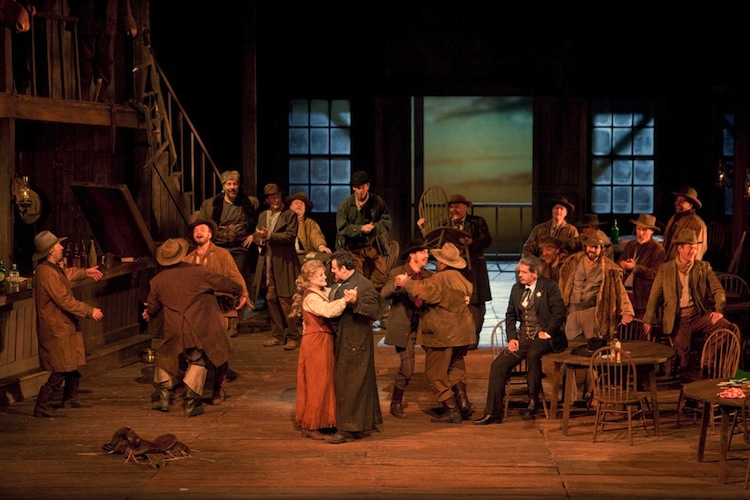
From Puccini's "La Fanciulla del West" ("Golden Girl of the West") HD series at The Met.

By Patricia DuceyGiacomo Puccini’s Wild West opera, La Fanciulla del West (“Golden Girl of the West”), is the latest offering from The Met: Live in HD series (Encore: Wednesday, January 26, 2011, 6:30 PST).

Commissioned 100 years ago by the Metropolitan Opera, Fanciulla is Puccini’s homage to the conventions and themes of the American Western—and to America itself. Puccini gave his patrons exactly what they were looking for, and after 19 standing curtain calls on opening night, the Met knew they had a durable hit in their first commission.

This year, the Met celebrates Fanciulla’s centenary with a boisterous, lyrical restaging featuring American soprano Deborah Voigt and Italian tenor Marcello Giordani and a delightful ensemble chorus of gunslingers, miners and banditos—a wonderful addition to a movie season that includes other shining examples of Americana like True Grit and the lesser Country Strong.

The music is Puccini-gorgeous, from one of his most beloved arias, “Ch’ella mi creda” (see here) sung by Dick Johnson as he begs his executioners to spare Minnie the knowledge of his perfidy, to the orchestral passages that reportedly inspired Andrew Lloyd-Weber’s Music of the Night.

Fanciulla’s story centers on frontierswoman Minnie, a saloon owner and Bible study teacher to a gold mining camp’s barely civilized miners. These are rough men: they drink their whiskey straight and shoot first, ask questions later. The only trace of sentiment emerges when they share stories of the dear mothers and big old dogs they left behind. Minnie and her “boys” are courageous loners, striking out for the fabled Sierra gold mines, for personal freedom and for adventure. Minnie with her book-learning and Bible lessons is the slim thread that ties them to civilization, and they are all in love in one fashion or the other with her. She helps them write home and tempers their anger in their many arguments and brawls. In one scene, when they catch one of their own cheating at poker, she instructs them, Bible in hand, “Every sinner can be redeemed.”  Later, we suspect she will have to walk that talk herself.

In Minnie we have a new kind of Puccini heroine: a self-made woman, owner of a thriving business, cheerful in adversity and fiercely independent. Her pistol is her best friend, she recounts to an overly amorous miner, and she breaks up more than one unruly mob with a few well-aimed gunshot blasts. Puccini looks more to Annie Oakley than Mimi for this Minnie. She would rather live alone than be trapped in a loveless marriage with any of the several men in camp who endlessly woo her–as soon as she asserts that independence, though, in walks the handsome stranger. Of course she falls totally in love, but her love leads her to triumph here rather than to a pitiable death, as in most of Puccini’s other operas. In the final act, she singlehandedly holds back the lynch mob and at the same time inspires her man to renounce his banditry and dedicate his life to goodness and love.

Deborah Voigt as Minnie.

In Fanciulla, Puccini weds the traditions of operatic tragedy with American optimism. Like the deservedly praised True Grit, Fanciulla exults in themes of Americana as well as in the Judeo-Christian heritage that anchors them. From True Grit’s Bible allusions–read without irony–to the rollicking barroom brawl in Fanciulla, both honor the eternal truths expressed by the Western genre and thus revive its classical expression. Puccini recognizes that the Western is the essential American morality play, and that goodness eventually will triumph in this land caught between wildness and civilization. That’s the real American Dream and the sense of possibility that drew so many of Puccini’s countrymen to our shores.

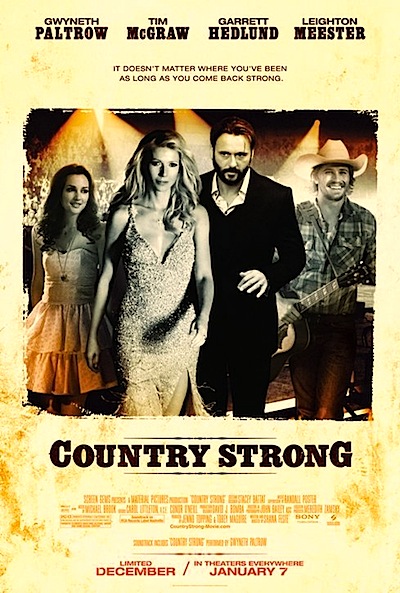
Writer/Director Shana Feste, on the other hand, is all mixed up about her Americana in Country Strong. She misses entirely the reason country music is so popular: there is no self-hating in Nashville. The movie starts out as a melodrama about Kelly Canter (Gwyneth Paltrow), a fading country singer sprung a little too early from rehab by her emotionally distant husband James (Tim McGraw) because … well, we’re never told why. He insists she needs to start touring before the docs release her. Do they need the money? Is he trying to gaslight Kelly because he loves a younger singer?  We hope to find out, yet McGraw’s character and motivation remain a mystery.

Kelly wants rehab orderly Beau (who also conveniently happens to be a singer) to open for her on the tour, but James chooses newcomer Chiles Stanton (Leighton Meester) instead. Kelly is jealous of the younger woman and imagines her flirting with James—or maybe she is flirting with him?—yet Kelly herself has been bedding Beau since rehab. Who’s zoomin’ who? Eventually all four of them are on tour together, in the crucible of Kelly’s comeback. They hook up, break up, fight and make up, with lots of streaked mascara but little discernable rationale. With all possible plot points on the table, the histrionics and plot twists remain vaguely mystifying. No much is at stake here: not principles, life and death, nor even love. In hipster movies, love hurts.

The actors do a heroic job, and a few of the tunes, even though we never hear one in its entirety, are iPod worthy. Paltrow proves again what a rich, emotionally layered actor she is, and Meester, of Gossip Girl fame, wrests depth and nuance from a most shallow stereotype. Garrett Hedlund from Tron could have a singing career. Tim McGraw, one of the most radiantly masculine stars on screen, though, is seriously misused or underused. McGraw’s James is written as cold and distant, but this behavior is never explained. Maybe a prequel will explain his pinched rejection of the whole lot of them?

Country Strong is a serviceable enough musical melodrama, but it’s hard to tell what the point is. This is either a script-by-committee mashup, or Feste is another screenwriter gripped by existential confusion towards her subject. She cannot decide if Country Strong is a classic melodrama or hipster hit-piece. On the one hand, the script panders to the bien pensant with jabs at what she envisions as flyover country: Christians are hypocrites, patriots are jingoists, pro-lifers are haters, crossover country is insipid and beauty queens are stupid, etc. Then why is Kelly’s triumphant comeback song an insipid pop song itself, presented without irony? On the other hand, sometimes Country Strong seems to be playing it straight, as with the actors’ performances, and that does work. Her method seems to be to throw tropes and clichés on the wall, however contradictory, and see what sticks.

Puccini’s Minnie and the Coen brothers’ Mattie Ross would be perplexed at so much wild emotion in service of such small stakes. Minnie probably would chuck Kelly out of her saloon at the first whine, and Hattie would sniff and ride off, head held high, to right another wrong. They knew that their journey was the American journey, into the wilderness and into the human heart, and that “strong” is more than just a word in a song.

In related news, the inevitable: the Royal Opera House’s Carmen is soon to be released in 3D (see here). I’m down with that.

Posted on January 10th, 2011 at 3:56pm.

LFM Review: Stalin Thought of You at The New York Jewish Film Festival

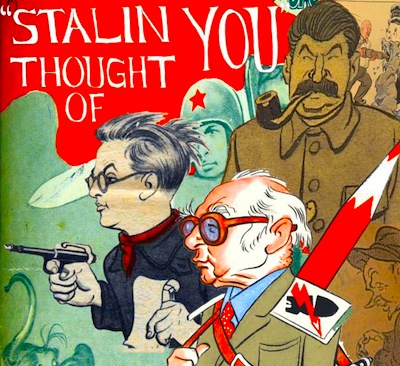
By Joe Bendel. Attention to detail and a long memory might be all well and good for office drones, but they are not so hot in dictators. Stalin was a case in point. He always remembered the little people he encountered—much to their woe. However, the tyrant saw a potential usefulness in one political cartoonist that proved to be his salvation. Indeed, the late Boris Efimov would outlive Stalin and his successors, surviving well past his centennial. It is a telling episode in Soviet history, even if Efimov himself was somewhat ambiguous about his relationship with his brother’s murderer in Stalin Thought of You (trailer above), Kevin McNeer’s documentary profile of the Communist caricaturist, which screens on the opening day of the 2011 New York Jewish Film Festival, co-presented by the Film Society of Lincoln Center and the Jewish Museum.

Efimov and his brother Mikhail Koltsov were both ardent Communists who had permanently adopted their revolutionary nom de plumes. Koltsov was the more outgoing sibling, rocketing up the ladder of the Soviet journalism establishment while secretly working for the NKVD. He is widely accepted to have been the inspiration for the Karkov character in Hemingway’s For Whom the Bell Tolls. Despite (or more likely because) of his prominence, he was executed during Stalin’s Great Purge, although he recanted his forced confession.

The role of satire in a tyranny.

Obviously, this put Efimov in a difficult position as the brother of a declared class enemy, but it was Stalin himself who threw the struggling artist a lifeline with a personal request for a very specific cartoon supposedly well suited to his talents. While it was only during Khrushchev’s anti-Stalin campaign that Efimov was fully rehabilitated, his lingering sense of indebtedness to the fearsome dictator is evident all through Thought.

To his credit, McNeer presents an unvarnished portrait of Efimov, often challenging him on his loyal service to the Communist system that murdered his brother. He also often broached the subject of Efimov’s Jewish identity, but the centenarian shut him down each time. While he might simply be ambivalent, McNeer shrewdly includes footage of old Soviet newscasts using Efimov’s Jewish heritage as cover for the virulently “anti-Zionist” cartoons he was required to produce.

If not an explicitly hostile witness, it is clear Efimov was not entirely forthcoming with McNeer. Yet, rather than papering over his evasiveness, McNeer wisely exploits it to make larger points. Frankly, one comes away from Thought with a much higher regard for Koltsov than its ostensive subject.

Throughout Thought, McNeer consistently asks the right questions and provides the necessary context to fully understand the propaganda under discussion. The resulting film offers fresh insights into a dark time in human history fueled by a poisonous ideology. Selections of the New York Jewish Film Festival frequently play at subsequent regional Jewish themed film festivals, so viewers outside the City should definitely keep an eye out for it.  For New Yorkers, Thought screens this Wednesday (1/12), both in the afternoon and evening, as the 2011 NYJFF kicks off at the Walter Reade Theater.

Posted on January 10th, 2011 at 2:19pm.

Director Peter Yates, 1929-2011 & The Lost Art of Understated Cool

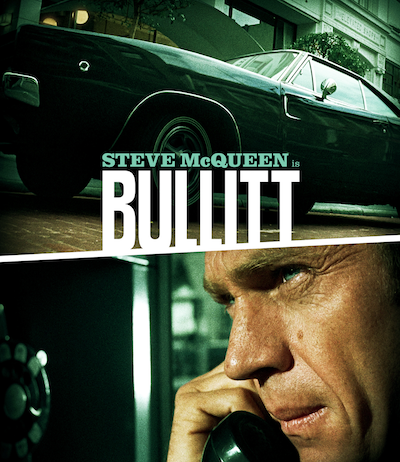
By Jason Apuzzo. Peter Yates, the director of Bullitt and other acclaimed films, has passed away at age 82.

I was very sorry to read this today, because just last weekend I’d watched Bullitt while listening to Yates’ director’s commentary – which was superb. Yates was a fine director – one of my favorites of his was The Deep from 1977 – and was originally brought from the UK to the United States by Steve McQueen to do Bullitt (Yates’ first American film) because of his fine work on the 1967 film RobberyRobbery had featured a great car chase and an avant-garde style that McQueen very much liked.

"Bullitt"'s cool sophistication has rarely been matched.

Yates and cinematographer William Fraker (who just passed away this past year) brought an understated, documentary styling to Bullitt that continues to make it a cut above its many imitators – a kind of clinical/ironic detachment that made everything in the film seem more believable, and therefore more intense. Almost as if eavesdropping, the audience hardly ever sees anything in Bullitt happen directly – but only through reflected images, windows, mirrors; plus, the long lenses Fraker used give the photography the feeling of being an act of surveillance. When combined with the tight, economical performances of the cast – and Lalo Schifrin’s jazz score – these qualities lend Bullitt a cool sophistication that few films of any genre can match.

I remember my parents telling me that when Bullitt came out in 1968, they were so excited by it that they sat through two consecutive screenings – something I don’t think they’ve done before or since. The film still has that kind of effect on people, I think in part due to its depiction of strong, stylish professionals (McQueen in particular) maintaining their cool in moments of extreme tension and suspense. Watch the famous car chase from the film above, for example. Look how perfectly dressed everybody is, and how they never lose their composure – even while careening over the vertiginous hills of San Francisco.

Yates and Irvin Kershner, who also passed away recently, were director/storytellers of a different generation who were less obtrusive, less likely to impose themselves on their material than today’s breed. They were, in short, pros – with a passion for documentary fidelity to reality – more than they were self-styled, egocentric auteurs out to distort reality (Nolan, Aronosfsky, etc.).

Yates will be missed; his films, however, will certainly live on and stand the test of time.

Posted on January 10th, 2011 at 1:51pm.