Whitewashing History: Communist China’s Oscar Entry Aftershock in IMAX

By Joe Bendel. The 2008 Sichuan earthquake was not simply a tragedy—it was a scandal. Average citizens were appalled by the government’s ineffectual response and the corrupt state building practices that amplified the quake’s severity. Yet what most outraged many survivors was the extent to which the Sichuan quake and its controversies paralleled that of the 1976 Tangshan earthquake. Clearly, lessons had not been learned. However, the People’s Liberation Army and a liberal dose of revisionist history ride to the rescue in Feng Xiaogang’s disaster drama Aftershock, which China has officially submitted for Oscar consideration in the best foreign language film category.

From "Aftershock": smiling PLA parents.

The summer of 1976 began as a happy, peaceful time for Yuan Ni and her family. Evidently, there was no Cultural Revolution to worry about in Tangshan, but the devastating earthquake made up for it in spades. Saved by her husband at the expense of his own life, Yuan Ni is faced with a devastating Sophie’s Choice. Both her twins are trapped under a concrete slab, but to save one child, the other will surely be crushed in the process. This being China, she chooses her son Fang Da.

Cruelly, his sister Fang Deng hears her own mother consigning her to death. Yet, through some twist of fate, Fang Deng lives, discovered relatively unscathed within a mountain of corpses. Having understandable abandonment issues, the young girl claims to have no memory of the traumatic events when asked by her adopted parents, a kindly couple serving in the PLA. Years pass and much melodrama happens, but when the 2008 quake hits Sichuan, both Fang Deng and Fang Da rush to join the Tangshan survivor volunteer relief workers. Right, you should definitely be able to guess where the third act is headed from there.

Aftershock is billed as the first commercial IMAX film produced in China. While the first fifteen minutes or so are probably pretty cool, as the Tangshan buildings fall like houses of cards, the next two hours of family drama must feel like overkill on the giant screen. Though relatively brief, Feng’s Irwin Allen scenes are tense and convincing. Indeed, he is a talented “big picture” director, but he is also something of a propagandist for the PLA. 2007’s Assembly, a well done war film that follows a grizzled army officer as he fights in the Chinese Civil War and the Korea War (against us), is a case in point.

The young Zifeng Zhang is absolutely heartrending as Fang Deng. As the adult Fang Deng, the striking Jingchu Zhang also tugs on the heartstrings quite effectively. Unfortunately much of the plot depends on characters deliberately making life harder than necessary, which quickly taxes viewer patience. It’s as if the film hopes the overblown angst can somehow fill up the giant IMAX screen.

Of course, there was plenty of heaviness going on in China during this time, but Aftershock scrupulously ignores the death rattle of the Cultural Revolution, the downfall of the Gang of Four, and the Tiananmen Square massacre. However, scenes of Mao’s funeral are shown with reverence and PLA soldiers are regularly hailed as heroes of the Tangshan rescue effort. Granted, not every film needs to address political issues, but the lack of context in Aftershock is as glaringly obvious as a film set in 1940s Germany that never mentions the National Socialists.

Though not wholly unwatchable, thanks in large measure to its Fang Dengs, Aftershocks is definitely a flawed film. Too long and too white-washed, it is more of a curiosity than a contender in this year’s foreign language Oscar contest.

Posted on December 14th, 2010 at 10:20am.
The Genius Child


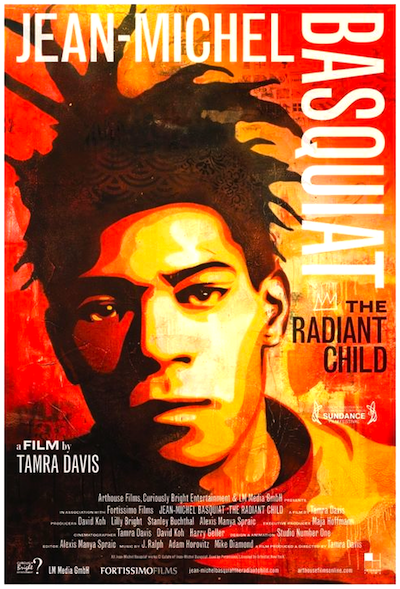
By David Ross. I make my living stumping for high modernism, so I am not exactly an enemy of the avant-garde and the experimental, and yet I am diffident about the extraordinary reputation of Jean-Michel Basquiat (1960-1988), the Brooklyn-born Haitian-American wunderkind who during the early eighties vaulted from graffiti artist to Warhol protégé and Madonna boy-toy in a mere ten years before dying of a heroin overdose.

I turned to Tamra Davis’ documentary Jean-Michel Basquiat: The Radiant Child (2009) for a glimmer of an explanation. The documentary turned out to be a trove of vintage footage and articulate commentary provided by those who stood just at the perimeter of Basquiat’s spotlight, but in the end I could find no trail of breadcrumbs to lead me out of the postmodern funhouse in which fame multiplies by some hidden law of light and reflection and desire. Basquiat wrote meaningless koans with spray paint and became famous; he founded a band with some downtown types, none of whom could play instruments, and become even more famous; he mooned around the trendiest clubs and become more famous still. He painted childlike hieroglyphics on whatever he could find and became a superstar. Dying young, he became a legend, which is precisely what he had set out to be.

Really, though, what is the substance of his achievement? His art is certainly vivid and energetic, and its neo-expressionist assault on the minimalism and conceptualism of the seventies is impossible not to cheer (“white paintings, white people, white wine” is how one interviewee recalls the pre-Basquiat era). And yet his art does not – for me at least – resolve into meaning. Its presumptive symbol language is too private and haphazard, and it is not tantalizing enough on its face to rouse my analytic energy and resolve. We kill ourselves to make sense of Finnegans Wake because we intuit that there is sense to be made; Basquiat’s art demands a gamble of time and energy that seems to run against the odds of an ultimate payoff.

The film’s numerous interviewees note Basquiat’s influences: Charlie Parker, John Coltrane, Miles Davis, William Burroughs, Jackson Pollock, Willem de Kooning. There’s something to be said for each of these connections, but Basquiat’s art seems to me closest to that of De Kooning: stark, nightmarish, garishly and luridly childlike, suffocating in its self-enclosed logic. I would say, though, that De Kooning’s punch is more concerted and harder thrown, his vision more ordered and hefty. Basquiat may have been more talented – I have no idea – but I doubt he had reflected nearly as carefully about what he was up to or exercised the same kind of winnowing intelligence. He seems to have worked by spontaneous trial and error, adding, subtracting, and overlaying in accordance with some inner sense of arrangement and meaning. This kind of improvisation can be electrifying when executed with supreme technical command (Keats, Coltrane, Pollock) but Basquiat was very far from virtuosic.

I can comprehend Basquiat only as a talented and perhaps semi-inspired cipher whose most superficial accouterments – name, hair, race – won him the role that had to be filled one way or another: that of the boy genius, the tragic naïf, with royalties and two-hundred years compounded interest owed to Keats. Basquiat was particularly suited to this role, being soft-spoken, dreamy, and vague in a way that might be misinterpreted as poetic. In comparison to Patti Smith, perhaps the only genuine genius of the punk-era downtown scene, Basquiat seems flimsy; his flourishes may or may not dazzle, but they are never more than flourishes.

The film, incidentally, adopts as epigraph Langston Hughes’ bad poem “Genius Child”:

This is a song for the genius child.
Sing it softly, for the song is wild.
Sing it softly as ever you can –
Lest the song get out of hand.

Nobody loves a genius child.

Can you love an eagle,
Tame or wild?
Can you love an eagle,
Wild or tame?
Can you love a monster
Of frightening name?

Nobody loves a genius child.

Kill him – and let his soul run wild.

The suggestion that the world “kills” the “genius child” in a snit of aggressive philistinism or atavism is ludicrous and particularly ludicrous in this case. Everybody loves a “genius child” and certainly everybody loved Basquiat. He was surrounded by benefactors. They paid his rent, slept with him, bought him paints, canvases, whatever he needed, furnished him with studio space, collected his paintings from the very start. Basquiat, in his early twenties, was fast on his way to substantial wealth and permanent celebrity. Had Basquiat lived only a few more years he would have been showered with a MacArthur Genius Grant and other remunerative goodies, and he would have wound up splitting his time between a downtown duplex and the south of France, with occasional appearances on Oprah to pontificate on the strain of being a genius.

Has society ever genuinely killed a “genius child”? It’s very hard to think of a case. Shelley initiated the accusation in “Adonais,” his bloated elegy for Keats, alleging that John Wilson Crocker’s savage review of Endymion in the Quarterly Review had done in the young poet. He writes in his preface:

The savage criticism produced the most violent effect on his susceptible mind; the agitation thus originated ended in the rupture of a blood-vessel in the lungs; a rapid consumption ensued, and the succeeding acknowledgements from more candid critics of the true greatness of his powers, were ineffectual to heal the wound thus wontonly inflicted.

Hating this kind of misty whining, Byron did his best to stab the trope in its cradle. His wry retort comes in Don Juan (Stanza 60, Canto XI):

John Keats, who was killed off by one critique,
Just as he really promised something great,
If not intelligible, without Greek
Contrived to talk about the Gods of late,
Much as they might have been supposed to speak.
Poor fellow! His was an untoward fate:
‘Tis strange the mind, that very fiery particle,
Should let itself be snuffed out by an Article.

Byron did his best, but it was no use. Every suicidal, immuno-compromised, coke-snorting, sport-car-gunning boy-genius would be laid like some pierced fawn on society”s doorstep.

The only figure who begins to make sense of Hughes’ silly poem is Oscar Wilde, though his genius was only part of the problem. Wilde was genuinely destroyed; all of the others – from Shelley himself to Michael Jackson – destroyed themselves for reasons of their own.

Posted on December 14th, 2010 at 9:45am.

One City, Three Drivers: Beijing Taxi

By Joe Bendel. It is an open question just how beneficial the 2008 Olympics were to average Chinese citizens. They were a source of pride perhaps, and certainly the well-connected made money through construction contracts and the like. Yet for the city’s working class cabbies, the Olympics – as well as China’s precipitous industrialization – have been a decidedly mixed bag. Indeed, life is not particularly easy for any of the three drivers director Miao Wang unobtrusively follows in Beijing Taxi (trailer above), which opens this Friday at Brooklyn’s reRun Gastropub Theater.

Starting two years prior to the Beijing Games, Taxi documents a city in flux. The games should be a boon to the drivers, what with all the tourists expected. Of course, nothing is so simple in China. Facing new language requirements (ironically, it seems travelers would be more likely to find an English speaking cabbie in Beijing than in New York) and rising costs, Taxi’s subjects are feeling increasingly pinched.

In various ways, the three cab drivers represent the inherent contradictions of contemporary Chinese society. While critical of China’s go-go economic policies, fifty-four year-old Bai Jiwen also fully recognizes his opportunities are limited because the Cultural Revolution permanently cut short his education. By contrast, thirtysomething Wei Caixia embraces China’s entrepreneurial ethos, but she is not so keen on the hard work part. Perhaps Zhou Yi is the most contented with his lot, but he still tries to maintain links to traditional Chinese culture.

Eschewing celebrity narration and talking head interviews, Taxi is not incompatible with the work of China’s so-called “Digital Generation” or “D-Generate” filmmakers. Though in many ways it functions as a critique of China’s comrade capitalism, Taxi is not the gritty, unremittingly depressing cinematic experience one finds in documentaries like Lixin Fan’s Last Train Home. Granted, Taxi’s three central POV figures certainly endure life’s challenges, they nonetheless prove to be quite resilient and even optimistic, at least to an extent.

Their real life dramas are also bookended by a surprisingly cool opening and closing credit sequence, which give the film a bit of panache. Indeed, it is well conceived and executed by the New York based Wang, who immigrated to America in 1990 (one year following the massacre at Tiananmen Square).

Cinematographers Ian Vollmer and Sean Price Williams dramatically capture the pulse and power of Beijing. However, this is a glass and steel urban jungle – which might disappoint viewers hoping to see an ancient and exotic capitol city, much like the underwhelmed tour groups Zhou Yi chauffeurs. Still, the cabbies offer a perfect vantage point for Wang to essentially ask “where are we and how did we get here?”  Considerably more accessible for general viewers than one might expect, Taxi is worth a trip out to Brooklyn when it opens at the reRun Gastropub this Friday (12/10).

Posted on December 10th, 2010 at 10:06am.

Invasion Alert!: Christina Hendricks, Michael Bay & Even Pauley Perette Join the Invasion!

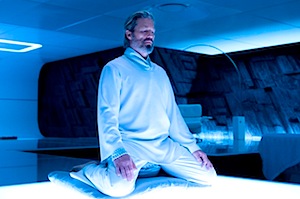
By Jason Apuzzo.Tron is approaching, a wave that’s looking smaller as it approaches shore. The film is tracking poorly; it’s also getting mixed reviews thus far (see here and here) … oh, and the total cost of the film, with marketing? Apparently around $320 million. Plus, people are starting to scratch their heads about the fact that this is the debut feature for the film’s director, Joseph Kosinski (see interviews with him here and here), whose background is in architecture and design rather than in drama or literature – you know, those old-fashioned disciplines that involve human beings.

Boomer New Age morality tale?

So, what are we about to get here with Tron? I’m guessing something stylish and dull – with a dash of retro-liberalism (of the anti-corporate variety) to keep the Boomers happy. (Incidentally, there’s some speculation that this new film may already be subtly setting up the corporate villain for the sequel … )

In the meantime, Olivia Wilde continues to flaunt herself (see here), and otherwise make herself out to be the face of the production. As annoying as she is, that’s probably a good idea given how flat Garrett Hedlund seems, and how spaced-out Jeff Bridges seems in his interviews about the film (see here). Somewhat more fun are the Daft Punk guys, whose “Derezzed” video just hit.

More sinister, however, are inferences from several people (see here and here) that Disney is psuedo-suppressing access to the charming, old version of Tron while the new film gets its marketing binge. That’s certainly an ironic development for a movie that’s supposedly a sub rosa critique of ‘fascism’ and enforced sameness. (In fairness, the old film just got remastered and will be getting a Blu-ray release in 2011.)

Incidentally, whatever happened to that Path to 9/11 DVD, Disney?

Beau Garrett in "Tron: Legacy." Maybe she knows where Disney's "Path to 9/11" DVD went.

• Michael Bay is coming out of his cocoon as he finishes Transformers 3. He’s talking to the media about the film now (see here and here), he’s allowing people to visit the set, and is now saying that he loves working in 3D. Also, a teaser trailer is coming, and there’s a new poster out for the film.

I’m not sure how much juice the Transformers series still has, really, but we’ll probably learn something from that trailer. Footnote: Megan Fox is really seeming out-of-sight/out-of-mind right now.

• Nobody’s hitting the panic button yet, but the Cowboys & Aliens trailer did not go over well – not just with me, but apparently with test audiences who laughed at it, thinking the film was a comedy. Ouch. Anyway, the production team is now suddenly doing a lot of interviews (here’s Favreau) and allowing set visits (see here and here), but questions are still being raised about whether this picture is going to work.

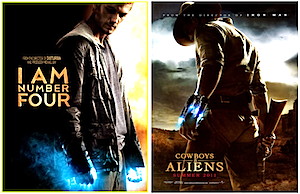
Also, Nikki Finke noticed today that the one-sheet for Dreamworks’ Cowboys & Aliens looks a lot like the one-sheet Dreamworks’ other alien invasion thriller, I Am Number 4. Oops.

They’ve since put out a new poster, although it still has the same feel.

I’m getting bad vibes about this project. Cowboys right now is looking like one of those All Star teams in basketball or baseball that looks great on paper but doesn’t play well. We’ll see.

• Ridley’s Scott’s Alien prequels have been pushed back to 2013 and 2014. What’s more annoying, however, is that Olivia Wilde is suddenly in the mix to play the lead. PLEASE STOP CASTING THIS PERSON. She’s already in Tron, Cowboys & Aliens and the Logan’s Run knockoff Now (which also just halted production) … and now Alien? Look, I haven’t seen Tron yet but I’ve seen enough of House to know that she’s not that good, besides which she’s almost as abrasive as Natalie Portman.

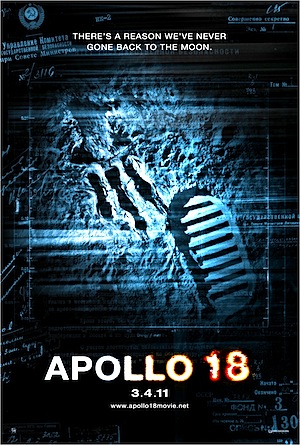
The new poster for "Apollo 18."

• I Am Bored by I Am Number 4, but it’s marketing binge has begun. This alien invader thriller – also from Michael Bay – has a new poster, the film will apparently be converted to IMAX (why?), and there are new interviews out with the director (here) and babes Teresa Palmer (here) and Dianna Agron (here). Basically this looks like another movie about a WASP teenage guy with Special Powers. Never seen that before.

• In other Alien Invasion News & NotesThe Thing has a new release date (October 14th), and there’s a new interview out with the film’s director, Matthijs van Heijningen; Pauley Perette will be playing a girl from Mars in Girl from Mars; Guillermo del Toro provides an update on At the Mountains of Madness (produced by James Cameron); SPOILER WARNINGthis may be what the alien looks like in J.J. Abrams’ Super 8; a production still has been leaked for The Darkest Hour; Star Trek’s screenwriters claim they’ve broken the next story; new set photos are out for Judge Dredd 3D; District 9′s Neill Blomkamp is going forward with a mysterious sci-fi project called Elysium; Alex Proyas is going to do a big new sci-fi spectacle called Amp; a Red Faction movie is coming to the SyFy channel; Mars Needs Moms has a new trailer out; Apollo 18 has a poster out already; there’s a big new Avatar exhibition in Seattle (see here and here);  and author Jonathan Lethem takes a look back at John Carpenter’s 1988 alien invasion thriller, They Live. Whew.

• On the Creature Invasion Front: Troll Hunter will be having its world premiere at Sundance; besides having one of the greatest titles in the history of the cinema, Piranha 3DD now also has a release date (September 16th); and David Ellis’ untitled 3D shark thriller recently got picked up for distribution. So there you go: sharks, piranhas and trolls.

• In the time since our last Invasion Alert! we’ve lost the great Leslie Nielsen from Forbidden Planet. Our condolences to his family; he certainly will be missed.

• On the Home Video Front, some classics from Roger Corman are finally coming to DVD: Not of this Earth, War of the Satellites and Attack of the Crab Monsters (not as bad as it sounds). Also: have I told you people that I caved and bought the whole first season of the new V? I’m definitely enjoying it thus far (here, by the way, is a review of the Complete Season 1 on DVD).

• It was both funny and sad to read about the Skyline guys’ surprised reaction to the torrent of abuse that film received on-line. Apparently they couldn’t understand all the trash-talking because, as they put it, “Brett Ratner liked it!”

• AND IN TODAY’S MOST IMPORTANT NEWS … I finally got around to watching the sci-fi music video “The Ghost Inside” that Christina Hendricks did this summer (see below). It’s a little odd, and slow … but it’s got Christina Hendricks in it as a robot with detachable parts, so how bad could it be – right?

And that’s what’s happening today on the Alien Invasion Front!

Posted on December 8th, 2010 at 9:06pm.

Bunnies Under Communism! The Oscar Nominated Rabbit à la Berlin + Nurith Aviv’s Loss

By Joe Bendel. Was it possible to thrive under Communism? Yes, for a short while, if you happened to be a rabbit in East Berlin. But their salad days did not last forever. In a story too strange not to be true, a population of rabbits temporarily flourished in the green belt running down the center of the despised Berlin Wall. Part nature documentary and part parable, directors Bartek Konopka and Piotr Rosolowski offer a truly original perspective on the Communist experience through the eyes of those East German bunnies in Rabbit à la Berlin (trailer above), a 2009 Academy Award nominee for best documentary short, which opens today in New York as part of a double bill of short docs examining Twentieth Century German history.

During the immediate post-war years, a hearty band of rabbits survived by raiding the garden patches on Potsdamer Platz. Much to their supposed surprise, sheltering walls were suddenly erected around them in 1961. With a nice grassy run, plenty of shade, and precious little human contact the whiskered critters made like rabbits and multiplied. The East German guards even began adopting them to help pass the time.

However, for many West Berliners, especially artists, the rabbits’ ability to burrow beneath the walls made them symbols of something greater—coyote tricksters for their divided age. Then, as escape attempts became more frequent and daring, the rabbits’ peaceful lives were upturned. Their lush grass was destroyed so that fugitive footsteps would be easier to track in the dirt beneath. Formerly their protectors, the guards declared open season on the rabbits, like a red army of Elmer Fudds.

One of Rabbit’s many surprises is the extent and quality of archival film capturing Berlin rabbits in their former environment. Credible simply as a wildlife film (even featuring the smoothly placid narration of Krystyna Czubówna, a well-known Polish voice-over artist for nature docs), it also has a slyly subversive sensibility, particularly when it incorporates news footage of the likes of Fidel Castro and Yassir Arafat come to gawk approvingly at the Wall. Wistful without being nostalgic, it is one of the more inventive and entertaining documentaries to reach theaters this year.

A meditation on the Holocaust.

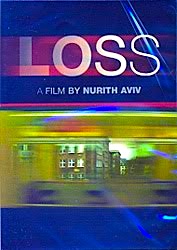
While the fate of the Berlin Wall rabbit warren is not widely known outside of Germany, the Holocaust and its implications are certainly well established terrain for documentarians. Yet, French-Israeli filmmaker Nurith Aviv finds fresh insights in Loss. Returning to her father’s ancestral home of Berlin, Aviv explores the cultural and scientific losses Germany imposed on itself through the Holocaust.

While relatively conventional in her approach, Aviv superimposes interviews with four prominent Berliners and a vintage television appearance by Hannah Arrendt over sights seen from the S-Bahn train as it makes its way through the city. It makes the talking heads more visually dynamic, and also gives viewers a good feeling for the still-grim looking city.

Frankly, the fifty minute Rabbit was robbed at last year’s Oscars. Highly recommended, it is unquestionably the main event of Film Forum’s Berlin documentary double feature. That said, the thirty minute Loss is also a thoughtful film worth seeing in tandem with Rabbit. Both screen together at New York’s Film Forum, beginning today (12/8).

Posted December 8th, 2010 at 2:07pm.

Women in the Islamic World: Scheherazade, Tell Me a Story

Actress Mona Zaki in "Scheherazade, Tell Me a Story."

By Joe Bendel. Hebba Younis wants to be Chris Wallace. Her husband wants her to be Oprah Winfrey. However, when at his behest she temporarily forgoes her hard-hitting newsmaker interviews in favor of women’s interest features, it winds up antagonizing the Egyptian government even more in Yousry Nasrallah’s Scheherazade, Tell Me a Story (trailer below), a recent selection of the Venice Film Festival which has its New York premiere during this year’s African Diaspora International Film Festival.

They should be Cairo’s most fearsome media couple. Younis is the formidable host of a morning talk show. Karim Hassan is an up-and-coming journalist in line to become editor-in-chief of one of Egypt’s state-owned newspapers. Unlike Younis though, Hassan never met a government official he wouldn’t suck up to. Reluctantly, she agrees to lay low during the upcoming editor selection process. Yet, as she invites average Egyptian women on her show to tell their stories, a portrait of a corrupt and misogynist Islamic society emerges that hardly thrills Hassan. When cabinet ministers start to be implicated in her guests’ stories of victimization, we know there will be trouble.

Hebba Younis with her husband, played by Hassan El Raddad.

Essentially, Scheherazade is four films in one, telling three discrete story arcs in flashbacks within the framework of Younis’ show. As the least controversial (and therefore least memorable), her first interview with a late middle-aged volunteer social worker gives Hassan reason for hope. While it runs a bit long, the second woman’s story is a much different matter. Convicted of murdering the man who was playing her and her two spinster sisters, it raises hot button questions about women’s legal rights in Egypt specifically and under Islamic law in general—not exactly territory Hassan and his political masters are eager to explore. When Younis’ third guest Nahed, a dentist from a prominent family, accuses a sitting minister of sexually and financial preying on mature unmarried women, all bets are off.

While cinematographer Samir Bahsan gives Scheherazade a lush, sophisticated look, it is a surprisingly tough film. Though Hassan might appear to be a modern dope-smoking yuppie, it becomes clear he would prefer his wife veiled and cloistered rather than more famous than him. Evidently, Mona Zaki has been the target of some heated disparagement from Egypt’s medieval quarters for her portrayal of the relatively liberated and assertive Younis. While she is a smart and attractive lead, Sanaa Akroud really steals the picture as Nahed, an older but still striking and all too vulnerable woman. Akroud brings out her intelligence and resoluteness, making her not-so uncommon circumstances a particularly effective indictment of Islamist Egypt.

Scheherazade would be bold for any Islamic country and is especially so in an Egypt where most media is wholly owned by the Soviet-sounding State Information Service. A feminist film in the best sense of the term, Scheherazade is a surprisingly forthright look at the status of Egyptian women today.  Timely and recommended, it screens as part of the 2010 ADIFF at the Anthology Film Archives on Sunday (12/12) and next Tuesday (12/14, the concluding night of the festival) at Symphony Space’s Thalia Theater.

Posted on December 6th, 2010 at 10:12am.