London River & The Legacy of Terrorism

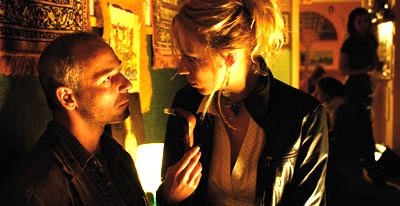
By Joe Bendel. Nothing brings back the terrible memories of 9/11 like the sight of home-made missing person posters. Evidently they were a common sight in London as well during the aftermath of the 7/7 bombings of 2005. One desperate mother hopes against hope that they will help her find her missing daughter in Rachid Bouchareb’s London River, which screens currently as part of the 2010 African Diaspora International Film Festival in New York.

Elisabeth Sommers lives a quiet life tending her farm on the island of Guernsey. Estranged from his family in Africa, Monsieur Ousmane works as a forester in France. She is a Protestant, while he is a Muslim, but they soon discover they are linked by the 7/7 bombing. Neither her daughter Jamie nor his son Ali has been heard from since that tragic day. Much to their surprise, it turns out their missing adult children were involved in a serious relationship. They were even learning Arabic together—a revelation Sommers has difficulty processing.
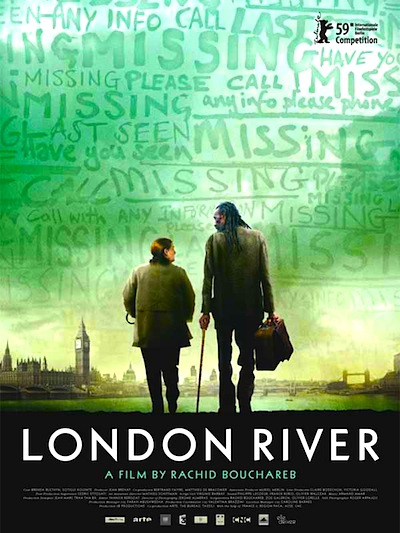
Eventually, the nervous Sommers and the stoic Ousmane form an uneasy truce that slowly evolves into something like friendship. Yet the nagging uncertainty of their children’s fate looms over their time spent together.

River is a quiet film about every mother and father’s greatest nightmare. Bouchareb largely eschews the political in favor of the starkly intimate. Still, some realities are impossible to avoid. Does it give pause to any of River’s many Muslim characters that their co-religionists just murdered 52 innocent people? Perhaps the ever taciturn Ousmane hints at such misgivings when he confides in Sommers his own failings as a father. It is hardly a transcendent epiphany, but it is an honest, sensitively turned scene.

While River boasts a large cast, it is essentially a two-hander for two vastly different parents. The Oscar-worthy Brenda Blethyn is agonizingly convincing as the distraught Sommers, perfectly counterbalanced by the deliberate Sotigui Kouyaté as Ousmane. Chronically ill during the shoot, Kouyaté passed away earlier this year, but his Silver Bear at the 2009 for River was well-deserved. Though quiet and reserved, he brings Ousmane to life – not merely as a stereotypical symbol of non-western wisdom. Instead, he is a flawed individual, whose character arc is just as heavy as that of Sommers.

Though often a political filmmaker, the French-Algerian Bouchareb’s greater loyalties clearly lie with his story and characters. That is why his most recent film, Outside the Law, is such an interesting take on the Algerian independence movement, in which it is devilishly difficult to differentiate the rebels from the gangsters. With River, he focuses like a laser on the pain and fear of his primary leads. Bouchareb also gets a nice assist from composer Armand Amar, whose jazz-inflected score adds a wistful air to proceedings. A simple, moving film that deftly sidesteps polemics, River is a good way to start the 2010 ADIFF.  It screens this Sunday (12/5) at Symphony Space’s Thalia Theater.

Posted on December 3rd, 2010 at 10:00am.

Truth and Consequences of Communism’s Past: Kawasaki’s Rose

By Joe Bendel. Everybody despises collaborators and informers, but what of the secret policemen who press them into betrayal? That is just one of the difficult questions raised by Petr Jarchovsky’s Kawasaki’s Rose, the Czech Republic’s official submission for best foreign language Oscar consideration, which opened Friday in New York at Film Forum.

Pavel Josek was a signatory to Charter 77. A critic of the Communist government’s perversion of psychiatric medicine (his chosen profession), Josek’s dissident credentials are unimpeachable. As a result, he is seen as a logical choice to receive the annual “Memory of the Nation” award for demonstrating moral integrity during the oppressive Communist regime. However, while working on a television documentary on Josek, his estranged son-in-law Ludek (a child of Communist apparachiks) starts to unearth troubling questions about the great man’s early years.

Josek’s wife Jana had once been the lover of Borek, an artist too idiosyncratic and honest to prosper under the Communist system. It begins to look like Josek might have played a small part in the campaign against the sculptor that culminated in his banishment to Sweden.

Whatever Josek did, it was relatively limited and his motives were complicated. He was not, for example, the state security officer stubbing out cigarettes on Borek’s hand. This fellow, known as “Kafka,” apparently pays no price for his crimes, as he smugly dissembles for Radka, Ludek’s television reporter lover. Conversely, Josek starts to slowly twist in the wind.

Martin Huba perfectly captures Josek’s complexity and contradictions in one of the year’s best screen performances. He has scenes discussing the perils of guilt with his mildly delinquent granddaughter that would be fraught with peril for lesser actors. Yet Huba sells them perfectly with his understated world-weariness.

The past haunting the present in "Kawasaki's Rose."

The weak link of the film is unquestionably the marital strife engulfing Ludek and Josek’s daughter, Lucie. Frankly, the confrontation between husband, wife, and mistress makes no sense whatsoever, merely distracting from the more significant drama at hand. Indeed, there is a measure of closure to be found in Rose when the audience finally meets Borek. Spiritually reborn during his time in Sweden, he has befriended Mr. Kawasaki, a Japanese artist who chose a life of self-imposed exile after his entire family was murdered during the 1995 sarin gas terrorist attack on the Tokyo subway.

Though long out of power, the Communist regime continues to cause suffering throughout Rose. Rose is a deeply humane film, but not a completely forgiving one, as evidenced by the bitter irony of its coda. Thoughtful and challenging, Rose is most likely a long shot for Oscar recognition, but it is one of the better films of this award season, well worth seeing at New York’s Film Forum.

Posted on December 1st, 2010 at 1:01pm.

Kersh Up Close

By Jason Apuzzo. So that you can get a feel for the man, I wanted to share with everybody some interviews that recently appeared on-line featuring my late friend and mentor Irvin Kershner. The interview above, which he did about a year ago, deals with making The Empire Strikes Back. It’s classic Kersh, in full storytelling mode. (You can see Part Two of this interview here.)

Kersh with Carrie Fisher.

One of the things I should have mentioned in my remarks about Kersh from Monday was his tremendous sense of humor, which you get a flavor of above. His humor was typically of the earthy, Jewish – and occasionally ribald – variety, and it’s what kept you hooked on the man, even if he’d just given you a verbal pounding.

I’ll never forget a time when Govindini and I had been up to his place, and Govindini had accidentally left behind a sweater, a blue cardigan. We asked Kersh later if he still had it. “No,” he said, with a wry grin. “I sold it to the Rag Man when he came by.” Classic Kersh. (With a cheeky grin, and with his typical old World courtliness, he then gently brought forth the sweater – neatly folded.)

Anyway, Kersh (born ‘Isadore’ Kershner) certainly came a long way from his youth in Philadelphia in the 1920s, when his Ukranian father supported the family selling fruits and vegetables from a street cart. It’s nice seeing him finally get his due right now in the media. It would’ve made him feel good, although – ever industrious, ever motivated – he wouldn’t have liked it distracting from his work …

Here are some of the better quotes I’ve seen about Kersh over the past few days:

George Lucas: “I considered him a mentor,” Mr. Lucas said in a statement after Mr. Kershner’s death. “Following ‘Star Wars,’ I knew one thing for sure: I didn’t want to direct the second movie myself. I needed someone I could trust, someone I really admired and whose work had maturity and humor. That was Kersh all over.”

“I didn’t want ‘Empire’ to turn into just another sequel, another episode in a series of space adventures,” he said. “I was trying to build something, and I knew Kersh was the guy to help me do it. He brought so much to the table. I am truly grateful to him.”

Francis Coppola: “We all enjoyed knowing Kersh, learning from him — and admired his creative spirit and indomitable will,” Coppola said in a statement released by Kershner’s publicists. “It was always exciting to talk with him about all aspects of cinema and life.”

Barbra Streisand: “He had the most incredible spirit, an exuberance for life. Always working, always thinking, always writing, amazingly gifted and forever curious. We met doing ‘Up The Sandbox’ in 1972 and remained friends ever since. I loved him,” she said in a statement.

Billy Dee Williams: “[A]n extraordinary mountain of a man with whom I’m proud to have shared the world of art.” “I bet he’s smiling at us right now with that wonderful impish smile,” Williams said in a statement.

Matthew Robbins: “To many, he represented the best in what American film making could do with its enviable resources and catholic traditions,” Robbins said. “He believed in emotion as the basis for all dramatic storytelling. For him, the worst cinematic crime was flatness, or lack of feeling. “Few who encountered Kershner either on the set or in the classroom will forget his almost ruthless pursuit of honesty and recognizable, complex human motivation,” Robbins said.

The interview below, conducted in his wonderful living room – full of artifacts from his many travels – is a more personal interview that deals with his youth, and his development as an artist, covering some of his early period as a painter and a photographer.

Part 2 of this interview can be seen here. I’ll be reviewing The Making of the Empire Strikes Back in coming days.

Posted December 1st, 2010 at 12:30pm.


Thanksgiving, Freedom, Music: Watch The Buena Vista Social Club This Weekend

Watch more free documentaries

By Jason Apuzzo. Those of us here at Libertas want to wish everyone a Happy Thanksgiving.

If you live in America, in almost any circumstance, you have a great deal to be thankful for – because you’re living in freedom.

Today we wanted to celebrate Thanksgiving by giving everyone the opportunity to watch a great film from 11 years ago from Wim Wenders, called The Buena Vista Social Club. This extraordinary, Oscar-nominated documentary is about a group of artists who did not live in freedom – living, instead, in Castro’s Cuba – yet who refused to let their circumstances dim their spirits, or destroy their art.

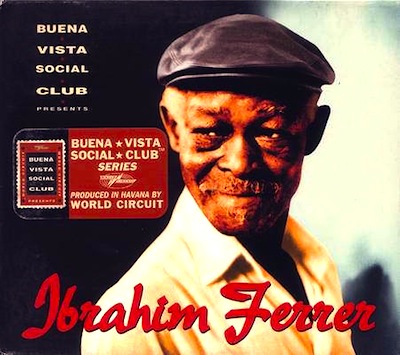
If you’ve never seen this film, take the opportunity over this weekend to watch it – here (through SnagFilms), for free. The music is extraordinary, Ibrahim Ferrer is unforgetable, and you may find yourself shedding a few tears by the end.

Happy Thanksgiving to everyone in advance.

Posted on November 24th, 2010 at 1:23pm.

Jazz Casual

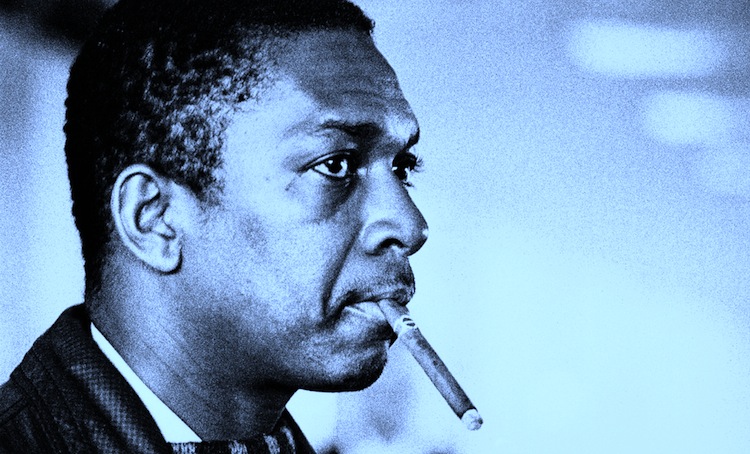
John Coltrane.

By David Ross. Between 1961 and 1968, Rolling Stone co-founder and music critic Ralph Gleason hosted twenty-eight half-hour episodes of Jazz Casual on public television. There wasn’t much glitz: Gleason would say a few words of introduction and his musical guest would be off to the races. Even so, Jazz Casual was probably the purest dose of cool ever delivered by American TV. In 2006, all twenty-eight episodes – 840 minutes worth – were released as a DVD box set titled The Complete Jazz Casual, but the set is now, alas, unavailable. Netflix offers three episodes – Basie, Gillespie, and Coltrane – on a single disc, as well as discs devoted exclusively to Coltrane, Brubeck, and B.B. King.

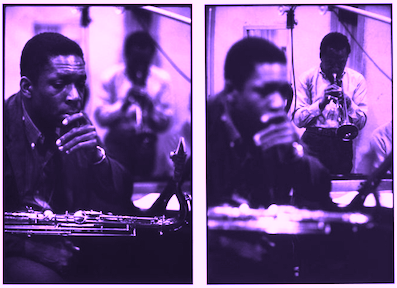
John Coltrane & Miles Davis.

Coltrane, of course, is like some astral event that comes around only once in many lifetimes; to see and hear him is to witness something epochal.

These excerpts are available on YouTube:

Jazz aficionados should also make a particular point of viewing, via Netflix, Miles Davis: Cool Jazz Sound (2004), a 25-minute dose of the Miles Davis Quintet – Davis, Coltrane, Wynton Kelly, Paul Chambers, Jimmy Cobb – filmed in New York in April 1959. Davis and Coltrane are such spectacularly paired opposites, the former’s angular reserve balancing the latter’s delving, groping virtuosity.

Posted on November 24th, 2010 at 12:58pm.

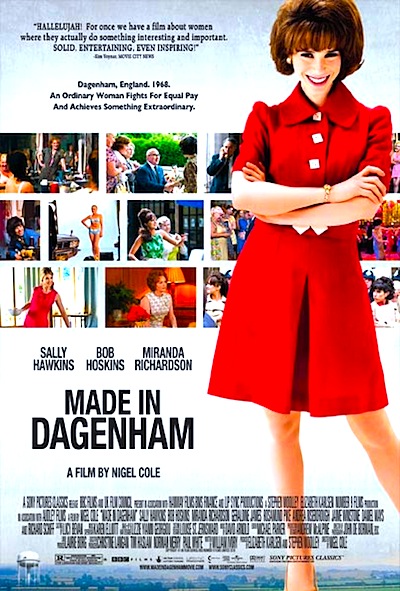
Labored Film: Made in Dagenham

By Joe Bendel. In the late 1960’s United Kingdom, trade unions dominated industrial policy, but did chauvinism trump class warfare? 187 women find out when their strike brings the mighty Ford plant to a standstill in Nigel Cole’s Made in Dagenham, which opened Friday in select theaters nationwide.

In one of the all time penny-wise-pound-foolish decisions, Ford reclassified the seamstresses working at their plant in the London suburb of Dagenham as “unskilled” rather than “semi-skilled” workers. This naturally resulted in a corresponding pay cut for the women. Encouraged by Albert, the factory’s union rep, they vote to authorize a work stoppage if their semi-skilled status is not reinstated. Though not previously active in the union or politics of any sort, Rita O’Grady is selected to attend the negotiations between Ford and their union. She is supposed to sit quietly in the corner, but when Monty Taylor, the feather-bedding head of their Local tries to sell out the Dagenham women, O’Grady gives them a case of what’s what.

Jaime Winstone disrobes for social justice.

Suddenly, the strike is on. However, the parameters have widened. With the encouragement of Albert, a former military officer raised by his single working mother, the Dagenham women are insisting equal pay for equal work. With 55,000 men now out of work, the union leadership is decidedly unenthusiastic. Ford is not too thrilled either. However, Barbara Castle, Harold Wilson’s minister for labor relations is quite impressed by the Dagenham women, while her boss is rather befuddled by it all.

Dagenham is a mostly harmless, Swinging Sixties Norma Rae, yet it veers awfully close to the patronizing attitudes it takes pains to skewer. We are clearly meant to cheer when O’Grady asserts herself with the sexist old boys around the negotiating table, but why shouldn’t she? William Ivory’s screenplay never actually uses the term “plucky gals,” but one can feel it floating in the air.

While Dagenham frames the issues surrounding the strike in simplistic terms, at least it earns credit for its pointed portrayal of the union leadership – a venal, Marx-quoting lot of chauvinist pigs. Of course, the overall membership is the salt of the earth, who eventually rally to the Dagenham women’s cause. Yet wisely, the film resists the dour naturalism of most union movies. Instead, it gives us Jaime Winstone in a mini-skirt.

Do not get the wrong impression though, Winstone (daughter of Ray) is mere window dressing. Dagenham is clearly intended as a star turn for Sally Hawkins – and certainly she is ‘likable’ enough. Everyone in the film is likable, unless they are management, in which case they are despicable. However, Hawkins’ soft-spoken, twitchy performance makes it hard to understand how she becomes such as a galvanizing force.

Granted Bob Hoskins’ big speech is ridiculously manipulative, but he still sells it, supplying the film’s most heartfelt moments. Though Wilson incisively contrasted himself with his Conservative opponent’s aristocratic background during the 1964 campaign, John Sessions plays him like an upper-class twit, emasculated by a look from Miranda Richardson as Castle – but at least they also supply some dramatic flair.

It might be faint praise, but Dagenham could have been far worse. When in doubt, Cole clearly opted to keep the tone light, which makes the film watchable – even if it is predictable and stilted.  It opened Friday in New York, Los Angeles and in select theaters elsewhere.

Posted on November 24th, 2010 at 12:31pm.