By Jason Apuzzo. Because we’ve been following both of these films extensively here at Libertas, I wanted to mention that the ‘Aussie Red Dawn‘ picture Tomorrow When the War Began and Mao’s Last Dancer both took home prizes last week at Australia’s IF Awards.
From "Call of Duty: Black Ops."
Tomorrow won for Best Feature Film, while Mao won a special box office achievement prize – as that little indie production has currently made about $15 million worldwide thus far, which is fantastic. Read more about this at Hollywood Reporter.
And did you catch the early grosses on Call of Duty: Black Ops? $650 million, according to the LA Times … yowza.
Incidentally, Call of Duty is apparently set during the Cold War, and based around a special operative who saves the US from a communist plot (oddly enough, without Angelina Jolie’s assistance). The operative travels between Cuba, Vietnam and Russia – and there’s even apparently a segment of the game in which players can go on a mission to bag Castro! Hola! (The Cuban government is apparently pretty upset at this.)
I like the sound of this game. Of course, you just wonder whether it occurs to anyone in Hollywood that this extremely popular game might make for a viable movie adaptation. (Just doing a little thinking outside the box, here!)
We’re always hearing how ‘money rules’ in Hollywood, rather than politics. Here’s another nice occasion to prove it.
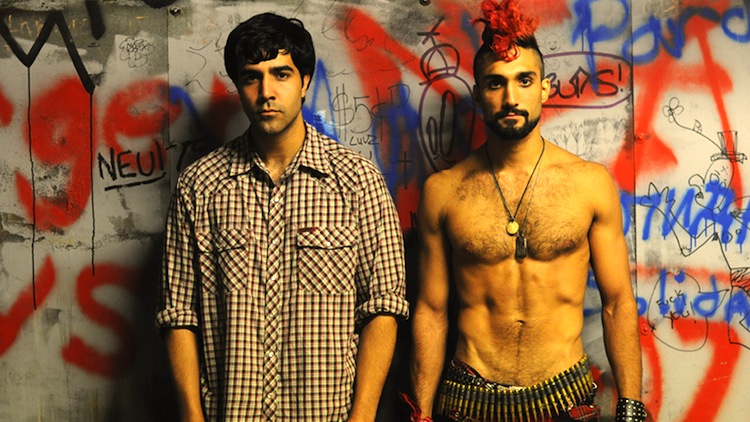
By Patricia Ducey.The Taqwacores is one of a few notable films lately (like Four Lions) nibbling at the margins of mainstream cinema with Muslims as its subject. Supported and developed at Sundance, and distributed by Strand Releasing, The Taqwacores is an original and winning little marvel.
The word taqwacore itself is a mashup of “taqwa,” meaning piety, and “core,” for hardcore – and the movie itself was adapted from Michael Muhammad Knight‘s 2003 novel, The Taqwacores, about an imagined Muslim punk scene in the U.S. – which in turn inspired an actual Muslim punk scene in America, then a documentary about it, and then this movie.
Strangely,The Taqwacores has been outright reviled by mainstream critics, but well-liked by audiences – Rotten Tomatoes gives it an 11% approval by critics and 51% by audiences – illustrating the apparently growing divide between the critical community and moviegoers. (I first began to notice this divide five years ago when I read a review of Memoirs of aGeisha, a movie I enjoyed and felt surpassed the novel, which stated that while the movie was well done and compelling, the reviewer felt he could not give it a thumbs up because its subject was a Japanese woman who engaged in and enjoyed – yes, shockingly, enjoyed! – an affair with an American military man in post-WWII Japan.) Sadly, it seems as though too many critics are either intimidated by political dogma, or feel obligated to uphold the politics and aesthetics of their mentors, to give little films like The Taqwacores a fair hearing.
Actress Noureen DeWulf, when not wearing a burqa.
The most unique aspect of The Taqwacores is that, for once, American Muslims are portrayed as the subject of a narrative and not as an objectified “other.” The Taqwacores is actually a coming of age story told from within a unique strata of American culture, with young people and their hopes and fears propelling the story. We are viewing the story of young American Muslims as they tell it to us in the way they want to tell it.
By contrast, a ‘mainstream’ Hollywood narrative would probably have involved a journalist writing about a punk rock scene that was pulling in local Muslim youth and ‘contaminating’ them with Western values. Somehow he would save these poor, besotted naifs; and, music swelling, the youths would return to the more pure, authentic lifestyle of their Muslim parents. (Or maybe a burned-out, disabled U.S. military vet would travel to another planet and rescue these well-meaning young people from American imperialism?)
In doing this, you might say that The Taqwacores revives the genre of politically incorrect cinema. I have not seen a movie that turns cliché on its head with such relish since the superb Last King of Scotland, a film that was as much a scathing indictment of western do-goodism as of Idi Amin.
As we hear the worried telephone voiceover of his mother, we meet young college kid Yusuf (Bobby Naderi), an American of Pakistani origin, arriving at a student rooming house run by “good Muslims,” as his mother assures him. Yes, a devout brother, Umar, does greet him and show him to his neat room, outfitted with a Koran – but as the day goes on, Yusuf begins to suspect that something is not quite halal about this place: metal music blares from the floor below; the refrigerator is filled with beer and nothing but beer; the one sister in the house, Rabeya (Noureen DeWulf) greets him – in a burqa covered with punk patches – and chats casually with him. A woman and man alone together, alcohol and rock and roll! What has Yusuf gotten himself into?
He spends the rest of the movie finding out. Soon he meets the other roommates – most notably the charismatic Jehangir (Dominic Rains), lead guitarist and resident punk theoretician. Jehangir has conceived his own anarchistic and liberating version of Islam, as expressed in his music. But Jehangir loves all music and especially idolizes Johnny Cash – “Johnny ruled the world” – and Jehangir is tired of being small. He wants out of submission and into relevance.
The roommates conduct Friday prayers, but with the woman, Rabeya, giving the sermon, and the prayers are usually followed by an all out drunken bash. Yusuf eventually falls for pretty former Roman Catholic Lynn, who has embraced Islam for its seeming lack of hierarchy that stands in contrast to her Catholic faith. But she and her freewheeling sexuality prove too much to Yusuf at the moment. Gradually though, Yusuf comes to understand and appreciate these new feminist and radical interpretations of his beloved Islam. He respects and is even thrilled by the way his housemates question and argue and embrace the Big Questions of life, like students everywhere, but he can’t jump into the mosh pit quite yet. And even though Yusuf is devout, he harbors no hostility to anyone – in contrast to angry young man Umar. He soon develops real affection for his housemates and their motley crew of hardcore rockers, feminists, and gays.
Yusuf changes, and he grows.
Actors Bobby Naderi and Dominic Rains.
Bobby Naderi plays Yusuf with the winning innocence of Dustin Hoffman in The Graduate. I would call this a breakout role for Naderi, except that America’s critical establishment has frozen out this little film and Mr. Naderi along with it. Dominic Rains brings handsome, tragic Jehangir to life, and the supporting characters all shine. Shot in primary colors against the grey sky of Buffalo’s winter, the camerawork echoes the graffiti slathered over every inch of the Taqwacores’ corner of the concrete jungle, and frames its characters like they are jumping off the page of a graphic novel.
Unfortunately, I suspect The Taqwacores will come and go quickly from theaters (not unlike Memoirs of a Geisha). So for an evening with Yusuf and his friends of smashing taboos and shocking the neighbors – set against the music of real taqwacore groups like The Komanis – you’ll have to move fast.
By Joe Bendel. When did skepticism become a term of derision in the scientific community? In truth, Bjørn Lomborg is not a so-called global warming “denier.” He agrees the Earth’s overall temperature is rising, but he takes issue with some of the more inflated estimates. It seems Lomborg’s primary sin though, is his application of rigorous risk assessments and cost-benefit analysis to the global warming debate. Having been likened to Adolf Hitler (yes, seriously) by Dr. Rajendra Pachuari of the UN’s Intergovernmental Panel on Climate Change, Lomborg gets a chance to speak for what he considers the maligned middle ground of the warming debate in Ondi Timoner’s new documentary, Cool It, which opened this past Friday in select theaters nationwide.
The Danish Lomborg always considered himself “lefter than left,” but when he chanced across an article by the late iconoclastic economist Julian Simon, his apostasy began. Simon argued, contrary to popular belief, that the state of the Earth was actually improving – in large measure due to the benefits of capitalist prosperity. Professor Lomborg took up the refutation of Simon’s book as a long-term class project, but his class found itself confirming far more than they contradicted. When he published their findings in his book The Skeptical Environmentalist, Lomborg’s name quickly became anathema to many of his academic colleagues.
Indeed, the extent to which Lomborg has been vilified, even persecuted, for deviating from politically correct orthodoxy is simply scandalous. Yet the Dane appears to be a happy warrior, embracing the warming debate as the next great fight. In conceding the general warming premise, he glosses over many legitimate questions about the integrity of the data often sited. Yet, he still gives warming partisans fits. For instance, Lomborg is tacky enough to actually run the numbers on the Kyoto Protocols, finding that at a projected cost of $250 billion in lost GDP annually, the EU’s plan to cut emissions 20% below 1990 levels will only cool the planet a negligible 0.1 degrees F. That is an inconvenient truth.
Indeed, the Al Gore documentary takes it in the shines and the credibility throughout Cool. Not simply held up as an example of reckless scare-mongering, Lomborg eviscerates several of Gore’s claims that gained particular traction in the public consciousness, including the Hurricane Katrina canard. Perhaps the best example of Lomborg’s rigorous methodology comes courtesy of the poor polar bears supposedly jeopardized by global warming. According to Lomborg, at the cost of $250 billion annually, implementing Kyoto might save one single polar bear a year (whose population has been steadily increasing over the past several years). In contrast, he suggests those truly concerned about polar bears work to crack down on poachers who kill 250 to 300 each year. Continue reading The Somewhat Skeptical Environmentalist: Cool It
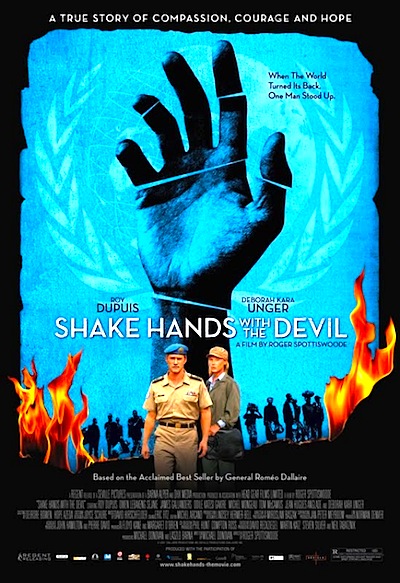
By Joe Bendel. Kofi Annan has blood on his hands. He might not have personally fired a shot in Rwanda, but his actions ensured the violent Hutu extremists remained heavily armed. So claims Lietenant-General Roméo Dallaire, the French-Canadian military commander of the UN peacekeeping forces in Rwanda. Based on Dallaire’s memoir, Roger Spottiswoode’s Shake Hands with the Devil, opening today, is an incisive indictment of the UN’s willful negligence during the 1994 mass killings.
Dallaire is a haunted man, haunted by the ghosts of 800,000 Rwandans who were murdered while he stood idly by, handcuffed by the UN’s restrictive rules of engagement and a lack of supplies. It need not have been so. As he first arrives at his post, the situation appears promising. All sides profess to want peace and are actively engaged in UN sponsored negotiations. Yet there are troubling signs, like the growing presence of informal Hutu militias strutting through the streets.
Initially, the UN Mission in Rwanda (UNAMIR) seems to get a lucky break when a well-placed source steps forward with information about huge weapons stockpiles in the ruling Hutu party headquarters. However, before Dallaire can launch his planned operation to seize the arms, the UN peacekeeping command orders him to stand down. Instead of confiscating the arms, he is to inform the hard-line Hutu president of what they know, and he is forbidden to offer asylum to his informer. At this point, the die is cast. Annan and the UN might as well have issued a proclamation declaring genocide season officially open.
A strong likeness of the real Dallaire, Roy Dupuis (who could also pass for Bruce Campbell’s older brother) gives a depressingly good performance, vividly showing the General’s military bearing cracking under the weight of the horror and futility of his position. Indeed, Shake is a rare film that genuinely respects military figures, like Belgian Colonel Luc Marchal – portrayed with genuine humanity by Québécois actor Michel Mongeau. Continue reading LFM Review: Shake Hands with Devil and Genocide in Our Times
By Jason Apuzzo. Opening this Friday in New York (and expanding across North America in coming weeks) is a superb new film called Disco & Atomic War – a film that both my Libertas colleague Joe Bendel and I agree is one of the most extraordinary documentaries of the year.
Disco & Atomic War deals with how Western popular entertainment ‘bootlegged’ into the Eastern Bloc or played on pirate TV stations – entertainments like Star Wars and Knight Rider and Dallas and the Emmanuelle films – played an enormous role in undermining the Soviet system. [You can read my LA Film Festival review of the film here.]
We’ve previously streamed Disco in its entirety here at Libertas, and overall I can’t recommend this film enough – among other reasons due to its obvious applicability to the current war on terror that we’re fighting, and how that might be won. The film also happens to be very drily amusing – almost a comedy in its own right.
[Here, incidentally, is a new interview with the film’s director, Jaak Kilmi.]
I’ve embedded a witty and unusual trailer from the film above. Enjoy!
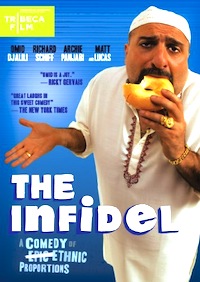
By Jason Apuzzo. A really hilarious and courageous little comedy called The Infidel, starring the talented and irrepressible Omid Djalili, just got its DVD release on the new Tribeca Films label. We really loved this film here at Libertas (see our glowing review of it here), and we recommend that everyone pick up a copy today.
The Infidel tells the story of an unassuming Muslim guy in the UK who discovers, by happenstance, that he was actually born Jewish. This wouldn’t be such a problem, except for the fact that his daughter is about to marry the stepson of a radical, jihad-promoting imam from Pakistan.
And that, as they say, is when the hijinks begin.
I’ve embedded the scene above in which Omid finds out about his true heritage. It’s a gas. Enjoy!