Don’t Call It Found Footage: LFM Reviews Digging Up the Marrow

By Joe Bendel. Thanks to the found footage sub-genre, the horror movie community hardly knows what to do when the real thing comes along. At least that is sort of the premise of the new meta-meta mock-and-shock doc from the team behind the Holliston television series. Director Adam Green, playing himself and riffing off his Holliston persona, starts to suspect monsters are real, so naturally he sets out to film them in Digging Up the Marrow, which launches on VOD and opens in select theaters this Friday.

Green really does get a great deal of intricately constructed fan fiction sent to him, in some cases much like the incredibly detailed but presumably barking mad missive that starts his on-camera excursion down the rabbit hole. A retired Boston cop named William Decker claims a secret band of the freakishly deformed live in a subterranean world he calls the Marrow. The entrances are closely guarded, but he has discovered one, logically located in an out of the way cemetery. Thus begins a series of futile stakeouts, with his reluctant cinematographer Will Barratt (played by cinematographer Will Barratt) in tow.

Of course, just when Green decides Decker is a complete nut leading them on a wild goose chase, they finally see something that changes everything. However, they still have to convince their colleagues to take their footage seriously. Green’s real life editor Josh Ethier (who also played the killer lumberjack-alien in Joe Begos’ Almost Human) is particularly skeptical, but he is perfectly willing to cut Green’s stolen shots. “It’s not found footage, it’s . . . footage” he insists.

Frankly, this is one of the best postmodern self-referential genre films since Wes Craven turned his signature franchise on its head with New Nightmare. It is light-years better than the Vicious Brothers’ knowing but disappointingly flat Grave Encounters 2. While there are plenty of creepy moments, the film is more about exploring how the horror industry and sub-culture would respond when confronted with possible evidence that maybe some of this stuff might just be real.

In a pleasant turn of events, Ethier and Hatchet star Kane Hodder (best known for his stint as Jason in the old school Friday the 13th films) are totally hilarious playing off each other and Green. They give the film a major energy boost during their scenes. Green himself is a good sport as the straight man for their quips and all of Decker’s macabre madness, whereas Ray Wise, the only cast member assuming a fictional persona, is reliably looney as the unreliable Decker.
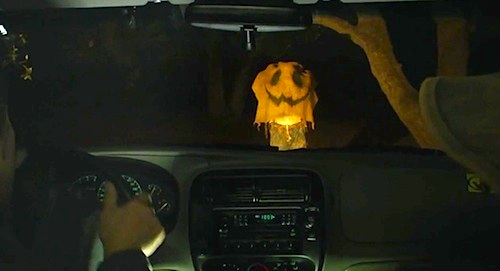
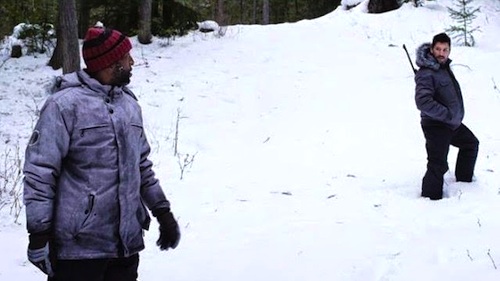
From "Digging Up the Marrow."

Inspired by the Alex Pardee’s monster art, Marrow is a strong creature feature that might even be more interesting when it operates in the ostensibly real world. Sadly, the film also marks the last screen appearance of Green’s late series co-star Dave Brockie. Green also was disciplined enough as a director to keep the scenes of actress Rileah Vanderbilt playing his actress-wife Rileah, even though she would now have to play his ex-wife should there ever be a sequel.

Given all that seems to transpire, fans will not be expecting a third season of Holliston anytime soon after watching it, but they should enjoy appearances from leading genre filmmakers like Don Coscarelli, Mick Garris, and Tom Holland. Highly recommended as a clever, fully developed, ironically meta genre film, Digging Up the Marrow hits iTunes this Friday (2/20).

LFM GRADE: B+

Posted on February 16th, 2015 at 10:04pm.
LFM Reviews Electric Boogaloo: the Wild, Untold Story of Cannon Films

By Joe Bendel. They were decades ahead of the curve, making profitable films about terrorism long before it became an overriding concern for Americans. Of course, Menahem Golan and Yoram Globus happened to be Israeli, so they understood how dangerous the world could be. Unfortunately, they were not as canny judging the American marketplace with the releases that followed Invasion U.S.A. and The Delta Force. Mark Astley compiles a breezy oral history of their rise and fall in Electric Boogaloo: the Wild, Untold Story of Cannon Films, which opens this year’s 2015 Film Comment Selects.

Yes, Hilla Medalia’s Cannon doc The Go-Go Boys just played the New York Jewish Film Festival, but there is always room for more Cannon. Reportedly, Go-Go is considered the B-movie moguls pre-emptive attempt to tell their side of the story. Hartley’s film even acknowledges the competition, comparing it to the dueling lambada films the former partners rushed to the marketplace after their contentious split. While Medalia spends more time on their early days in Israel, Hartley delves further into the early history of Cannon before Golan and Globus acquired it to serve as their Hollywood beachhead.

Plenty of the executives, writers, and directors associated with Cannon fondly remember the duo’s eccentricities, but there is not a lot of nostalgia coming from Frank Yablans, the former MGM studio head, who was contractually obligated to distribute their mid-1980s output. Hartley, who previously documented the Australian exploitation cinema of the 1970s and 1980s in Not Quite Hollywood and surveyed the low budget foreign and domestic action movies filmed in the Philippines with Machete Maidens Unleashed, not surprisingly shows an affinity for the nuttier movies in their filmography, like the notoriously spaced out futuristic rock opera The Apple and Tobe Hooper’s sci-fi grand guignol, Lifeforce.

Of course, it was their ill-conceived bids for Hollywood blockbuster respectability with the peacenik Superman IV and the Sylvester Stallone arm-wrestling epic Over the Top that would be their undoing. Frankly, it seems they never really understood their true comparative advantage: action cinema. Cannon really did take Chuck Norris to the next level and they substantially prolonged Charles Bronson’s career. They also discovered a Belgian waiter named Jean-Claude Van Damme. Unfortunately, they never really figured out what to do with their potential breakout star Michael Dudikoff, beyond the completely awesome American Ninja franchise and never recognized the untapped star-power of frequent supporting player Steve James (who frustratingly goes unmentioned again, after being overlooked by The Go-Go Boys).

Hartley marries up generous helpings of off-the-wall clips with some hilarious commentary (it is especially nice to see Catherine Mary Stewart remembering The Apple with self-deprecating humor). However, some of his talky head witnesses suggest some of the Hollywood resentment of Golan and Globus was a dark product of anti-Israeli, anti-immigrant sentiments, which is a place Medalia’s film never treads. Boogaloo (taking its title from their ill-advised break-dancing sequel) also gives the almost-moguls credit for successfully backing a number legit art films, but it is less interested in this side of their business than Go-Go Boys.

Go watch The Delta Force (with Chuck Norris, Lee Marvin, and the late Steve James) and try to pretend it doesn’t hold up today. The best of Cannon really defined the 1980s. Even after two documentaries, the full importance of those action movies still has not been fully explored. For instance, James may well be the first African American cult actor whose fan-base at the height of his productivity was nearly entirely white (and probably right-of-center). That seems culturally significant, but nobody wants to pick up on it. Regardless, Electric Boogaloo delivers plenty of entertaining nostalgia and attitude. Recommended for genre fans, it kicks off the 2015 edition of Film Comment Selects this Friday (2/20), at the Walter Reade Theater.

LFM GRADE: B+

Posted on February 16th, 2015 at 11:02am.

LFM Reviews Black Mountain Side @ The 2015 SF Indie Fest

By Joe Bendel. What was an ancient civilization doing in the northern most regions of the Yukon’s Taiga Cordillera? Not much, at least not anymore. However, their stag-headed demigod might be up to some bad supernatural business in writer-director Nick Szostakiwskyj’s Black Mountain Side, which screens during the 2015 SF Indie Fest.

Although there are indigenous peoples in the Taiga Ecozone, by the time you reach the research station commanded by Myles Jensen, civilization thins out to pretty much to nothing. That is why the discovery of a Mesoamerican monument (or rather the visible tip of it) is such a significant surprise. The more academically respectable Peter Olsen is flown out to inspect it, unfortunately for him. He agrees, it is the darnedest thing, but it is not Mesoamerican.

Soon thereafter, the camp cat is found murdered at the excavation site, like a sacrifice at an altar. The next day, the outpost’s indigenous workers have all taken to the wind. With the weather getting even worse, the men are cut off from the world, struggling with each other’s increasingly violent, delusional behavior, diagnosed by the camp doctor as the result of exposure to an ancient but still potent virus.

Frankly, Szostakiwskyj’s surprisingly subtle script allows for the possible the bedlam might just as easily be the product of an all-too human psychosis brought on by stress and isolation as it is the result of a killer virus or the work of a malevolent entity. We can probably safely assume all three are a factor in the ensuing chaos.

From "Black Mountain Side."

Despite the severed body parts, Mountain is remarkably restrained for a horror film. Much like the original Howard Hawks produced The Thing, it features some unusually smart dialogue, particularly the speculation regarding the vanished civilization that left behind the ominous artifact (someone should have thrown a bone up in the air in front of it to see if it would turn into a space station). This film was not exactly a bumper crop of opportunities for actresses, but Szostakiwskyj deals pretty forthrightly with both sides of masculinity—the cerebral reserve and the arm-chopping violence.

Arguably, Mountain is a little too quiet, soaking up atmosphere when it should be getting somewhere quicker. The primary characters are also a bit tricky to differentiate from one another. Mostly, they are smart, intense, and liberally appointed with facial hair. Still, Michael Dickson makes all of Olsen’s anthropological speculation sound cool.

While its horror movie mechanics are a tad off, the creepy vibe and distinct sense of place elevate Mountain above most indie genre outings. It the sort of film that makes viewers feel chilly in the moment and inspires gratitude as they live in major metropolitan centers after their screenings. Recommended for fans of naturalistic horror films, Black Mountain Side screens this Sunday (2/15), and the following Wednesday (2/18), as part of this year’s SF Indie Fest.

LFM GRADE: B

Posted on February 9th, 2015 at 8:59pm.

Off-Broadway Goes Big Screen: LFM Reviews The Last Five Years

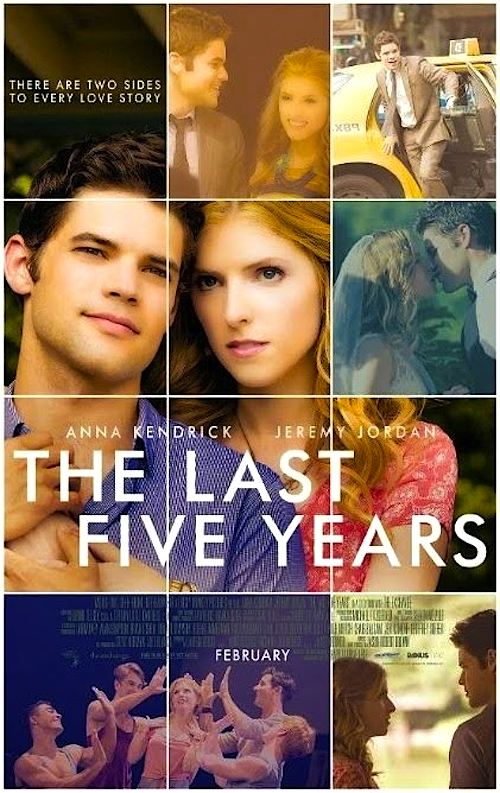
By Joe Bendel. The title of Jamie Wellerstein’s bestselling debut novel sounds nauseatingly pretentious, but Light Out of Darkness happens to be a hat tip to Sondheim’s Merrily We Roll Along, so all is forgiven. Regardless, his remarkable early success will put a strain on his marriage to a would-be Broadway actress. We know it will not last, because he walks out in the first scene. We will subsequently see how it all unraveled in Richard LaGravenese’s adaptation of Jason Robert Brown’s Off-Broadway musical, The Last Five Years, which opens this Friday in New York.

Wellerstein is leaving and it looks like he is never coming back. Cathy Hiatt is obviously devastated, but it gives her the first opportunity to show her range with the nakedly revealing feature spot, “Still Hurting.” There is more to this story than first appears. Wellerstein was once reasonably in love with Hiatt. It was he who first suggested they live together, before he eventually proposed. Yet, Wellerstein’s immediate success caused friction. Yes, it brought him into close proximity of literary groupies and trampy editorial assistants, but it is really caused more of a psychological disconnect between the brashly confident Wellerstein and the increasingly despondent Wellerstein née Hiatt.

Although the original stage production somewhat resembled Love Letters in its stripped down, dueling song-and-monologue structure, LaGravenese opens it up quite nicely. He brings it out onto the streets of New York and transforms the musical numbers into dramatic exchanges.

Frankly, the real issue with LFY is common to many new book musicals today. You might consider it the Rent effect. There simply is not enough emotional diversity to the score. Each number requires the cast to start at practically a crescendo level, maintaining the notes and the soul-baring wails. Even the show’s “novelty song,” “Shiksa Goddess” requires Wellerstein to belt out at the top of his lungs. It is more effective when a show goes up and down the scale. Give us some slow groovers and easy loopers, but with catchy melodies. Then hit us with the show-stopper.

Be that as it may, Anna Kendrick and Jeremy Jordan do everything that is asked of them and then some. As a veteran of Broadway (the way better than you’ve heard Bonnie & Clyde) and Smash, Jordan exhibits the chops you would expect, but the strength and clarity of Kendrick exceeds the expectations established by Pitch Perfect and her Tony nomination for High Society at the precocious age of twelve. They also have appealing chemistry together in the early days and convincingly push each away during the later bad times. Together, they make the arc of the relationship feel true.

Much of LFY’s narrative context and on-screen communication is delivered through song, often giving it a rock opera-ish vibe. Necessarily, one song often leads into another, reinforcing the samey-ness of the score. Nevertheless, Wellerstein’s climatic “If I Didn’t Believe in You” stands out as a dramatic equalizer, largely regaining the audience sympathy he lost in the opening scenes. Cinematographer Steven Meizler makes it all sparkle in a way that subtly evokes the big colorful Golden Age musicals, but in a way the still feels contemporary. If you like the sound of most post-Rent Broadway musicals that are not period productions, LaGravenese’s adaptation should be like catnip. For the rest of us, the two leads manage to carry the day through sheer gumption. Recommended for fans of movie musicals, The Last Five Years opens this Friday (2/13) in New York, at the Village East.

LFM GRADE: B-

Posted on February 9th, 2015 at 8:58pm.

LFM Reviews Gett: The Trial of Viviane Amsalem

By Joe Bendel. There is one area where Israel should find common ground with its radical neighbors: its rabbinical system of divorce that applies to all, regardless of faith or lack thereof, and invariably favors men. Of course, women’s rights are assiduously protected in other spheres of life, so that compatibility extends only so far. Nevertheless, for an emotionally neglected wife desperate to move on with her life, divorce proceedings are unbearably unjust, absurd, and protracted in Ronit & Schlomi Elkabetz’s Golden Globe nominated Gett: the Trial of Viviane Amsalem, which opens this Friday in New York.

Amsalem has not lived with her husband Elisha for years. All that time, she has stayed with her grown siblings, dutifully sending meals home to Elisha and their children every night. She has never been unfaithful or in any way brought shame on the family—aside from the scandal of their separation. She simply had enough of his passive aggressive cruelty and the isolation imposed by his anti-social Puritanism.

In an American court, this would be an open and shut case, especially when her husband contemptuously disregards notices to appear in court. Despite his recalcitrant behavior, the law remains on his side. As long as he continues to deny her long-sought after divorce (or gett), nobody can force him to change his mind. Viviane Amsalem’s decidedly unreligious attorney Carmel Ben Tovim will continue to file objections and call witnesses, but the institutional fix is in. Yet, like some sort of Kafkaesque Sisyphus, she continues to press a case that will be observed in months and eventually years.

Gett paints a traumatizing portrait of divorce, but unlike L.A. Law or American exposes like Divorce Corp, the Elkabetz sibling filmmakers never accuse the attorneys of exploiting the proceedings for financial gain. Frankly, everyone in this film is abjectly miserable, but the three-judge panel refuses impose a sensible gett, due their overriding doctrinal concerns.

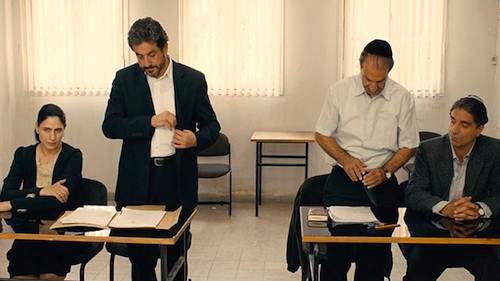
From "Gett: The Trial of Viviane Amsalem."

Ronit Elkabetz (so seductively earthy in the Oscar disqualified The Band’s Visit) is quite remarkable as Ms. Amsalem. She viscerally conveys a sense of her bitter exhaustion, but can still shock us with eruptions of repressed emotion, manifesting as rage or inappropriate laughter. Simon Abkarian plays Mr. Amsalem with rigid discipline, coming off cold, clammy, and callous. Yet, he adroitly reveals aspects of the husband “defendant” that explain and somewhat humanize his actions to some extent, but not at the expense of viewer sympathy for his embattled wife.

In terms of themes, tone, and intensity, Gett most closely compares to Asghar Farhadi’s A Separation, but it probably does the Iranian filmmaker no favors to liken his film with an Israeli work. Regardless, they are both seamlessly exhausting viewing experiences. Arguably, it is the mark of a healthy society that can forthrightly address its faults through cultural and artistic statements. Frankly, you will not see Arab cinema tackle gender inequity so candidly. Of course they also have even more fundamental issues than biased divorce law to contend with, like honor killings and female genital mutilation. No doubt that is slim comfort to the Viviane Amsalems, but worth noting nonetheless. Recommended for the sheer power of its performances and the Elkabetzes’ almost unbearably intimate dramatic focus, Gett: the Trial of Viviane Amsalem opens this Friday (2/13) in New York, at the Lincoln Plaza Cinema.

LFM GRADE: B

Posted on February 9th, 2015 at 8:58pm.

Imperial Assassins Do What They Do: LFM Reviews Brotherhood of Blades; Now on DVD/Blu-ray

By Joe Bendel. Would you feel confident throwing your conspiratorial lot in with something called “the Eunuch Clique?” Maybe not now, but the late Ming Dynasty were far different times. Senior Eunuch Wei Zhongxian was thought to control seventy percent of court officials, the so-called Clique. The new emperor is determined root out the eunuch’s influence, but that will be easier said than done for the three Jinyiwei imperial assassins in Lu Yang’s Brotherhood of Blades, which Well Go USA releases this week on DVD and Blu-ray.

The trio of Jinyiwei are so scruffy, their new commander Zhao Jingzhong is confident they have not been corrupted. It also means they could use a windfall. Shen Lian yearns to buy the freedom of Zhou Miaotong, a courtesan he has long visited, but it is unlikely to happen on his Imperial salary. The older and gaunter Lu Jianxing covets a promotion, but that will require bribes beyond his means. Meanwhile, the consumptive rookie, Jin Yichuan makes regular blackmail payments to an older associate from his criminal past.

Since they all need money, Shen Lian makes an executive decision to strike a deal with Wei. In exchange for a considerable sum of gold Taels, the Jinyiwei assassin lets Wei escape, delivering the charred body of a servant in his place. The three are hailed as heroes, but Wei’s followers are already conspiring to eliminate the only witnesses who know the powerful Eunuch is still alive. Unbeknownst to them, Zhao is part of the cabal. It turns out he is Wei’s secret foster-son. As the leader of the Eastern Depot, Zhao will give the three assassins assignments specifically intended to silence them permanently. When they manage to live anyway, things really start getting complicated.

In a way, Brotherhood is like a gangster movie decked out as a wuxia epic. Everyone is on the take to some extent. The question is how morally compromised are they? Like a good Triad or Yakuza film, it is heavy with themes of loyalty and betrayal, with personal allegiances frequently trumping concern for corps, dynasty, and nation. Of course there is also plenty of hack-and-slash action, featuring more crimson blood splatters than is typical of the genre.

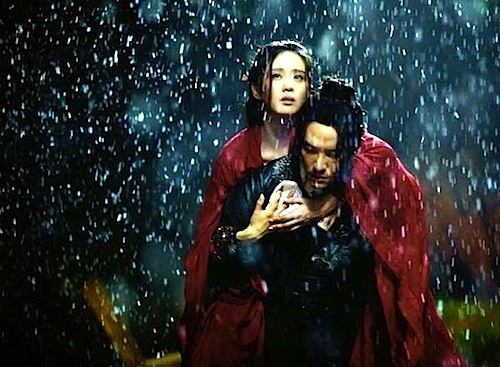
From "Brotherhood of Blades."

Taiwanese superstar Chang Chen, whose credits go back to Edward Yang’s masterpiece A Brighter Summer Day is perfectly suited for the tightly wounded Shen Lian. He broods hard and when he loses his cool, it is serious business. Frankly, it is one of his best performances in years. Likewise, Wang Qianyuan is appropriately world weary and a bit vinegary as old Lu Jianxing. However, Ethan Li largely fades into the background as the young, sickly Jin Yichuan.

Brotherhood is fully loaded with colorful supporting turns, but it strangely shortchanges Dani Zhou’s screen time, even though she seems quite promising as Wei’s butt-kicking daughter, Wei Ting. On the other hand, Cecilia Liu totally looks the part and delivers the aching tragedy in spades as the more-substantial-than-you-expect courtesan.

It is hard to believe Brotherhood’s robust action and intrigue comes from the same director who helmed My Spectacular Theater, a sensitive drama about empathy and accommodation, but here it is—and it is jolly nice to have it. Recommended for fans who like their wuxia on the bloody, morally ambiguous side, Brotherhood of Blades is now available on DVD, Blu-ray, and digital platforms, from Well Go USA.

LFM GRADE: B+

Posted on February 9th, 2015 at 8:57pm.