Statham Happens in Vegas: LFM Reviews Wild Card

By Joe Bendel. It is not exactly a critic’s dream come true, but it rises to one of our frequent challenges. We often lament studios remaking classic movies, making them considerably worse, rather than redoing and hopefully improving less-than-great films. That sort of happens here when Jason Statham steps into a role originated by Burt Reynolds. It’s already sounding better, isn’t it? In fact, Statham is much more convincing as the lethal bodyguard with a gambling problem in Simon West’s Wild Card, which opens this Friday in New York.

Like the somewhat notorious 1986 film Heat, Wild Card was adapted by screenwriter William Goldman from his own novel. On the screen, it follows much the same structure, but off-screen, hopefully there will be far less litigation. Nick Wild has an uneasy truce with the Mafia. He stays on good terms with the mega-connected Baby, but for the most part, he does not bother them and they do not bother him. Most of his jobs are a little demeaning, like babysitting nickel-and-dime gambler Cyrus Kinnick, but he keeps hoping to hit it big at the tables and run off to Corsica (it was Venice before).
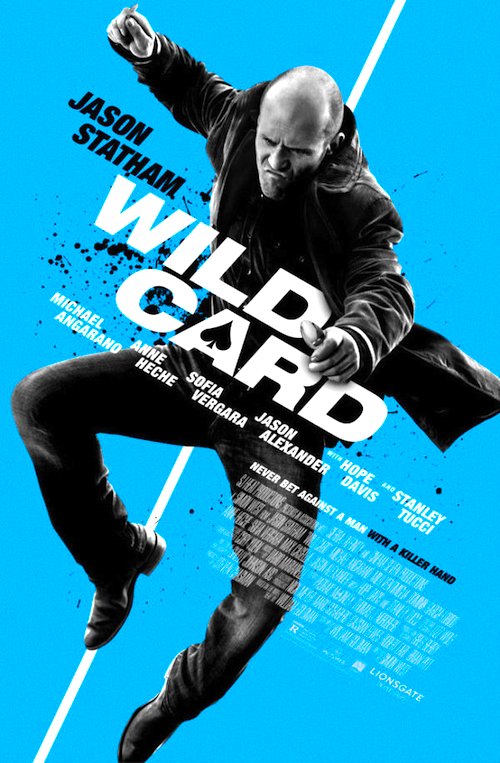
This equilibrium is disrupted when a visiting gangster brutalizes Holly, a prostitute Wild was formerly involved with. She wants him to get the creep’s name, so she can pursue legal action. However, Wild wants no part of anything connected to the Golden Nugget, which must be thrilled to be so explicitly identified as a mobster resort. Of course, as a good guy, Wild can’t help himself. Despite his hesitation, he lays quite a beating on the entitled Danny DeMarco and his henchmen and facilitates their further humiliation at Holly’s hands. From there, one thing leads to another.

Wild Card has a handful of spectacular fights (choreographed by Cory Yuen), sprinkled throughout long stretches of compulsive gambling and macho brooding. The gimmick for Wild (or Nick “Mex” Escalante as he was once known) is his facility for using commonplace items, such as credit cards and poker chips, as deadly weapons. Needless to say, this works so much better with Statham than Reynolds. Dominik García-Lorido (Andy Garcia’s daughter in the excellent Lost City and in real life) and Stanley Tucci also represent considerable upgrades as Holly and Baby, respectively. Indeed, the casting is nearly perfect this time around. Unfortunately, the Kinnick character still gums up the works with his unnecessary subplot.

Unlike the previous film’s revolving door-battery of directors, West keeps Wild Card moving along at a decent clip, even though it is more about gambling and gangster power games than action, per se. He also maintains a relatively upbeat mood, nicely underscored by some classic licensed blues and R&B tunes from artists like Magic Slim, Albert King, and Charles Brown. It still isn’t perfect but it is better, which is something. You could even say it’s not bad—but nowhere near Statham’s best work in The Bank Job and Redemption. For fans of old school Vegas, Wild Card opens this Friday (1/30) in New York.

LFM GRADE: C+

Posted on January 28th, 2015 at 5:36pm.

LFM Reviews True Story @ The 2015 Sundance Film Festival

By Joe Bendel. Who is the bigger user, the disgraced journalist or the alleged family murderer? It is a close call, but the “journalist” has no competition when it comes to willful self-deception. Mike Finkel’s strange and problematic relationship with Christian Longo provides the dramatic grist for British theater Rupert Goold’s ripped-from-the-tell-alls feature debut, True Story, which screens during the 2015 Sundance Film Festival.

For a while, Finkel was the golden boy at the New York Times, scoring numerous Sunday magazine covers. Then he was busted for “compositing” victims somewhat haphazardly in a human trafficking story. At least Christian Longo was still a fan. While on the lam, he used Finkel’s name as an alias. Intrigued by the connection, the real Finkel pays a jail house visit to the man accused of killing his wife and three children. Recognizing a story that could salvage his career, Finkel agrees to co-author a book with Longo. Of course, he assumes it will be exculpatory, but early trial developments leave him feeling confused and betrayed.

Clearly, this is not a film looking to rehabilitate the NYT’s scandal-plagued image. Gretchen Mol plays Finkel’s editor as an ice cold CYAing Machiavellian, which might be the truest aspect of True Story. The ironic postscript also serves as a final middle finger to the Gray Lady. However, Goold and co-screenwriter David Kajganich are not trying to do any favors for Finkel or Longo, either. In all honesty, everyone comes out of it looking badly, but that makes it fascinating to watch.

From "True Story."

Longo, the media savvy sociopath, just might be the role James Franco was born to play. He is so frighteningly convincing turning on the charm and manipulating everyone around him, it makes you wonder. Although it is a far less showy role, Jonah Hill’s Finkel is also believably slow on the uptake (so much so, it also makes you wonder). Mol is suitably severe, but True Story is not a great vehicle for actresses, completely wasting Felicity Jones as Finkel’s more guarded but nearly personality-less girlfriend.

Franco and Hill’s scenes together have fair degree of crackle, but the suspense never really rises above room temperature. Frankly, there are no miscarriages of justice in True Story, unless you count the Times getting off easy after yet another journalistic scandal. Yet, it is strangely refreshing to see a film that is not out to gin up cheap outrage. Recommended for those who appreciate adult drama, True Story screens again this Thursday (1/29) and Saturday (1/31) in Park City and Sunday (2/1) in Salt Lake, as part of this year’s Sundance.

LFM GRADE: B

Posted on January 28th, 2015 at 4:54pm.

Paginini at the Crossroads: LFM Reviews The Devil’s Violinist

By Joe Bendel. Niccolò Paginini was the Robert Johnson of classical music. His ferocious technique and unparalleled popular success were seriously considered the fruits of a Faustian bargain. The talent was always there. Getting people to listen was the hard part. In fact, it was such a tricky proposition, the materialist maestro gladly makes that deal in Bernard Rose’s The Devil’s Violinist, which opens this Friday in New York.

Sulfur has not numbed the Mephistophelean Urbani’s nose for talent. He immediately recognizes the gifts of an aspiring Don Juan violinist scuffling in grubby music halls. He pledges to guarantee Paginini’s career and serve as his personal servant in this world, if Paginini agrees to do the same for him in the next. Shortly after signing a contract he probably should have read more closely, Paginini’s career ignites. He becomes a figure of dark romance and veiled controversy, like an early nineteenth century heavy metal rock star.

Eventually, Paginini gets bored with it all, spending long hours brooding in the tub, doing his best to resemble The Death of Marat. Fortunately, Paginini somewhat snaps out of his lethargy when he accepts upstart promoter John Watson’s offer to produce and conduct his London debuts concerts. However, Paginini’s demands will stretch the limits of Watson’s resources. Met by a mob of moralizing progressive protestors, Watson and his diva mistress Elisabeth Wells are forced to quarter Paginini and Urbani in their home. Of course, Watson’s daughter Charlotte immediately catches Paginini’s eye, but she is not inclined to swoon over the maestro, at least not yet.

We always thought Jared Harris just might be the Devil, so Violinist practically feels like a confirmation. He is delightfully sinister chewing on the scenery. Yet ironically, Urbani (who seems to be more of a minion than Old Scratch himself) is not infrequently portrayed as a more empathetic fellow than Paginini. Regardless, it is great fun watching him lurk and glower.

From "The Devil’s Violinist."

Violin prodigy and classical crossover artist David Garrett can certainly play. Acting is a little iffier. Perhaps the many scenes of his Paginini huddling in bed sheets in a state of near catatonia was a shrewd strategic decision on Rose’s part. Fortunately, Harris has some terrific supporting players to engage with, including Christian McKay, unflaggingly earnest as Watson, as well as Joely Richardson suggesting Eliza Doolittle’s morally flexible cousin as tabloid music critic Ethel Langham.

In a way, Devil’s Violinist reconciles the classy Jekyll films Rose has helmed, such as the Beethoven bio-pic Immortal Beloved and the superior Sophie Marceau version of Anna Karenina, with his Hydish scare fare, like Candyman and SXTape. For obvious reasons, he leans towards the former, depicting Urbani more as a Svengali than a figure of satanic horror. It works relatively well, despite Garrett’s awkwardness, which sometimes even feels fitting in context. Harris certainly does his thing and Garrett’s musical chops are also quite cinematic. Recommended for classical connoisseurs who appreciate a bit of uncanny garnish, The Devil’s Violinist opens this Friday (1/30) in New York, at the Quad Cinema.

LFM GRADE: B-

Posted on January 28, 2015 at 4:53pm.

LFM Reviews Darkness on the Edge of Town @ The 2015 Slamdance Film Festival

By Joe Bendel. Young Cleo Callahan might not look like a vigilante, but she has the right skills. She is crack sharpshooter, particularly with a rifle-scope. Arguably, her investigative talents are somewhat subpar, but in such a small provincial village she is bound to find her sister’s killer sooner or later. However, the guilty party is closer than she could imagine in Patrick Ryan’s moody revenge drama Darkness on the Edge of Town, which screens during the 2015 Slamdance Film Festival.

Since the death of their parents, Callahan’s relationship with her older sister Aishling has been strained. She now lives with Foster parents, while Aishling lives the wild life—or at least she was. Although we see full well who the killer is, it feels like the sort of thing that should be held close to the vest. Regardless, Cleo Callahan soon sets out to even the score, presuming the murderer is one of the dodgy characters in her sister’s social circle.

Technically, they are innocent, but it is clearly implied they did sister Aishling wrong in more conventional ways, so there is no need to feel sympathy for their sorry hides. However, it is a different story when suspicion falls on Virgil O’Riley, the brother of her profoundly troubled best friend Robin.

The tone of Darkness is so dark, it is like Milton’s darkness visible. You do not want to know what goes on behind closed doors because it is sure to be awful. This is not a wish fulfillment vigilante movie like the later Death Wish films. It is scrupulously serious, even though there is a good deal of blood down the stretch. At times, Ryan plays with the themes and visual language of the western genre, but it is really more closely akin to a film like Heavenly Creatures, but executed in a drastically more naturalistic style.

From "Darkness on the Edge of Town."

Be that as it may, Darkness heralds the arrival of Emma Willis as a major new screen talent to watch. Her performance as Robin O’Riley is truly harrowing, riveting, and downright scary. It is bad luck for Emma Eliza Regan, whose intense slow-burning work as Callahan is likely to be overlooked, even though it is excellent, as well.

It is hard to classify Darkness as a thriller, because of its deliberate pacing and thoroughly realized sense of hardscrabble place. Still, this film has grit in abundance. Definitely recommended for patrons of Irish cinema and violent contemporary tragedies in general, Darkness on the Edge of Town screens again today (1/28) at Treasure Mountain Inn, as part of this year’s Slamdance.

LFM GRADE: B+

Posted on January 28th, 2015 at 4:53pm.

LFM Reviews Above and Beyond

By Joe Bendel. Twice they answered the call to protect democracy, prevailing against the odds each time. In 1948, a number of former American WWII military pilots volunteered to fly for the fledgling state of Israel when it was under attack from nearly the entire Arab world. They were vastly outgunned and outnumbered, but their experience and sheer guts became game-changers. Director Roberta Grossman and producer Nancy Spielberg (sister of the other filmmaker named Spielberg) chronicle the birth of the Israeli Air Force in Above and Beyond, which opens this Friday in New York.

When the Arab nations launched the War of 1948, it looked pretty grim for Israel. The Israeli military did not have a single plane to its name, but the Egyptians had an extensive fleet. Rectifying the situation would be a tricky business. Although Pres. Truman supported the creation of Israel, his foreign policy advisors were much less enthusiastic. In fact, they pushed through an arms embargo, ostensibly for the entire region, but disproportionately falling on the almost entirely unarmed Israel.  It was not like there were not plenty of surplus fighter planes leftover from WWII. Fortunately, engineer Al Schwimmer (formerly with TWA and Lockheed) devised a plan to smuggle planes from America to Israel.

Of course, he also had to recruit pilots, such as Lou Lenart, whose Lindberg-like flight over the Mediterranean serves as the film’s gripping prologue. They were not just risking their lives, they were also risking their American citizenship and perhaps even their liberty for violating the Neutrality Act, but they had their reasons. While not necessarily ardent Zionists, most predominantly but not exclusively Jewish volunteers were determined to avoid a repeat of the Holocaust’s genocidal horrors. However, they were still military aviators, with all the swagger you would expect.

Above documents a truly desperate time in Israeli history, yet it is also hugely engaging, thanks to the boisterous reminiscences of the surviving volunteers. They all have great stories to tell, but Grossman and Spielberg were particularly blessed by the documentary gods when they sat down with Gideon Lichtman, who couldn’t tell a boring story if he tried.

Through its first-person interviews and supplemental commentaries, Above assembles a full portrait of Squadron 101’s early days that is chocked full of fascinating episodes. Shrewdly, it refrains from playing the conspiracy card with respects to the untimely death of legendary ace Canadian volunteer Buzz Beurling, but its straight reporting of the facts still makes you wonder.

This is a flat-out terrific film that is not ashamed to celebrate heroism and derring-do attitude. Indeed, it is truly inspiring (and often wickedly funny) to hear the volunteers recount their exploits. Grossman and company have crafted a fitting platform for their oral history, supplying solid historical context and some surprisingly cinematic visuals. Rigorously researched and wildly entertaining, Above and Beyond is very highly recommended (especially for students) when it opens this Friday (1/30) in New York, at the Village East.

LFM GRADE: A

Posted on January 26th, 2015 at 5:57pm.

LFM Reviews The Go-Go Boys: the Inside Story of Cannon Films @ The 2015 New York Jewish Film Festival

By Joe Bendel. Turning Superman into a bomb-banning peacenik was an idea destined to fail. Nobody should have understood that better than the men who brought the world the American Ninja franchise. Unfortunately, they got caught up in the deal and the predictable failure of Superman IV: the Quest for Peace spelled the beginning of the end for scrappy Cannon Films. The rise and fall of the self-made, 1980s defining moguls Menahem Golan and Yoram Globus are chronicled in Hilla Medalia’s The Go-Go Boys: the Inside Story of Cannon Films, which screens during the 2015 New York Jewish Film Festival.

While working in his native Israel, Menahem Golan attained a level of international respect for films that combined popular appeal with critical respectability, such as his Oscar nominated Operation Thunderbolt. His first English language productions were not so successful, but he kept trying until he found the right formula. Indeed, formula would be the right word. With his cousin, Yoram Globus, Golan acquired Cannon Films, turning it into the little studio that could, by releasing a series of cheaply produced but highly satisfying action movies.

With a regular stable of stars that included Chuck Norris (including the Delta Force and Missing in Action series), Charles Bronson (especially the Death Wish sequels), Michael Dudikoff (American Ninja), and a Belgian waiter named Jean-Claude Van Damme, Cannon became the action house of its era. Any guy who remembers the 1980s will have fond memories of Cannon. When Golan and Globus respected their competitive advantages, they were wildly profitable. In fact, Cannon became notoriously successful pre-selling films they had not yet made (a standard practice these days), largely on the strength of the stars they had signed and a bankable concept.

Even dabbling in art cinema did not doom the Cannon empire. The same team behind Ninja III: the Domination (a longstanding fan favorite) also scored an Academy Award for foreign language film for the Dutch WWII drama The Assault. In some cases, they even leveraged distribution for prestige pictures with their signature action movies. Unfortunately, when the more artistically ambitious Golan convinced the fundraiser-extraordinaire Globus to start bankrolling traditional studio level budgets, the box office results were disastrous.

Chuck Norris in Cannon's "Delta Force."

Anyone who loves martial arts films and B-movies will inhale Go-Go Boys. Medalia scored long in-depth sit-down interviews with the late Golan and the surviving Globus, even capturing their reunion after years of estrangement. She also talks to most of the principle supporting players, including a highly animated Van Damme and a more reflective Dudikoff. It is also nice to see Andrei Konchalovsky get his due as a Cannon artist (most notably for Runaway Train). However, the oversight of the late great cult action star Steve James, who played an important role in many iconic Cannon hits, is frankly inexcusable.

Clearly in retrospect, Cannon never should have never bothered with the middling middle ground. Their bread-and-butter action films like Avenging Force and Bloodsport still hold up to this day, while their art house releases, such as Norman Mailer’s Tough Guys Don’t Dance and Godard’s King Lear remain distinctive for their idiosyncrasies. For the most part, Medalia gives them their due in a breezily affectionate profile. Even though the absence of James will annoy fans, The Go-Go Boys is still recommended for cult film connoisseurs when it screens twice this Thursday (1/29) at the Walter Reade Theater, as part of this year’s NYJFF.

LFM GRADE: B

Posted on January 26th, 2015 at 5:56pm.