LFM Reviews I for Iran @ MoMA’s First Look 2015

I COMME IRAN de Sanaz Azari | CVB AUTEUR | BANDE-ANNONCE from CVB-VIDEP on Vimeo.

By Joe Bendel. You can find some rather unpleasant images and references in the text books of post-Islamic Revolutionary Iran. Nobody understands that better than an Iranian-Persian filmmaker’s Persian tutor. However, he still uses a problematic text due to a lack of better options. His language lessons will illuminate deeper truths in Sanaz Azari’s I for Iran, which screens during the Museum of the Moving Image’s 2015 First Look.

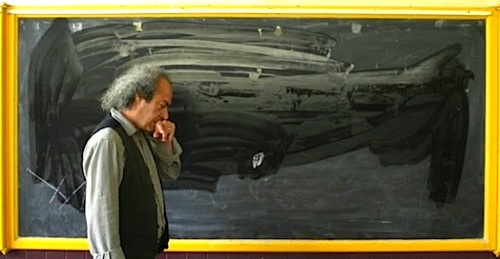
Azari was born in Iran, but lived in Brussels since early childhood. As a result, she did not speak Persian until she enrolled in classes as an adult. During her studies, she was struck by the way language carries cultural specific codes and meanings. This was particularly so with respects to Persia and Iranian identity, even and especially following the revolution. As he bemoans their textbook, Behrouz Majidi will expound on the beauties and ironies of Persian culture in a series of improvised lectures.

That might sound rather academic, but Majidi is the sort of screen presence who could read the Brussels phone book and keep the audience riveted. His delivery is sort of like vintage Mark Twain—drily witty and deceptively elliptical. Just when you think he is hopelessly off point, he brings each mini-monologue home with panache. At times he waxes nostalgic for lost Iranian treasures, like the storied Shirazi wine the Islamist government has long since forbidden. When he addresses current events, such as the 2013 presidential elections, his analysis also sounds pretty darn spot-on.
From "I for Iran."

Unfortunately, that means Majidi is more of a realist than an optimist. However, his love for Persian culture and nostalgia for the Iran that once was is wholly engaging and at times quite touching. In between his improvised riffs, Azari presents a sort of visual free association based on the particular Persian letter under discussion. Frankly, these seem to work better over time, with the latter chain of images taking on far more evident meaning. Still, for the most part, they just take viewers away from the heart of the film.

I for Iran might sound simple and in terms of its formal structure it certainly is. However, despite its mere fifty minute running time, it overflows with thoughtful insights on human nature and grand themes like freedom, cultural survival, and human dignity. For such an unassuming film, it really sticks with viewers. Even though it is hard to define its cinematic category and the exact nature of Majidi’s performance, it still ought to be a star-making turn. Surprisingly moving, I for Iran is very highly recommended when it screens this Saturday (1/17), with the equally difficult to classify International Tourism as part of this year’s First Look at MoMI.

LFM GRADE: A

Posted on January 14th, 2015 at 11:10pm.
LFM Reviews Vice

By Joe Bendel. Evidently, Michael Crichton gave humanity too much credit in Westworld. Instead of using cutting edge android technology to facilitate adventures in the Old West and ancient Rome, Julian Michaels has built a Vegas-style resort, where rich pervs can commit sex crimes with impunity. However, when one android-resident escapes into the real world, her programmers will pull out all the stops to recapture her in Brian A. Miller’s Vice, which opens this Friday in New York.

Like Kenny on South Park, pretty much every night Kelly and her friend Melissa are killed by a guest. Their memories are wiped and their bodies are repaired, so they can be reactivated a few days later. This time, Michaels expedites the process, to cater to a big hedge fund party. Seriously, someone at his level should not be micromanaging this sort of day-to-day business. Regardless, they put a rush on Kelly’s maintenance, leaving behind memories that understandably alarm her. Not inclined to go back for more such treatment, she escapes from the resort-compound.

Naturally, Michaels wants her back ASAP, but he does not want the cops involved, particularly not his nemesis, Roy Tedeschi. The world weary detective blames Vice for stirring up bad impulses that then spill over onto his streets. Despite the risk to his career, he has made it his business to antagonize Michaels. He and Kelly really ought to get together, as you know they must eventually.

There are an awful lot of stupid decisions and unnecessary villainy coming from Michaels and his associates. Pedantically speaking, there really ought to be multiply-redundant safeguards in place to avoid a situation like this—embarrassing, but probably not illegal. Needless to say, Vice is a pale shadow compared to Crichton’s Westworld and it suffers from the lack of a heavy comparable to Yul Brynner’s gunslinger. Still, it delivers a reasonable mix of trashy entertainment through its credible near future world-building and voyeurism dressed up as moral righteousness.

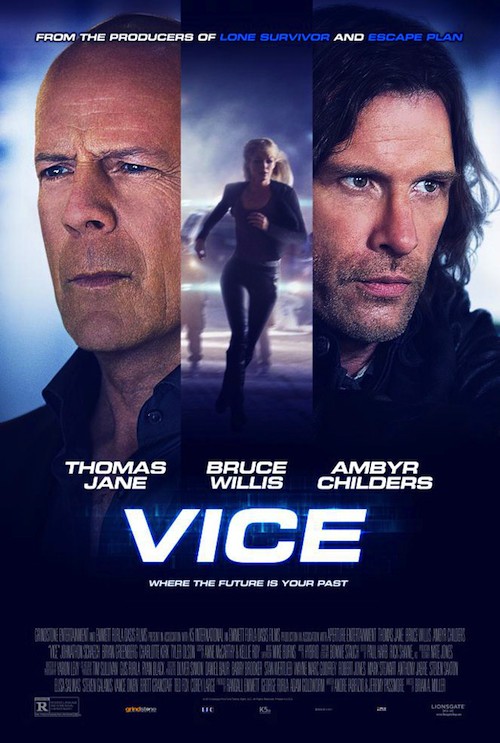
As a mid-January release, it is probably safe to say Vice is not destined to be a major awards player, but at least none of the primary cast-members embarrass themselves. Ambyr Childers is not half bad portraying Kelly’s slow process of self-assertion. Likewise, Thomas Jane is sufficiently hardnosed as Tedeschi and Bruce Willis chews on a fair amount of scenery as Michaels. Charlotte Kirk also makes the most of her limited screen time as the perennially ill-fated Melissa. Frankly, both Childers and Jane easily exceed expectations. It is just too bad Andre Fabrizio & Jeremy Passmore’s script is so derivative and uninspired.

Indeed, Vice is the sort of film you want to rewrite as you watch it. The whole concept of the Vice resort ought to be a launching pad for some clever social commentary, but like its creepy clientele, it just brings out the worst in its screenwriters. Still, everyone whose face is on the poster gives it a fair try. It is diverting enough if you enjoy B-movies, but anyone primarily intrigued by the premise should catch up with the Crichton film instead. For those looking for some slightly lurid, light-on-the-technical-stuff science fiction, Vice opens this Friday (1/16) in New York, at the Cinema Village.

LFM GRADE: C+

Posted on January 14th, 2015 at 11:10pm.
LFM Reviews New French Shorts at the IFC Center

By Joe Bendel. The original idea was to present a selection of French short films with prestigious festival credentials as a warm up for the My French Film Festival. However, the mood is sure to be drastically different from what anyone would have anticipated when UniFrance presents the third annual New French Shorts showcase at the IFC Center.

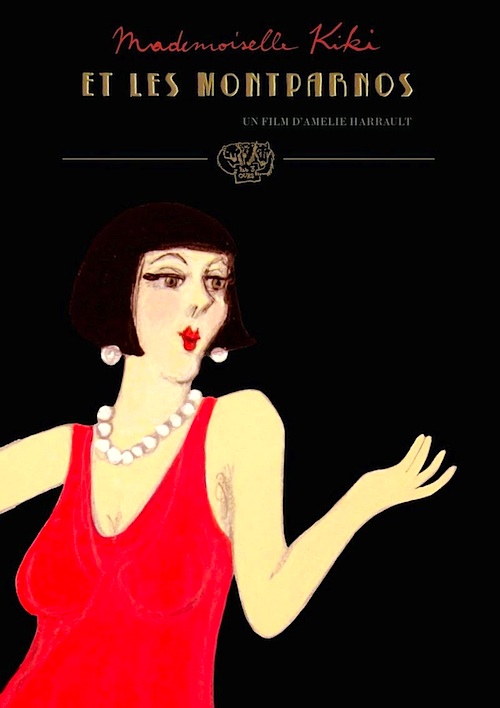
As the world reels from the terrorist attack on Charlie Hebdo, cineastes can take particularly comfort from Amélie Harrault’s Kiki of Montparnasse, because it represents everything we love about French culture and everything the Islamist killers would hate. Chronicling the life of a cultured and independent woman, it is elegant, artistic, and a bit racy. Alice Prin (a.k.a. Kiki) rose from humble beginnings to find fame as an artist’s model, torch singer, actress, and memoirist in the Parisian artists’ community of Montparnasse. It would be impossible to make a boring film about “the Queen of Montparnasse,” but Harrault’s short film is particularly inspired, altering the look of the animation to reflect the style of each successive artist Prin encounters, including Mondigliani and Man Ray.

Prin’s story is not all champagne and caviar, but it portrays Paris as we always want to think of the city. Bandine Lenoir’s The America of Womankind also offers a bit of sauciness (and Antoine Sahler’s fusiony trumpet gives the closing credits a nice kick), but it is more of a sketch than a narrative. While a teenaged girl and her boyfriend make the beast with two backs, her mother, grandmother, and aunts debate whether they should interrupt them or embrace their sex-positive attitude. It is somewhat amusing but inconsequential.

However, two of the programmed films explore the grittier side of contemporary France. Clément Tréhin-Lalanne’s Aïssa is the lesser of the two, serving more as a statement than a film. A young Congolese immigrant is seeking amnesty protection, claiming to be a distressed minor. However, a coldly bureaucratic medical examination may very well disprove her claim. Essentially, Aïssa is a one note film, but the vulnerability of Manda Touré’s performance is still impressive. It is also notable how the television-like aspect ratio gives it the feel of Super-8 micro docs.

Jean-Bernard Marin’s The Runaway addresses similar themes, but it is a fully developed narrative. Lakdar is a tough talking social worker, but he really cares about his charges, even the self-destructive ones like Sabrina. Through his efforts, she has landed a service industry trainee position, which might convince the court to sentence her to probation rather than a prison stretch, if she presents herself in a thoughtful, contrite manner. Alas, that might be too much to ask. Unfortunately, she might drag down Lakdar with her, as well.

As Lakdar, Adel Bencherif is absolutely terrific delivering a tragic, street level performance akin to what you might see in early Scorsese. Runaway is hardly a lecturing multicultural guilt trip either, emphasizing the flawed reality of human nature. Like Sabrine, an inmate in a Washington state women’s prison is a difficult case to help in Laure de Clermont-Tornerre’s Rabbit. She had committed to care for a dwarf rabbit as part of a counseling program designed to develop responsibility, but she might sabotage herself instead. Frankly, Rabbit is a perfectly presentable film, but the stakes and intensity cannot compare to Runaway.

French-based Chinese filmmaker Hu Wei’s docu-essay Butter Lamp might sound conspicuously out of place, but visually, it is unusually distinctive, so why not stretch the selection parameters? As an itinerant photographer and his assistant snap portraits of hardscrabble Tibetan families in front of anachronistic fake backdrops, Hu offers a shrewd commentary on the conflict between traditional Tibetan culture and globalization. Deceptively simple, it is actually quite cleverly executed.

Kiki of Montparnasse, The Runaway, and Butter Lamp are all excellent short films, under any circumstances. Of course, next week’s UniFrance showcase will be an opportunity to see them, as well as a time to express solidarity with the admirably iconoclastic Charlie Hebdo. Also recommended on strictly cinematic terms, the 2015 New French Shorts program screens this Wednesday (1/14) at the IFC Center.

Posted on January 14th, 2015 at 11:09pm.

LFM Reviews Once Upon a Time in Shanghai; Now on DVD/Blu-ray

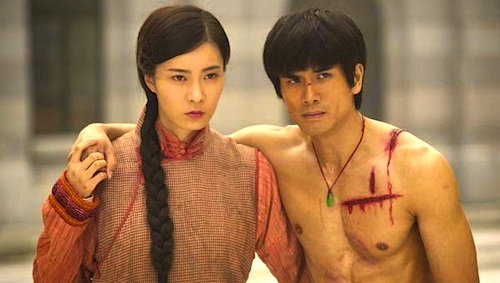
By Joe Bendel. Ma Yongzhen is one of China’s favorite Robin Hood-ish gangsters. Film and television versions of his story (including the Shaw Brothers’ Boxer from Shantung) often transplant Ma to the wild and woolly Republican 1930s, but the first film version of the Nineteenth Century bumpkin-turned racketeer was the 1927 silent Shandong Ma Yongzhen. A new supercharged remake/reinvention of the 1972 Shaw Brothers fan favorite takes even more liberties with Ma’s story, but if he has any surviving descendants, they are not likely to object to the heroic portrayal of the martial artist in Wong Ching-po’s Once Upon a Time in Shanghai, which releases this week on DVD and Blu-ray, from Well Go USA.

Ma Yongzhen came from the dirt poor provinces to make his fortune in Shanghai. Ironically, he has exactly the sort of skills to make it in the go-go city, but he promised his sainted mother he would never become a gangster. To remind him to temper the power of his iron-fist, she gave him his only valuable possession: a jade bracelet.

Living in a slum watched over by the kindly Master Tie, Ma quickly gets a lay of the land. Through a series spectacular sparring sessions, Ma earns the trust and a legit job from Long Qi, a gangster-club owner more closely resembling the historical Ma Yongzhen. The brash Long Qi has taken over a sizable portion of the Ave Gang’s territory, but he is asking for trouble with his outspoken anti-Japanese sentiments. When the Axe Gang and the Japanese form an alliance, Ma will be pulled into the fray to protect everyone halfway decent.

OUATIS is definitely following the buddy movie playbook, but screenwriter Angela Wong somewhat inverts the formula, by having the naïve country boy stay strong and start to reform the hedonistic crime lord. Even so, the narrative is rather simplistic, but the film’s grit and tragic vibe will appeal to genre audiences nonetheless.

The martial arts sequences choreographed by Yuen Woo-ping and Yuen Cheung-yan are obviously the important thing here—and they deliver. Fortunately, Philip Ng and second lead Andy On have the skills and bearing for the often brutal but wildly cinematic beatdowns. There is no question they can carry this stuff off. Veteran martial arts stars Sammo Hung and Chen Kuen-tai (the 1972 Ma Yongzhen) lend the film further street cred.

From "Once Upon a Time in Shanghai."

After working his way up through a series of increasingly prominent supporting roles (Lionel, the undercover cop stepson in From Vegas to Macau), Ng gets his shot playing the hero here. His turn as Ma is not exactly a bases-clearing homerun, but Ng is not bad at all. He has a strong presence, develops some reasonably believable romantic chemistry with Michelle Hu’s Tie Ju (the somewhat judgmental daughter of Master Tie), and excels in the fight scenes. Although Andy On goes a bit over the top with Long Qi’s outrageous preening and weird bursts of laughter, it sort of works anyway, because this is a genre that rewards attitude – which he brings in generous servings.

Indeed, most action enthusiasts will want to see more of Ng and the more established On after Wong’s Ma Yongzhen reboot, which says a lot. If you are looking for impressive martial arts action and can easily overlook some predictably excessive anti-Japanese propaganda, then it is a safe bet. Recommended for martial arts and historical gangster fans, Once Upon a Time in Shanghai is now available for home viewing from Well Go USA.

LFM GRADE: B

Posted on January 14th, 2015 at 11:08pm.

LFM Reviews Giuseppe Makes a Movie

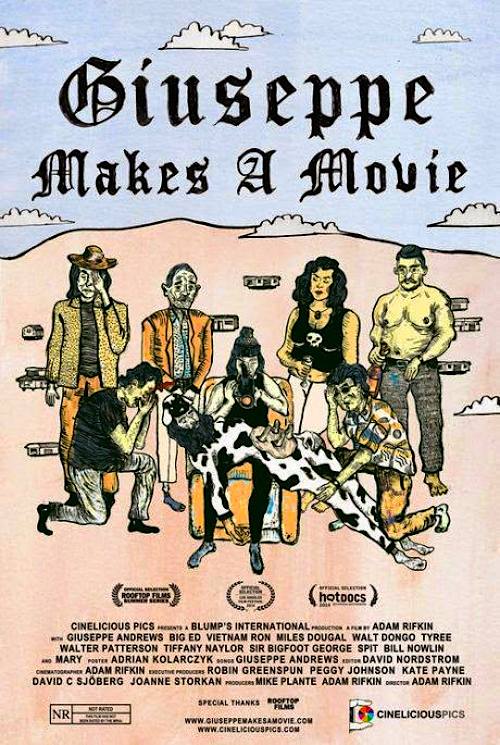
By Joe Bendel. Wrap your head around this—Giuseppe Andrews has made more full length features than either Terrence Malick or Quentin Tarantino. Andrews would consider Garbanzo Gas his tenth “proper” feature, but there were ten or so earlier films that just didn’t come together the way he hoped. Of course, Andrews will be the first to admit “proper” is a decidedly subjective term in his case. Adam Rifkin documents Garbanzo’s whirlwind preproduction and two day shooting schedule in Giuseppe Makes a Movie, which opens this Thursday at Anthology Film Archives.

Andrews lives in a Ventura trailer park, next to his producer-father, Ed, a former back-up musician with the Bee-Gees. After previous stretches of veritable homelessness, both men feel they have finally put down roots. The experience gives them a clear affinity for their regular cast-members, most of whom are either homeless or living a half step away. Yet, they have made lasting friendships and scored quick pocket money through their work on Andrews’ films.

Based on the behind-the-scenes footage of Garbanzo and the judiciously selected clips of his precious movies, an Andrews joint looks darned near unwatchable. Yet, despite his obvious eccentricities, the micro-budget auteur comes across quite well adjusted and even sort of insightful. Unlike Ed Wood or American Movie’s Mark Borchardt, Andrews harbors no illusions about the level of his artistry. Nor would he argue he just needs some time to hone his craft, like the ambitious filmmaking duo in Journey to Planet X. Instead, Andrews more or less acknowledges he is a Z-grade filmmaker, but he is okay with that, which is cool.

In fact, Andrews is clearly well versed in European auteurs like Fassbinder and Buñuel, has a normal girlfriend, and maintains an obscenely healthy diet. Naturally, lunacy is inescapable on his sets, but his shoots are considerably calmer than you would expect. Frankly, aspiring micro-budget filmmakers should check out his technique, because he must be doing something right, considering how prolific he is. Arguably, he is a real professional, at least by some weird standard. Maybe Martian.

There are plenty of head-shakingly insane moments in GMaM, but for the most part, it is Andrews’ earnestness and energy that propels the film along, as well as the camaraderie of his ensemble players, such as Vietnam Ron, Sir Bigfoot George, Walt Dongo, and “Spit.” It is pretty hilarious watching “the magic” happen, but Andrews’ affection for these outsiders’ outsiders is rather endearing. Recommended for idealistic cineastes and those who appreciate the micro-budget scene, Giuseppe Makes a Movie opens this Thursday (1/15) in New York, at Anthology Film Archives, where they are also screening Andrews’ Garbanzo Gas and In the Garden, so good luck with those if you’re going.

LFM GRADE: B

Posted on January 14th, 2015 at 11:07pm.

LFM Reviews Pretty Rosebud

Pretty Rosebud Official Trailer from Devolver Digital Films on Vimeo.

By Joe Bendel. Cecilia “Sissy” Santos is a political consultant who feels deeply guilty when she succumbs to adulterous temptation. Yes, that sounds far-fetched, but if you can accept it, there are merits to be found in Oscar Torre’s Pretty Rosebud, written by and starring his real life wife Chuti Tiu, which opens this Friday in Los Angeles.

Apparently, Santos works for a combination boutique PR agency and political consulting firm, but it’s not clear what they do during odd numbered years. Regardless, she at least has a going career with opportunities for advancement. That is more than her lay-about husband Phil can say. He resents his wife’s status as the sole breadwinner, but he refuses to even consider anything less than his previous gig. In all honesty, his ambition has dried up and his sex drive essentially followed with it.

However, Sissy Santos has this boxing trainer (conveniently played by Torre, who looks the part). She regrets it afterward, but of course her husband is still his same insufferably entitled self. Time spent with her traditional Filipino family does not help much either, especially when they complain about her golden boy brother’s divorced Anglo girlfriend. To make matters worse, she has plenty of candidates for further adultery at work, including the congressional nominee, whose campaign she is assigned to.

Tiu might be writing from a Filipina perspective, but the issues Santos wrestles with should resonate with audiences from diverse ethnic backgrounds, with old school parents. Arguably, she really stacks the deck against dumb old Phil, but her scenes with the family’s Catholic priest are surprisingly well written and more than fair to the priest. In fact, the good Father just might have some helpful, nonjudgmental counsel to offer.

From "Pretty Rosebud."

Obviously, Rosebud was conceived as a showcase for Tiu (a former Miss Illinois), but she proves to be equal to the challenge of carrying the picture. She is a striking presence, but the maturity tempering her sexuality is something you almost never see on film. It is a bold, vulnerably exposed performance. While Torre has limited screen time as Alejandro the trainer, he helps generate the necessary heat to set in motion all the subsequent conflicts. Richard Yniguez’s Father Antonio also nicely bolsters the film’s forgiving tone. In contrast, Kipp Shiotani certainly makes viewers contemptuous of Phil, which seems to be his assignment, while the Santos parents are mostly played as broad, churchy stereotypes.

Rosebud is a small intimate film, but it juggles some heavy themes relatively dexterously. If nothing else, the gym scenes ought to convince DirecTV they need Tiu and Torre for the next season of Kingdom. Recommended for those who appreciate a frank, women’s POV adultery drama, Pretty Rosebud opens this Friday (1/16) in Los Angeles at the Arena Cinema.

LFM GRADE: B

Posted on January 14th, 2015 at 11:06pm.