LFM Reviews Uncle Tony, Three Fools, and the Secret Service @ The AFI’s 2014 EU Film Showcase

“Uncle Tony, Three Fools and the Secret Service” – Trailer from activist 38 on Vimeo.

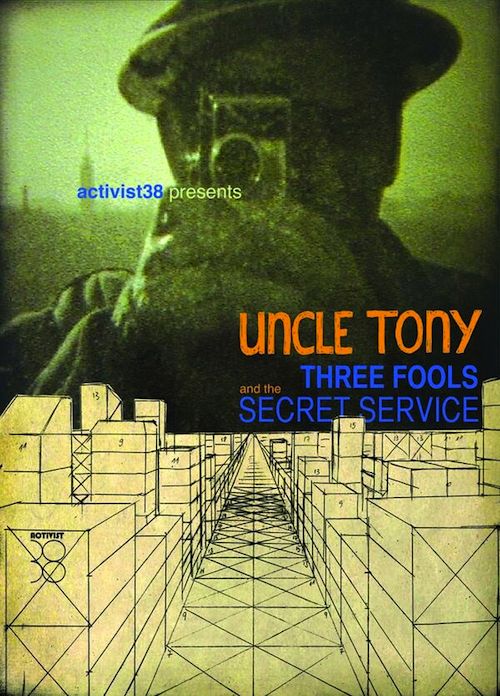
By Joe Bendel. High ranking secret policemen do not often get to present their own work at MoMA, but Donio Donev did. His involvement in the Bulgarian domestic intelligence service is an established fact now that his dossier has been released. However, Donev’s films really aren’t his films. It was always an open secret Anton Trayanov was the uncredited animator of beloved Bulgarian classics like The Three Fools, but Donev took all the bows on the international festival circuit. Mina Mileva & Vesela Kazakova set the record straight with Uncle Tony, Three Fools, and the Secret Service, which screens during the AFI’s 2014 EU Film Showcase.

By all accounts, Donev really was a clever and skillful caricaturist, but he probably could not have animated a mouse if he shot 50,000 volts through it. Most Bulgarian filmmakers, especially those working in animation, knew Trayanov was the real artist responsible for some of the country’s best loved films. They also understood why his name was not on any of them. Under Communism, all of the film authority’s division heads and nearly all of the film directors were secret service agents.

Eventually, the understandably frustrated Trayanov was fired when he started complaining. For three years he survived as a construction worker for a Japanese firm building a luxury hotel in Sofia (lord knows why). He was lucky to get that gig, considering he was blackballed at every other Bulgarian state industry. Eventually, he started teaching animation at the National Academy Theater and Film Arts, where Mileva took his courses, before he was sacked again under murky circumstances.
Sadly, little has changed since the fall of Communism. The apparatchiks still jealously guard their power, but Trayanov might just get the last posthumous laugh. Although he died shortly after filming wrapped, his documentary had a record breaking theatrical run in Bulgaria. Not surprisingly, Donev’s family has threatened legal action. More troubling (if not necessarily shocking), Mileva and Kazakova have had their copyright protection revoked, award nominations rescinded, and endured a campaign of physical and emotional harassment.

It is easy to see why Uncle Tony et al touched a nerve. It addresses head on the privileges and abuses of position that have carried over from the Communist era. The case it makes on Trayanov’s behalf (and against Donev) is not just convincing. It is pretty much conclusive. In fact, there are a handful of scenes that are jaw-droppingly damning, as when Dimitar Tomov, animation chair of the National Academy, tries to convince Mileva Trayanov never taught the classes she enrolled in, through a combination of double-talk and Orwellian Newspeak. It is nearly as surreal watching an interviewer catch Donev in a telling contradiction during an archival television report. You have to wonder what happened to that poor guy.

Yet, UTTFTSS is as much a tribute to Trayanov and his films (and they really are his films) as it is an expose of institutionalized Party corruption. Despite all the wrongs done to him, Trayanov is an unflaggingly upbeat and winning presence on camera. Spending time with him is a pleasure. This is a genuinely bold documentary that will resonate with animation fans and anyone who values artistic freedom. If its cogently presented revelations do not forever change how you think of Bulgarian animation, nothing will. Highly recommended, Uncle Tony, Three Fools, and the Secret Service screens this coming Wednesday (12/17) and next Saturday (12/18), as part of the AFI’s EU Film Showcase, outside of Washington, DC.

LFM GRADE: A

December 14th, 2014 at 10:32pm.
LFM Reviews Radhe, Radhe: the Rites of Holi

By Joe Bendel. In 1913, the premiere of Stravinsky’s The Rites of Spring caused riots. One hundred years later it has been codified and canonized to such an extent, considerable programming was commissioned to celebrate its centennial. The music does not directly correlate to Stravinsky’s score, but it served as something of a road map for Prashant Bhargava when he filmed the Holi springtime festival in the Northern Indian city of Mathura. Conceived and commissioned as a collaboration with musician Vijay Iyer, Bhargava’s Radhe, Radhe: the Rites of Holi screens with the composer’s live score accompaniment as part of Iyer’s Music of Transformation concert program at BAM.

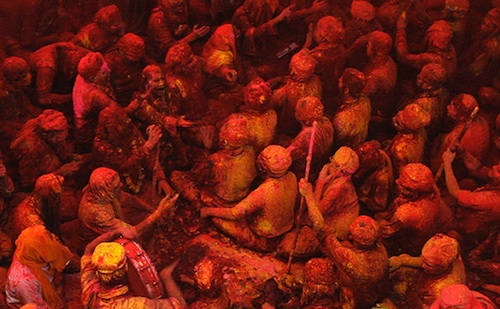
Now available on DVD from ECM Records, Radhe, Radhe is sort of an experimental melding of music and images in the spirit of Shirley Clarke’s Bridges-Go-Round, but with dramatic and ethnographic components. Bhargava duly captures the eight day Holi festivities in Lord Krishna’s traditional birthplace, but he intersperses the revelry with impressionistic scenes of the goddess Radha, whose ardor for Krishna encompassed and transcended all forms of love.

Although it mirrors the twelve movement structure of Stravinsky’s Rites, viewers will be forgiven if they do not pick up on that point while immersed in the work, especially since the film only identifies two primary sections, “Adoration” and “Transcendence.” Iyer’s solo piano prelude is rather dissonant and free-ish, but it soon gives way to a brightly hued, driving theme with a somewhat Metheny-esque vibe nicely suited to the exuberant crowd scenes. Eventually the flutes evoke the sounds of traditional Indian musical forms, but the trumpets build to a series of rather brassy and jazzy crescendos.

From "Radhe, Radhe: the Rites of Holi."

During the “Transcendence” section, Iyer’s skittering piano often announces abrupt mood swings on screen. While Holi is a celebration, nobody is excluded from the customary dousing of colorful dies and powders, regardless of age or general willingness. Indeed, some targets of the merriment clearly do not enjoy the attention, which rather darkens the film’s tone, but it is true to life.

Perhaps the most intimidating challenge fell to actress Anna George, who must convey the passion and devotion of Radha without the benefit of dialogue. Yet, she does so with great power and sensitivity, without ever allowing becoming overwhelmed by Iyer’s roiling score.

The combined artistry of Iyer, Bhargava, and George really transports viewers to an entirely different sphere. Even with the recorded score, it is the darnedest Stravinsky tribute. Hearing it performed live (by Iyer with the International Contemporary Ensemble) should give it a further kick. Recommended for those who appreciate multi-media collaborations, Radhe, Radhe: the Rites of Holi screens during Iyer’s Music of Transformation concerts this Thursday, Friday, and Saturday (12/18-12/20) at BAM.

LFM GRADE: A-

Posted on December 14th, 2014 at 10:32pm.

LFM Reviews Sagrada: the Mystery of Creation

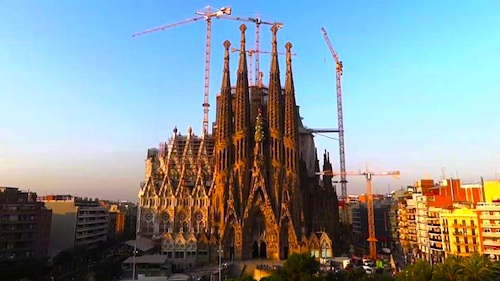
By Joe Bendel. It could very well have been St. Joseph himself who miraculously constructed the Loretto Chapel’s circular staircase in Santa Fe, but strictly speaking, he was a carpenter. That leaves Antoni Gaudí in pretty exclusive company as a beautified architect. One hundred thirty years after it first broke ground, his life defining project continues to be erected in Barcelona. Stefan Haupt follows the progress and meditates on the significance of the already imposing cathedral in Sagrada: the Mystery of Creation, which opens this Friday in New York.

Originally commissioned in 1882, the Order of St. Joseph hired Gaudí to take control of the unwieldy project a year later. Known for his devout Catholicism and wholly distinctive style, Gaudí was an inspired but slightly risky choice. Throughout his final years, he lived and breathed the Sagrada Familia, even though he knew he would never live to see its completion. He hoped to see the Nativity façade finished, but tragically succumbed to injuries sustained from a tram accident. For a while, his assistant Domènech Sugranyes carried on in his stead, until the macro events of the Twentieth Century temporarily halted the project.

Haupt does a nice job chronicling the various phases of construction, but his cast of talking head experts are suspiciously concise when discussing the effects of the Spanish Civil War. Evidently, when the Loyalists were burning churches, they also destroyed all of Gaudí’s plans and scale models that they could find, leaving the Sugranyes and his fellow architects in absolute disarray, but they were good leftists, so let’s not discuss it.

Still, Haupt and the current architectural team clearly understand the Ken Follett-like sweep of the project. For many, it represents not just faith in God and his church, but a faith that succeeding generations would finish the work they started. Obviously, the final Sagrada Familia will be necessarily different from what Gaudí originally conceived, which is a burden and an opportunity for several contemporary artists working on its decorative elements. Easily the most eloquent is Japanese sculptor Etsuro Sotoo, who converted to Catholicism while working on the Sagrada Familia. In fact, there are a number of Japanese connections to the cathedral, such as Hiroshi Teshigahara, who previously documented an earlier period of construction in his film Antonio Gaudí (also opening this Friday).

From "Sagrada: the Mystery of Creation."

At times, Haupt asks (or implies) some spot on questions, like what do contemporary Christians build if we no longer erect cathedrals? Of course, his trump card is the Sagrada Familia itself. It is a stunning sight, perhaps even more so when juxtaposed against the modern secular cranes supporting its raise into the heavens. It would be hard to make it look prosaic, but Haupt and cinematographer Patrick Lindenmaier find particularly cinematic angles for some truly dramatic visual compositions.

On the other hand, Haupt forces an artificially surreal note into the film when he stages brief scenes of dancer Anna Huber posing amid the half-constructed interiors. Regardless, it still serves as a thoughtful overview, primer, and guided tour of what has already become Barcelona’s most popular tourist attraction. Sometimes religion and architecture can actually draw a crowd. Recommended for Gaudí admirers, Sagrada: the Mystery of Creation opens this Friday (12/19) in New York, at the Elinor Bunin Munroe Film Center.

LFM GRADE: B

December 14th, 2014 at 10:31pm.

LFM Reviews The Captive

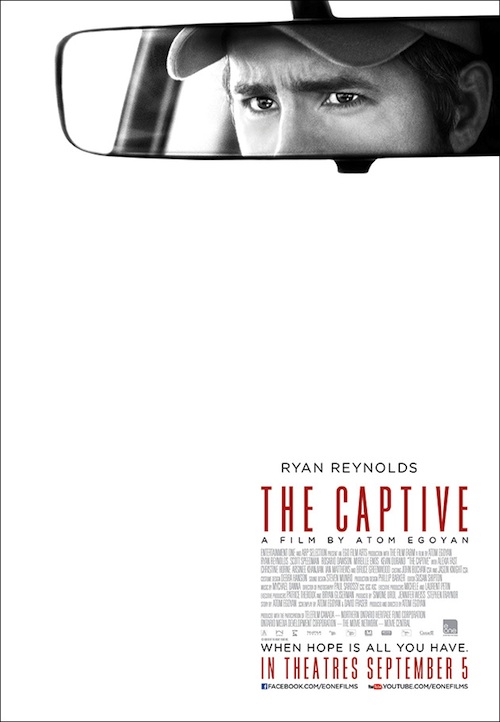
By Joe Bendel. Its population is less than ninety thousand, but evidently organized pedophilia is a growing danger in Niagara Falls, Ontario. They now have a sizable police task force working full time on such crimes. The leader even becomes an Oprah style celebrity. However, they have not produced sterling results. After eight years, Matthew Lane’s daughter Cass is still missing. Past his breaking point, the desperate father is more than willing to take the law into his own hands, if he can finally find a target in Atom Egoyan’s The Captive, which opens tomorrow in New York.

It has been a hard eight years for Lane and his wife, Tina. She still blames him for their daughter’s abduction and so does he. He only briefly popped out to pick up a pie while she rested in the back seat of his truck after ice skating practice. Tragically, it was long enough for the pederast ringleader stalking them. As the years advanced and their marriage imploded, Tina started seeing Det. Nicole Dunlop for counseling, but her partner (and lover) Det. Jeff Cornwall still suspects Lane sold his daughter to a pedophile ring, because he reminds him of a guy he used to know. Seriously, that’s the best he can do after eight years?

Of course, Lane’s investigative techniques basically amount to him driving around looking for something suspicious, but he is still more effective than the cops, who will make a series of spectacular blunders. Eventually, Det. Dunlop will wind up in peril herself, following a head-scratchingly unlikely chain of events.

Frankly, it is a real shame Captive morphs into such a klutzy thriller, because Ryan Reynolds’ lead performance could have been a career game-changer in a tighter, more grounded film. He really digs in and digs deep as Lane. You feel his pain and his rage, without any cheap theatrics. He also makes the thriller mechanics work better than they deserve to, particularly an oblique confrontation with his daughter’s abductor late in the game.

Conversely, Kevin Durand is an excellent actor, but his performance as Mika, the pervert ringleader is beyond caricature. Everything about him, from his affected voice to his sinister sliver of a moustache screams “Chester Molester.” Yet, he still hob nobs with Niagara Falls’ elite without anyone getting suspicious. Rosario Dawson is reasonably competent as Det. Dunlop. She may not look like she is from Niagara Falls, Ont., but diversity in Canadian cinema is a good thing. As if on cue, Scott Speedman also turns up, underwhelming us as Cornwall, arguably the worst cop ever who wasn’t on the take, just to remind everyone this is a Canadian film.

There was a time during the mid-1990s and early 2000s people who did not normally patronize festivals and art cinemas still went to Egoyan’s films because they were so widely acclaimed and zeitgeisty. What a difference three or four films make. Many of his regular themes are still present and accounted for, but the narrative twists are rather clunky and therefore dashed difficult to buy into. Reynolds’ work is legitimately award caliber, but it really needs Ice-T and Richard Belzer. If you have DirecTV, it is almost worth watching just to see how Paul Sarossy’s uncompromisingly icy cinematography conflicts with the otherwise lurid vibe, but it is hard to recommended The Captive when it opens today (12/12) in New York, at the Village East.

LFM GRADE: C-

Posted on December 12, 2014 at 8:34pm.

LFM Reviews Waste Land @ The AFI’s 2014 EU Film Showcase

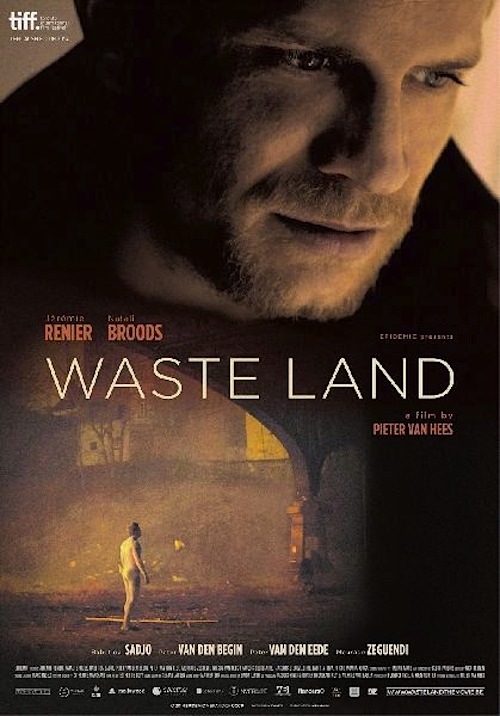
By Joe Bendel. Géant is the Col. Kurtz of Belgian art dealers. He has definitely embraced the heart of darkness in the Congo. He even has his personal “witch doctor.” It is not clear that he really believes, if the cop pursuing him believes he believes, or even whether the cop starts to believe himself. Regardless, Det. Leo Woeste is in for a rough final investigation in Pieter Van Hees’s Waste Land, which screens during the AFI’s 2014 EU Film Showcase.

Woeste is your basic cop on the edge. He tries to be a good husband and a responsible father to the step-son he has helped raise since infancy, but he has seen some terrible things. The fact that his new partner, Johnny Rimbaud, is a coke-fueled hedonist hardly stabilizes his erratic mood swings. When his wife Kathleen announces her pregnancy, but doubts the wisdom of keeping the baby, Woeste promises to retire from the force and start acting normal. Unfortunately, he has one last case to solve.

When an African immigrant is murdered and dumped in a garbage bag, the initial clues point towards Géant. Woeste tries to be extra-supportive to the slain man’s grieving sister, Aysha Tshimanga, perhaps because his fatherly instincts have been stimulated. However, their relationship soon takes on weird sexual overtones. She will accompany him to various underground boxing matches and hipster night clubs, where the throbbing hot house atmosphere will keep his head spinning.

Waste Land flirts with a lot of genres, but it never fully commits to any. It also injects some clumsy commentary on imperialism, particularly a running non-joke supposedly claiming Woeste is descended from Leopold II. Nevertheless, much of the second act investigation is rather compelling procedural stuff. Unfortunately, the climax is so self-consciously feverish, it undermines the gritty mystery and ambiguous genre elements that proceeded it.

Still, there is no denying Dardenne Brothers regular Jérémie Renier puts on a clinic as Woeste. This is fierce, no-holds-barred, rub-your-nose-in-the-self-destruction work, but it is never self-indulgent. In fact, he balances the inward burn with the outward rage quite adroitly. Babetida Sadjo also finds a spark in Tshimanga that elevates her beyond a mere victim, while Peter Van den Begin gorges on scenery as the roguish Rimbaud.

Despite its narrative frustrations, Waste Land is a massively stylish film. Cinematographer Menno Mans makes Brussels look like a real life Sin City, where most of the buildings are either abandoned warehouses or underground dance clubs. The opening sequence is especially evocative, in a disconcerting way. Nicely played and skillfully put together, Waste Land just lurches out of control down the stretch. Recommended for those who will admire its ambition, Waste Land screens this coming Tuesday (12/16) and Wednesday (12/17), as part of the AFI’s EU Film Showcase, outside of Washington, DC.

LFM GRADE: B-

Posted on December 12th, 2014 at 8:59pm.

LFM Reviews Magician: the Astonishing Life & Work of Orson Welles

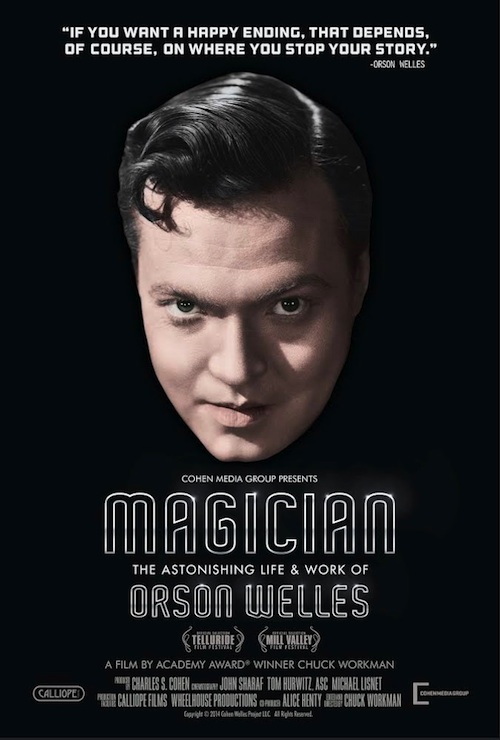
By Joe Bendel. Just imagine what might have been if Orson Welles had worked in the digital era. Probably no other filmmakers left behind so many unfinished yet potentially great films. As his latest video-biographer Chuck Workman documents, Welles had no shortage of work ethic. It was simply a lack of everything else, particularly money. You may have heard this story before, but Workman illustrates the great auteur’s rise and fall with a wealth of striking visuals and many rarely seen archival interviews. Welles gets the full Workman treatment in Magician: the Astonishing Life & Work of Orson Welles, which opens this Wednesday in New York.

Welles was a precocious but never small child. Evidently, in the Welles family, children had to be interesting performers, or they were banished to the nursery to be boring in private. Obviously, Master Orson was not about to be shunted away. In a departure from many DVD-behind-the-scenes-extras, Workman patiently invests a bit of time up-front on Welles’ formative years in Woodstock, Illinois, where he honed his craft at the Todd School and the local Woodstock Theatre, whose main stage has since been renamed in Welles’ honor. Workman takes the audience there and it does indeed look like fitting launching pad for Comet Welles—an intimate yet classy space that could fire a young genius’s imagination.

By the time Welles hit the New York theater world, he was practically a fully formed master. Workman breezes through his early Broadway triumphs and radio superstardom, essentially using the feature films to island-hop his way through Welles career. At this point, the film starts to feel very familiar to anyone with a casual knowledge of Welles’ life and career. Yes, Citizen Kane is a masterpiece and The Magnificent Ambersons sort of is too, but according to Welles RKO cut out the most important parts. However, Workman includes some fascinating interview excerpts with the late Oscar winning Robert Wise, justifying the cuts he made at the studio’s behest.

Magician also incorporates tantalizing glimpses of films Welles started but never completed, such as The Deep, Don Quixote, and the technically finished but now mostly lost Merchant of Venice. Frankly, this is some of the best material Workman collects, hinting at what might have been. It nicely compliments Workman’s full visual portrait of the artist, which also directly addresses his larger than life celebrity status, as seen through clips of Welles guest appearances on I Love Lucy, The Muppet Show, and various chat shows and commercials.

There are not a lot of surprises in Magician. Frankly, you really have to stretch to find any new material at all in the film. Still, Workman and company make a convincing defense of Welles’ unfinished oeuvre, arguing he was committed enough to start production, whereas most would-be filmmakers accept defeat in the development or pre-production stages.

Magician certainly makes you want to watch all of Welles’ films again, including the ones that we can’t, which means it probably accomplishes its goals, but it never feels as fresh as Visionaries, Workman’s relatively recent (stylistically traditional) survey of avant-garde filmmaking. Recommended for Welles diehards looking for something to tide them over until the long rumored release of The Other Side of the Wind (promised for the auteur’s centennial this coming May), Magician opens Wednesday (12/10) in New York, at the Lincoln Plaza Cinema.

LFM GRADE: B-

Posted on December 9th, 2014 at 8:24pm.